

What is SOC analyst burnout?
SOC analyst burnout is a state of chronic occupational stress specific to security operations center (SOC) professionals, marked by emotional exhaustion, depersonalization, and a persistent sense that the volume of work will never be manageable. It goes beyond ordinary job fatigue: burned-out analysts begin disengaging from the alerts, investigations, and teammates that define their daily work.
The operational impact is real and growing. Burned-out analysts take longer to investigate threats, miss critical detections more frequently, and eventually leave, taking institutional knowledge with them. Gartner identified cybersecurity burnout as a top trend for 2025, signaling that this is no longer an edge case. For SOC teams already stretched thin, every departure compounds the pressure on whoever remains.
Explore the 2026 Cloud Threat Report
Get the latest cloud threat intelligence from Wiz Research.

What causes SOC analyst burnout?
Burnout in security operations is not caused by a single factor. It is the result of structural and systemic pressures that compound over time, making the work unsustainable even for analysts who genuinely love the mission. Here are the primary drivers.
Alert overload and false positives
The average organization generates 4,484 security alerts every day, and roughly half go completely uninvestigated. Of the alerts that do get reviewed, about two-thirds turn out to be false positives. That ratio means analysts spend most of their shift chasing noise instead of real threats.
Consider a typical scenario: an analyst starts a morning shift with 300 alerts in the queue. After four hours of triage, they have closed 280 (most of them benign or duplicated). The remaining 20 need deeper investigation, but the analyst's focus is already spent.
Decision fatigue sets in, and each subsequent alert gets less scrutiny than it deserves. Over weeks and months, this cycle erodes analyst confidence. When every signal looks like noise, the temptation to auto-close or deprioritize becomes harder to resist. This is the core of alert fatigue: not laziness, but a rational response to an irrational volume of low-fidelity detections.
Tool sprawl and context-switching
A single investigation often requires an analyst to pivot between five to ten disconnected consoles: SIEM for log correlation, EDR for endpoint telemetry, CSPM for cloud posture data, a ticketing system for workflow tracking, and identity tools for access context. Each tool has its own interface, query language, and data model, and the cognitive cost of switching between them is significant.
Cloud adoption has amplified this problem. As organizations spread workloads across AWS, Azure, and GCP, each environment generates its own stream of fragmented security alerts. Analysts end up correlating data manually across platforms that were never designed to talk to each other. Consolidating into fewer platforms with built-in cloud context directly reduces this cognitive load, giving analysts a single view instead of a scavenger hunt across tabs.
Skills gap and staffing shortages
The talent shortage in cybersecurity is well documented, and SOC positions are among the hardest to fill. When experienced analysts leave, the remaining team absorbs their workload. New hires need months of onboarding before they can handle complex investigations independently. This creates a compounding cycle: heavier workloads accelerate burnout, which drives more departures, which makes workloads heavier still.
Career stagnation and lack of growth
Repetitive triage work is one of the most underestimated burnout drivers. When analysts spend 90% of their time on Tier 1 alert classification, they never develop the advanced skills (like threat hunting or detection engineering) that make a security career rewarding.
Many SOC analysts start looking elsewhere. That points to a workforce that feels trapped, not challenged. The good news: when tooling handles routine triage and enrichment, analysts can redirect their energy toward higher-value work. That shift turns a retention problem into a career development opportunity.
SOC Automation Guide: AI Agents, Tools, and Use Cases
Learn how SOC automation reduces manual workloads, improves threat detection, and accelerates response with AI-driven tools and real-time security workflows.
Leggi di più
How does alert fatigue drive SOC burnout?
If burnout has a single biggest accelerator, it is alert fatigue. The sheer volume of low-confidence detections creates a triage treadmill that exhausts analysts before they ever reach a genuine threat. Understanding how this cycle works is the first step toward breaking it.
Traditional detection approaches rely on broad rule sets that cast a wide net. Every anomaly triggers an alert, regardless of whether it represents real risk. Analysts then spend hours manually enriching each alert with context: who owns the affected resource, what data is exposed, whether the identity involved has elevated privileges, and what the blast radius looks like. That manual enrichment is where investigation toil lives.
A context-aware approach flips this model. Instead of alerting on every anomaly and leaving analysts to figure out what matters, it correlates cloud context at detection time: resource relationships, identity paths, network reachability, and data sensitivity. The result is fewer, higher-confidence alerts that arrive with the investigation context already attached.
| Factor | Traditional detection approach | Context-aware cloud-native approach |
|---|---|---|
| Alert volume | High (thousands per day) | Reduced (focused on confirmed risk) |
| False positive rate | High (majority of alerts) | Significantly lower through contextual filtering |
| Average investigation time | Significant (manual enrichment required) | Minutes (context pre-attached) |
| Analyst confidence | Low (signal buried in noise) | High (each alert includes blast radius and impact) |
When analysts trust the alerts they receive, two things change. First, they stop auto-closing detections out of fatigue. Second, they actually have time and mental energy for deeper investigation work. That trust is the foundation for sustainable SOC operations.
Signs and consequences of SOC analyst burnout
SOC analyst burnout affects both the individual and the organization. Recognizing the early warning signs helps leaders intervene before the damage compounds.
Warning signs in individual analysts
Burnout rarely announces itself. It builds gradually, often masked by the high-pressure environment that SOC teams consider normal. The earliest warning signs include persistent exhaustion that does not improve with time off, growing cynicism toward the work ("none of these alerts matter anyway"), and a noticeable increase in errors during routine triage.
Here is what the progression often looks like in practice: an analyst who used to investigate every medium-severity alert starts skipping the ones that "probably" are not real. Over a few weeks, that threshold creeps higher. Eventually, a genuine threat slips through, not because the analyst lacks skill, but because the volume of noise trained them to tune out.
Organizational impact and security risk
When experienced analysts leave, they take years of institutional knowledge with them: which alerts are reliably actionable, how the environment is architected, where the real risks live. That knowledge cannot be documented in a runbook. New analysts need months to rebuild it, and in the meantime, MTTR degrades and the team's overall detection capability drops.
With shrinking staff tenure across the industry, this is not just a people problem. It is a security posture risk. Every departure widens the gap between when a threat is detected and when it is contained. The cost is not just recruiting and onboarding; it is the increased breach exposure during the transition. Organizations that treat analyst retention as a SOC framework priority (rather than an HR line item) end up with more resilient security programs.
Watch 5-min demo
See how Wiz Defend automates cloud threat investigation and response.

How to reduce SOC analyst burnout
Solving SOC burnout requires both technical and cultural changes. No single tool or policy is enough on its own. The most effective approaches address the root causes from multiple angles simultaneously.
Automate repetitive triage and enrichment
The first step is removing the manual work that consumes the most analyst time without requiring analyst judgment. Automated triage handles alert enrichment, deduplication, and initial classification so that analysts only see alerts that need a human decision.
Basic playbook automation through SOAR platforms has been available for years, but it has limits. Playbooks follow predefined logic trees, which means they can only handle scenarios someone anticipated in advance. AI-driven investigation goes further by building full attack context automatically: correlating related alerts, mapping affected resources, identifying lateral movement paths, and assembling a complete storyline. The difference is the gap between "this alert was enriched" and "this alert was investigated." The latter is what actually reduces investigation toil and frees analysts for higher-value work.
Build human-AI partnerships
A common concern in SOC teams is whether AI will replace analysts entirely. The short answer is no, but the analyst role does change. AI handles the parts of the job that benefit from speed and correlation: scanning thousands of events, identifying patterns, enriching detections with context, and building behavioral analytics baselines. Analysts handle the parts that require judgment and creativity: deciding whether a detection warrants escalation, designing new detection logic, and making incident response decisions under ambiguity.
Think of it as shifting from "analyst as assembly line worker" to "analyst as decision maker." AI handles the volume. Analysts handle the judgment. When that partnership works well, analysts spend less time on repetitive correlation and more time on threat hunting and detection engineering, which is exactly the kind of work that keeps experienced professionals engaged and growing.
Invest in career development and training
Retention starts with showing analysts a path forward. Rotation programs that move Tier 1 analysts into threat hunting, detection engineering, or incident response roles give team members new challenges and skills. Conference attendance and certification support signal that the organization values growth, not just coverage.
For SOC leaders, career development is a retention strategy with measurable returns. An analyst who sees a clear progression from triage to threat hunting to detection engineering is far less likely to leave than one stuck processing the same alert types indefinitely. The investment in training pays off as reduced turnover, shorter hiring gaps, and a more capable team overall.
Shift from reactive to proactive security
Every misconfiguration or vulnerability that reaches production becomes a runtime alert that lands in a SOC analyst's queue. Shift-left security (catching issues during development and deployment rather than after they are live) directly reduces the volume of alerts that reach the SOC.
Pre-deployment scanning for infrastructure-as-code misconfigurations, container image vulnerabilities, and identity misconfigurations eliminates entire categories of runtime alerts before they are generated. This code-to-cloud approach does not just improve security posture. It also reduces the triage burden on SOC teams, giving them space to focus on novel threats rather than preventable ones. Combined with SOC best practices around process and culture, this shift transforms the operational reality for security teams.
How Wiz helps prevent SOC analyst burnout
Each burnout cause covered in this article has a corresponding capability in Wiz Defend that directly addresses it. Rather than adding another tool to the stack, Wiz consolidates cloud security into a single platform designed to reduce noise, automate toil, and give analysts the context they need to act with confidence.
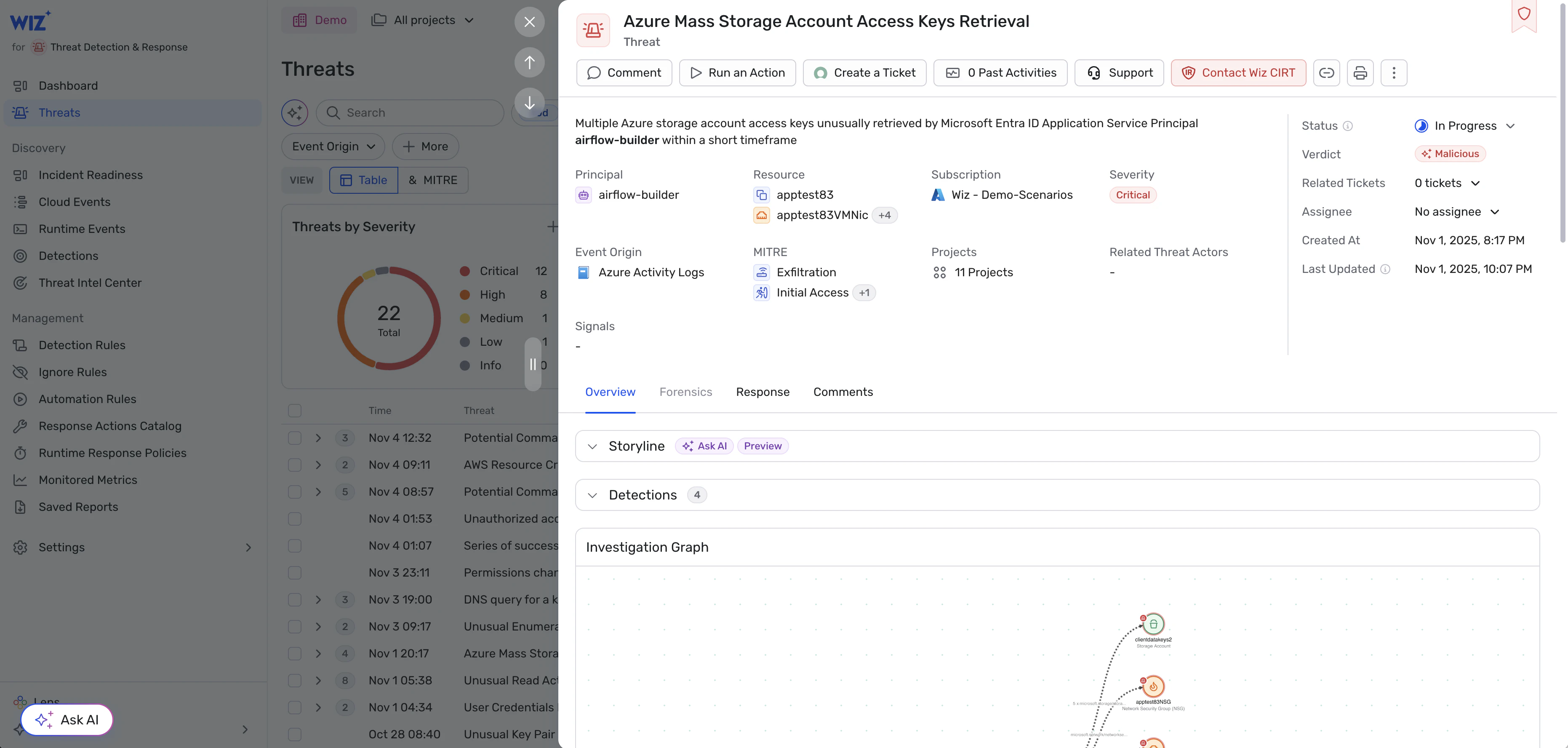
Automated investigation with Blue Agent: The Wiz Blue Agent automates the investigation process, building complete attack storylines that would take analysts hours to assemble manually. It correlates related events, maps affected resources, and delivers a full narrative so analysts can make fast, confident decisions instead of spending their shift on manual correlation.
Cloud context via Security Graph: For every detection, Wiz Security Graph provides instant cloud context: blast radius, identity paths, data exposure, and network reachability. Analysts see the full picture in a single view without pivoting between consoles, eliminating the context-switching that compounds fatigue.
One-click response actions: Wiz Defend offers one-click response capabilities that remove the dependency on DevOps teams for remediation. Analysts can contain threats immediately rather than waiting hours for cross-team coordination, reducing the firefighting that extends incidents and accelerates burnout.
Agentless architecture: Wiz's agentless scanning consolidates cloud security tooling into one platform, directly attacking tool sprawl. There are no agents to deploy, maintain, or troubleshoot across environments, which simplifies operations for both security and infrastructure teams.
Code-to-cloud shift-left prevention: Wiz catches misconfigurations and vulnerabilities before deployment through code-to-cloud visibility. Fewer issues reaching production means fewer runtime alerts in the SOC queue, reducing triage burden at the source.
My favorite thing about the Blue Agent is how quickly it allows us as human analysts to understand why an alert happened, what it means, and contextualize it within our environment
Justin Lachesky, Director of Cyber Resilience at Redis
When detections are high-fidelity, investigations are automated, and context is built in, analysts can focus on strategic defense instead of drowning in noise. That is how you retain experienced talent and build resilient security operations teams. Get a demo to see the difference firsthand.
Get a demo
See how Wiz Defend reduces alert fatigue and investigation toil for SOC teams.
