



What is agentic incident response?
Agentic incident response is a way of handling security incidents where autonomous AI agents perceive what is happening, reason about the cause, and take action across the incident response lifecycle with limited human input. That matters because attacks in the cloud now unfold in minutes, and a workflow that can investigate and contain a threat on its own gives your team back the time that manual triage used to eat up.
An autonomous agent here is software that pursues a goal, such as "confirm whether this alert is a real threat," and decides its own steps to get there. It runs on a perceive-reason-act loop: it reads telemetry, forms a hypothesis, tests that idea against more data, then acts. While autonomous systems aim to operate within established guardrails, recent real-world incidents show that enforcing strict boundaries across complex cloud environments remains an ongoing operational challenge. While often referred to broadly as AI incident response, highlighting autonomy emphasizes that the system actively plans and executes actions rather than simply generating recommendations.
Cloud Incident Response Plan Template
Get a ready-to-use template that maps roles, runbooks, and escalation paths so your team can respond to cloud incidents with confidence.

Why agentic incident response matters now
Attackers have changed gears. They use automation to find a foothold, move laterally, and reach sensitive data faster than a human analyst can read the first alert. When lateral movement can happen in minutes, response measured in hours is a losing game.
Meanwhile, most security teams are buried. Alert fatigue means real threats sit in a queue behind hundreds of low-priority notifications, and dwell time (how long an attacker stays hidden) stretches longer than anyone wants. Machine-speed containment flips that math, turning fast response into a real control rather than a nice-to-have.
The financial case is just as clear. Organizations that respond faster contain breaches before they spread, cutting both the damage and the cost. Speed here protects both your data and your budget.
How does agentic incident response work?
At its core sits the perceive-reason-act loop, with an observe step that feeds each cycle back into the next. The pattern lines up neatly with the incident response stages your team already knows, so it helps to see the two side by side.
| Loop phase | What the agent does | IR lifecycle stage |
|---|---|---|
| Perceive | Reads telemetry from SIEM, EDR, and cloud logs to spot something off | Detect |
| Reason | Forms a hypothesis and runs root-cause analysis against related signals | Triage and investigate |
| Act | Takes a containment action, such as isolating a host or revoking access | Contain |
| Observe | Checks the result and updates its next move, or hands off to a person | Verify and recover |
Here is how that looks in a real cloud incident. An agent notices a cloud identity suddenly spinning up new virtual machines in a region your company never uses. It pulls the identity's recent activity, checks which permissions it holds, and tests whether the behavior matches a known attack pattern. Finding stolen credentials in use, it revokes the session, quarantines the newly created virtual machines, and flags the account, then writes up the evidence for a human to confirm.
That whole sequence is alert triage automation carried through to a decision, not just a routed ticket. Standards bodies back this direction too: the finalized NIST SP 800-61 Revision 3 guidelines align modern incident response directly with the outcome-driven NIST CSF 2.0 Core Functions (Govern, Identify, Protect, Detect, Respond, Recover). Under this updated standard, automating alert handling, triage, and information sharing is recommended so responders can move faster from detection to recovery. The orchestration underneath ties these signals together, which is why the agent can reason across identity, workload, and control-plane data at once.
What is an Incident Response Plan (IRP)?
An incident response plan is a documented, structured approach that outlines how an organization detects, contains, eradicates, and recovers from cybersecurity incidents.
Leggi di più
Agentic vs. traditional automation: SOAR, copilots, and AI-assisted response
It helps to picture three tiers of automation, because each one hands off a different amount of decision-making. The jump to agentic is really a jump in decision autonomy.
| Approach | How it decides | Who acts |
|---|---|---|
| Rule-based SOAR | Runs fixed, deterministic playbooks written ahead of time | The system, but only along pre-set paths |
| AI-assisted (copilot) | Reads context and recommends the next step in plain language | A human, after reading the suggestion |
| Agentic | Plans its own steps and adapts as new data arrives | The agent, operating within predefined guardrails with human-in-the-loop approval and oversight |
SOAR playbooks are great when an incident matches existing playbooks you already have and that is no longer the case with novel AI attack vectors. A copilot adds smarts, yet it still waits on a person to click. What agentic incident response automation adds is the ability to choose a path, act on it, and adjust, all while a human stays in the loop for the calls that carry real weight.
What is AI Detection and Response (AIDR)?
AI detection and response (AIDR) is a security capability that monitors your AI systems, prompts, agents, models, and the data pipelines feeding them, then acts when something goes wrong.
Leggi di più
What are the benefits of agentic incident response?
The gains show up first in your core metrics and then in how your people spend their day.
Faster triage and containment: Agents work in seconds, dramatically reducing mean time to triage (MTTA) and mean time to respond (MTTR).
Full-alert coverage: Even low-severity alerts get investigated, so nothing quietly slips through while the queue grows.
Consistent handling: Every alert follows the same rigorous steps, so triage quality no longer depends on who is on shift.
An audit trail by default: Each verdict comes with the evidence and reasoning behind it, which makes reviews and handoffs painless.
Analysts freed for judgment work: With grunt work handled, your team can hunt threats and lead the hard investigations that need human insight.
Put simply, autonomous SOC response raises triage throughput without asking you to hire more people. That is why lean teams tend to feel the difference first.
Watch 5-min demo
See how Wiz Defend investigates and contains cloud threats in real time, with full context from the Security Graph.

Limits, trust, and human oversight
The most common worry is the black-box problem: when an agent provides a result, do you know how it got there? That concern is fair, and it is exactly why explainability has to be built in, not bolted on. An agent that shows its evidence and its reasoning is one you can actually trust with production systems.
The answer most teams land on is bounded autonomy. You let agents act freely on routine, low-risk work, and you place approval gates in front of high-impact moves like shutting down a production database. Good governance keeps a human in the loop where the stakes are highest, so speed never comes at the cost of control. Watch out for false positives here, because an agent that acts confidently on bad reasoning can cause real harm, which loops back to why auditable reasoning matters so much.
What to look for in an agentic incident response solution
Not every tool that claims to be agentic will hold up in a real cloud environment. A few requirements separate the useful from the flashy.
Cloud and identity context: The agent needs to see the cloud control plane, identity permissions, and workload data together, or its verdicts will miss the real blast radius.
Evidence-backed verdicts: Every decision should carry the signals that led to it, so your analysts can confirm the call in seconds.
Code-to-cloud remediation: Look for a system that fixes the root cause, such as the misconfiguration or the Terraform template, not just the symptom.
Clear guardrails: You should be able to set exactly what the agent can do on its own and where it must pause for approval.
The context requirement is the one buyers underrate. Two agents can run the same model, but the one that reasons over a full map of your environment will simply be right more often.
How Wiz Defend brings agentic investigation to incident response
Cloud investigations usually mean stitching together evidence by hand across a SIEM, an EDR, cloud audit logs, and multiple provider consoles, a process that is slow, fragmented, and prone to blind spots. Wiz Defend closes that gap by unifying cloud detection, investigation, and response into a single context-rich platform.
It starts with the Wiz Security Graph, a unified, real-time map of every cloud resource, identity, entitlement, network path, and exposure. Wiz Defend ingests telemetry from across your environment into that graph, including cloud control plane and audit logs, AI service and workload activity, Kubernetes and container signals, identity events, and network flows. When the lightweight Wiz Runtime Sensor or cloud log integrations detect suspicious activity, the attack story and timeline are immediately correlated against that graph.
From there, the Wiz Blue Agent goes to work. Working like a cloud incident responder, it investigates on its own: it queries the graph to uncover the full blast radius, evaluates risk findings, and coordinates with specialized forensics sub-agents to analyze live disk and memory artifacts. The Blue Agent investigates but does not take response actions itself. Instead of delivering a vague score, it hands your team a clear, auditable investigation summary: a concrete verdict (Malicious, Planned Action, etc.), a confidence level, and the reasoning behind it.
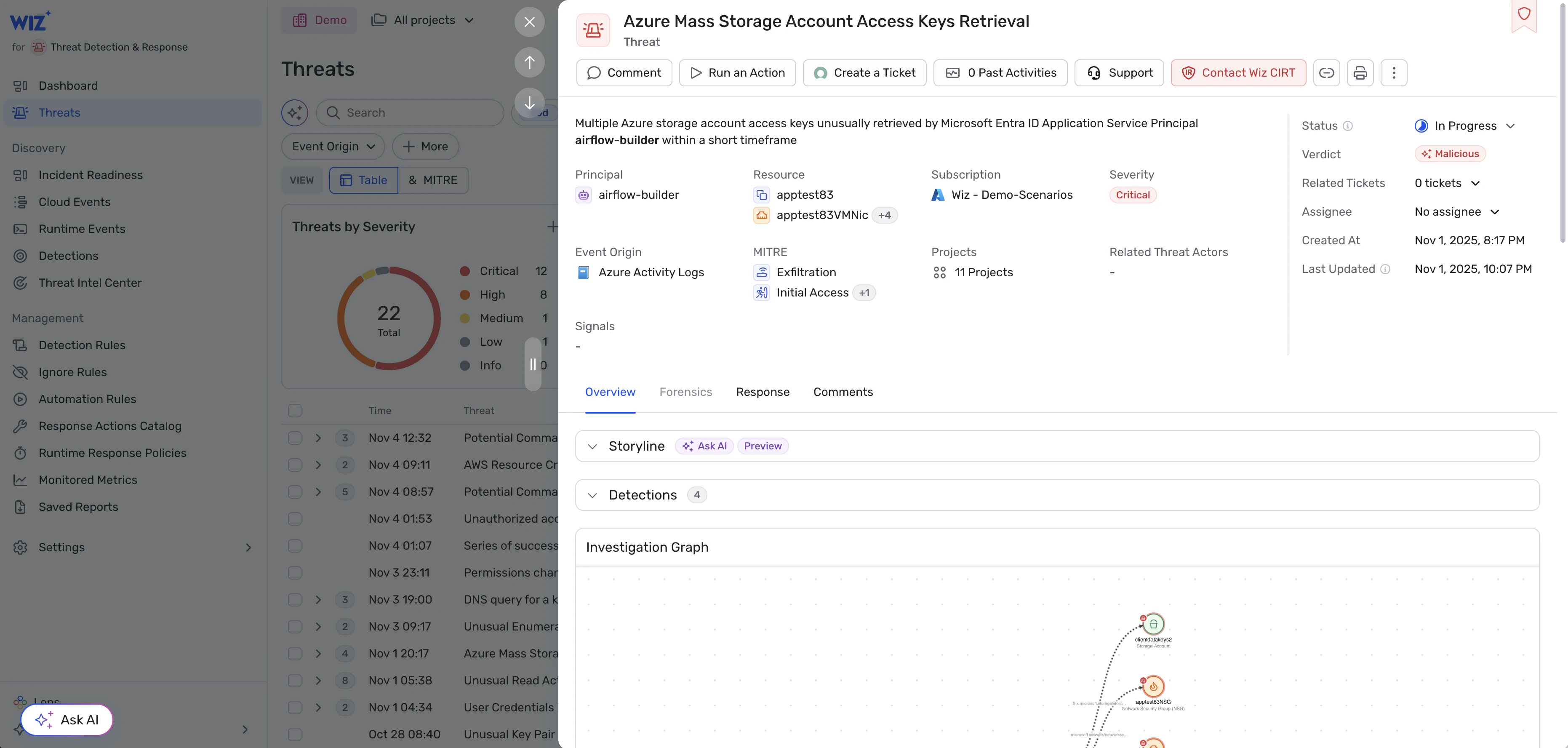
With full context established, your team can take one-click containment actions (such as isolating a compromised instance or revoking active credentials) or trigger automated response playbooks via Wiz Workflows. And because the Security Graph connects runtime back to build time, responders can trace the compromised asset directly to its source code repository and owner, fixing the vulnerability or misconfiguration at the root.
Ready to see how it works in your environment? Get a demo and watch the Blue Agent investigate a live threat and set your team up for one-click containment.
See Wiz Defend in action
Learn how Wiz Defend and the Blue Agent triage and investigate cloud threats with full Security Graph context, so your team can contain them fast.
