

What is Upwind Security and how does it approach cloud protection?
Upwind is a cloud security platform built around a sensor-first design, with emerging CNAPP capabilities. Rather than relying primarily on API posture snapshots, Upwind leans on extended Berkeley Packet Filter (eBPF) to monitor workloads as they execute in real time.
The architecture centers on an eBPF sensor deployed as a Kubernetes DaemonSet or host agent. From this vantage point within the Linux kernel, the sensor captures live system calls, process execution, and network connections across container pods without requiring application code changes.
Upwind's strength lies in high-fidelity runtime telemetry: it maps live application topologies, inspects container network flows, and helps fast-moving engineering teams observe active container communications. In container-heavy architectures, this runtime visibility gives teams deep insight into what is running in their clusters.
It also fits the way most cloud teams build today. In the CNCF 2025 Annual Cloud Native Survey, 82% of container users now run Kubernetes in production, up from 66% in 2023. So a sensor tuned for Kubernetes and Linux lands right where the workloads live.
Explore the Wiz Runtime Sensor
See how lightweight eBPF kernel monitoring delivers real-time workload protection with near-zero overhead.

Why teams might consider alternatives to Upwind
Runtime signals are valuable, but enterprise clouds keep growing in scope. Flexera's 2026 State of the Cloud report surveyed 753 cloud decision-makers and technical leaders. In it, 82% of organizations named security a top cloud challenge.
That pressure shows up in how rapidly the cloud footprint is expanding. According to Wiz Research’s State of AI in the Cloud 2026 report, 81% of cloud environments now leverage managed AI services, 57% have deployed self-hosted AI agents, and 80% run Model Context Protocol (MCP) servers, with 5% directly internet-facing.
What's more, 68% of organizations inherit self-hosted AI models transitively through third-party software, leaving a quarter of organizations with zero visibility into the AI services operating in their estate.
When infrastructure expands into managed APIs, serverless orchestration, and agentic protocols, a host-sensor-only model leaves massive blind spots. Here are five reasons teams look beyond that approach:
The shift from point sensors to unified platforms
A common misconception in cloud security is that teams must choose between a comprehensive cloud platform and a dedicated runtime security tool. Today, that is a false dilemma. Leading cloud security platforms natively include runtime sensors, giving organizations deep workload defense without requiring a separate point solution.
More importantly, runtime in isolation only treats symptoms. A runtime detection tells you an attack is underway right now, but stopping it permanently requires tracing the event back through code-to-cloud context: the container registry, the CI/CD pipeline, and the infrastructure as code (IaC) template that deployed it.
Crucially, that supply chain begins on the developer laptop. When a sensor only monitors production Kubernetes nodes, it can only react after compromised code or malicious packages have already been deployed.
True supply chain integrity requires visibility that extends all the way back to developer workstations, stopping code tampering and exposed secrets on the local machine before workloads ever reach production. When security teams deploy platforms that unify code security, posture, and native eBPF runtime sensors, they do not just contain active incidents. They trace vulnerabilities back to the source code, eliminating the underlying flaw so it cannot redeploy across production.
Cloud visibility beyond kernel sensors
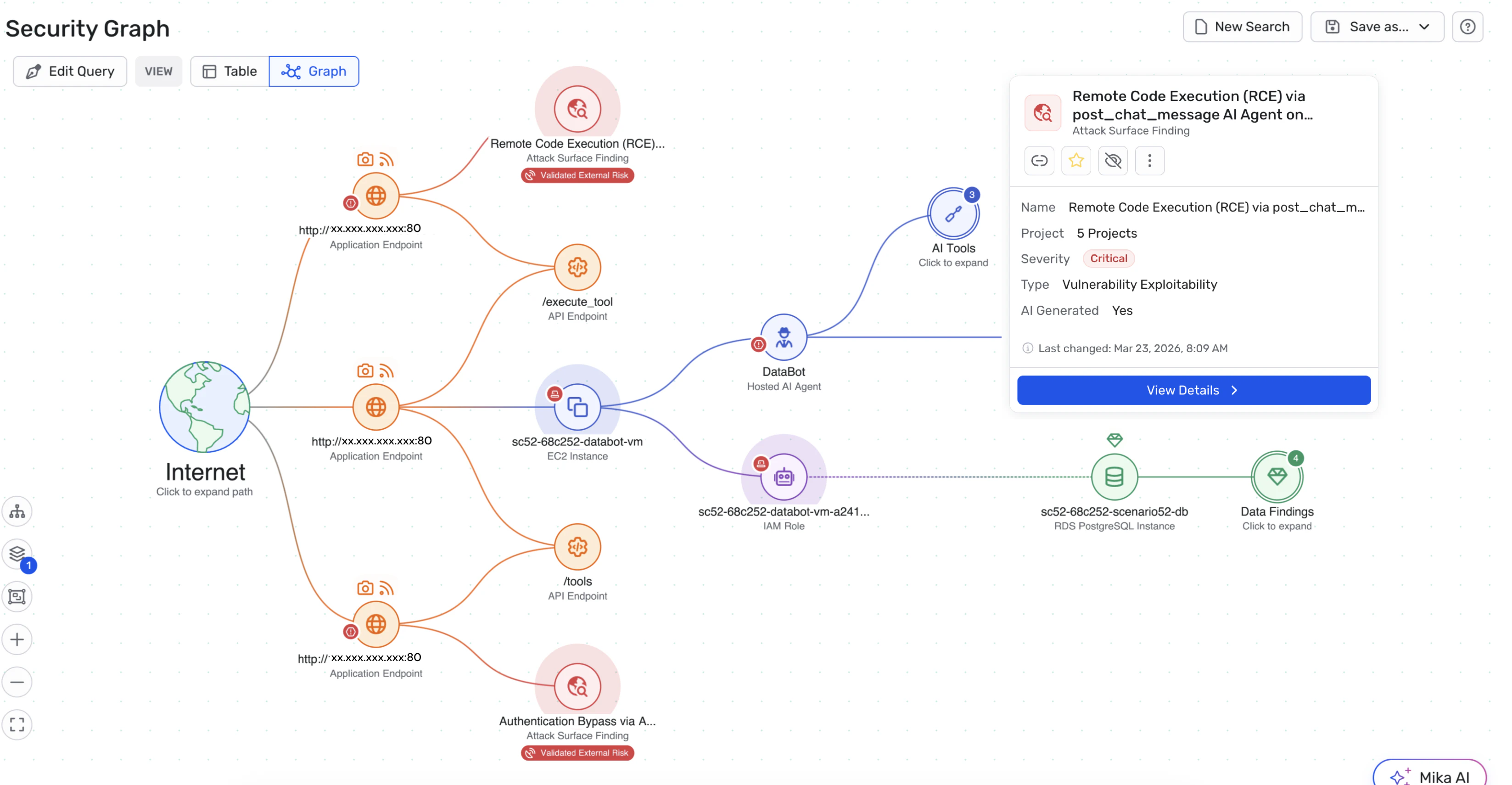
A large part of the modern attack surface cannot host an eBPF sensor at all. That includes cloud control planes and identity and access management (IAM) consoles. It also covers managed platform services, serverless functions like AWS Lambda and Google Cloud Functions, and object storage such as Amazon S3 and Azure Blob.
Managed databases like Amazon RDS and BigQuery sit in that same gap, and so do many Windows systems. Agentless, API-based scanning reads these services directly, so it covers ground a kernel sensor cannot reach. The result is fewer blind spots across un-instrumented assets.
Take a common cloud exposure path: a public S3 bucket accessible to an AWS Lambda function operating with an over-permissive IAM role. No sensor runs on any of it, yet the path is a real exposure. Agentless coverage sees that chain, while a runtime-only view would miss it entirely.
Securing the AI era
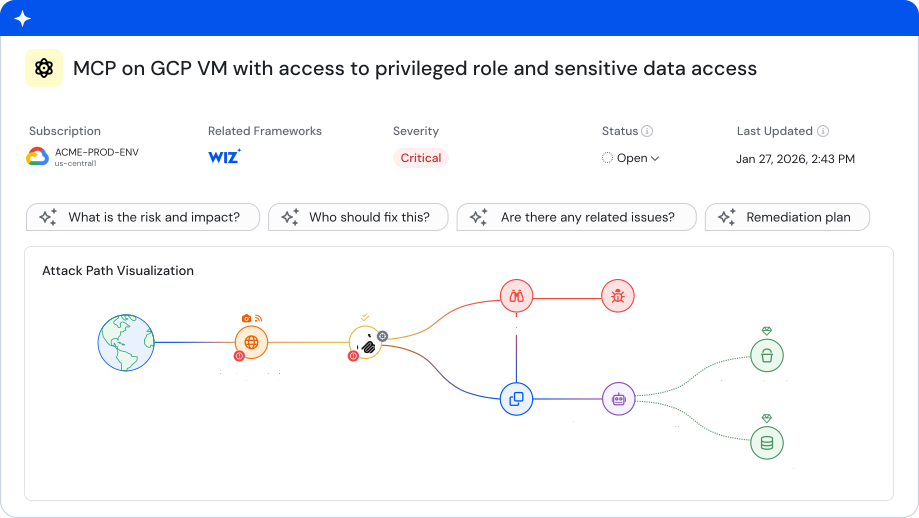
Cloud teams are shipping AI fast. That includes managed models on Amazon Bedrock, Azure OpenAI, and Vertex AI. Add self-hosted open-source large language models (LLMs), vector databases, and multi-agent frameworks to the mix. Watching host system calls alone will not tell you where these live or how they are exposed.
Protecting them calls for AI security posture management (AI-SPM), which discovers AI assets and checks how they are configured. It also means catching threats like prompt injection, model poisoning, sensitive data leaking into models, shadow AI running outside approved channels, and unauthorized use of GPU resources.
Operational fatigue and AI-driven SecOps

Raw runtime data piles up quickly, and no analyst can hand-correlate thousands of alerts against a sprawling cloud. What helps is prioritizing what attackers can actually exploit. Wiz's State of Cloud Risk 2026 found remote code execution made up only 9% of observed high and critical findings. That gap shows why exploitability should steer triage.
That is where autonomous AI security agents help most. They investigate an alert end to end and trace the full blast radius across connected resources. Analysts then get a clear verdict instead of a raw event.
When an autonomous AI agent investigates an anomalous container process, it immediately evaluates the surrounding blast radius: is the container internet-exposed, what sensitive data can it read, and what cloud identities can it assume? Analysts then spend their time on the few alerts that genuinely threaten the business.
Platform consolidation over tool sprawl
Running separate vendors for runtime, posture, data, identity, code, and AI adds cost and friction. Buyers increasingly want one platform that folds these capabilities together:
CSPM: cloud security posture management, which finds misconfigurations across your accounts.
DSPM: data security posture management, which tracks where sensitive data lives and who can reach it.
CIEM: cloud infrastructure entitlement management, which right-sizes identities and permissions.
ASPM: application security posture management, which secures code before it ships.
AI security: discovery and protection for models, data, and agents.
Forrester Wave™ for CNAPP Solutions 2026
Explore independent analyst evaluation and comparative rankings across top vendors in The Forrester Wave™ report.

Common Upwind alternatives to consider
The strongest options today blend two ideas. They pair frictionless agentless coverage for the whole estate with a lightweight eBPF sensor for deep runtime signals on the workloads that matter most. Read each snapshot with your own architecture in mind.
Below are five platforms worth evaluating, each with a short snapshot, core strengths, and the profile it suits best.
1. Wiz
Wiz is a leader in the CNAPP market, protecting more than 50% of the Fortune 100 from code to runtime. Beyond pioneering agentless visibility, Wiz delivers deep in-workload defense through an eBPF runtime sensor deployed at scale across the world's largest production environments.
The platform connects live workload defense with full cloud context through several core capabilities:
Lightweight eBPF Runtime Sensor: Deploys a low-overhead eBPF sensor purpose-built for Linux hosts, Kubernetes clusters, and container workloads to capture live system calls, network activity, and process execution in real time.
Real-Time Active CDR (Wiz Defend): Actively blocks malicious processes (fileless malware, container drift, cryptomining, reverse shells) using kernel-level Runtime Response Policies, with automated workload isolation and forensic capture.
Context-Rich Attack Path Analysis: Correlates runtime anomalies directly into the Wiz Security Graph, instantly surfacing toxic combinations (internet exposure, high IAM privileges, sensitive data access) to eliminate false positives.
Unified Code-to-Cloud and AI Security: Consolidates CSPM, CIEM, DSPM, and ASPM through Wiz Code (extending security to developer workstations for early supply chain defense), alongside native AI security and autonomous AI investigation agents.
For a real-world example, see how Redis deployed Wiz Sensors across all production GKE clusters, shifting away from multi-tool sprawl to get consistent runtime threat detection that "actually matches how our cloud operates." Similar runtime and graph context capabilities protect workloads at organizations like Zendesk, Texas A&M University, and Rogo.
Ideal for organizations that want enterprise-grade runtime defense inside a full-stack CNAPP that closes blind spots and secures the AI and cloud lifecycle.
2. Sysdig Secure
Sysdig Secure is an established leader in container and Kubernetes runtime security, built on the open-source Falco engine.
Deep syscall auditing: rich visibility into container behavior at the system-call level.
Kubernetes runtime rules: extensive out-of-the-box detections tuned for Kubernetes.
Container vulnerability management: strong scanning and prioritization for container images.
Ideal for platform engineering teams invested in Falco and open-source standards who want specialized Kubernetes runtime observability.
3. Palo Alto Networks (Prisma Cloud)
Prisma Cloud is a broad enterprise suite that pairs runtime protection through Defender agents with network security, CSPM, and code security.
Wide feature matrix: covers many cloud security use cases under one enterprise suite.
Firewall integrations: connects cleanly with the broader Palo Alto network security stack.
SOC workflows: supports global security operations center processes at scale.
Ideal for large enterprises standardizing their entire security and networking perimeter under one Palo Alto Networks umbrella.
4. CrowdStrike Falcon Cloud Security
Falcon Cloud Security extends CrowdStrike's endpoint detection and response platform into cloud workloads and cloud infrastructure.
Single agent architecture: one agent spans on-premises endpoints and cloud virtual machines.
Managed threat hunting: Falcon OverWatch adds human-led hunting on top of detections.
Familiar EDR console: teams manage endpoint and cloud detections in one place they already know.
Ideal for traditional SOC and incident response teams that want to run desktop, server, and cloud VM detections through a familiar EDR console.
5. Datadog Cloud Security
Datadog Cloud Security folds security into Datadog's broader application observability and monitoring platform.
Unified telemetry: combines APM traces, system metrics, and infrastructure logs in one view.
Cloud Workload Security: adds runtime security events alongside monitoring data.
Engineering-friendly workflows: fits teams already living inside Datadog dashboards.
Ideal for DevOps, SRE, and engineering-centric teams that want to consolidate application monitoring and security telemetry in Datadog.
How can you make the right choice for your organization?
Evaluating runtime and cloud security platforms requires looking beyond high-level feature checklists. The right platform depends on your infrastructure architecture, your team's operational model, and where your applications are headed.
Deployment and environment fit
Not everything can be moved to the cloud at once, and not every cloud asset can support a sensor. A solution must secure both legacy workloads and modern cloud-native architectures across multi-cloud and on-premises environments without operational friction.
When evaluating deployment models, teams navigate three approaches:
Traditional agent solutions: deliver host-level visibility and deep control, but introduce installation friction, maintenance overhead, and resource drag on ephemeral workloads.
Agentless solutions: provide 100% estate-wide visibility across cloud control planes, PaaS, storage, and serverless within minutes via cloud APIs, completely eliminating host disruption.
eBPF sensors: offer high-performance kernel-level workload monitoring and protection with minimal overhead for Linux and Kubernetes nodes.
Points to consider:
Prioritize a hybrid architecture: 100% agentless visibility to eliminate blind spots across un-instrumentable assets (storage, IAM, serverless, PaaS, Windows), paired with lightweight eBPF sensors where in-workload runtime defense is essential.
Ensure uniform policy enforcement across VMs, containers, serverless, and bare metal across AWS, Azure, GCP, and on-premises environments.
Verify that sensor deployment extends across your pipeline, including developer workstations, to protect the software supply chain from developer commit to production runtime.
Runtime Security Buyer’s Guide
Learn how to evaluate, select, and deploy the ideal runtime protection for your modern cloud stack.

Cloud-native and AI coverage
Cloud-native stacks are complex and distributed. Point tools that only watch runtime events leave teams blind to misconfigurations, identity escalations, and exposed data. Modern cloud security demands full-lifecycle CNAPP protection paired with native defense for enterprise AI pipelines.
Points to consider:
Correlate runtime alerts with cloud graph context. An active runtime detection should immediately show internet reachability, attached IAM roles, software vulnerabilities, and downstream data paths.
Evaluate native AI Security Posture Management (AI-SPM) and Runtime AI Protection: can the platform discover shadow AI, protect training data, secure managed GenAI (Amazon Bedrock, Azure OpenAI, Vertex AI), and detect prompt injection or unauthorized GPU utilization?
Look for automated Cloud Detection and Response (CDR) that can actively block malicious processes (such as container drift or cryptomining) and isolate compromised workloads.
Ensure Data Security Posture Management (DSPM) and Cloud Infrastructure Entitlement Management (CIEM) are natively integrated into the risk model rather than offered as bolted-on modules.
Developer and Ops workflow support
Security solutions should accelerate engineering velocity, not stall it. The best platforms embed security directly into developer tools and CI/CD pipelines, enabling developers to remediate root causes in code before deployment.
Points to consider:
Integrates natively with CI/CD workflows, container registries, and Infrastructure as Code (IaC) templates (Terraform, CloudFormation) to shift remediation left.
Leverages autonomous AI security agents, such as Wiz’s Green Agent, to automatically investigate alert blast radius, rule out false positives, and deliver step-by-step remediation plans directly to resource owners.
Delivers pre-built integrations into SIEMs (Splunk, Microsoft Sentinel), ticketing platforms (Jira, ServiceNow), and communication tools (Slack, Teams) with rich API and webhook support.
Cost structure and total ownership
Licensing models vary significantly across cloud security vendors, and upfront discounts often obscure high downstream operational costs.
Sensor-first runtime platforms typically price their software per Kubernetes node or per active workload. While aggressive upfront node-level discounting may look attractive on paper, licensing is only a fraction of total cost of ownership (TCO):
Operational and staffing overhead: managing, updating, and troubleshooting kernel daemonsets across high-velocity clusters requires continuous engineering effort. If an agent causes cluster instability or node drain issues, the time spent debugging far exceeds the software savings.
The cost of blind spots: when a sensor-only tool cannot cover managed cloud databases, serverless, object storage, and IAM control planes, teams are forced to buy supplemental CSPM, DSPM, and CIEM point solutions, multiplying license and integration costs.
Scalability and predictability: look for pricing models that scale predictably with your overall cloud footprint rather than penalizing dynamic, auto-scaling Kubernetes nodes.
Context is what turns broad coverage into decisive action. In Wiz's State of Cloud Risk 2026 analysis, applying context cut high-priority findings by more than half across four major risk categories.
See Wiz in action
Explore how Wiz unifies code, cloud, and runtime in one platform so you can start secure and stay secure.
