
What is a cloud engineer?
A cloud engineer designs, deploys, automates, and operates cloud infrastructure and cloud-based services.
In practical terms, that can mean:
Provisioning cloud infrastructure
Writing and maintaining infrastructure as code
Managing deployments and release workflows
Improving cost, performance, and reliability
Implementing access controls and secrets handling
Monitoring environments and keeping them in sync
Depending on the organization, a cloud engineer may work as part of an infrastructure, DevOps, or platform team.
Cloud engineers bridge the gap between architectural design and reliable execution in production environments. They sit at the intersection of infrastructure, automation, and application delivery. In large organizations, that often means partnering with platform, security, and developer teams. In smaller organizations, a single cloud engineer may cover all of that at once.
AWS Security Specialty Exam Prep Guide
Ready to deepen your security expertise as a cloud engineer?

Why is cloud security now part of cloud engineering?
Cloud security follows a shared responsibility model. The cloud provider secures the underlying infrastructure, but your organization is still responsible for workloads, identities, access controls, secrets, network exposure, and configurations.
That’s why security is no longer something a cloud engineer can treat as a separate team’s problem. Cloud engineers are in the middle of the decisions that shape risk, because they define infrastructure, permissions, networking, pipelines, and deployment patterns.
In practice, cloud engineers help reduce risk by securing configurations, managing identities and permissions carefully, integrating security checks into deployments, and making secure defaults easier to adopt than insecure ones.
Cloud security improves even more when engineers replace manual configuration with automated guardrails that prevent common exposures like open storage, hardcoded secrets, and overprivileged roles.
That’s why modern cloud engineering duties increasingly include security guardrails as part of the platform itself, not as an after-the-fact review step.
Essential cloud engineer skills
The technical side of cloud engineering is broad, but some skill areas show up almost everywhere. If you want to grow in the role, the goal is not to master every tool at once. The goal is to build a solid foundation in the areas that shape how cloud systems are built, operated, and secured.
Infrastructure as code and automation
Infrastructure as code (IaC) provides the foundation for repeatable, version-controlled cloud environments. With IaC, you define infrastructure in files, store it in version control, and review it like software.
Tools like Terraform, Pulumi, CloudFormation, and Ansible let you standardize environments and automate change.
This matters because repeatable infrastructure is easier to scale, review, and secure. It also gives teams a clean place to add policy validation and security checks before production.
Containers and orchestration
Containers are baseline knowledge now, even if your organization is not fully Kubernetes-everything.
You should understand image creation, registries, runtime config, and the mistakes that commonly cause trouble in production. On the Kubernetes side, you do not need to memorize every API object, but you should understand clusters, deployments, services, ingress, network policies, secrets, and RBAC. Together, those primitives shape how workloads communicate, authenticate, and stay isolated in production.
Identity and cloud security
Cloud engineers should understand IAM roles, trust relationships, permission boundaries, service control policies, secret storage and rotation, workload identity federation, and least privilege. These controls limit what identities can do across AWS, Azure, and Google Cloud, which directly reduces the blast radius of misconfigurations and compromised credentials. A lot of real-world cloud risk is identity-driven, and one overprivileged role can turn a small issue into a very large one.
This is also where cloud engineering overlaps with cloud software engineering, because runtime behavior, access patterns, and deployment workflows all shape how software behaves in production.
CI/CD, observability, and resilience
Cloud engineers are part of the delivery path, so they need to build and manage pipelines, place security checks in the right stages, validate and sign artifacts, and automate repetitive review steps. Those controls help teams prove that a container image or deployment artifact came from a trusted build process before it reaches production. It also means having strong production instincts. Logs, metrics, traces, alerting, rollback plans, and incident basics all matter.
AI and automation in cloud engineering
AI is accelerating cloud work by helping generate code, scripts, policies, and infrastructure templates.
While AI speeds up template generation, engineers still review generated code for least-privilege alignment, network hygiene, and secure defaults.
As AI workloads become more common, cloud engineers need a basic understanding of AI governance, data access controls, model endpoint security, and workload isolation. Those controls help teams protect training data, secure inference APIs, and keep AI workloads separated from the rest of the environment..
Cloud engineer career paths and security specializations
One of the nice things about cloud engineering is that it does not force you into a single long-term track. The role gives you exposure to infrastructure, delivery, architecture, and security, which means you can start broad and specialize later based on the kind of problems you actually enjoy solving.
Some engineers end up loving pipelines and developer enablement. Others get pulled toward large-scale design, resilience, or IAM-heavy security work. A common pattern is to spend a few years building broad operational depth, then move toward the specialization that best matches your strengths:
| Career path | Main focus | Security angle |
|---|---|---|
| Cloud engineer | Build and run cloud infrastructure | Secure configs, access controls, and deployment hygiene |
| DevOps or platform engineer | Pipelines, internal platforms, and developer enablement | Shift-left checks and policy guardrails |
| Cloud architect | Large-scale design, multi-cloud, and resilience | Segmentation, security patterns, and long-term risk |
| Cloud security engineer | Posture, IAM, workload, and runtime risk | Deep focus on posture, identity risk, and remediation |
You don’t need to pick your final specialization on day one. What matters early on is building enough hands-on experience to understand which part of the stack you want to go deeper on.
Watch 12-min demo
See how Wiz Cloud gives cloud engineers continuous posture and exposure context across their environments.

Building hands-on experience in cloud security environments
Certifications are useful, especially if you’re changing careers or trying to satisfy cloud engineer education requirements. Good foundational options include AWS Certified Solutions Architect Associate, Azure Administrator Associate, and Google Associate Cloud Engineer.
If you want to go deeper, common advanced certifications include CKA, CCSP, HashiCorp, Terraform Associate, and AWS Security Specialty. That mix covers Kubernetes, cloud security, infrastructure as code, and provider-specific security depth..
But projects usually matter more. A better learning roadmap looks like this:
Pick one cloud platform and learn its core services well.
Build a small environment using Terraform or Pulumi.
Deploy a containerized application.
Add a CI/CD pipeline.
Add logging, alerting, IAM boundaries, and secrets management.
Break things on purpose and fix them.
Document what you learned.
A public repo that proves you can build, secure, and explain something real usually goes further than a long list of badges. Make security work visible too: scan IaC, avoid hard-coded credentials, lock down permissions, and catch risky changes before production.
Salary expectations and job market outlook for cloud engineers
In the U.S., salary aggregators such as Glassdoor and Indeed commonly place cloud engineer compensation in broad bands like these: entry-level roles often fall around $80,000 to $110,000, mid-level roles around $120,000 to $160,000, and senior roles around $160,000 to $220,000 or more. Pay varies by market, industry, cloud platform depth, and responsibilities such as Kubernetes operations, IAM design, platform engineering, and security ownership. Engineers with meaningful security depth often command a premium over generalist peers because they can reduce risk without slowing delivery.
How Wiz accelerates cloud engineering careers through security integration
Cloud engineers deal with three compounding problems: security findings that arrive too late to fix cheaply, alert volumes that don't tell you what actually matters, and identity sprawl that's nearly impossible to reason about without dedicated tooling. Wiz connects code, cloud, and runtime context through its Security Graph to address all three in a single platform — mapping relationships across identities, workloads, vulnerabilities, exposure paths, and data so teams can act on real attack paths instead of isolated findings.
The earliest point to catch a misconfiguration is before it ships. Wiz Code surfaces security feedback directly in the IDE, pull requests, and CI/CD pipelines so engineers fix risky configurations in the same context where they write them, connected back to the source rather than flagged weeks later in production.
In live environments, visibility gaps create blind spots that alerts alone can't close. Wiz Cloud gives teams continuous posture and exposure context across cloud resources and Kubernetes workloads — without adding manual review steps to every change.
Overpermissioned identities are one of the most common paths through a cloud environment. Wiz CIEM analyzes entitlements and shows where identity risk is actually concentrated, making least-privilege work actionable instead of theoretical.
When something breaks in production, the cost is time spent tracing cause from symptom. Wiz Defend accelerates investigation with timelines, root-cause analysis, and blast-radius context drawing on the same Security Graph that connects code, cloud, and identity across the platform.
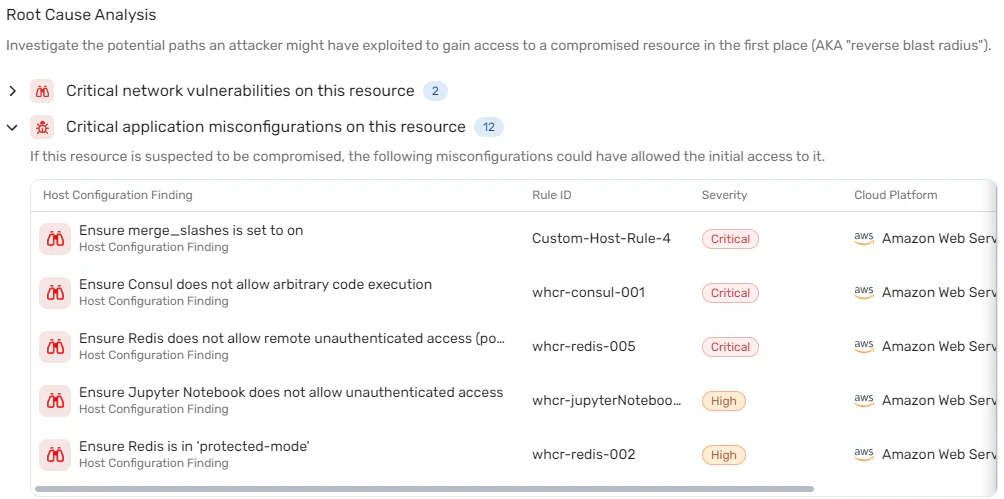
The net result is that cloud engineers spend less time triaging noise and more time fixing what matters. Security feedback reaches teams earlier, context travels with findings instead of living in a separate tool, and infrastructure can be built securely without handing off every change to a downstream review step.Request a demo to explore how Wiz connects code, cloud, and identity context so your team can prioritize real risk faster.
See Wiz in action
See how the Security Graph maps identities, workloads, and exposure paths across your cloud environment.
