



What is cloud financial management (CFM)?
Cloud financial management (CFM) is the practice of planning, tracking, and improving how your organization spends money in the cloud. It treats variable, consumption-based cloud costs as an ongoing, operational discipline, instead of a fixed annual budget line, so spending decisions remain tied directly to business value.
This framing matters because the Cloud bills you for what you use and usage can change by the hour. A single deploy can move your run-rate, so cost has to be watched the same way you watch uptime. As Cloud and AI infrastructure scale and grow, the stakes for getting CFM right are also increasing.
You may hear CFM used interchangeably with Cloud FinOps, and the two overlap heavily in day-to-day work, but they do represent slightly different scopes:
CFM is the broader functional discipline owned primarily by the Finance team, focused on areas like accounting, budgeting, governance, and overall financial strategy.
Cloud FinOps is the cross-functional operating model that works across Finance, Engineering, Product, and Business teams to drive cost visibility, accountability, and efficiency.
In practice, a healthy CFM engine relies on a few core principles : consistent cost transparency, unit economics that tie spend to output, and showback or chargeback reports that make spending feel real to the teams behind it. Together, these habits limit the possibility of cloud sprawl from quietly inflating the bill.
Demystifying AI Tokenomics
This eBook provides engineering and FinOps teams with a practical roadmap to understand token billing, eliminate architectural waste, and tie AI spend directly to business value.

CFM vs. cloud cost management vs. FinOps
As just mentioned, these terms may be used interchangeably, but there are differences when it comes to their scopes. One is a tactic, one is an operating model, and one is the broader financial discipline that encompasses the other two .
| Term | Scope | Who owns it |
|---|---|---|
| Cloud cost management | The practice of monitoring, analyzing, allocating, and optimizing cloud infrastructure spend to maximize business value without compromising performance, reliability, or security. | Engineering and Product teams t |
| FinOps | The cross-functional operating model and culture that encourages cost as shared, real-time responsibility | A FinOps practice coordinating finance, engineering, and product |
| Cloud financial management | The broad financial discipline that adds planning, allocation, and governance on top of cloud cost management and FinOps | Finance and FinOps leadership, with engineering acting on it |
Put simply, cloud cost management is something you do, FinOps is how you organize to do it, and CFM is the wider system that keeps it aligned to the business. Many teams treat CFM and Cloud FinOps as the same effort which can work perfectly fine as long as ownership stays clear.
The four pillars of cloud financial management
The most effective CFM disciplines can be broken down into four interconnected pillars. Each pillar is dependent on the others, so a gap in one can reduce the efficacy of the others.
Cost visibility and allocation
You cannot manage what you cannot see. This pillar brings each team’s spend into one tagged, filterable view, then splits it across teams, services, and products so each charge has a home. The strongest allocation programs rely on consistent resource tagging and cost allocation keys, and feed the showback or chargeback reports that make spend feel real to the people creating it.
Cost optimization
Once spend is visible, you can start safely exploring areas of waste or those lacking efficiency. This means right-sizing overprovisioned instances, switching off idle or orphaned resources, adding autoscaling, and buying commitment-based discounts such as reserved instances or savings plans, plus using spot capacity for interruptible workloads. The catch is context: cutting a resource without knowing how it is used or what depends on it can break something in production, so be sure to act on real usage and relationship data.
Forecasting and budgeting
Cloud bills change with usage, which can make them hard to predict. Forecasting takes into account recent trends and run-rates to project next month's spend, set budgets, and catch anomalies before the invoice arrives. For example, a forecast that flags a steady climb in data-transfer costs gives you weeks to act instead of a surprise at month-end. A solid forecast turns an unpredictable variable cost into a number finance can actually plan around.
Governance and accountability
Guardrails keep spend predictable without slowing anyone down. Think: tagging rules that reject untagged resources, budget alerts that fire in Slack, and clear ownership so that every service has someone responsible for its cost. When done well, governance guides engineers, rather than blocking them.
Watch 12-min demo
Watch how cost data connects to the resources and real usage behind it in a live cloud environment.

How to build a cloud financial management practice
Getting started with a CFM practice does not require a large team, but you do need to start with a strong foundation:
Unify cloud cost visibility: Bring cost visibility from across clouds into a single pane of glass. Avoid fragmented point solutions. Choose a platform that normalizes visibility across AWS, Azure, and GCP with deep architectural context and granular visibility down to the resource.
Map cost ownership: Map cost to teams, projects, environments, and application services. This builds the foundation for cost attribution and maps ownership so you can assign cost action items to teams.
Tie cloud spend directly to business value: Move beyond raw cloud bills by tying costs to features that are driving business value. Where possible, anchor to unit economics—like cost per customer, transaction, or feature—to define what real efficiency looks like.
Automate governance: Enforce tagging, set budgets, and add monitors that alert on budget overruns and cost anomalies so problems surface on their own, instead of waiting for a monthly review.
Continuously optimize: Automatically surface cost optimization opportunities and assign them to owners for review and remediation. Aim for continuous improvement vs. one time optimization exercises.
Meet with cost stakeholders on an active cadence: Review metrics on a consistent operating rhythm with stakeholders across product, engineering, and the business. Review actual spend, update forecasts, and adjust cost monitoring and optimization thresholds as needed. Adjust cost commitments strategy based on forecasts.
Cloud financial management tools
Every major provider ships its own cost tooling. AWS has Cost Explorer and Cost Management, Azure offers Cost Management, and Google Cloud provides Billing reports. These are free and detailed, but each one sees only its own cloud, which leaves teams stitching spreadsheets together when they run in more than one place.
Third-party CFM platforms and cloud cost optimization tools exist to close that gap. They pull every provider into one view and, at their best, add the usage and resource context that native billing screens leave out. When you compare options, weigh a few things:
Multicloud coverage: one consistent view across AWS, Azure, GCP, and Kubernetes, not a separate login per cloud.
Granular allocation: spend broken down by team, service, tag, and resource so every charge has an owner.
Usage and resource context: the ability to see why a cost exists and what depends on it before you cut.
Actionable optimization recommendations: savings ranked by effort and impact, with steps you can actually follow.
Anomaly detection: alerts that catch runaway spend before it reaches the invoice.
Commitments governance: the ability to monitor and optimize savings plan and committed use discounts coverage to maximize savings.
Budgets and forecasting: the ability to set budgets, forecast costs, and monitor how actual costs are trending against your forecasts.
Common cloud financial management challenges
Even teams with a tooling budget face challenges with cloud financial management., any of the challenges can be traced back to missing context, rather than missing data:
Data silos: cost sits in separate provider consoles, so no one sees the whole picture at once.
Tool sprawl: billing dashboards, spreadsheets, and one-off scripts rarely agree, which erodes trust in the numbers.
The missing why: a dashboard can show that a service costs more this month, but it doesn’t show which resources drove it or whether the jump is waste or healthy growth.
Unclear ownership: when no one is accountable for a service's spend, cleanup stalls no matter how good the data looks.
The good news is that closing the context gap fixes many of these challenges, all at once.. When your team can see which resources drive a charge, how they connect, and who can safely change them, the picture finance trusts becomes the same one engineers act on, which is the foundation of sustainable cloud cost optimization.
Cloud Costs: Optimize, Control, and Reduce Spend
Cloud cost is the total spend across compute, storage, networking, observability, licensing, and third-party services in public clouds.
もっと読む

Benefits of a strong CFM practice
A strong CFM practice pays off in ways finance and engineering can both appreciate:
Predictable spend: volatile bills turn into numbers you can plan around.
Less waste: idle and oversized resources get caught before they pile up.
Faster, safer decisions: teams act on context, so they can trim costs without risking performance.
Engineering accountability: owners see the cost of what they run and take responsibility for it.
Smarter investment: clear unit economics guide where the next cloud dollar should go.
Bringing context to cloud financial management with Wiz
Most cloud financial management tools can show you the bill. The harder question is understanding the context behind each number. Wiz Cloud Cost centralizes spend visibility and maps cost to the Wiz Graph, a live map of your cloud environment. Because cost data sits next to resource relationships and real usage data, your team can see what drives a charge and whether it can be reduced without impacting performance.
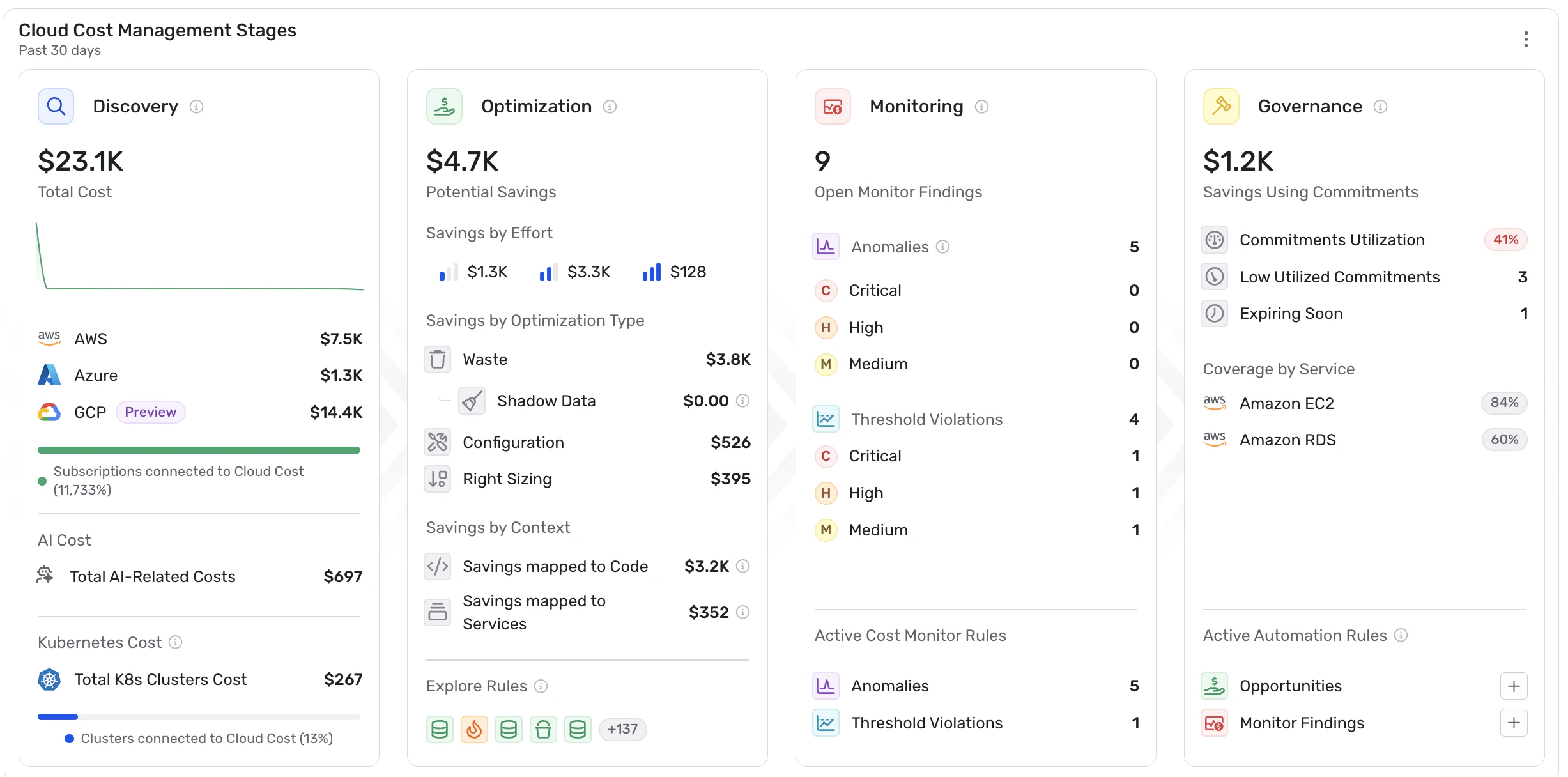
Wiz ingests and normalizes spend data across AWS, Azure, and GCP environments, including AI and Kubernetes costs.Use the Wiz Cost Explorer to analyze and investigate costs, with granular filters that let you drill into costs by resource type, service, AI model, and more.. Wiz automatically attributes costs to application services in the Wiz Service Catalog, allowing you to easily assign cost owners and understand how cost breaks down across different application features.
To drive cost efficiency, Wiz automatically surfaces context-aware cost optimization recommendations to help you eliminate waste, prioritized by effort and savings impact. You can also set up cost monitors in Wiz to alert owners to suspicious cost spikes and budget violations, so you can respond quickly and prevent a major cost overrun. The result is FinOps, platform, and product teams are aligned to the same understanding of spend and can proactively work to eliminate waste across the environment. Request a demo now to see how your cloud costs connect to the resources and usage behind them.
See your cloud costs in context
See how Wiz maps every charge to the resources, usage, and owners behind it, so your teams can cut waste without guessing.
