

What is AI incident response?
AI incident response is a security discipline that covers two converging areas: applying artificial intelligence to speed up how teams detect, investigate, and contain threats, and the specialized process of responding to incidents that target AI systems such as models, training pipelines, autonomous agents, and inference endpoints. This matters because organizations now face threats on both fronts at once. Attackers exploit AI systems as targets while also using AI to accelerate their own campaigns, and traditional IR playbooks were never designed for either scenario.
Incident response, or IR, is the organized approach to detecting, containing, and recovering from security events. The foundational framework most teams follow is the NIST Computer Security Incident Handling Guide (SP 800-61r2), which defines a four-phase lifecycle: preparation, detection and analysis, containment and recovery, and post-incident activity. Organizations like MITRE ATLAS and the Coalition for Secure AI (CoSAI) are now adapting these frameworks for AI-specific threats.
In practice, these two dimensions overlap constantly. A SOC team investigating a compromised cloud workload may discover the attacker accessed an AI training dataset, requiring both AI-enhanced investigation speed and AI-specific containment procedures. The rest of this article covers both sides because separating them creates the exact blind spots attackers exploit.
Wiz AI Agent Demo
Book a demo to learn how Wiz Defend detects, investigates, and remediates threats across your cloud and AI workloads, from detection to resolution.

Traditional incident response vs. AI incident response
The shift from traditional to AI-driven IR is not just about layering automation on top of existing processes. It reflects a fundamental change in how investigations actually work, from who can run them to what evidence is even available.
| Dimension | Conventional Incident Response | AI-Driven Incident Response |
|---|---|---|
| Detection method | Rule-based signatures and IOC matching | Behavioral analytics, anomaly detection, and cloud-native TTP detection |
| Investigation approach | Manual log correlation across siloed tools | Automated timeline generation with cross-layer correlation |
| Evidence capture | Analyst-initiated disk forensics | Automatic forensic capture triggered at moment of detection |
Analyst requirement | Requires Tier 3 cloud expertise | Empowers junior analysts with AI-guided triage |
| Response speed | Hours to days MTTR | Minutes-level MTTR |
Infrastructure assumption | Static servers with persistent evidence | Ephemeral containers, serverless, identity-based perimeters |
One distinction worth calling out: "automated" and "AI-driven" are not the same thing. Automated IR means scripted SOAR playbooks that execute predefined steps when a condition fires, like blocking an IP address. AI-driven IR means systems that reason through evidence, adapt their investigation path based on what they find, and make contextual decisions about severity and blast radius.
What are the benefits of AI incident response?
When you frame AI incident response by what it actually changes for security teams, the value becomes concrete. IBM found extensive AI use in security saves $1.9M per breach on average:
Cuts investigation time from hours to minutes: Automated timeline generation and forensic capture eliminate the manual "first hour" of every incident where analysts chase logs and resource owners.
Empowers junior analysts to handle complex cloud investigations: AI-guided triage delivers the cloud expertise that would otherwise require Tier 3 specialists, closing the security skills gap without new headcount.
Eliminates alert fatigue through contextual validation: Instead of thousands of low-fidelity alerts, AI surfaces only threats validated against full environmental context, including identity, exposure, and data sensitivity.
Captures evidence from ephemeral resources before it disappears: Automated forensic collection for containers, serverless functions, and managed services preserves evidence regardless of workload lifecycle.
Shifts IR from reactive to anticipatory: Behavioral analytics and continuous threat intelligence identify attack patterns before they escalate, catching unusual permission changes or anomalous API patterns early.
AI Incident Response Use Cases
AI contributes most in the parts of incident response that traditionally absorb the majority of analyst time: reviewing noisy alerts, assembling context, and determining what actually matters. In cloud environments, these steps become even heavier due to the volume of signals and the complexity of identity and configuration data. AI helps streamline several of incident response workflows, including:
High-volume alert triage
Event correlation and attack path reconstruction
Contextual prioritization
Pattern and behavior detection
Proactive vulnerability validation
Intelligent containment and response orchestration
Forensic preservation in ephemeral environments
Connecting investigation to remediation and validation
High-volume alert triage
Cloud environments generate thousands of daily alerts from control-plane events, workload telemetry, access logs, and configuration changes. Without filtering, this volume creates alert fatigue, where analysts become desensitized to notifications and miss real threats. AI addresses this by suppressing clearly benign behavior. Research shows AI-driven triage has halved false positives in some applications, surfacing only the signals that warrant review.
Event correlation and attack path reconstruction
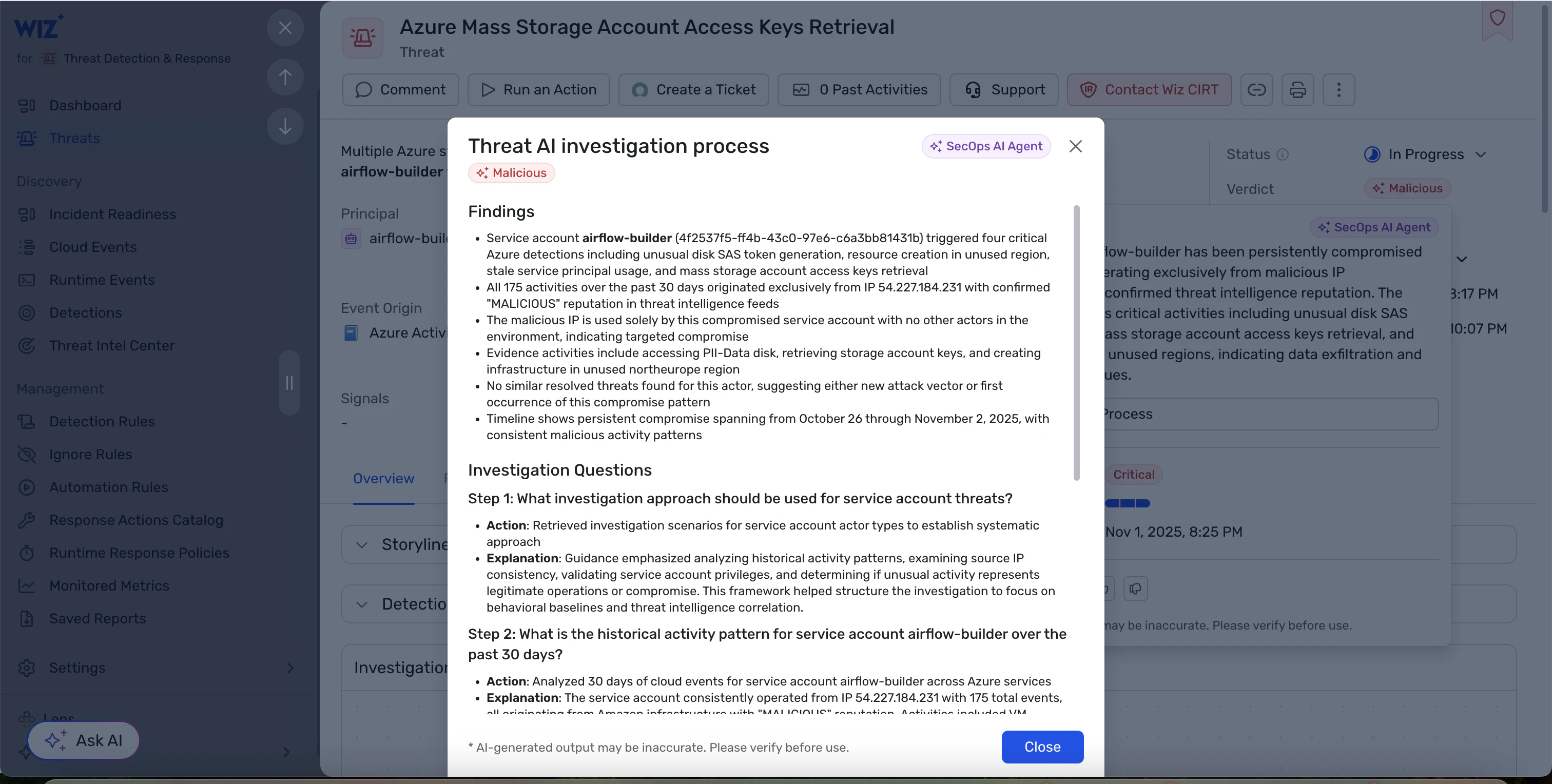
Incidents often span multiple systems: an IAM key used from a new location, followed by unusual API calls, followed by a configuration change. AI can connect these related events automatically, correlating signals across resource metadata, network flows, and identity activity to produce a chronological investigation timeline that shows how an attacker moved laterally, what they accessed, and what the full blast radius looks like.
Contextual prioritization
Not every anomalous event is a threat. AI can weigh factors such as internet exposure, privilege level, recent changes, data access, and network reachability to elevate issues that present actual risk. This reduces time spent on alerts that are unusual but harmless, which matters even more when 25% of respondents don't know what AI services are running in their environment.
Pattern and behavior detection
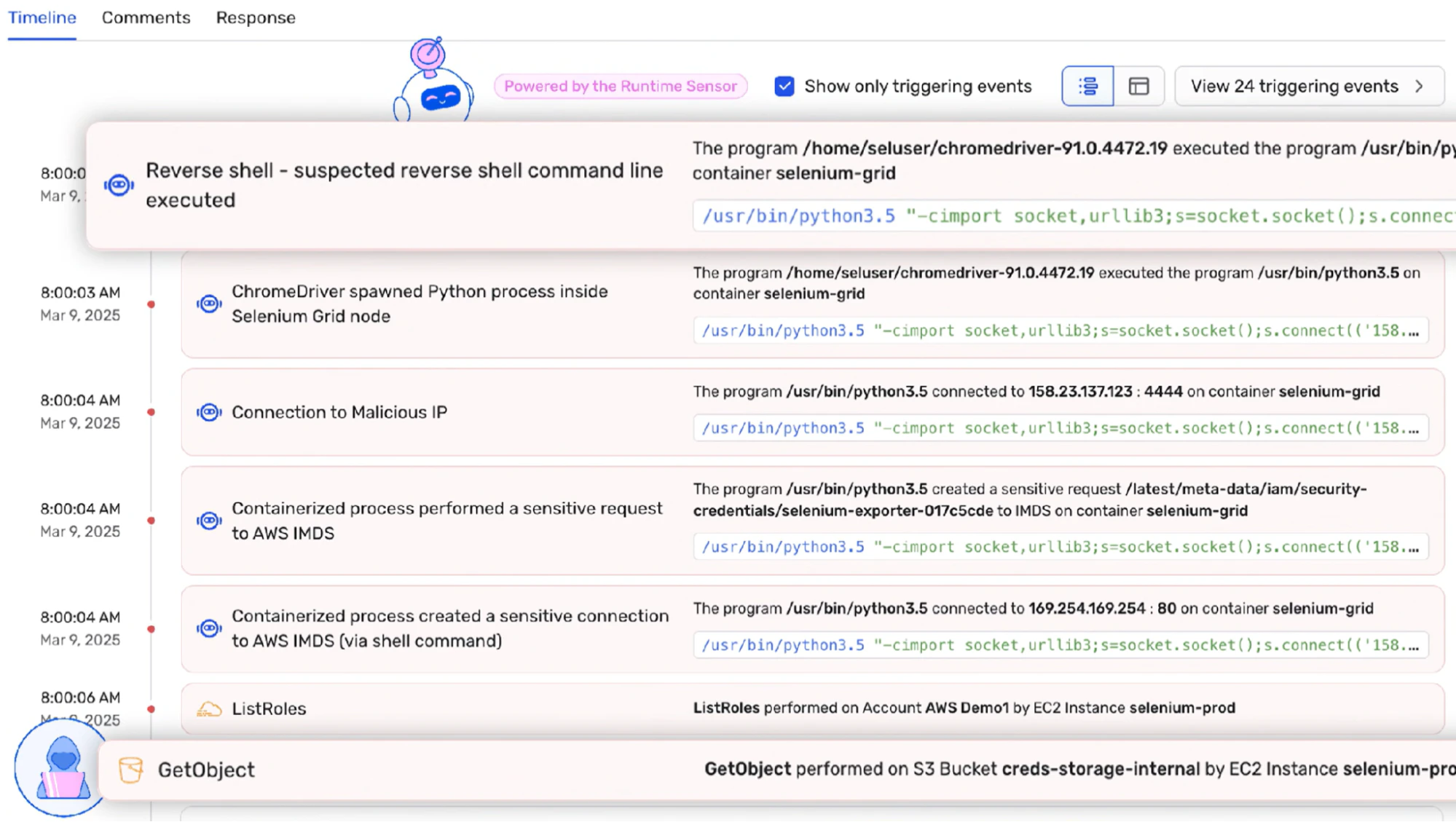
Some threats are subtle: gradual privilege creep, small configuration deviations, or low-and-slow probing. Machine learning models can surface these behaviors earlier by tracking long-term patterns across identities and workloads.
Proactive vulnerability validation
Instead of relying solely on static vulnerability scans, AI agents can reason through application logic to actively test whether a vulnerability is exploitable in context. This separates theoretical risk from confirmed exposure, helping teams focus on the findings that actually matter rather than chasing every CVE on the list.
Intelligent containment and response orchestration
For well-understood scenarios, AI can suggest or initiate containment actions within predefined guardrails: isolating compromised workloads, revoking exposed access keys, adjusting overly permissive IAM policies, or reverting unauthorized configuration changes. Beyond individual actions, AI can assess detection confidence and route responses accordingly, automatically executing containment for high-confidence threats while escalating ambiguous cases for human approval.
Forensic preservation in ephemeral environments
Containers and serverless functions can terminate within seconds, destroying critical evidence. AI-driven response can automatically trigger disk snapshots, capture process trees, and preserve cloud event logs the moment a threat is detected, ensuring forensic data survives even when the infrastructure doesn't.
Connecting investigation to remediation and validation
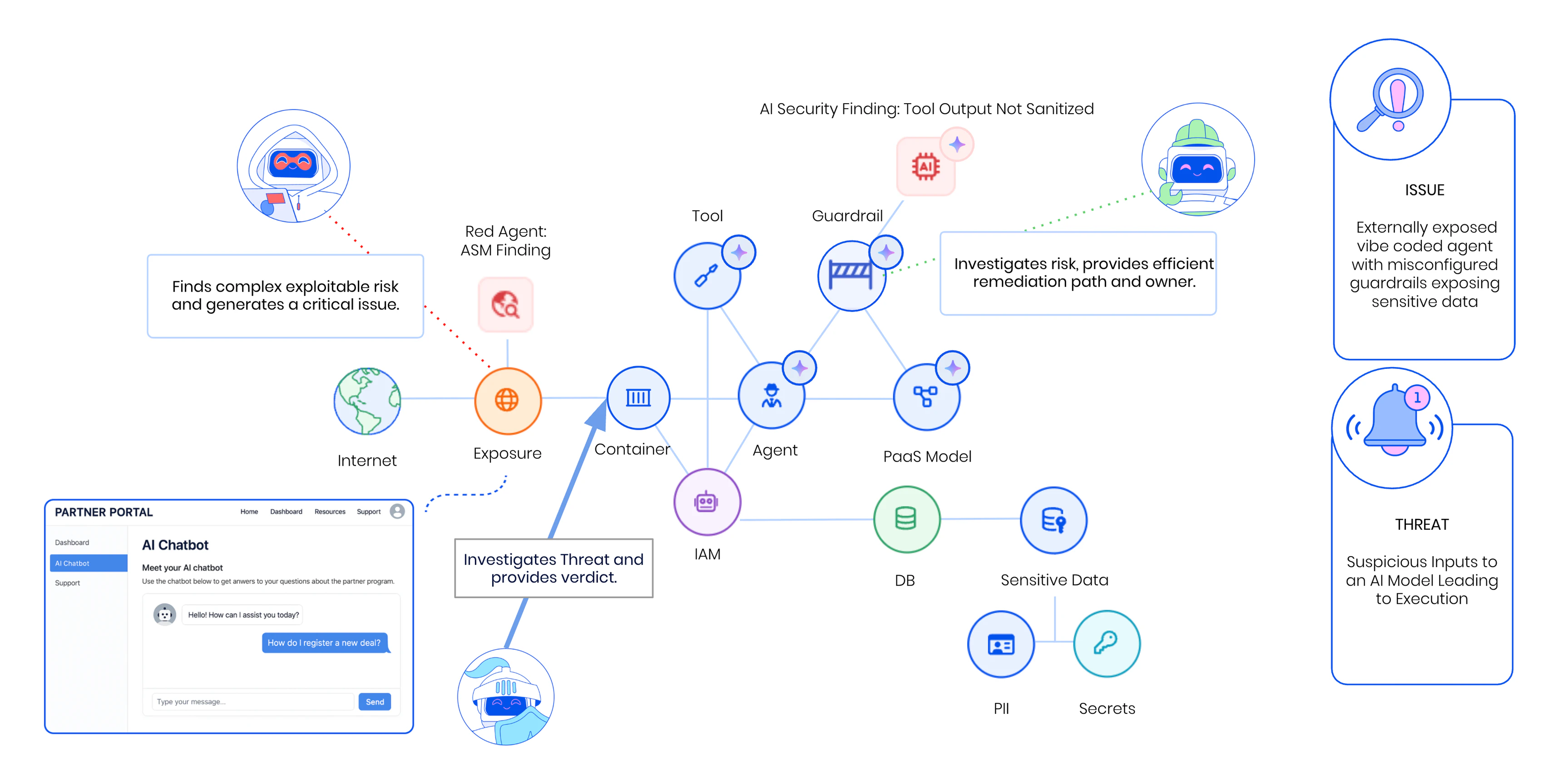
The greatest efficiency gains come when AI investigation, remediation, and validation agents work as a system rather than standalone tools. An investigation agent produces a structured analysis of a threat; a remediation agent uses that analysis to trace the root cause and generate fix guidance; an offensive validation agent continuously tests whether defenses hold against real-world attack logic. An orchestration layer connects these agents to operational workflows, defining when to auto-remediate, when to escalate for human review, and how to notify the right teams. This creates a closed loop where every phase of incident response feeds the next.
How Grammarly used AI to shrink investigation time by 90%
See an example of the AI investigation prompt Grammarly’s team uses to generate consistent, high-quality analysis.

How Wiz Defend brings AI into cloud incident response

Wiz Defend is the detection and response pillar of the Wiz platform, purpose-built for cloud-native environments where AI workloads, ephemeral infrastructure, and identity-based attacks converge. Everything in Wiz Defend is grounded in the Wiz Security Graph, a continuously updated model that maps every resource, identity, permission, vulnerability, network path, and data classification across multi-cloud environments, transforming isolated alerts into fully contextualized incidents with blast radius, ownership, and remediation paths.
When a threat is detected, the Blue Agent autonomously investigates, gathering evidence across cloud telemetry, runtime signals, and identity context. It approaches investigation the way a seasoned incident responder would, correlating CloudTrail, VPC Flow Logs, and runtime sensor events to map the full attack path, and produces a clear verdict (Malicious, Security Test, Planned Action, Not Malicious, or Inconclusive) with confidence level and full investigation summary, enabling junior analysts to handle complex cloud investigations without Tier 3 escalation. Meanwhile, the Red Agent proactively validates exploitable risks across web applications and APIs by reasoning through application logic, and the Green Agent drives remediation by tracing issues to their root cause and generating environment-specific, step-by-step fixes.
Workflows then orchestrate the full response, routing high-confidence containment actions for automatic execution while escalating lower-confidence decisions for human approval through integrations with Slack, Jira, ServiceNow, and other operational tools. Wiz's agentless-first architecture delivers full posture visibility without deployment friction, while the lightweight eBPF-based runtime sensor can be deployed surgically on high-value AI workloads for real-time blocking and deep forensic capture.
Book a Wiz demo to see how Wiz Defend delivers AI-driven cloud incident response end-to-end, from real-time detection and automated investigation through contextual remediation across your cloud and AI workloads.
Detect active cloud threats
Learn how Wiz Defend detects active threats using runtime signals and cloud context—so you can respond faster and with precision.
