

What is AI-powered behavioral analysis?
AI-powered behavioral analytics focuses on understanding what “normal” looks like in an environment—and flagging when behavior meaningfully deviates from it. Instead of relying on static rules or known indicators, these systems learn patterns across users, workloads, and identities over time, making them better suited for detecting subtle or previously unseen threats.
AI Security Sample Assessment
In this Sample Assessment Report, you’ll get a peek behind the curtain to see what an AI Security Assessment should look like.

How AI-powered behavioral analytics works
AI-powered behavioral analytics focuses on understanding how systems normally behave, then identifying activity that meaningfully deviates from those patterns. What distinguishes AI-powered approaches from traditional rule-based anomaly detection is how those baselines are established, maintained, and evaluated as environments change.
Rather than relying on fixed thresholds or manually defined rules (for example, “alert if more than X logins per minute” or “flag access from country Y”), AI-powered systems use statistical learning and pattern recognition to model normal behavior across identities, workloads, networks, and data access over time. These models can capture nuance – like typical sequences of actions, time-of-day patterns, and relationships between resources – that are difficult to express reliably as static rules.
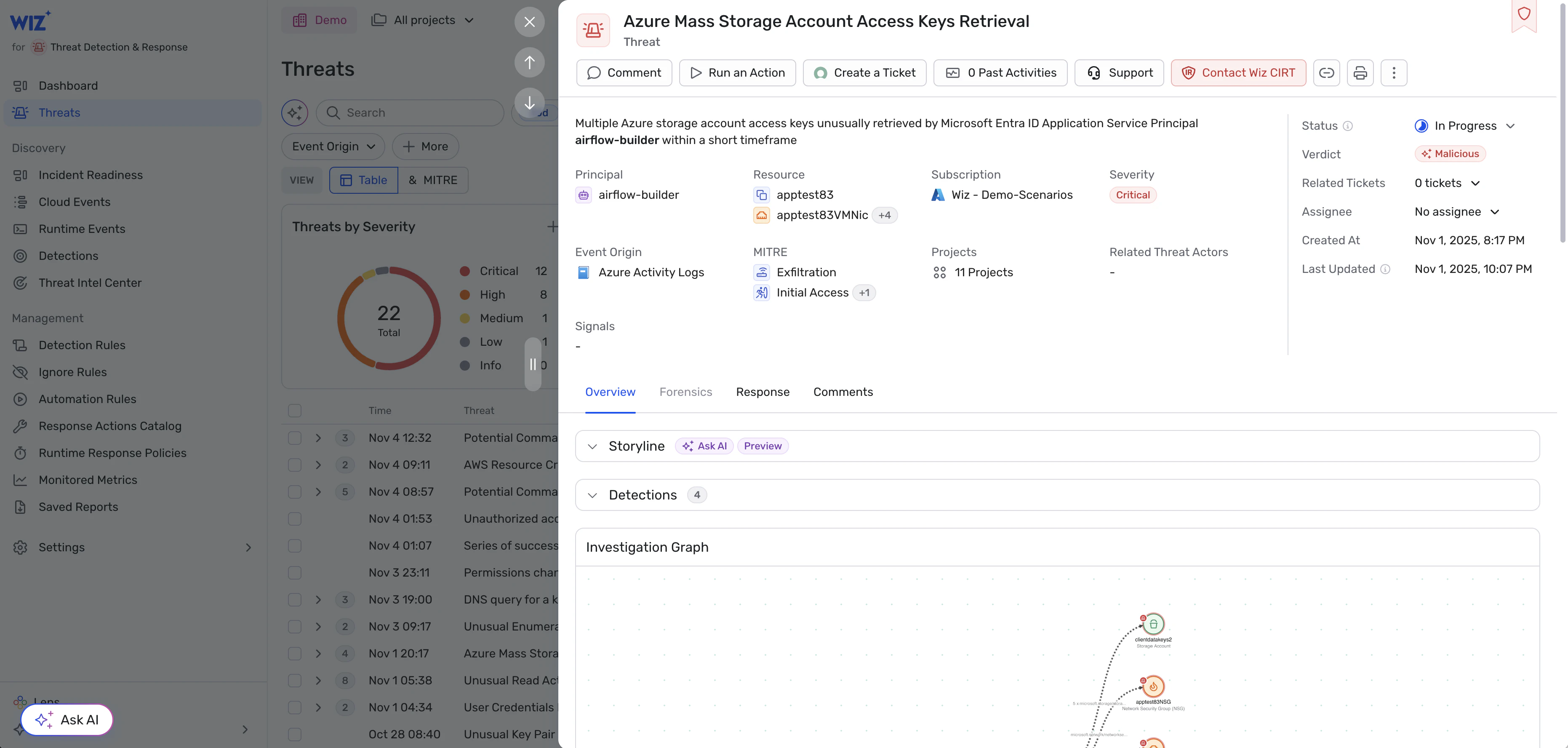
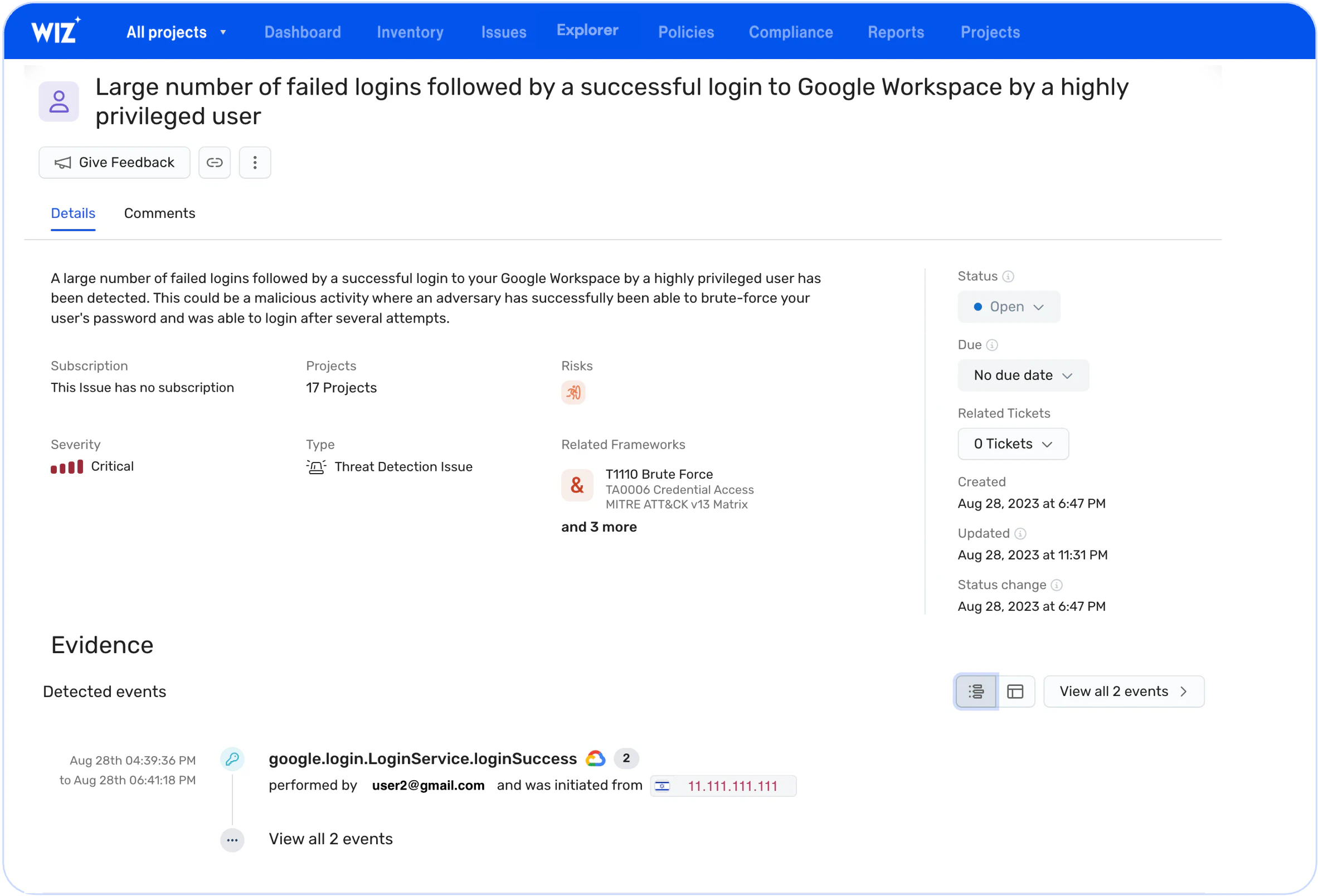
In practice, telemetry from cloud platforms – such as authentication events, API calls, network connections, process activity, and data access – is continuously analyzed to build behavioral profiles. Machine learning techniques help detect subtle deviations within those profiles, including changes in timing, frequency, access paths, or combinations of actions that may indicate misuse. The goal isn’t to “understand intent,” but to flag when behavior falls outside expected operational boundaries.
The value of this approach emerges through correlation rather than isolated alerts. Individual actions often look legitimate when viewed on their own. AI-powered behavioral analytics evaluates how actions relate to one another over time and across systems, surfacing patterns that signal elevated risk – such as a service account suddenly being used from a new execution context, accessing unfamiliar resources, and performing actions it rarely performs in normal automation.
Because cloud environments are dynamic, behavioral models must evolve. As infrastructure scales, deployment patterns shift, and automation expands, AI-powered systems can recalibrate baselines to reflect new “normal” behavior without requiring constant manual rule rewriting. This adaptability is a key reason behavioral analytics tends to perform better in cloud-native environments where change is continuous and static detection logic quickly becomes noisy or stale.
At the same time, AI-powered behavioral analytics is not a substitute for clear context. Behavioral signals become far more actionable when paired with security-relevant attributes – such as identity permissions, network exposure, and sensitive data access – so teams can distinguish harmless novelty from genuinely exploitable risk. Done well, the outcome is fewer low-value alerts and faster, higher-confidence investigations when something truly abnormal occurs.
Advantages of AI-powered behavioral analysis
AI-powered behavioral analytics offers several advantages over traditional detection approaches, particularly in cloud environments where scale and change are constant.
Improved detection in dynamic environments
Because behavioral models adapt as infrastructure and usage patterns evolve, they are better suited to cloud-native environments than static, rule-based systems. This reduces blind spots created by ephemeral workloads, automation, and frequent configuration changes that can quickly invalidate fixed detection logic.Reduced alert fatigue
By evaluating behavior in context rather than triggering on individual events, behavioral analytics helps filter out low-signal noise. Actions that are technically unusual but operationally expected are less likely to generate alerts, allowing security teams to focus on activity that represents meaningful deviation from normal behavior.Earlier identification of misuse and compromise
Behavioral analytics can surface suspicious activity even when attackers use valid credentials or legitimate tooling. Because it looks for deviations in how identities and workloads are used – rather than known malicious indicators – it can help identify abuse that would otherwise blend into normal operational traffic.Better prioritization through correlation
The ability to connect events across identities, workloads, network paths, and data access allows teams to assess risk more holistically. Instead of responding to isolated anomalies, analysts can focus on patterns of activity that indicate potential attack progression or elevated impact.Greater resilience to unknown threats
Unlike signature-based detection, behavioral analytics does not depend on prior knowledge of specific attack techniques. This makes it more effective against novel or evolving threats, including those that do not yet have well-defined indicators or exploit signatures.Operational efficiency for security teams
By reducing noise and surfacing higher-confidence signals, behavioral analytics supports faster investigation and decision-making. Analysts spend less time triaging false positives and more time responding to activity that warrants attention.
Detect active cloud threats
Learn how Wiz Defend detects active threats using runtime signals and cloud context—so you can respond faster and with precision.

Common challenges and limitations of AI-powered behavioral analytics
While AI-powered behavioral analytics offers clear advantages, it also comes with practical challenges that security teams need to understand to use it effectively.
Baseline quality and concept drift
Behavioral analytics is only as good as its understanding of what “normal” looks like. In fast-moving or poorly governed environments, this can become difficult. Rapid changes – such as new services, rotating roles, seasonal traffic patterns, or experimental workflows – can cause the system to learn risky behavior as acceptable. Over time, this phenomenon, often referred to as concept drift, can reduce detection accuracy.
Mitigating this requires thoughtful baseline design. Techniques such as peer-group baselining (comparing similar identities or workloads), incorporating temporal patterns (time-of-day or day-of-week behavior), and periodically retraining models help ensure that “normal” reflects healthy operations rather than accumulated misconfigurations.
Lack of contextual awareness
Anomalous behavior does not automatically imply malicious activity. A developer testing a new tool or a one-off operational task can look unusual without representing risk. Without sufficient context – such as whether a resource is production or sandbox, or whether an identity has elevated privileges – behavioral systems may generate unnecessary alerts.
This is why behavioral signals must be evaluated alongside contextual information like asset criticality, permission scope, network exposure, and data sensitivity. Without that context, even accurate anomaly detection can lead to false positives.
Explainability and analyst trust
For behavioral analytics to be useful, security teams need to understand why something was flagged. Explainability refers to the system’s ability to clearly show the factors that contributed to a detection – such as unusual API usage, unexpected timing, new locations, or deviations from peer behavior.
Effective systems present this information transparently and support feedback loops, allowing analysts to mark findings as benign or malicious. Over time, this feedback helps refine detections and improves signal quality, creating a continuous improvement cycle rather than a static rule set.
Scale and performance constraints
Cloud environments generate massive volumes of telemetry. Behavioral analytics systems must process this data efficiently to remain timely and cost-effective. If analysis cannot keep up with event volume, detections may lag behind real activity or become prohibitively expensive to operate.
Where AI-powered behavioral analytics fits in a cloud security strategy
AI-powered behavioral analytics is most effective when treated as a complementary capability rather than a standalone security control. Its strength lies in surfacing suspicious activity that traditional preventive controls and static detections often miss – but it depends heavily on surrounding context to be actionable.
In practice, behavioral analytics works best alongside foundational cloud security measures such as identity and access management, network segmentation, vulnerability management, and configuration monitoring. Preventive controls reduce the likelihood of misuse, while behavioral analytics helps detect when those controls are bypassed, misused, or insufficient.
Behavioral signals are particularly valuable in scenarios where attackers rely on legitimate access. When compromised credentials, service accounts, or automation are used, activity can appear “valid” at the surface level. Behavioral analytics helps highlight when those identities behave in ways that are inconsistent with their historical or expected usage, prompting investigation even in the absence of known indicators of compromise.
This approach also complements risk-based prioritization. Behavioral anomalies become far more meaningful when combined with information about asset criticality, permission scope, network exposure, and data sensitivity. An unusual action taken against a low-impact sandbox resource may be benign, while the same behavior targeting a production system with sensitive data warrants immediate attention.


How Wiz applies AI-powered behavioral analytics in cloud security
Wiz applies AI-powered behavioral analytics as part of its broader cloud detection and response strategy, with a focus on identifying meaningful risk rather than isolated anomalies. Instead of treating behavioral signals in isolation, Wiz evaluates them alongside cloud context such as identity permissions, network exposure, asset criticality, and data sensitivity.
Within Wiz Defend, behavioral analytics are used to establish baselines for cloud entities including users, service accounts, workloads, and data resources. These baselines reflect how identities and systems are typically used across the environment, enabling detection of activity that deviates in ways that may indicate misuse, compromise, or policy violations.
When anomalous behavior is detected, Wiz correlates runtime signals with control-plane events, configuration data, and identity context to determine whether the activity represents real risk. This correlation helps reduce alert fatigue by filtering out benign deviations and prioritizing cases where unusual behavior intersects with excessive permissions, public exposure, or access to sensitive data.
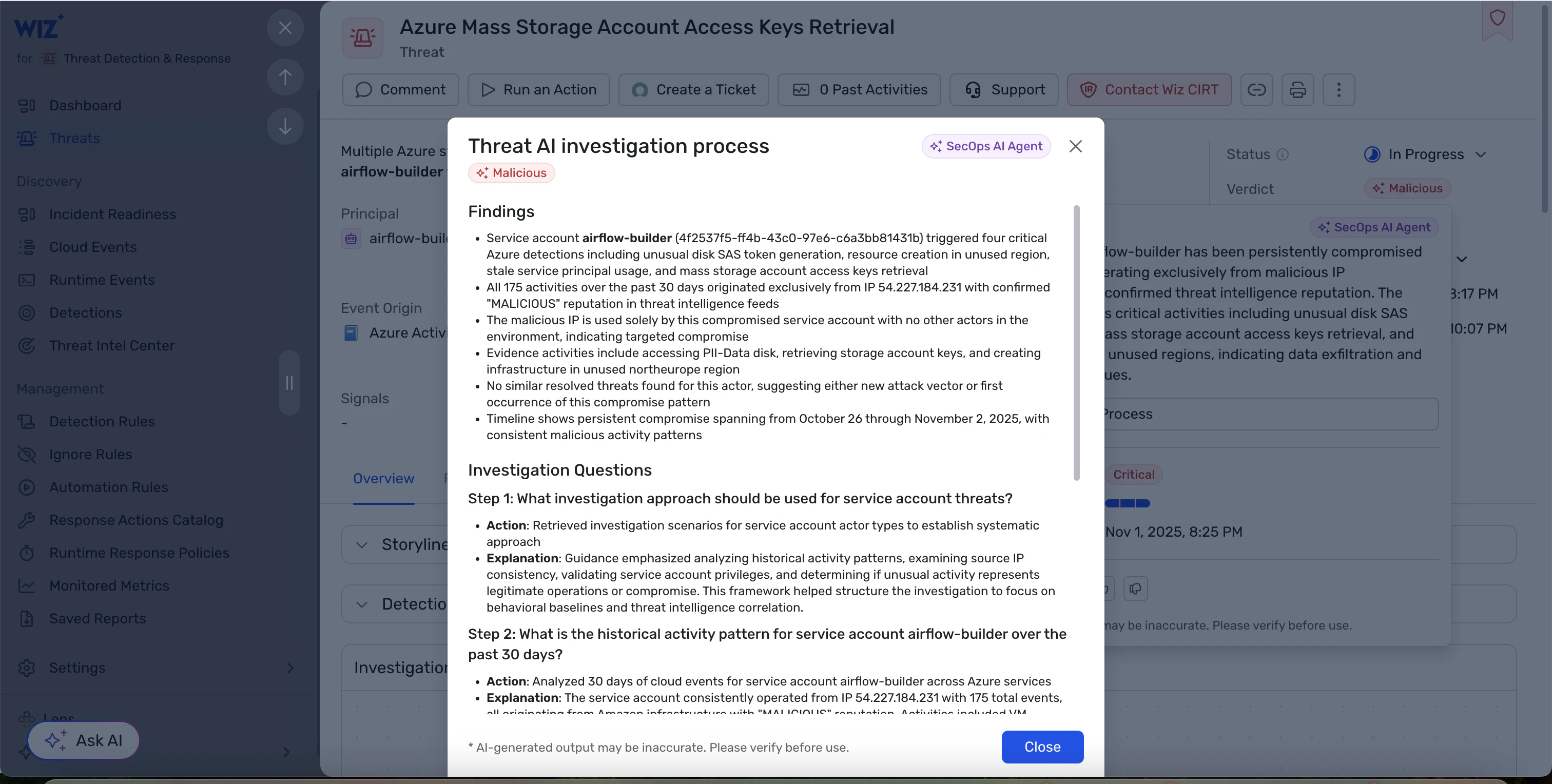
To accelerate investigation, Wiz leverages the SecOps AI Agent. The Agent automatically investigates newly triggered threats, pulling together related runtime events, cloud configuration data, and identity context across the environment. It is trained on Wiz’s internal incident response knowledge base and applies the methods and insight of Wiz’s IR experts to each investigation, helping assess potential blast radius and impact before an analyst begins manual triage.
Crucially, the SecOps AI Agent is designed to be transparent and assistive rather than authoritative. It presents its findings, supporting evidence, and reasoning clearly, allowing analysts to understand what was analyzed, why it matters, and how the conclusion was reached. Analyst feedback – such as confirming or dismissing findings – helps continuously refine future investigations, improving signal quality over time without removing human oversight.
We have been seeing really interesting things out of the SecOps AI Agent already. It is driving faster decision-making and dispositioning of alerts, especially in cases of anomalous behavior
Justin Lachesky, Director of Cyber Resilience at Redis
Importantly, Wiz’s use of behavioral analytics is system-focused rather than model-focused. In AI environments, Wiz applies the same principles used for cloud workloads: securing how AI systems interact with infrastructure, identities, and data, rather than attempting to analyze model outputs or infer intent. This ensures consistent security coverage across traditional and AI-driven workloads.
By combining behavioral analytics, automated investigation, and deep cloud context, Wiz helps security teams move faster from detection to decision – without relying on opaque scoring or speculative interpretations of behavior.
Detect active cloud threats
Learn how Wiz Defend detects active threats using runtime signals and cloud context—so you can respond faster and with precision.