


What is threat detection and response?
Threat detection and response (TDR) is a cybersecurity discipline that combines continuous monitoring, threat identification, investigation, and containment to find and stop attacks before they cause damage. The "detection" half covers identifying suspicious or malicious activity across your environment. The "response" half covers containing, investigating, and remediating whatever you find.
TDR is not a single tool. It spans people, processes, and technology working together to shrink the window between an attacker's first move and your team's reaction. Attackers don't wait for scheduled scans or quarterly reviews, so TDR must operate as a continuous loop rather than a periodic activity.
Incident Response Plan Template
Structure the response half of your TDR program with a ready-to-use cloud IR playbook.

Why threat detection and response matters
Organizations have expanded their infrastructure faster than their security operations have adapted. The attack surface is broader, threats are faster, and the talent pool hasn't kept up. Three shifts make TDR essential right now.
The attack surface has expanded beyond endpoints. Traditional TDR was built for persistent servers and known network boundaries. Modern environments introduce ephemeral workloads, identity-based access, and API-driven infrastructure that legacy tools were never designed to monitor. An attacker using a stolen credential to exfiltrate data through a legitimate API call generates zero endpoint alerts. Without detection across identity, network, and API layers, these attacks are invisible.
Threats move at machine speed. Automated attack tooling and AI-assisted exploitation compress the time between initial access and impact. Manual log hunting cannot keep pace with attackers who can exploit a vulnerability and move laterally within minutes. Automated detection and response is a necessity, not a luxury.
The skills gap is growing. Most security teams cannot hire fast enough to keep pace with alert volume. Cloud incidents, identity-based attacks, and AI workloads require expertise that many Tier 1 and Tier 2 analysts lack. AI-powered triage and automated investigation are becoming essential components of a modern TDR program.
What is an advanced persistent threat (APT)?
An advanced persistent threat is a sophisticated cyberattack where skilled hackers break into your network and stay hidden for months or even years
もっと読む
What threats does TDR defend against?
Knowing which threats a program is meant to catch gives useful shape to how you build detection coverage. The categories below span the attack types most cloud and hybrid teams plan for, and each one maps to signals a mature program can watch.
Malware and ransomware: Malicious software that runs on a workload to steal data, encrypt files, or hold systems hostage. Detection here watches for suspicious processes, unexpected file encryption, and known-bad binaries at runtime.
Phishing and credential theft: Tricking a person into handing over a password or token, which an attacker then reuses to log in as them. Because the login looks legitimate, catching it depends on spotting unusual identity activity rather than a broken door.
Insider threats: Risky or malicious actions from someone who already has access, whether an employee, contractor, or a compromised account acting on their behalf. Behavioral baselines help surface access patterns that fall outside what a given user normally does.
Advanced persistent threats (APTs): Well-resourced attackers who quietly stay inside an environment for weeks or months to reach a specific goal. Their patience is the giveaway, so correlating small signals over time matters more than any single alert.
Zero-day exploits: Attacks that target a flaw before a patch exists, which means signatures for them do not yet exist either. Watching for the behavior an exploit produces, like a web server suddenly spawning a shell, is what closes this gap.
Distributed denial-of-service (DDoS) attacks: Flooding a service with traffic from many sources until it slows down or falls over. Traffic-pattern monitoring flags the surge so teams can absorb or reroute it.
Data breaches: The unauthorized access or removal of sensitive information, often the end goal that ties the other threats together. Knowing where sensitive data lives lets a program prioritize the signals that point toward it.
How does threat detection and response work?
TDR operates as a continuous loop. Each phase feeds the next, and the cycle repeats as your environment changes.
Continuous monitoring. Detection starts with telemetry: endpoint logs, network flow data, cloud audit logs, identity provider logs, runtime signals, and DNS queries. The breadth of telemetry sources determines what you can and cannot detect.
Threat detection. Once telemetry is flowing, detection methods identify what is suspicious. Signature-based detection matches known indicators of compromise like file hashes and known-bad domains. Behavioral analytics baselines normal user and entity behavior and alerts on deviations. Threat intelligence feeds keep detection current with emerging attack techniques without requiring manual rule writing.
Triage and investigation. Detection alone is not enough. Triage determines whether a detection is a true positive, and investigation builds the full attack narrative. The fastest investigations start with a unified context model (identity, exposure, data sensitivity, and workload reachability) so analysts don't have to pivot across consoles to understand blast radius.
Response and containment. Response means isolating compromised resources, blocking malicious processes, capturing forensic evidence, and containing blast radius. In environments with short-lived infrastructure, forensic data must be captured automatically at the moment of detection or it is lost.
Recovery and remediation. Restore affected systems and fix the root cause, whether a misconfiguration, an overprivileged identity, or a vulnerable dependency, to prevent recurrence.
Types of threat detection and response
Different TDR types address different layers of the environment. Modern programs combine several to eliminate blind spots.
Endpoint detection and response (EDR) monitors processes, files, and behaviors on endpoints. It remains valuable for host-level threats like malware and unauthorized binaries but is blind to attacks that never touch a server.
Network detection and response (NDR) analyzes network traffic patterns to detect anomalous lateral movement. It struggles with encrypted, API-based communication that is increasingly common in modern environments.
Cloud detection and response (CDR) monitors cloud audit logs, identity activity, and API calls. It is the missing layer for organizations that have adopted cloud infrastructure but still rely solely on EDR and SIEM.
Identity threat detection and response (ITDR) focuses on credential compromise and privilege escalation through identity provider logs and IAM activity. It needs pairing with runtime and network signals for full coverage.
Extended detection and response (XDR) correlates signals across endpoints, networks, identity, and cloud into a unified view. Its effectiveness depends on how deeply it integrates telemetry from each layer.
Managed detection and response (MDR) extends team capacity through outsourced monitoring and response. Third-party analysts may lack deep context about your specific architecture.
Watch 5-min demo
See how Wiz Defend unifies detection across identity, cloud, and runtime layers to eliminate the blind spots described above.

What technologies power threat detection and response?
Behind every TDR program sits a set of tools that gather signals, make sense of them, and turn a decision into action. It helps to split them into two groups: the technologies that surface a threat and the ones that help you act on it.
Detection technologies
These tools collect and analyze the telemetry that tells you something is wrong.
SIEM (security information and event management): Aggregates logs and events from across your environment into one place, then runs rules and analytics to flag suspicious activity. It gives analysts a searchable record for hunting and investigation.
DSPM (data security posture management): Finds where sensitive data lives and how exposed it is, then feeds that sensitivity picture into detection. When an alert touches a store full of customer records, that context tells a team to move first.
EDR and CDR: The endpoint and cloud detection layers covered above also belong here, supplying host-level and cloud-native signals that the rest of the stack builds on.
Response technologies
These tools take a confirmed threat and help teams contain, track, and learn from it.
SOAR (security orchestration, automation, and response): Runs predefined playbooks so routine containment steps happen automatically, such as isolating a host or revoking a token. This frees analysts to focus on the calls that genuinely need a human.
Ticketing and case-management integration: Routes an incident to the right owner and keeps a record of who did what and when. It connects the security team to the developers and operators who fix the underlying flaw.
Forensic and audit tools: Capture the evidence, like process trees, shell histories, and system logs, that explain how an attack unfolded. In short-lived cloud infrastructure, grabbing this at the moment of detection is what preserves the trail.
Security orchestration platforms: Tie the other response tools together into coordinated workflows, so a single verdict can trigger containment, a ticket, and evidence capture in one motion.
In practice, many cloud-native teams are moving away from stitching these bolt-on layers together and leaning instead toward detection driven by shared context, where the signal and its meaning already live in one place.
What is AI Detection and Response (AIDR)?
AI detection and response (AIDR) is a security capability that monitors your AI systems, prompts, agents, models, and the data pipelines feeding them, then acts when something goes wrong.
もっと読む
What to look for in a TDR solution
The tooling you choose shapes what your TDR program can realistically accomplish. When evaluating solutions, focus on these capabilities.
Cross-layer detection coverage. The solution should detect threats across endpoints, networks, identities, APIs, and workloads. Ask vendors specifically whether the solution detects identity-based attack techniques like credential theft, privilege escalation, and cross-account lateral movement.
Contextual enrichment from a unified risk model. Every detection should carry identity permissions, data classification, network exposure, and vulnerability context. A unified risk model lets analysts instantly understand blast radius without manual pivoting across consoles.
Automated forensics and investigation. The solution should automatically capture forensic evidence at detection time and produce a correlated attack timeline without requiring senior analyst expertise for every incident.
AI-powered triage and response. Look for a tool that does more than score alerts, it should investigate them. The strongest platforms deploy investigation agents that produce a structured analysis for every triggered threat, complete with a verdict, confidence level, involved entities, blast radius, and recommended next steps. This is how smaller teams handle investigation workloads that would otherwise require significantly more headcount.
Wiz's approach to threat detection and response
Wiz Defend is the detection and response pillar of the Wiz cloud security platform, built on the Wiz Security Graph. Every detection carries full context: not just "something suspicious happened," but who did it, what they could access, and what the blast radius would be.
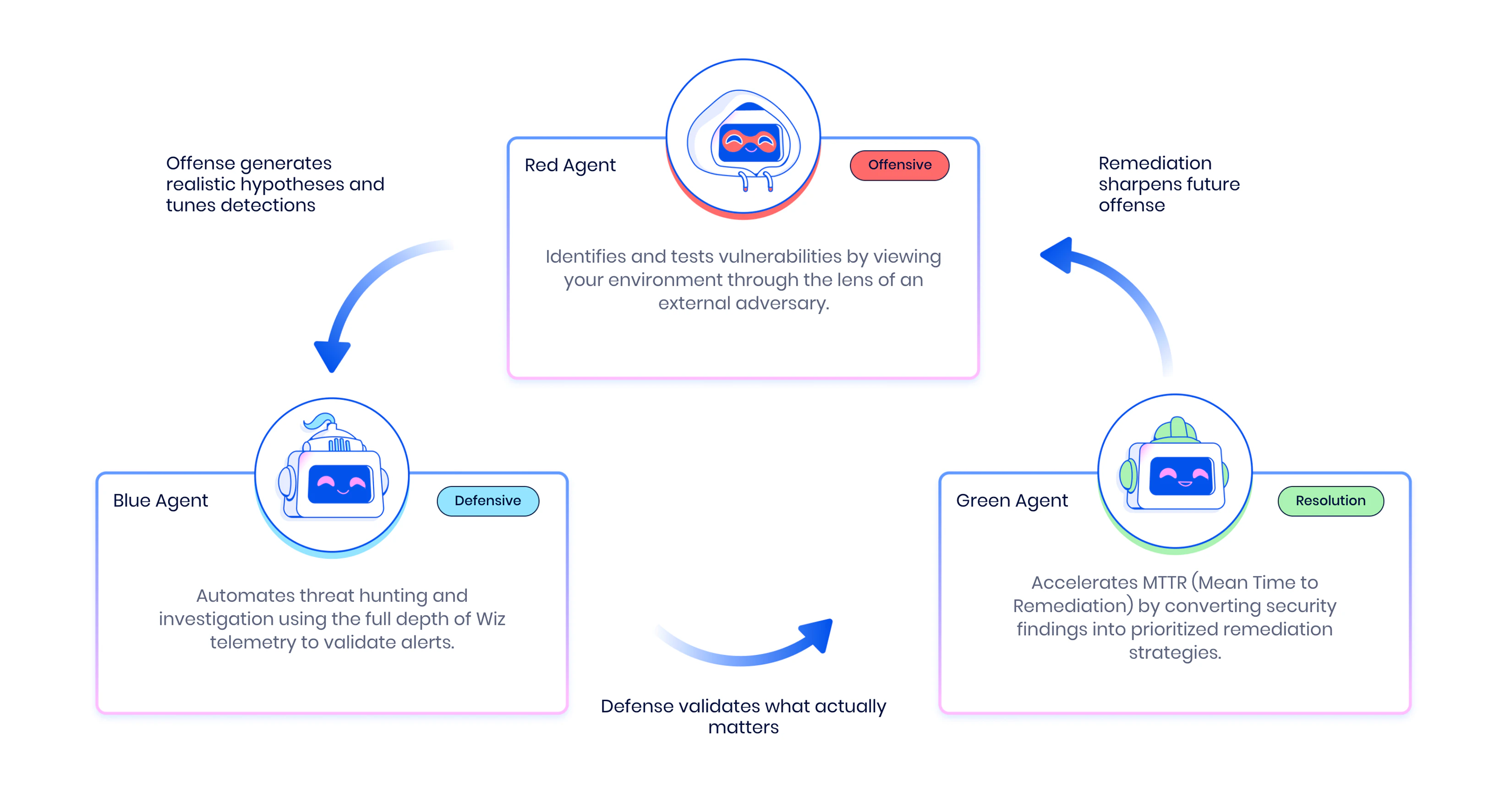
Three purpose-built AI Agents extend Wiz Defend across the full TDR lifecycle:
Blue Agent automatically investigates every triggered threat by correlating cloud events, runtime signals, and identity context. It produces a transparent, review-ready verdict with full reasoning, trained on the Wiz IR team's knowledge base and continuously refined through analyst feedback.
Green Agent drives remediation by analyzing your highest-risk issues, tracing each to its root cause, and generating actionable fix guidance mapped to the right developer or owner.
Agentic Workflows connect agent analysis to your operational processes. Teams define how automation and human approvals interact. For example, auto-remediating a high-confidence finding while routing a lower-confidence verdict to a developer for review in Slack.
With the Red Agent validating exploitable risks through AI-powered offensive testing, Wiz closes the loop: detect, investigate, validate, remediate, and continuously improve.
Get a demo to see how Wiz Defend connects runtime signals, identity context, and exposure data so every detection tells the full attack story. Book a Wiz Defend demo to see how threat detection and response works when every alert carries identity, exposure, and data context.
See Wiz Defend in action
Experience threat detection and response where every alert carries identity, exposure, and data context from the Wiz Security Graph.
