



What is an AIBOM?
An AIBOM (AI Bill of Materials), or AI-BOM, is a comprehensive inventory of every component that makes up an AI system: the models, training datasets, software dependencies, frameworks, and the infrastructure running it all. Think of it as the ingredient label for your AI, except instead of listing calories and preservatives, it lists which version of a foundation model you fine-tuned, where the training data came from, and what frameworks hold the whole thing together.
When a vulnerability drops in a popular framework or a licensing issue surfaces in a base model, security teams need to know which production systems are affected, fast. An AIBOM gives them that map. Without one, you are left asking questions nobody can answer quickly: Which version powers our recommendation engine? Who fine-tuned it? What upstream weights did they start from?
AI Security Starter Pack
Establish a practical baseline for securing AI workloads, services, and dependencies across the cloud.

Why have AI-BOMs become essential?
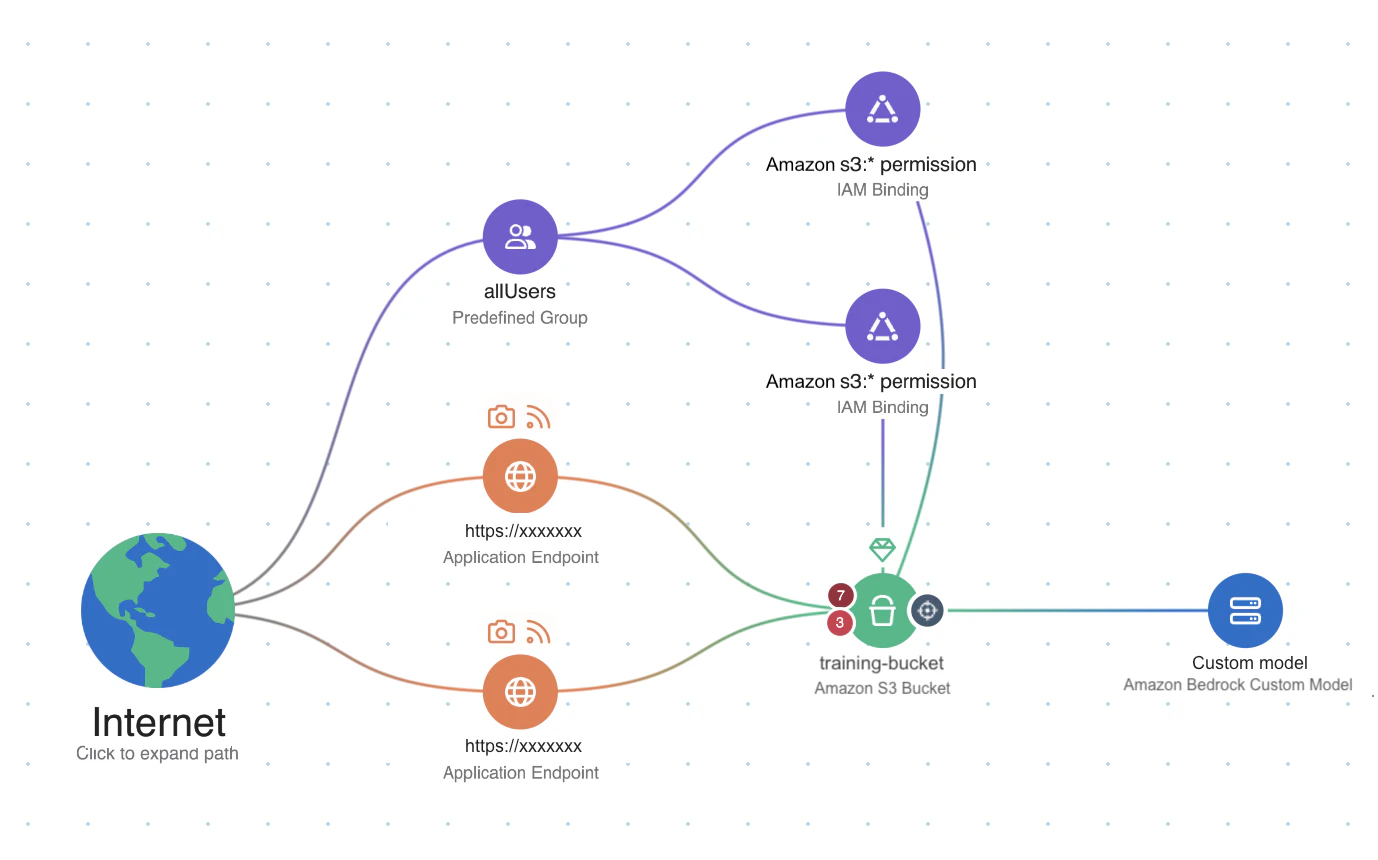
The following converging forces make AI-BOMs a critical component of responsible AI governance:
AI risk and transparency demands: As organizations embed generative AI and AI-powered applications into business operations, they need clear visibility into the AI assets they are running and how those assets might introduce vulnerabilities or compliance gaps.
Regulatory pressure: New policies, like the EU AI Act and the NIST AI Risk Management Framework, require organizations to maintain detailed records of AI components, their usage, and their associated risk profiles. Technical documentation requirements under the EU AI Act make traceability in AI systems non-negotiable.
Supply chain security concerns: The AI attack surface extends beyond your own infrastructure to include third-party models, open-source libraries, and AI services. Just as supply chain attacks target software dependencies, AI systems face similar risks from compromised models, poisoned datasets, and vulnerable APIs.
Internal governance requirements: Organizations implementing responsible AI initiatives need mechanisms to track model lineage, enforce usage policies, and ensure that AI adoption aligns with business values. AI-BOMs provide the data foundation to make these governance initiatives auditable and enforceable.
Wiz helps security teams build and maintain AI-BOMs by providing continuous visibility into cloud-hosted model dependencies, automatically discovering AI services, and mapping their connections across your infrastructure.
Real-world example: Wiz researchers discovered architecture risks for AI-as-a-Service providers
In 2024, Wiz Research uncovered critical isolation vulnerabilities in Hugging Face’s AI-as-a-Service platform by uploading a malicious pickle-formatted model that achieved remote code execution and potentially enabled cross-tenant access to other customers’ models and sensitive data.
The vulnerabilities stemmed from gaps that a comprehensive AI-BOM would have surfaced: insufficient sandboxing in shared inference infrastructure, overly permissive container registry access, and Amazon EKS IMDS exposure.
To resolve them, Hugging Face worked closely with Wiz to validate findings and implement mitigations, including enhanced tenant separation and improved security controls.
Hugging Face’s experience demonstrates how AI-BOM visibility, along with continuous monitoring, helps organizations detect supply chain risks in AI systems before attackers can exploit them. By maintaining a complete inventory of AI components, their dependencies, and access paths, security teams can identify dangerous configurations and enforce guardrails as AI systems scale.
7 core components of an AI-BOM
An AI-BOM captures more than a list of models. For effective security, governance, and operations, an AI-BOM documents the full set of components powering an AI system and their relationships.
A complete AI-BOM includes the following seven core components at a minimum:
1. Data layer
The data layer captures all data assets AI systems rely on for training, inference, and storage. Understanding these data dependencies is essential for managing data scientists’ workflows and ensuring compliance with data privacy regulations.
Here are the components of the data layer:
Training data: The datasets teams use to train or fine-tune models, including their origin, licensing, and any applied preprocessing
Inference-time data: Data sources the model accesses during production, such as real-time APIs, feature stores, or data warehouses
Data stores: The underlying storage systems (like cloud storage, databases, or vector databases) that hold AI-related data
2. Model layer
The model layer tracks AI models, their metadata, and their evolution over time. Tracking these models lets teams maintain control over versions and configurations.
The model layer includes these components:
Foundation models: Pre-trained models from providers like OpenAI, Anthropic, or open-source repositories
Fine-tuned models: Models customized for specific use cases through transfer learning or additional training
Internally trained models: Models developed entirely in-house, including custom architectures and algorithms
Model versions and configurations: Specific versions deployed in production, along with their hyperparameters and deployment contexts
3. Dependency layer
The dependency layer identifies potential vulnerabilities in the AI supply chain and helps teams track where security risks originate across the software stack.
The dependency layer includes:
ML frameworks: Software development frameworks (like TensorFlow, PyTorch, or JAX) teams use to build and run models
AI SDKs: Libraries for interacting with hosted AI services (like OpenAI SDK, Anthropic SDK, or LangChain)
Third-party packages: Supporting libraries and open-source components that models depend on
Runtime dependencies: Everything that’s necessary for training, serving, or orchestrating AI models in production
4. Infrastructure layer
The infrastructure layer tracks the hardware and cloud resources supporting AI workloads.
Continuous management of these controls AI risk and cloud cost environments.
The infrastructure layer includes:
Compute resources: GPUs, TPUs, and other acceleration hardware AI workloads use
Storage and networking: The cloud infrastructure supporting AI operations, including network paths between components
Cloud environments: Accounts, regions, and deployment boundaries where AI workloads run
5. Security and governance
The security and governance layer enables teams to assess exposure and implement least-privilege access for AI systems by providing comprehensive visibility into identities and access patterns.
The following components comprise the security and governance layer:
Identities and access: Service accounts, roles, permissions, and credentials AI systems use
Access paths: How models connect to data sources, downstream services, and external APIs
Security controls: Policies, guardrails, and validation mechanisms that teams apply to AI components
Inside MCP Security: A Field Guide
Examine how MCP servers, connected tools, identities, and data access expand the relationships an AI-BOM must track.

6. People and processes
People and processes support accountability and reproducibility across the AI lifecycle by clearly documenting who manages what and how changes occur.
The following elements comprise this layer:
Ownership: Clear assignment of responsibility for each AI component
Change history: Audit trails that show who modified components, when, and why
Approval workflows: Processes that govern how AI components move through development, testing, and production
7. Usage and documentation
The usage and documentation layer provides context on how AI systems behave and evolve, enabling teams to maintain model quality and compliance over time.
Implement these features for usage and documentation:
Model lineage: Upstream and downstream relationships that show how components connect
Use cases: Documentation of intended model purposes and acceptable usage boundaries
Performance metrics: Accuracy, latency, and other measures teams track over time
These seven components enable an AI-BOM to map how AI systems actually operate in production. By capturing both assets and their relationships, the AI-BOM provides the foundation for traceability, risk assessment, and governance as AI systems evolve.
How do AI-BOMs enable key security functions?
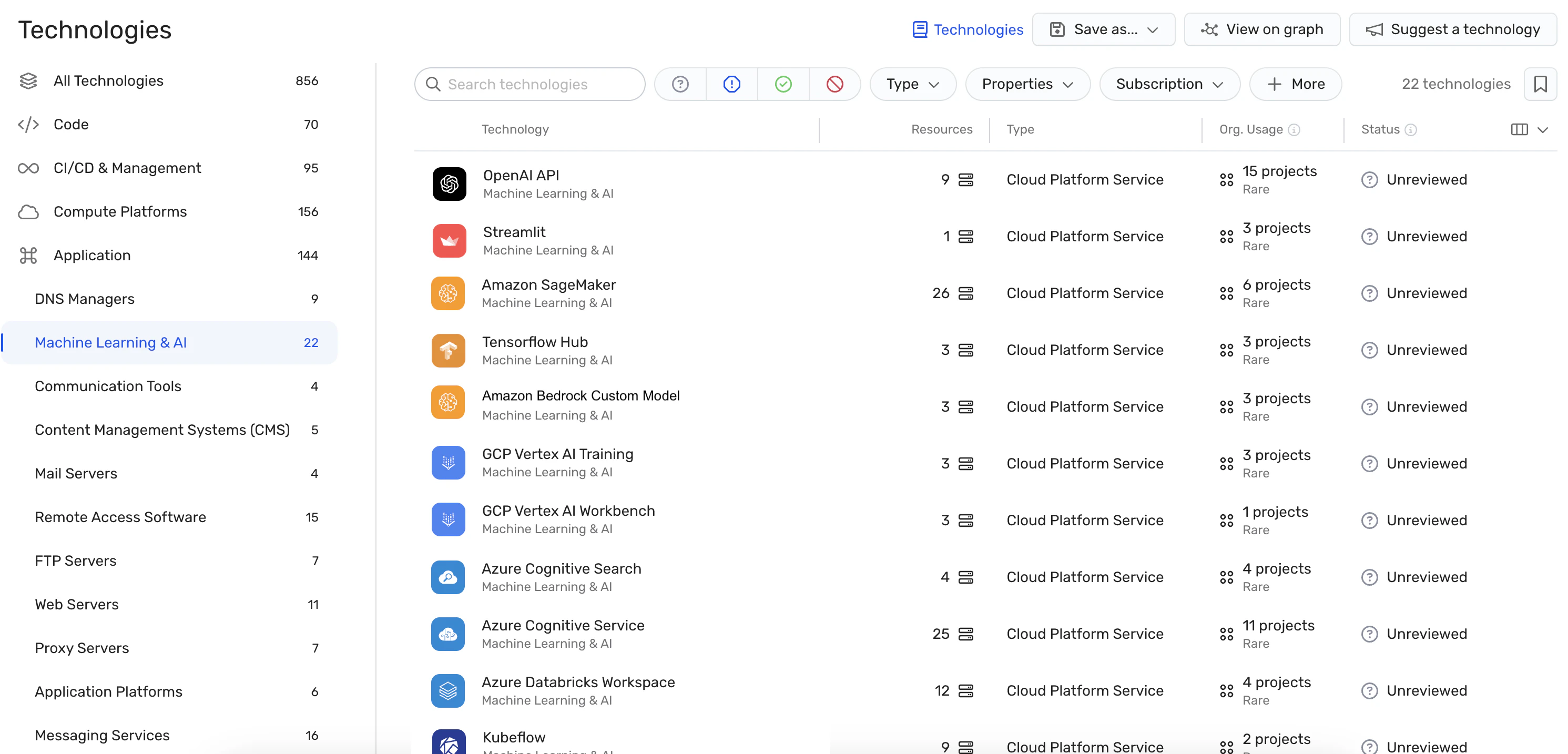
AI-BOMs underpin these security use cases and benefits across the AI lifecycle:
Discovery and inventory: AI-BOMs identify the models, datasets, services, and dependencies running across environments. Surfacing unmanaged or undocumented AI usage as systems evolve lets teams address AI security risks before they escalate.
Traceability and explainability: Organizations understand how teams build models, where they run, and the data and services they rely on. Mapping AI behavior back to underlying components simplifies reviews and incident investigations.
Risk assessment and prioritization: Teams evaluate exposure based on access to sensitive data, permissions, and downstream dependencies. Using an AI-BOM to prioritize issues through real relationships between components replaces treating findings in isolation.
Governance and compliance: AI-BOMs support audits, internal reviews, and regulatory requirements with a structured record of AI components. The record also demonstrates ownership, controls, and change history, helping organizations meet cloud compliance requirements.
Change management and incident response: Before deploying updates, teams assess the impact of model changes, data updates, or dependency upgrades. During incidents, AI-BOMs speed up investigations by identifying affected AI components and their blast radius.
This structured record provides the shared context engineering, security, and governance teams need to move beyond static documentation or tribal knowledge. According to Wiz's AI Security Readiness Report, only 13% of organizations have adopted AI-specific posture management, even though 87% are already running AI services, and 25% admit they don't know what AI services are running in their environment at all. An AI-BOM closes exactly that blind spot. Using an AI-BOM lets organizations reason about AI systems using a consistent, traceable view that evolves alongside production.
How AI-BOMs help with compliance frameworks
AI-BOMs are the technical foundation for meeting emerging AI governance requirements. They interact with standard compliance frameworks in the following ways:
NIST AI Risk Management Framework: NIST’s framework requires transparency, traceability, and continuous monitoring of AI systems. AI-BOMs deliver the structured inventory needed to demonstrate these capabilities during audits. The GOVERN function specifically calls for mechanisms to inventory AI systems.
EU Artificial Intelligence Act: The EU AI Act requires organizations to maintain technical documentation for high-risk AI systems, including details about training data, model architecture, and validation processes. AI-BOMs capture this information in a format that supports regulatory reporting under Article 11 and Annex IV.
Industry-specific regulations: Financial services, healthcare, and other regulated industries are developing AI-specific compliance requirements. A comprehensive AI-BOM positions organizations to adapt quickly as these regulations take effect.
Implementing cloud compliance tools alongside AI-BOMs lets organizations automate much of the necessary evidence collection for AI governance frameworks.
AI-BOM and AI-SPM: how they fit into AI security
An AI-BOM is the foundational inventory layer for AI security. It answers the basic question of what AI components exist, where they run, and how they connect to data, identities, and other systems. Without that shared map, security teams struggle to apply consistent controls, assess real exposure, or respond when something goes wrong.
AI security builds on this inventory. Teams use the AI-BOM to identify shadow AI, map AI supply chain risk, enforce policies across the AI lifecycle, and prioritize issues based on actual relationships rather than isolated findings. AI security posture management is one important capability in this broader picture. It acts on the inventory by continuously checking for misconfigurations, exposed models, risky agent permissions, and insecure connections so teams can close gaps before they become incidents.
In practice, the AI-BOM turns static lists into operational context. Security, development, and governance teams gain a single source of truth they can use for discovery, risk prioritization, policy enforcement, and incident response across the full AI stack. This approach also supports AI supply chain security efforts by making dependencies, provenance, and access paths visible and actionable.
How to build an AI-BOM with Wiz
Developing an AI-BOM is straightforward with Wiz, which automates discovery and continuous monitoring. Our cloud native application protection platform (CNAPP) enables AI-BOMs through these capabilities:
Automated discovery: Wiz automatically discovers AI services, model usage, and supporting infrastructure across cloud environments. This automation eliminates manual cataloging and keeps your AI-BOM current as teams experiment with and deploy new services.
Graph-based visibility: Wiz maps every model, dataset, identity, network path, and cloud resource into the Wiz Security Graph. This mapping allows security teams to see the AI that exists, how it behaves in production, what it can access, and where real risk accumulates.
Policy enforcement: Teams can embed automated checks into pipelines to enforce compliance gates. Policy-as-code rules automatically validate AI components before they reach production.
Drift detection: Wiz tracks component behavior to detect unauthorized changes or configuration drift. This tracking is critical because even minor, unapproved changes to models or dependencies can introduce vulnerabilities or break compliance.
Integration with workflows: Wiz connects with CI/CD pipelines and remediation workflows to make your AI-BOM actionable. When it detects issues, automated workflows trigger remediation or alert the appropriate teams.
Building your AI-BOM on agentless cloud visibility means it continuously updates as teams deploy new services or introduce AI agents and tools. As a result, security teams detect shadow AI early, enforce guardrails consistently, and prioritize AI risk using the same context-driven workflows they already use for cloud security.
Curious what an AI-BOM looks like once Wiz builds it for you? Get a sample AI Security Posture Assessment Report and see the issues it uncovers.
See Wiz in Action
Explore how Wiz connects AI inventory with posture, identity, data, exposure, and runtime context.

FAQs about AI-BOM
Organizations often have practical questions as they move from concept to implementation. Here are answers to the most common ones.