
What are cloud security controls?
Cloud security controls are the specialized policies, operational procedures, and technical mechanisms deployed to safeguard cloud-based applications, datasets, and underlying infrastructure. They span critical disciplines, including cryptographic encryption, identity governance, microsegmentation, and continuous runtime logging to preserve confidentiality, integrity, and availability.
Under the Shared Responsibility Model, your cloud service provider (CSP) guarantees the hardware, virtualization stack, and physical security of the data center. You are entirely responsible for the assets running inside that infrastructure.
Why do cloud security controls matter?
Because the cloud control plane is inherently software-defined, configuration errors or overly permissive access states can instantly expose an enterprise. This operational model means that the vast majority of cloud breaches stem from customer-managed control failures rather than zero-day exploits in the provider's underlying hardware.
Without robust controls, a single minor misconfiguration can scale automatically across an entire environment, turning a minor oversight into an enterprise-wide incident. Implementing structured, automated controls ensures that security parameters scale dynamically alongside your infrastructure.
The Cloud Security Workflow Handbook
Get the 5-step framework for modern cloud security maturity.

Types of cloud security controls
To build an effective defense-in-depth strategy, enterprise security teams must balance four distinct categories of controls:
| Control type | What they do | Examples |
|---|---|---|
| Deterrent controls | Discourage attackers before they act | Security warning banners, compliance certifications displayed to vendors, and visible audit logging that signals monitoring is active |
| Preventive controls | Block threats from succeeding | Encryption at rest and in transit, MFA enforcement, network segmentation, and least-privilege IAM policies |
| Detective controls | Identify threats and anomalies in progress | Cloud-native SIEM, intrusion detection systems, and configuration drift monitoring |
| Corrective controls | Contain damage and restore normal operations | Automated remediation workflows, immutable backups, and incident response runbooks |
What effective cloud security controls require
Cloud security controls break down when teams can’t see what exists, can’t tell what changed, and can’t quickly enforce a fix. According to the Wiz 2026 CISO Security Budget Benchmark, tool sprawl has hit a critical breaking point: 58% of organizations now run more than 25 disconnected security utilities, and half of all CISOs state that this fragmentation actively hinders their cloud safety programs. Before you roll out more controls, make sure these building blocks are consolidated and in place.
Here are the capabilities that make controls work in practice:
Centralized asset inventory: You need a reliable list of accounts, subscriptions, projects, workloads, identities, and data stores, including ephemeral resources, unified across a single control plane.
Native integration with cloud control planes: Controls should map directly to real provider enforcement points—like IAM, organizational policies, security groups, KMS, and workload configurations—rather than operating as detached, top-heavy overlays.
Automation for enforcement and rollback: If you detect a public bucket or an over-privileged role, you need a repeatable, programmatic way to fix it fast and prevent it from reappearing without waiting for human intervention.
Evidence and ownership: A control is only useful if you can instantly prove it is active, see exactly where it is failing, and route the remediation data straight to the specific engineering squad that owns the infrastructure.
If any of these are missing, you will end up with a long list of fragmented findings, severe alert fatigue, and slow remediation cycles.
The top cloud security control frameworks
Frameworks provide the organizational structure for selecting and implementing controls. Rather than treating them as compliance checklists, use them to map your control coverage across the four types discussed above and identify gaps in your security program.
MITRE ATT&CK®
MITRE ATT&CK catalogs adversary tactics and techniques based on real-world observations. For cloud environments, the Cloud Matrix documents how attackers exploit cloud-specific services across platforms—including Office Suites, Identity Providers, SaaS, and IaaS—from initial access through credential theft to data exfiltration.
Implementing defensive controls requires knowing exactly what threat actors do once they break in. According to the Wiz Cloud Threats Retrospective 2026, once an initial foothold is established, high- and critical-severity detections cluster around cloud-native behaviors rather than traditional host-based lateral movement. Threat actors overwhelmingly prioritize identity manipulation, service enumeration, scripting, and resource control to rapidly pivot across the control plane.
Use ATT&CK to map your detective and preventive controls against these behaviors. If your controls don't address common cloud tactics like "Valid Accounts: Cloud Accounts" or "Account Manipulation," you have critical coverage gaps where attackers are most active.
NIST Cybersecurity Framework
The NIST Cybersecurity Framework organizes security activities into five functions: Identify, Protect, Detect, Respond, and Recover. These functions map directly to cloud security control types, with Protect covering preventive controls, Detect covering detective controls, and Respond and Recover covering corrective controls.
NIST CSF is particularly useful for organizations that need to communicate security posture to executive leadership or align with U.S. federal requirements.
Cloud Security Alliance (CSA) Security, Trust, Assurance, and Risk (STAR) program
The CSA's STAR program provides a comprehensive suite of certifications and guidelines for assessing cloud services' security capabilities. This framework emphasizes transparency so you can make informed decisions about cloud service providers based on their security posture.
The program includes several levels, including the following:
Level I (Self-assessment): Communicates that organizations practice foundational security, which the certificate holder proves
Level II (Third-party audit): Centers on an independent assessment that proves expertise and focuses on security protocols and advanced security
Level III (Continuous auditing): Proves the top level of assurance that verifies continuous monitoring and best security practices
ISO/IEC 27017:2015
This international standard extends ISO/IEC 27002 into the cloud and offers specific guidance on cloud service acquisition, delivery, and operations. This ISO/IEC framework also helps you align your cloud security practices with globally recognized standards.
Collectively, these frameworks create a strong foundation for implementing cloud security controls. By adopting them, you can ensure compliance and strengthen your cloud environment against cyber threats.
Deterrent cloud security control best practices
Below are two best practices for deterrent cloud security control:
1. Tailor and implement governance frameworks for cloud environments
Governance frameworks deter violations by making policy enforcement visible and automatic. When teams know that tagging policies, resource quotas, and configuration standards are codified and continuously enforced, they're far less likely to attempt workarounds.
You can implement governance frameworks using infrastructure-as-code tools like Terraform or AWS CloudFormation. The example below enforces a tagging policy that requires a "Project" tag before resources can be created:
{
  "Version": "2012-10-17",
  "Statement": [
    {
      "Effect": "Allow",
      "Action": "s3:*",
      "Resource": "*",
      "Condition": {"StringEquals": {"aws:MultiFactorAuthPresent": "true"}}
    }
  ]
}
Your team can also create modules for each NIST function to enforce policies across your cloud infrastructure. As you implement new processes, set a goal to achieve a certain level of compliance with your chosen framework within six months.
2. Practice security awareness training, phishing simulations, and penetration testing
Security awareness training must extend beyond your security team to include every employee who touches cloud resources. Regular sessions should demonstrate current attack methods and how they evolve.
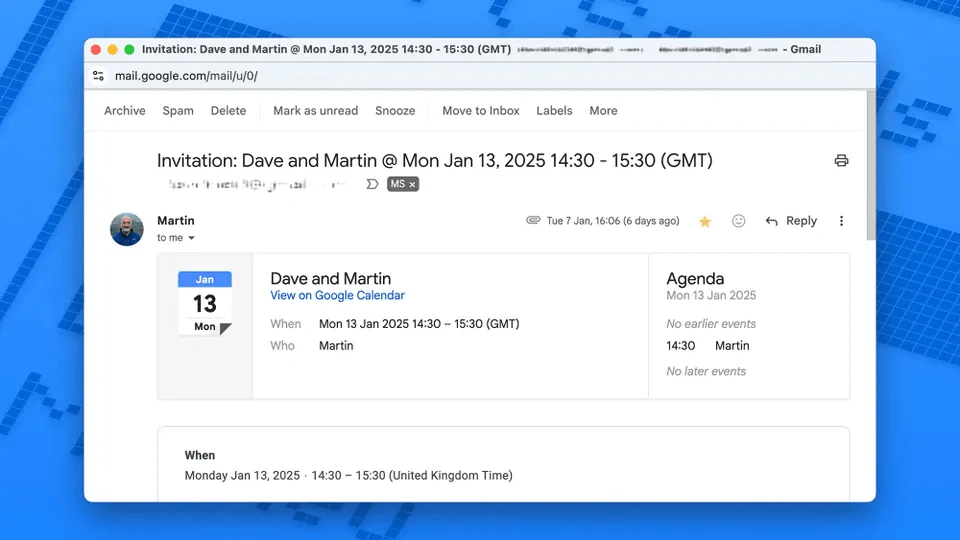
Consider a recent phishing campaign targeting cloud users: attackers send fake interview invitations through Google Calendar, complete with legitimate-looking scheduling links. The victim clicks what appears to be a standard Google Meet invite, but the shortened URL routes credentials to the attacker instead. This scenario illustrates why phishing simulations should mirror real-world tactics, not just generic examples.
To avoid issues like this, conduct regular phishing simulations to assess for human errors like the above Meet invite scenario. These can help you train team members for consciously sophisticated attacks. Additionally, you can conduct penetration tests through simulated cyberattacks to find weaknesses within your cloud security.
Preventative cloud security control best practices
1. Enforce strict permissions
Zero trust assumes that no user, device, or network segment is inherently trustworthy. Every access request must be verified based on identity, device posture, and context before granting the minimum privileges needed.
In modern cloud ecosystems, this principle must aggressively extend to automated, non-human entities. Wiz research indicates that machine-to-machine control planes are expanding rapidly, with 57% of organizations deploying self-hosted AI agents and 80% adopting Model Context Protocol (MCP) servers. These orchestration layers handle highly sensitive data paths; if an AI service account or autonomous agent is left over-privileged, it introduces an aggressive, automated attack path where a compromise allows lateral movement straight into corporate data stores.
In cloud environments, mitigating this requires continuous authentication, microsegmentation between workloads, and just-in-time access grants rather than standing privileges. This model significantly reduces organizations' attack surface by thoroughly vetting each access request.
For example, in AWS, IAM policies allow you to specify permissions and conditions:
resource "aws_resourcegroupstaggingapi_tag_policy" "compliance" {
<POLICY
{
 "Version": "2012-10-17",
 "Statement": [
 {
 "Effect": "Allow",
 "Action": "tagging:TagResources",
 "Resource": "*",
 "Condition": {
 "StringEquals": {
 "aws:RequestTag/Project": "prod"
 }
 }
 }
 ]
}
POLICY
}
You can implement a zero-trust architecture with these key strategies:
Set up guardrails to enforce least-privilege access, which minimizes the blast radius of potential breaches.
Use AWS CloudTrail for continuous auditing. It provides a detailed record of all actions users have taken within your AWS environment.
Aim to reduce your attack surface significantly within the first quarter of implementation.
2. Regularly update and patch systems
Keeping your systems up-to-date is crucial for mitigating vulnerabilities. To do this, apply and manage the latest security patches to protect all your software and systems. This practice prevents attackers from exploiting known vulnerabilities, which are often the most straightforward entry points.
You can automate patch updates in your cloud environment using tools like AWS Systems Manager Patch Manager.
3. Prioritize risk management
Risk assessments help you identify potential vulnerabilities in your cloud infrastructure and allow you to prioritize security efforts based on their severity and the likelihood of risks. To streamline this process, you can use a Python script, such as AWS Inspector, for automated vulnerability scanning in cloud settings:
import boto3

client = boto3.client('inspector')
assessment_targets = client.list_assessment_targets()['assessmentTargetArns']
for target in assessment_targets:
    client.start_assessment_run(assessmentTemplateArn=target)
Prioritizing risks ensures that you allocate resources effectively to address the most critical vulnerabilities first, which strengthens your cloud environment's resilience. You can use a cloud controls matrix in tools like Microsoft Excel or Google Sheets to categorize and prioritize risks based on their impact and likelihood.
Detective cloud security controls best practice
Below are two best practices you can implement today:
1. Leverage AI and machine learning for threat detection and response
Machine learning models can baseline normal behavior and flag deviations that rule-based systems miss. The example below uses an Isolation Forest algorithm to detect anomalous patterns in cloud traffic data:
from sklearn.ensemble import IsolationForest
import pandas as pd

# Load dataset
data = pd.read_csv('cloud_traffic_data.csv')

# Train the model
model = IsolationForest()
model.fit(data)

# Detect anomalies
anomalies = model.predict(data)
You can also adopt a cloud-native platform that implements the latest AI tech for advanced security.
Wiz's Cloud Detection and Response, for example, uses AI to identify and remediate risks by correlating risk factors across cloud environments. Additionally, Wiz uses third-party AI providers, such as Azure OpenAI, to power features like Ask AI, which further supports its security posture management.
The Ultimate Cloud Security Buyer's Guide
Everything you need to know when evaluating cloud security solutions

2. Conduct consistent configuration audits
Practicing audits consistently for your cloud configuration settings will help you identify misconfigurations or unauthorized changes and verify that your security posture meets standards. One way to conduct regular audits and vulnerability scanning is to use automated tools that detect inconsistencies and errors, such as AWS Audit Manager or Azure Security Center.
Additionally, a unified, cloud-native solution like Wiz can find security issues and offer priority-ranked solutions. The platform continuously scans cloud environments across your cloud infrastructure, such as AWS and Azure, without requiring agents and spots misconfigurations, unauthorized changes, and compliance issues in real time. Wiz can also provide prioritized vulnerability assessments, so you know exactly what's at risk and which issues you should tackle first (and how).
Corrective cloud security controls best practices
You can leverage the following two controls for increased cloud security:
1. Build a cloud incident response plan
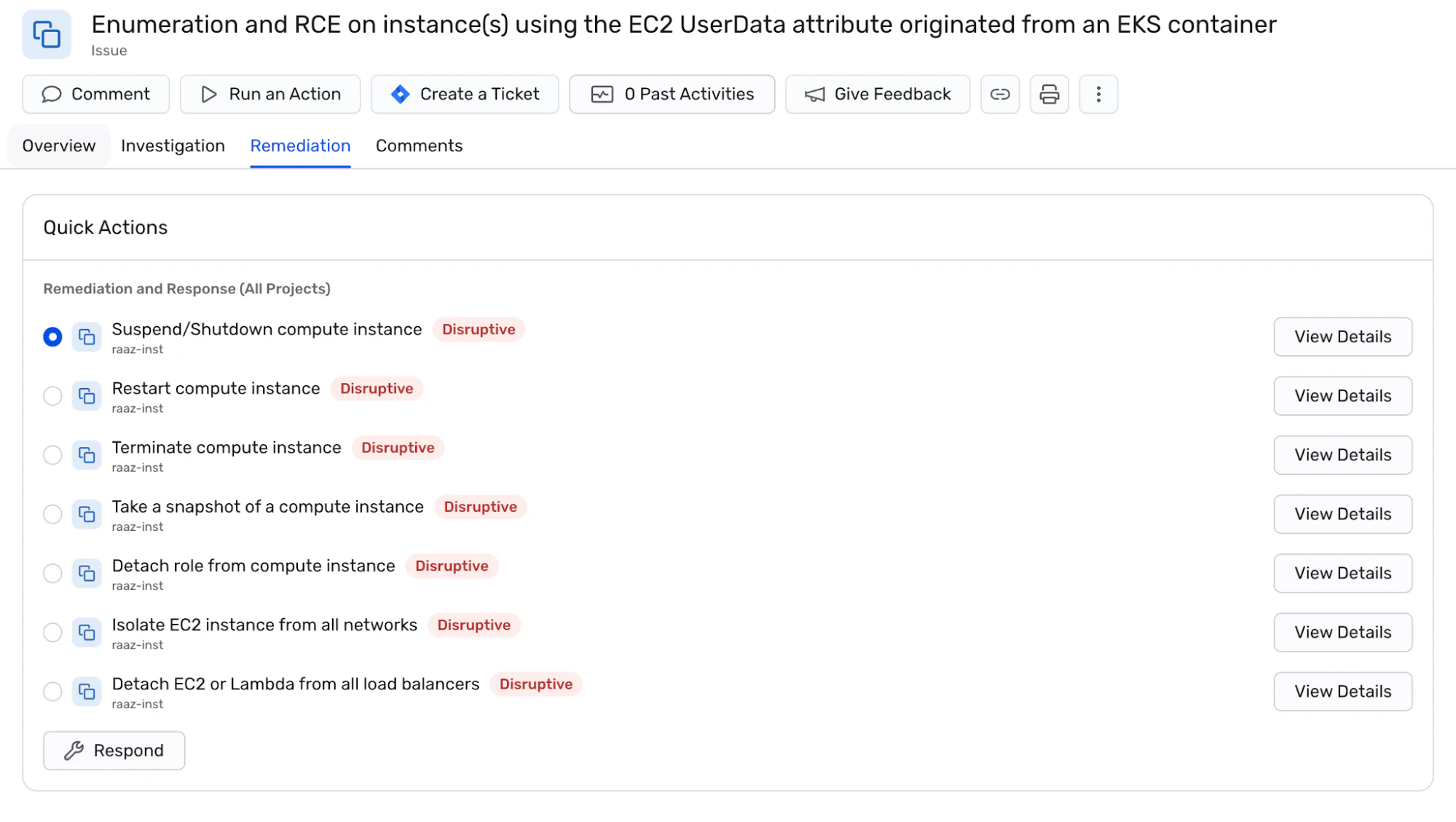
Cloud incident response differs fundamentally from traditional IR because containment happens through APIs, not network cables. When a workload is compromised, you don't physically isolate a machine. Instead, you modify security groups, revoke IAM credentials, or snapshot the instance for forensics, all through the control plane.
Your incident response plan should include cloud-specific playbooks for common scenarios:
Data exfiltration: Automatically isolate affected resources, revoke credentials, and trigger forensic analysis.
Privilege escalation: Disable compromised accounts, alert security teams, and audit recent permission changes.
Misconfigurations: Revert unauthorized changes using IaC state files and prevent recurrence through policy enforcement.
You should also use cloud-native security platforms with automated workflows to streamline containment and remediation. Unified platforms like Wiz can help you contain and resolve these threats within a more complex infrastructure like the cloud.
2. Adopt a cloud-native security platform
A cloud-native application protection platform consolidates posture management, workload protection, and threat detection into a single control plane. Instead of correlating findings across disconnected tools, you get unified visibility and prioritized remediation guidance from one platform.
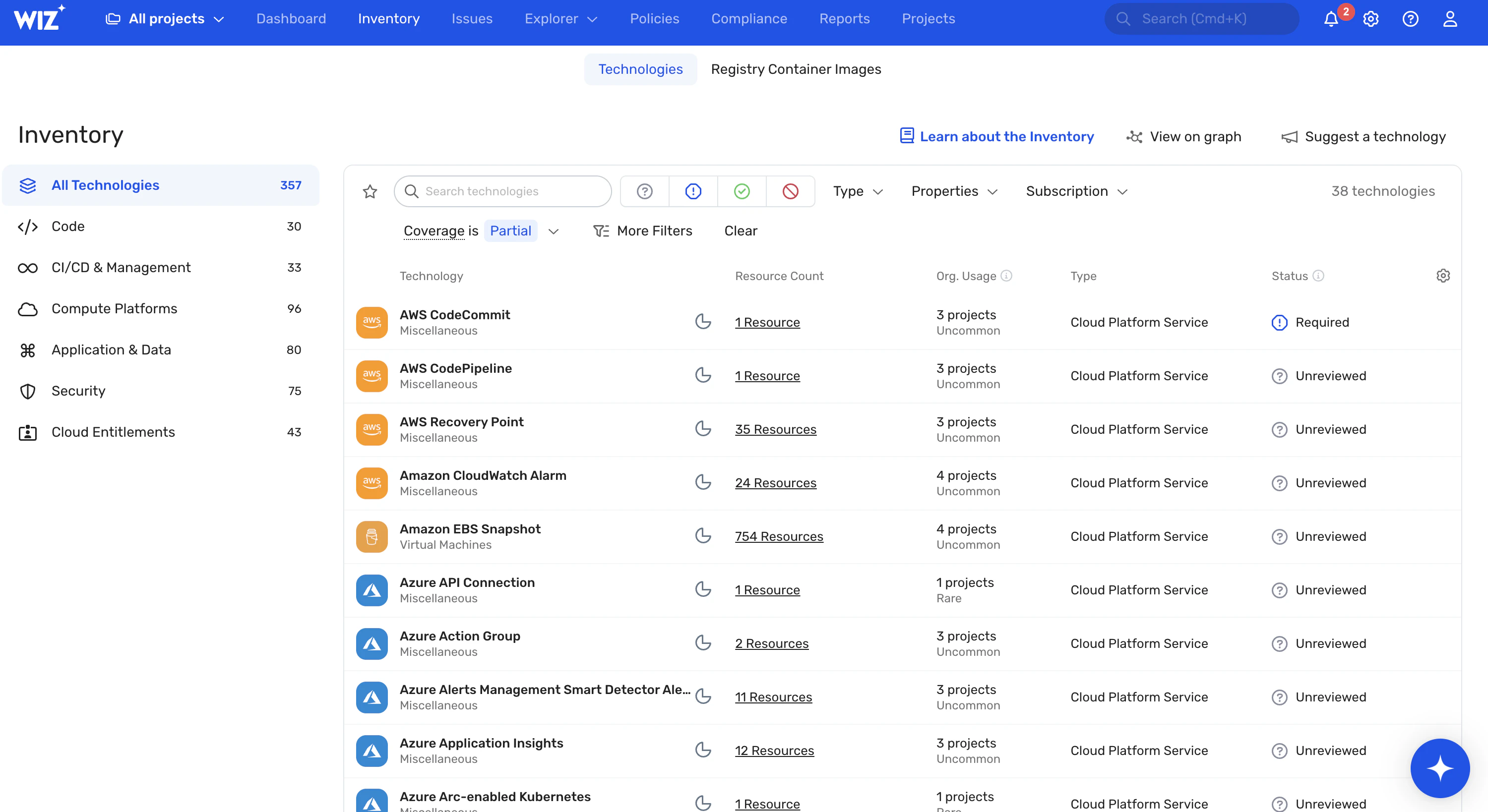
When you use a CNAPP like Wiz, you'll get these immediate advantages to your cloud security:
Visibility across all clouds: Gain a complete view of your cloud environments, including AWS, GCP, Azure, and more.
Awareness across all resources: Maintain visibility into all assets, such as virtual machines, serverless functions, containers, databases, and managed servers.
Catch all risk factors: Identify risks, network exposure, secrets, malware, and sensitive data in real time, from prevention to detection.
Eliminate blind spots: Use agentless visibility to detect security gaps by leveraging cloud service provider APIs, which helps you avoid agent configuration and maintenance.
Cloud security controls checklist
Here’s a quick reference summary you can use to ensure you’ve got the controls you need in place and working effectively:
1. Identity & Access Management (IAM)
✅ Enforce least privilege access (RBAC, ABAC)
✅ Implement MFA for all users, especially privileged accounts
✅ Regularly audit IAM policies and remove unused credentials
2. Data Security
✅ Encrypt data at rest and in transit (TLS 1.2/1.3, AES-256)
✅ Apply data classification and access controls
✅ Enable logging and monitoring for unauthorized access
3. Network Security
✅ Restrict ingress/egress traffic with security groups and firewalls
✅ Implement private networking (VPC, private endpoints)
✅ Use zero-trust principles for internal communication
4. Threat Detection & Response
✅ Enable cloud-native security monitoring (CSPM, CWPP, SIEM)
✅ Automate anomaly detection and incident response
✅ Conduct regular security assessments and penetration tests
5. Application & Workload Security
✅ Scan container images and serverless functions for vulnerabilities
✅ Apply runtime protection (EDR, behavior-based detection)
✅ Secure CI/CD pipelines with automated security checks
6. Compliance & Governance
✅ Continuously monitor for regulatory compliance (SOC 2, ISO 27001, NIST)
✅ Use Infrastructure as Code (IaC) security scanning
✅ Maintain a centralized security policy and enforcement framework
How controls vary by deployment model
Below are key cloud security controls and how they can change, depending on the infrastructure you choose:
| Security control | Public cloud | Private cloud | Hybrid cloud |
|---|---|---|---|
| IAM | Cloud IAM solutions, MFA, the principle of least privilege, and zero trust. | On-premises Active Directory, role-based access control, and LDAP. | Federated IAM across different environments. |
| Threat detection and response | AI-powered security (like Wiz) in combination with internal tools like AWS GuardDuty and Azure Sentinel. | SIEM, IDS/IPS, and manual forensic analysis. | Cross-platform visibility and a unified threat response. |
| Data protection and encryption | Encryption at all stages, key management systems for secure encryption key storage, and data loss prevention to protect sensitive information. | Local encryption and script data governance policies. | Classification for data and enforcement throughout all clouds. |
| Network security | Cloud-native firewalls (like network security groups and security groups) and zero-trust protocols. | Traditional firewalls and micro-segmentation. | VPN and hybrid gateway security. |
| Compliance and governance | Automated compliance frameworks with platforms like Wiz and tools like AWS Audit Manager. | Internal audits and manual compliance tracking. | Federated compliance reporting and hybrid security policies. |
Ultimately, implementation depends on your organization, your cloud infrastructure, and your industry's different needs.
How Wiz strengthens cloud security controls
The shared responsibility model creates visibility gaps when you can't see how misconfigurations, vulnerabilities, and identity risks combine into exploitable attack paths. Wiz addresses this by mapping your entire cloud environment into a unified security graph that correlates risks across all four control types.
Rather than managing separate tools for posture management, vulnerability scanning, and threat detection, Wiz consolidates these capabilities into a single platform. This includes AI-powered threat correlation through Wiz CDR, which detects suspicious activity patterns that rule-based systems miss.
Start with visibility: Connect your cloud environments and build an inventory of workloads, managed services, identities, and data stores.
Map controls to real risk: See how misconfigurations, vulnerabilities, secrets, and permissions combine into high-impact paths, instead of reviewing each finding in isolation.
Drive remediation with proof: Route issues to the right owners with clear evidence and fix guidance, so teams can close the exposure and verify it is gone.
Extend controls to AI workloads: Apply the same control logic to AI services, model pipelines, and the data they can access, so AI risk is managed as part of the broader cloud program.
Book a demo to see how Wiz maps to your framework.
Ensure compliance across your cloud environments
See how Wiz eliminates the manual effort and complexity of achieving compliance in dynamic and multi-cloud environments.
