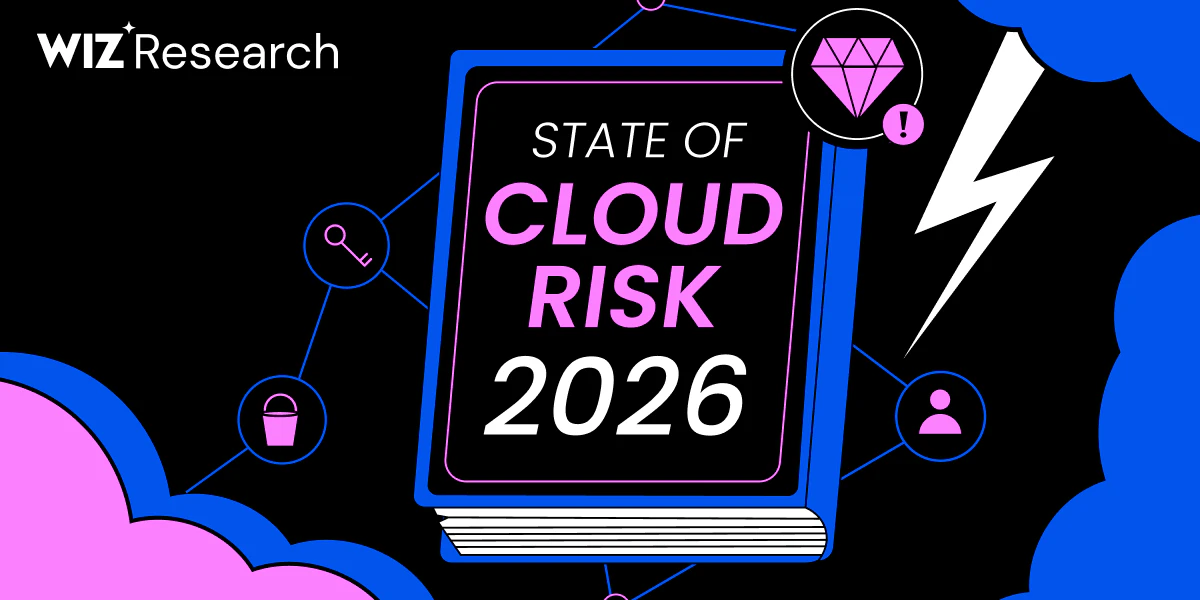
Today, Wiz Research is releasing The State of Cloud Security Risk 2026. In it, we explore how cloud risk is being heavily influenced by two converging trends: expanding attack surfaces and shrinking response windows.
To keep pace, defenders must shift from chasing raw alert volume to prioritizing deep environmental context, unlocking the precise insights needed to eliminate real-world attack paths before adversaries can exploit them.
Shrinking Reaction Windows: The Acceleration of Adversary Weaponization
As organizations scale their cloud footprints, security tools generate an overwhelming volume of alerts across thousands of tracked software products. At the same time, adversary weaponization has accelerated at an unprecedented pace. Over the past several years, data from ZeroDayClock shows that the average window between vulnerability disclosure and active in-the-wild exploitation has plummeted from over two years down to just 21.5 days.

In this compressed threat landscape, speed alone is not enough. Defenders must pinpoint and eliminate true exploitable exposure before weaponization begins.
The Context Filter: Turning Alerts Into Action
Treating every isolated vulnerability or weak credential alert with equal urgency quickly leads to defender fatigue. Without environmental context, security teams spend valuable engineering cycles remediating theoretical risks rather than actionable exposures.
To measure the true impact of contextual prioritization, Wiz Research evaluated high-priority alerts across enterprise environments before and after applying critical risk criteria, including external reachability, toxic permission combinations, and sensitive data access. Across four major risk categories, contextual analysis eliminated more than half of the initial findings:

The Takeaway: Most high-severity alerts exist in isolation. Without downstream conditions like external internet exposure, lateral movement paths, or adjacent high-privilege IAM roles, an isolated flaw rarely provides an adversary with a viable attack path. By filtering for complete, exploitable attack paths rather than standalone severity scores, defenders can immediately cut through the noise and focus remediation on the findings that represent genuine enterprise risk.
Perimeter Access and the Power of Reachability
Security teams historically focus their defenses on entry points, obsessing over how attackers might get in. However, in modern cloud architectures, perimeter defense alone is no longer viable. Today, 30% of observed cloud environments already contain at least one externally exposed machine tied to high-impact lateral movement paths. With adversary weaponization timelines collapsing and reconnaissance largely automated, attempting to seal every single perimeter boundary perfectly is an uphill battle.
The true severity of an intrusion is not defined by the initial foothold, but by privilege and reachability: what an adversary can inherit, access, or pivot to next.

In contrast, software remote code execution made up only 9% of observed findings.
The Takeaway: While vulnerability management programs traditionally prioritize patching software CVEs, real-world exploitability heavily favors exposed access pathways, credentials, and secrets. An exposed asset only becomes a true crisis when combined with downstream reachability and privilege, transforming an otherwise routine flaw into a viable path toward environment compromise.
Prioritize Where Risk Actually Concentrates
The good news for defenders is that you do not have to patch every alert simultaneously. Despite the massive scale and growing footprint of modern cloud environments, exploitable risk is heavily concentrated rather than evenly distributed.
A tiny fraction of technologies accounts for the overwhelming majority of critical, weaponized exploits:

The Takeaway: Exhausting engineering resources on broad, unprioritized patch campaigns yields diminishing security returns. By concentrating remediation efforts on this core cluster of high-impact technologies and weaponized exposures, security teams can eliminate a disproportionate share of enterprise risk with surgical efficiency.
Get the Full 2026 Breakdown
Defenders cannot patch their way out of expanding cloud attack surfaces. To win the race against collapsing exploitation timelines, security programs must prioritize the toxic intersections of access and privilege that grant adversaries real opportunity.
Download The State of Cloud Security Risk 2026 to explore our comprehensive dataset, intrusion benchmarks, and the 13-tier Contextual Risk Prioritization Model built to stop high-impact breach paths before they start.
Get the full report