

What is a data risk assessment?
A data risk assessment is a full evaluation of the risks tied to the data your organization stores, uses, and moves. It identifies, classifies, and ranks the weaknesses around that data, so you can fix the exposures that matter before an attacker finds them.
In the cloud, this includes all data across PaaS and hosted databases, storage buckets, data warehouses, serverless resources, and development environments.
Data Governance & Compliance Guide
Data governance and compliance are central to the DSO mandate.

Why are data risk assessments important?
Sensitive data now spreads across multiple clouds, accounts, and services, which makes it easy to lose track of what is exposed. A data risk assessment shows you exactly where that data sits and which of it is actually at risk.
Unlike general data risk assessments, a cloud data risk assessment pinpoints cloud-native risks and security challenges. As data proliferates and cloud environments get more complex, new data visibility, management, security, and compliance challenges crop up. Data risk assessments boil down these factors into a simple question: “What risks does my data pose?”
Below are some of the most important reasons data risk assessments belong at the top of your security priorities. Each one maps to a real risk cloud teams face today.
Cloud security: Cloud data security assessments help protect enterprise cloud environments, which are susceptible to internal risks like misconfigurations and vulnerabilities and external risks like cyberattacks. According to IBM, the global average cost of a data breach was $4.4 million in 2025. Thorough data security assessments are a core control for preventing data-related incidents and attacks, and they also streamline data management.
Regulatory compliance: Data risk assessments can help you spot regulatory risks in data so that you stay compliant with laws and frameworks like GDPR, HIPAA, PCI DSS, and CCPA. Another benefit? Now that businesses increasingly port and store data in different countries, data risk assessments can also help address data sovereignty and compliance risks.
AI data security: Data risk assessments must also consider AI training data due to the unique security challenges it presents. AI models are only as good as the data they're trained on, and this data can be a significant source of vulnerability.
Cloud detection and response (CDR): The benefits of data risk assessments are wide and varied. For example, data risk assessments can help improve your CDR capabilities. Knowing where crown jewel data lives lets you detect and remediate the most pressing threats first, keeping them from maturing into large-scale incidents.
Cloud service provider (CSP) risk management: Most businesses use cloud services from multiple CSPs with varying security responsibility models. That’s where cross-platform data risk assessments come in. Well-designed risk assessments uncover data risks posed by your third-party CSPs and empower you to address them.
Mergers and acquisitions (M&A): M&A is a powerful driver of growth for many enterprises. But when companies merge or acquire another company, there’s a huge influx of new data. Data risk assessments enable you to analyze and evaluate incoming data. Its benefits don't end there: Assessments also help you create a plan of action to mitigate critical data risks and ensure secure M&A processes.
How does a data risk assessment work?
Here’s a step-by-step breakdown of a typical data risk assessment process:
Discovery: The first step of a data risk assessment involves discovering every single data asset across your cloud platforms (and on-premises environments, if you have any).
Classification: Once you’ve successfully created a data inventory, it’s important to assign classifiers based on business-specific criteria. During this step, you’ll get a clear view of what your most sensitive data is, who can access it, and why.
Risk analysis: This step involves using different risk evaluation methods to analyze the risk that your data assets pose. By considering and correlating various cloud contexts, you’ll uncover data risks such as exposure, misconfigured databases, overprivileged identities, and dangerous attack paths.
Risk reduction plan: Once you’ve completed your risk evaluation to identify data risks, it’s important to prioritize and address them in order of criticality. Creating a queue of critical risks is a good way to start.
Documentation: A data risk assessment isn’t complete without documentation. During this step, put together detailed notes from all the data vulnerability assessments and processes you conducted. This documentation is an important resource for regulatory audits. It can also help you optimize your risk evaluation tools and risk assessment methods for future assessments.
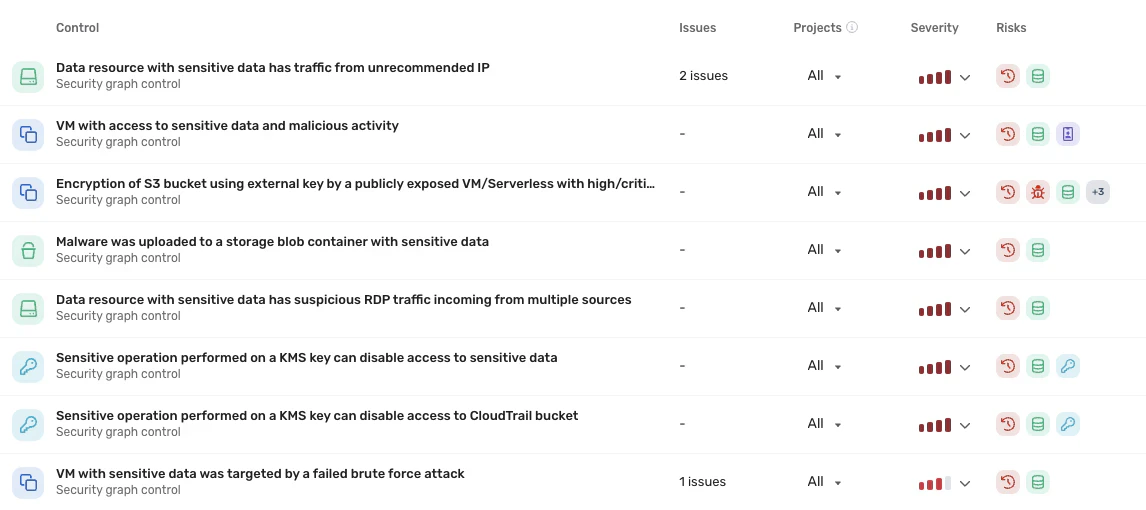
Data risk assessments: common challenges and best practices
Before we explore best practices for data risk assessments, let’s explore some common challenges that you’re likely to face during the data risk assessment process.
Common challenges
Lack of visibility: For businesses with complex multi-cloud environments, it can be difficult to inventory every single data asset. If you have blind spots in your cloud environments, there’s a higher chance of shadow data and hidden risks.
Multi-tenant complexities: Like most businesses, your SaaS and PaaS infrastructure is probably multi-tenant. Multi-tenancy has its benefits but brings a couple of data-related headaches to deal with. Tackling cross-tenant data risks might appear difficult, but don’t worry: It’s nothing that strong tenant isolation frameworks can’t solve.
Compliance hurdles: Because there are so many compliance requirements and frameworks to follow (including GDPR, HIPAA, CCPA, and PCI DSS), it can be difficult to track and evaluate everything during data assessments. This problem gets even more complicated if you conduct data assessments manually or without optimal tools.
Navigating shared responsibility: No two CSPs have the exact same shared responsibility security models. Businesses that store data across different CSP platforms must know the nuances of every CSP’s shared responsibility model for data to conduct effective data risk assessments.
Integration roadblocks: In theory, connecting a security tool to cloud environments is the best way to conduct data risk assessments. Still, certain legacy solutions are integration-averse. It can take a long time to get everything set up, and even after your integrations are in place, they might be inefficient. Similarly, agent-based solutions can impact performance and speed.
Siloed processes: A data risk assessment needs to be a highly strategic and unified effort. If data risk assessment efforts are disjointed or siloed, data risks could mature into serious incidents. Without communication and collaboration between key teams and stakeholders, it’s impossible to conduct a comprehensive or accurate data risk assessment.
Cloud Data Security Snapshot - Current Exposure Trends
Wiz Research analyzed hundreds of thousands of cloud accounts across organizations of all sizes to assess the current state of data security in the cloud.

DSPM's role in data risk assessments
As sensitive data spreads across more environments,Data Security Posture Management (DSPM)has become a practical way to keep assessments current. DSPM continuously shows where sensitive data lives and who can access it, flagging risks like over-permissioning, misconfigurations, and data sprawl.
DSPM tools automatically discover and classify sensitive data across various environments, including cloud services, SaaS platforms, and on-premises systems. This ensures that organizations have a complete view of their data landscape, which is essential for an accurate risk assessment. Wiz's Cloud Data Security Snapshot found that 29% of cloud environments have exposed assets containing personal information.
DSPM also contextualizes risk. It assigns risk scores based on factors such as data sensitivity, exposure level, and regulatory requirements, so teams can focus their resources on the most critical issues first. In essence, DSPM serves as the foundation for modern data risk assessments, offering automated, continuous analysis of an organization's data security posture.
Data risk assessment checklist
Before we sign off, here’s a checklist that you can use when conducting a data risk assessment:
Do we have complete visibility of our cloud environments, especially databases and storage buckets?
Do we have a comprehensive data inventory?
Do we know where our critical data is located?
Do we have a clear understanding of CSP data security shared responsibility models?
Does our data have accurate classifiers?
Do we have a prioritized view of critical data risks?
Is our data compliant with relevant frameworks?
Do we have documentation of data risks and assessment processes?
Do we have metrics and KPIs to evaluate the effectiveness of our data risk assessments?
What can we do to optimize our data risk assessment tools and processes?
Do we have a strong DSPM solution to solve our data risks and needs?
How Wiz can help with data risk assessments
Finding data risks is rarely the hard part; knowing which ones an attacker could actually reach is. Wiz DSPM discovers and classifies sensitive data agentlessly, then maps it against identity and exposure on the Security Graph to show real attack paths. Wiz Defend watches runtime for suspicious access to that data as it happens. The same coverage now reaches AI datasets and models, so the data feeding your pipelines does not quietly become your next exposed asset.
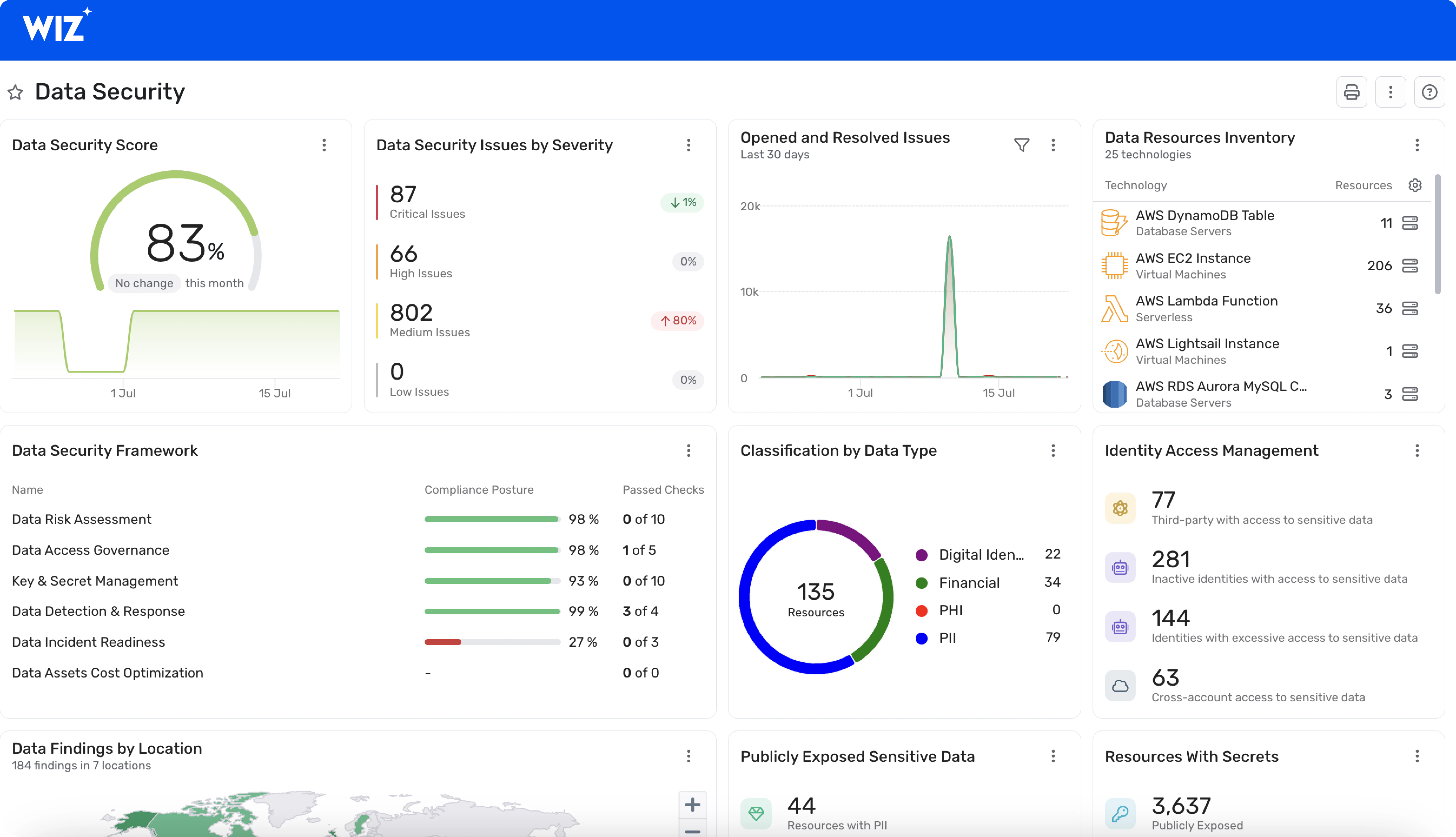
Wiz covers each stage of this process, from agentless discovery to risk correlation on the Security Graph to remediation tracking, without a separate tool for each step. That means the same platform that finds exposed data also shows you which risks to fix first.
Get a demo now to see how Wiz can transform your data security.
Ready to see it on your own cloud environment?
Protect your most critical cloud data
Learn why CISOs at the fastest companies choose Wiz to secure their cloud environments.
