



What is secrets detection?
Secrets detection is the process of identifying and managing sensitive information like API keys, passwords, and tokens within codebases to prevent unauthorized access and data breaches. In practice, that means catching a hard-coded credential before it slips into a repository, a config file, or a cloud environment where someone else can use it, whether it rides along on a routine push to GitHub or GitLab, or sits inside a config file or cloud environment like AWS, Azure, or GCP.
With cloud-native apps running the show, the margin for error has shrunk, and attackers have noticed. Wiz Research found that 21% of cloud intrusions in 2025 began with exposed secrets. Assume secrets will end up in your codebase, and judge your program by how quickly it catches them before someone uses them against you.
Secrets Security Cheat Sheet: From Sprawl to Control
API keys, tokens, and credentials often end up scattered across repos, pipelines, and SaaS tools. This cheat sheet helps you cut through the noise, identify what matters, and build guardrails that prevent future leaks.

Secret types and associated risks
We often deal with a variety of secrets in our day-to-day development work. Here's a breakdown of the most common types, which can be used as a checklist for scanning:
API keys: To access third-party services, you need API keys. If exposed, they could allow unauthorized users to interact with external services, potentially leading to privilege escalation or data loss.
Database credentials: The backbone of any secure system, database credentials can lead to data theft or even system-wide breaches if compromised.
Encryption keys: If encryption keys are exposed, the privacy and integrity of encrypted data could be compromised, allowing attackers to decrypt and steal data.
Access tokens: Because these are used to authenticate users and services, exposed tokens may enable attackers to pose as valid users, granting them unauthorized access.
Passwords: Hard-coded passwords in code or config files are common but disastrous, exposing entire systems to external threats. Remember: Even automated system passwords must be secured.
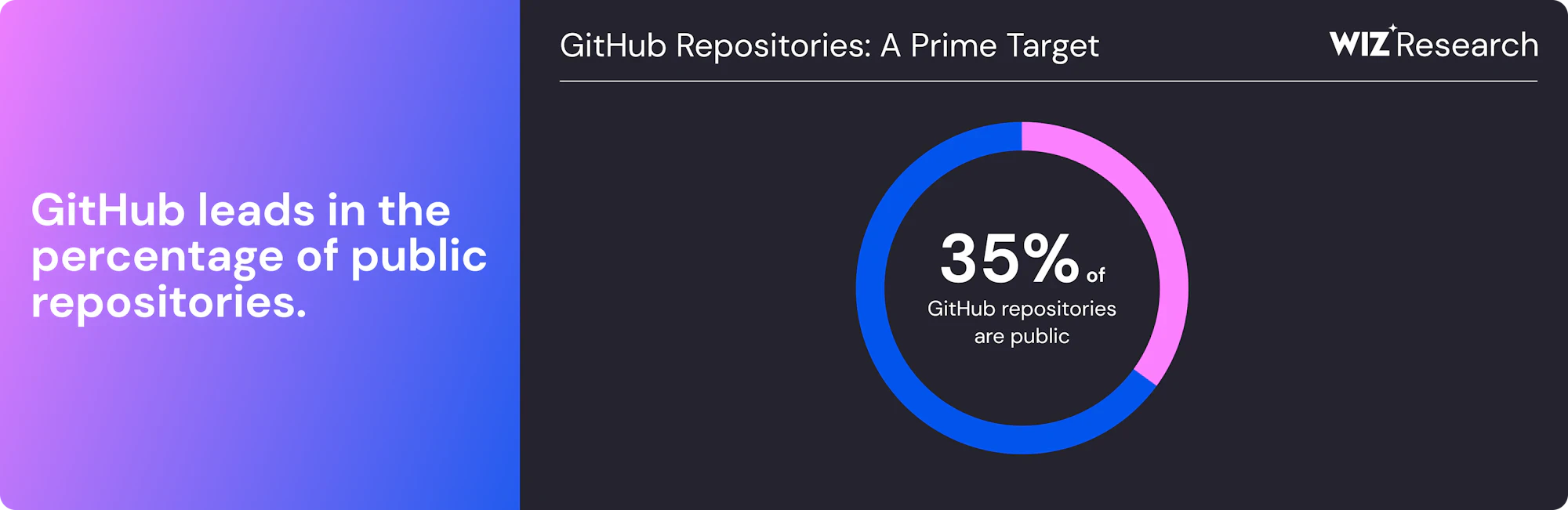
Exposing secrets in our codebases can lead to severe repercussions, ranging from data breaches to financial losses and reputational damage. The cost of incident response, combined with potential legal penalties, can devastate an organization. In addition to the direct financial consequences, leaked credentials can undermine customer trust and damage long-term brand loyalty. Exposure is also common: Wiz Research found that 61% of organizations have secrets sitting in public repositories.
Recent Wiz Research findings show how often secrets end up in the open:
Forbes AI 50 leaks (2025): Wiz Research found verified secret leaks at 65% of Forbes AI 50 companies with a GitHub presence, many buried in deleted forks, gists, and developers’ personal repositories that standard scans miss. One leaked Hugging Face token could have exposed roughly 1,000 private models.
VS Code extension marketplaces (2025): Wiz Research uncovered more than 550 secrets embedded in published extensions on the VS Code Marketplace and Open VSX, available to anyone who downloaded the package. Some were still valid, and Wiz worked with Microsoft to close the gap.
How secrets detection tools work
Secrets detection works by scanning code and related artifacts, then flagging strings that look like credentials. It usually starts with a full scan of existing codebases to surface hard-coded secrets, followed by continuous scanning in CI/CD pipelines that catches new secrets before they reach production.
Watch 5-minute demo
Watch how Wiz Code scans commits pre-merge, checks whether exposed keys are active in your cloud, and provides developers with instant remediation guidance.
Watch now
Under the hood, detection tools combine several techniques to find secrets that follow a known pattern and those that do not:
Pattern matching and regex: Flags strings that match known formats, like AWS keys or access tokens.
Entropy analysis: Spots high-randomness strings that look like keys even when they match no known pattern.
Contextual analysis: Reads surrounding variable names, comments, and file paths to tell a real secret from a placeholder.
AI and machine learning: Learns from context to catch novel secrets and cut the false positives that flood rule-only scanners.
Active secret validation: Makes a lightweight, read-only API call to the issuing service to confirm whether a credential still works or has already been revoked or expired, which removes dead keys from the queue.
Git history scanning: Scans the full commit history in addition to the current HEAD. Developers often delete a secret in a follow-up commit and assume it’s gone, but it stays in the .git history for anyone who clones the repo.
Each technique covers a blind spot the others miss. Pattern matching is fast but rigid, entropy analysis catches the odd strings, contextual and machine learning approaches judge whether a match is worth your attention, and validation confirms whether it still works.
Alerting and reporting turn detection into action. Real-time alerts tell developers exactly which secret leaked and where, so teams can rotate or revoke it fast. Without that, detection is just more noise.
Common challenges in secrets detection
Most secrets detection programs struggle with triage: separating the secrets that matter from the flood of everything else. False positives bury real leaks under placeholder strings and test fixtures, while false negatives let novel or obfuscated credentials slip past rule-only scanners. Both erode trust in the tool.
That noise feeds alert fatigue. When a scanner reports thousands of findings with no sense of which are reachable, teams stop reading the alerts, and the dangerous secret gets the same attention as a dummy value in a unit test. That signal problem is measurable: Wiz Research found that about 40% of public-repo secrets can impact a company, so the work is finding those few among the noise. The variety of secret formats makes this worse, since every cloud provider, framework, and internal service mints credentials in its own shape.
Secrets also sprawl. They spread across fast-changing codebases, config files, container images, and cloud services, and the map shifts with every commit and deploy. The fix is context and prioritization: connect each finding to whether the workload is running, exposed, and holding real access, so you can chase the few secrets that create a genuine path in.
Integrating secrets detection into your security workflow
Secrets detection works best when it runs at every stage rather than as a single gate, so your code, configurations, and cloud services stay covered from the first commit through production. The goal is simple: catch a secret as early as possible, then keep watching in case one slips through.
Development phase: Source code repositories
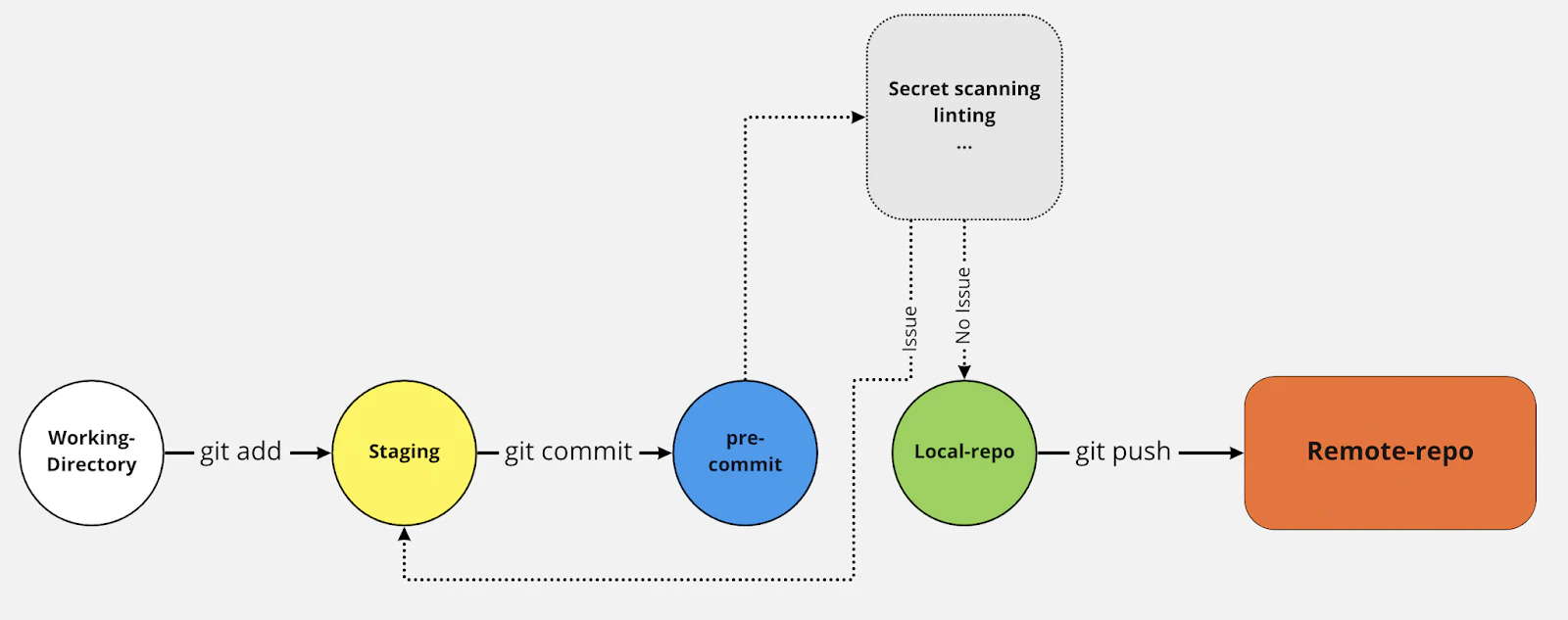
During development, secrets are often hardcoded into the project’s Git repository. Tools like pre-commit hooks can scan repositories like GitHub or GitLab, identifying secrets in code before they make it into version control. By integrating scanning at this stage, you can prevent both public and private repositories from becoming a source of vulnerabilities.
Deployment phase
In the deployment phase, leaving sensitive information in configuration files is a common threat vector. Configure secrets detection tools to scan both files and environment variables to ensure no secrets are exposed during this stage.
CI/CD pipelines are another critical area where secrets frequently leak. Best practices like using secrets management tools and securely handling environment variables can prevent leaks during automated builds and deployments.

Post-deployment: Cloud environments
After deployment, exposed secrets move from a code problem to a cloud problem. Scanning tools should continuously watch cloud infrastructure across AWS, Azure, and GCP for leaked credentials and weak access controls. Wiz connects secrets found in the cloud back to the code and identities that touch them, so teams can see which exposed secrets are actually reachable.
How secrets detection fits your broader security posture
Secrets detection is one piece of a larger picture. When you pair it with cloud security posture management (CSPM) and cloud infrastructure entitlement management (CIEM), a leaked credential stops being an isolated finding and becomes one node in a mapped attack path, which is what limits lateral movement if a secret is ever used.
Top secrets detection tools
In this section, we'll explore the top tools available for secrets detection, highlighting their key features and how they fit into different development workflows so you can choose the best solution for your project's security needs.
Wiz
Wiz protects secrets alongside misconfigurations and vulnerabilities across cloud environments.
Wiz’s secrets detection capabilities span the entire software development lifecycle, ensuring that sensitive information, like API keys, passwords, and tokens, is not exposed at any stage. That coverage runs from the initial code commit all the way to the cloud deployment.
Wiz Code and Wiz Cloud work together to protect secrets across your entire environment. It offers deep integration across cloud infrastructures, making it ideal for enterprises looking for an end-to-end security solution.
Key features
Code Scanning: Wiz Code scans source code repositories and CI/CD pipelines to detect hardcoded secrets, such as API keys, passwords, and access tokens, before they reach production environments.
Cloud Environment Scanning: The platform also scans cloud resources, including virtual machines, containers, and serverless functions, to identify secrets that may have been inadvertently deployed.
Data Storage Scanning: Wiz extends its secret detection capabilities to various data storage locations, including cloud storage buckets and databases.
Security Graph Integration: Wiz incorporates detected secrets into its Security Graph, enabling context-aware risk assessment and attack path analysis.
Code-to-Cloud Mapping: Wiz correlates secrets found in code with those detected in cloud environments, providing a complete picture of secret exposure throughout the development lifecycle.
GitGuardian
GitGuardian specializes in detecting secrets within code repositories, both public and private. Its core focus is helping developers and enterprises prevent secrets from leaking into places like GitHub, where they could be exploited by attackers.
Key features
Automatic scanning of public and private repositories
Detailed reporting and alerting mechanisms
Integrates with CI/CD pipelines and developer tools
Enterprise-grade management dashboards for team-based collaboration
Spectral
Spectral is an AI-powered secret scanning tool that integrates directly into DevOps pipelines. Its primary focus is developer-first security, ensuring that secrets are caught before they are committed to the codebase.
Key features
AI-powered detection for improved pattern recognition
Integrates directly with CI/CD pipelines
Fast scans with low overhead, designed for developer productivity
Comprehensive support for multiple programming languages and environments
Gitleaks
Gitleaks is an open-source tool designed to scan Git repositories for hard-coded secrets. It's lightweight, simple to use, and ideal for smaller teams or individual developers looking for a basic but effective detection solution.
Key features
Scans local and remote Git repositories for secrets
Configurable with custom rules for detecting custom secrets
Easy setup and minimal system requirements
Support for scanning private repositories
How Wiz approaches secrets detection
Most secret scanners share the same weakness: they hand you a long list of findings with no sense of which ones an attacker could actually use. A key in an archived test branch and a live database credential on an internet-facing workload look identical in that list. Wiz starts from the opposite end, treating a secret as risky only when something running can reach it.
Wiz Code handles the detection side across the places secrets hide, including:
Source repositories
CI/CD pipelines
IaC templates
Container images
It flags hardcoded API keys, passwords, and tokens early, while a developer can still fix them in the same pull request instead of after they ship.
Wiz Cloud then covers the exposure side, finding secrets that made it into:
Virtual machines
Storage buckets
Managed services
The Security Graph ties the two together, so a credential found in code is connected to the identities, permissions, and network paths it touches once deployed. That connection is what turns a wall of alerts into a short list of secrets that are genuinely reachable.
The same approach carries into AI systems. As teams wire models, agents, and managed AI services into production, those pipelines accumulate their own keys and access tokens.
Wiz Research, for example, uncovered an exposed DeepSeek database that leaked API keys and plaintext chat logs, which is why Wiz secures secrets across that AI footprint using the same code-to-cloud context rather than treating it as a separate problem. That gives security and development teams one view of where credentials live, which are exposed, and which actually matter.
Request a demo to explore how Wiz can secure your cloud environment.
Stop Fixing in Production
Walk through how Wiz finds issues in code, blocks them in CI, enforces policy at deploy, and traces runtime risks back to the source
