



What Are ITDR Tools?
ITDR tools are security platforms that detect, investigate, and respond to active threats targeting your identity infrastructure (like Active Directory, Okta, or Entra ID). While traditional Identity and Access Management (IAM) focuses on granting access, ITDR tools actively monitor for credential theft, privilege escalation, and lateral movement by attackers who have bypassed your perimeter.
Incident Response Plan Template
Structure the response half of your TDR program with a ready-to-use cloud IR playbook.

Core evaluation criteria for identity threat detection and response tools
Identity threat detection and response tools vary widely in how they collect signals and how they act on them. Before comparing vendors, it helps to agree on the technical requirements that separate a capable platform from a log-forwarding dashboard. The criteria below map to the telemetry, detection logic, and response controls an enterprise program depends on.
Telemetry ingestion and multi-layer identity coverage
Coverage starts with the data an ITDR tool can see. A strong platform ingests on-premises directory activity (Active Directory event logs and Kerberos ticket requests), cloud identity provider telemetry (Microsoft Entra ID sign-in and audit logs, the Okta System Log, Google Workspace audit events), and cloud provider management planes (AWS CloudTrail, Azure Activity logs, and Google Cloud audit logs).
A trickier requirement is coverage for non-human identities. Service accounts, API keys, CI/CD machine users, serverless execution roles, and service principals now make up a large share of identities in most cloud environments, and they rarely have an interactive multi-factor prompt protecting them. A tool that only watches employee sign-ins misses the accounts attackers most want to abuse.
Real-time detection mechanisms and behavioral profiling
Detection logic should combine signature-style rules with behavioral baselining. Rules catch known-bad patterns such as impossible travel, brute-force bursts, and sign-ins from flagged IP addresses. Baselines catch the subtler cases, like a service account that suddenly reads a sensitive storage bucket at 3 a.m. or an admin role making API calls it has never made before.
Ask which specific techniques a tool flags. Strong platforms detect:
Directory attacks: Pass-the-Hash, Golden Ticket, and Kerberoasting against Active Directory.
Session and token abuse: token theft and session hijacking through adversary-in-the-middle phishing.
Cloud identity abuse: illicit OAuth app consent grants and chained IAM role assumption across accounts.
Detection also has to work where workloads are ephemeral. When tokens live for minutes and container identities come and go, static IP or host correlation breaks down, so the tool needs to reason about the identity itself rather than the machine it ran on.
Production-safe automated response and containment
Response capabilities sit on a spectrum from passive alerting, to analyst-run playbooks, to autonomous remediation. What matters most is granularity. Revoking refresh tokens, forcing a step-up authentication challenge, triggering a password reset, quarantining a compromised cloud role, or tightening a temporary session policy all contain a threat without taking the business offline.
The anti-pattern to avoid is blunt account suspension. Disabling a shared service account can cascade into downtime across dependent microservices and integrations, which is exactly why many teams quietly switch automated response off. A tool that offers reversible, scoped actions keeps the response automated and safe. These controls are the backbone of a modern threat detection and response program.
Top ITDR tools and solutions comparison matrix
Solutions are listed in no particular order, with Wiz shown first as our lead recommendation for cloud-first environments. The table compares each platform on the architectural dimensions that drive day-to-day outcomes rather than on marketing scorecards.
Architecture and capability comparison table
| Tool | Primary architecture | Core identity domains | Detection telemetry | Response model | Deployment fit |
|---|---|---|---|---|---|
| Wiz (Wiz Defend) | Agentless API + graph, optional eBPF runtime sensor | Multi-cloud IAM, cloud IdP, SaaS, containers | Cloud audit logs, IdP events, runtime, graph context | Guided + automated workflows, control-plane containment, session/role actions | Cloud-first and multi-cloud enterprises |
| SentinelOne Singularity Identity | Endpoint agent + deception | On-prem AD, cloud IdP | DC telemetry, decoys/lures, endpoint signals | Deception-driven detection, endpoint response | SentinelOne customers wanting active defense |
| Microsoft Entra ID Protection | Native cloud identity engine | Entra ID, Microsoft 365 | Global sign-in signal, user risk scoring | Conditional access, self-remediation (MFA, reset) | Microsoft 365 / E5 standardized orgs |
| Silverfort Identity Protection | Agentless identity broker | AD, Entra ID, Okta, legacy protocols | Kerberos, NTLM, LDAP, RADIUS auth traffic | Inline MFA enforcement, access blocking | Hybrid orgs with heavy legacy/AD estates |
| Huntress Managed ITDR | Cloud API integration + 24/7 SOC | Microsoft 365, Google Workspace | SaaS identity events, triaged by analysts | Human-led triage, account isolation | Lean teams and MSPs without an in-house SOC |
| CyberArk Identity Security Platform | PAM-centered identity suite | Privileged accounts, workforce, machine | Session activity, privilege use, threat analytics | Vaulting, just-in-time access, session control | Regulated orgs prioritizing privileged access |
| CrowdStrike Falcon Identity Protection | Domain controller sensor + endpoint agent | On-prem AD, Entra ID | Directory traffic, Kerberos/NTLM, endpoint telemetry | Real-time blocking, risk-based conditional access | Endpoint-first orgs on Falcon |
Key architectural differentiators across tooling paradigms
The market clusters into four deployment paradigms, and knowing which one a tool belongs to tells you where it will be strong and where it will leave gaps.
Cloud-native security and graph platforms: tools like Wiz unify multi-cloud control-plane telemetry, entitlement graphing, and runtime detection across AWS, Azure, GCP, and identity providers without agents.
Directory and endpoint extensions: solutions such as CrowdStrike and SentinelOne build on EDR agents or domain controller sensors, focusing on credential protection at the operating system and Kerberos/LDAP layers.
Identity infrastructure and brokering platforms: tools like Microsoft Entra ID Protection, Silverfort, and CyberArk operate inline or alongside identity providers to enforce continuous conditional access and multi-factor controls across legacy and cloud apps.
Managed detection and response services: turnkey offerings such as Huntress deliver outsourced SOC triage and fast containment for teams without the headcount to run detection themselves.
Leading identity threat detection and response tools
The profiles below describe how each platform is built and where it fits best. Each is strong in its intended environment, so the goal is to match architecture to your estate rather than crown a single winner.
Wiz Cloud Detection and Response
Wiz takes an agentless approach, integrating directly with multi-cloud management planes (AWS CloudTrail, Azure Activity logs, Google Cloud audit logs) and identity providers (Microsoft Entra ID, Okta, Google Workspace), with an optional eBPF runtime sensor for workload-level execution signals. It correlates cloud identities, effective permissions, network routes, and vulnerabilities onto the Wiz Security Graph. That is also what powers its cloud detection and response coverage.
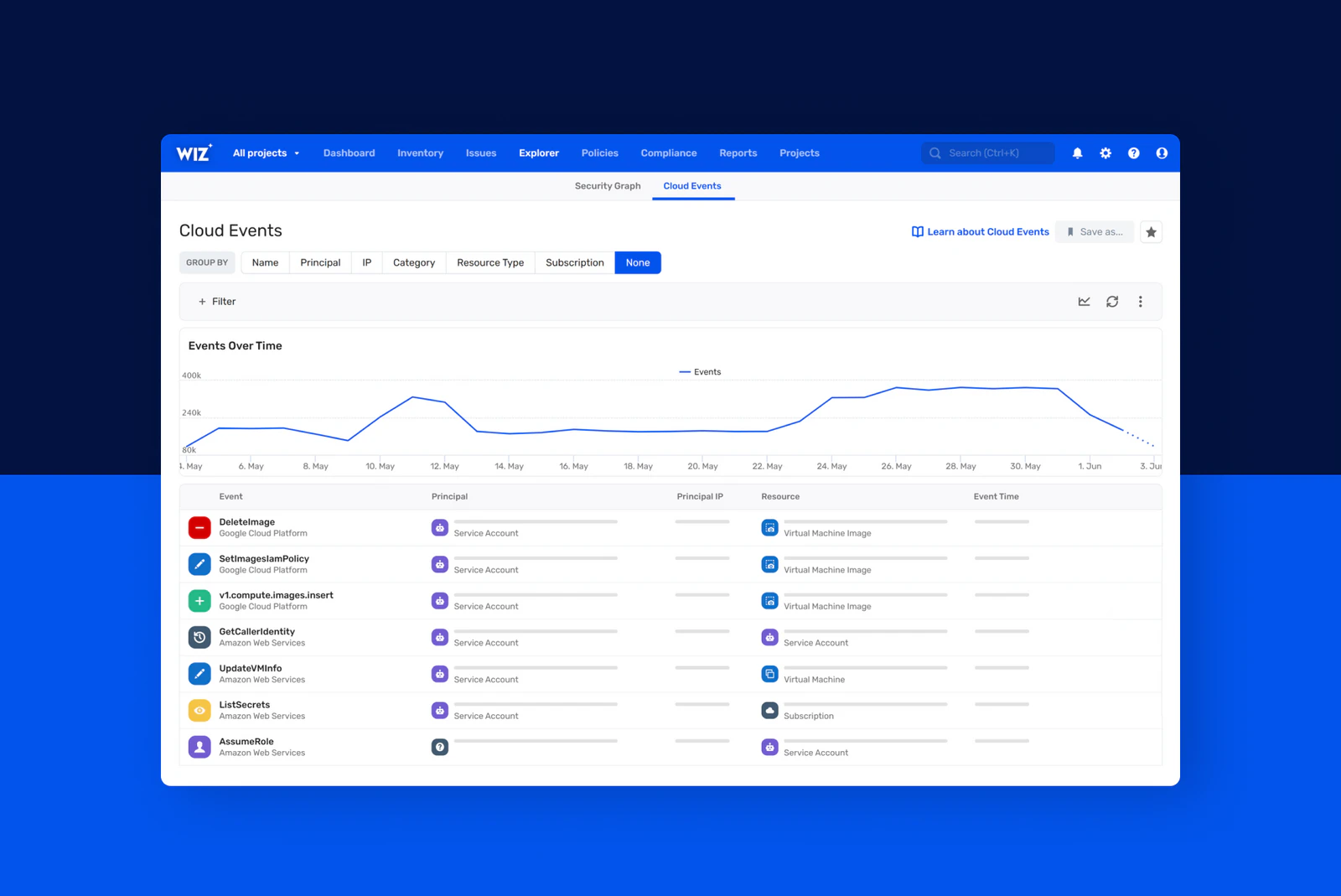
Unified posture and detection: pairs proactive entitlement visibility with real-time detection in Wiz Defend, so over-privileged identities are found before compromise and abused ones are caught during an attack.
Context-rich investigation: the Blue Agent automatically correlates a login with the identity's permission scope, recent API activity, and resource access to produce a transparent verdict.
Reversible, automated response: agentic workflows can validate a suspicious login with the user in Slack and escalate to SecOps with full context, keeping containment scoped.
Best for cloud-first, multi-cloud, and modern enterprise environments that want identity threat detection and response across AWS, Azure, GCP, containers, and cloud identity providers without agent overhead or blind spots across non-human identities.
Watch 5-min demo
See how Wiz Defend unifies detection across identity, cloud, and runtime layers to eliminate the blind spots described above.

CrowdStrike Falcon Identity Protection
CrowdStrike deploys a sensor directly to domain controllers, paired with endpoint Falcon agents, to analyze live directory traffic, Kerberos requests, and NTLM authentications without modifying directory objects.
Deep directory visibility: real-time blocking of unauthorized protocol requests such as DCSync and Kerberoasting.
Endpoint correlation: identity signals tie directly to endpoint telemetry for full attack-chain context.
Risk-based access: dynamic conditional access adjusts to identity risk in real time.
Best for large enterprises with an established Falcon endpoint footprint that need low-latency protection for hybrid Active Directory and on-premises domain hierarchies.
SentinelOne Singularity Identity
SentinelOne combines agent-based identity security with deception, using decoys and lures alongside domain controller telemetry to catch directory harvesting and credential theft.
Attack path mapping: Ranger AD surfaces exploitable Active Directory paths before attackers walk them.
Native deception: fake credentials mislead attackers and trigger high-confidence alerts.
Endpoint-level escalation detection: flags privilege escalation attempts where they execute.
Best for organizations that want active defense and deception-driven threat hunting to catch adversaries probing internal Active Directory structures before lateral movement begins.
Microsoft Entra ID Protection
Microsoft Entra ID Protection is a native cloud identity engine built into Microsoft 365 and Entra ID, drawing on global signal intelligence and user risk scoring.
Policy-driven enforcement: conditional access ties risk directly to sign-in decisions.
Automated self-remediation: self-service password reset and MFA step-up resolve many risk events without an analyst.
Native integration: leaked-credential detection and signals flow across the Microsoft security stack.
Best for enterprises standardized on Microsoft 365 and Azure with E5 licensing that want native, policy-driven sign-in and user risk mitigation without deploying third-party directory sensors.
Silverfort Identity Protection
Silverfort uses an agentless identity broker that integrates with Active Directory, Entra ID, Okta, and legacy systems through native authentication protocols like Kerberos, NTLM, LDAP, and RADIUS.
Legacy MFA coverage: enforces MFA and conditional access on command-line tools, PowerShell, RDP, and legacy software that cannot natively support modern authentication.
Service account protection: brings visibility and controls to accounts that agents cannot reach.
Broad reach without agents: extends protection across systems where per-server deployment is impractical.
Best for complex hybrid organizations with substantial legacy infrastructure, on-premises dependencies, and unmanaged service accounts.
Huntress Managed ITDR
Huntress pairs cloud API integration with Microsoft 365 and Google Workspace with a 24/7 human-led security operations center.
Fast onboarding: API-based setup with pre-tuned rules that filter out routine SaaS login noise.
Human triage: analysts investigate suspicious inbox rules, session anomalies, and malicious OAuth grants.
Immediate containment: compromised accounts can be isolated before an internal team steps in.
Best for mid-market organizations, lean security teams, and managed service providers that need expert-led monitoring of cloud workforce identities without building an internal SOC.
CyberArk Identity Security Platform
CyberArk combines privileged access management with identity security, uniting session monitoring, privilege elevation, and endpoint privilege control with threat analytics.
Privileged account depth: strong governance and behavioral detection around admin and root accounts.
Credential protection: vaulting and just-in-time access shrink standing privilege.
Abuse detection: flags credential dumping and privileged session misuse.
Best for regulated enterprises where safeguarding privileged administrator credentials and critical infrastructure access is the top mandate.
How to select an ITDR platform for hybrid and multi-cloud infrastructure
The right choice depends less on feature counts and more on how a tool fits your identity environment and your team. Use the two lenses below to turn a shortlist into a decision.
Evaluating directory support and identity environment compatibility
Start with infrastructure fit. Does the tool require software agents on domain controllers, and does it need domain admin credentials or schema changes to deploy? Then check how it interfaces with your cloud identity providers (Okta, Entra ID, Ping) and multi-cloud IAM models (AWS IAM, Google Cloud IAM).
Architecture shapes risk. Inline brokers enable real-time challenge and response but introduce latency and an availability dependency, while out-of-band API collection removes operational disruption at the cost of careful API rate-limit management. Neither is automatically better, so match the model to your tolerance for latency versus deployment friction.
Signal fidelity and integration with the SecOps ecosystem
Test detection fidelity directly. Can the platform tell legitimate administrative scripting apart from lateral movement, and can it suppress false positives from normal developer workflows? Then evaluate two-way integration with your SIEM (Splunk, Microsoft Sentinel), SOAR (Cortex XSOAR, Tines), and cloud detection and response tooling.
Finally, judge the alerts themselves. Useful alerts carry a forensic timeline, associated IP reputation, the compromised session, and the impacted cloud resources, not a raw log dump an analyst has to decode. The more context an alert carries, the less a tuned CIEM and posture baseline has to be reconstructed by hand during an incident.
Common operational pitfalls in enterprise identity threat detection
Even capable tools fail when the program around them repeats a few predictable mistakes. Two account for most of the lost value.
The blind spot of non-human and machine identities
The most common anti-pattern is watching employee accounts while ignoring machine identities. Attackers know this. They abuse long-lived service account tokens, hardcoded API keys left in application repositories, and over-privileged CI/CD runners to move across cloud environments without ever triggering an MFA prompt or a user sign-in alert.
Machine identity threats need their own detection logic. Monitoring API invocation frequency, unusual parameter changes, and unexpected originating endpoints is how you catch a token being used by someone other than the workload it belongs to.
Disconnected posture analysis and false-positive paralysis
The second pitfall is deploying detection without baseline entitlement and posture visibility. Without knowing an identity's effective access and reachable resources, analysts burn hours triaging alerts on accounts that have no real privileges. That is how alert fatigue sets in, and it is why teams eventually disable automated response, quietly removing the "R" from ITDR. Grounding detection in posture is what keeps response trustworthy enough to leave on.
How Wiz approaches cloud ITDR
Traditional ITDR tools primarily monitor on-premises Active Directory and endpoints. Wiz delivers cloud-focused ITDR by pairing proactive identity governance with real-time detection across multi-cloud infrastructure and modern identity providers (IdPs).
Proactive entitlement mapping and identity attack paths
Before an incident occurs, Wiz maps effective permissions across AWS, Azure, GCP, Microsoft Entra ID, and Okta on the Wiz Security Graph. It normalizes role hierarchies, trust policies, and permission boundaries into a single view.
This surfaces toxic combinations, such as an overprivileged service account tied to an internet-facing workload with a known vulnerability and a path to sensitive data. Removing these identity attack paths prevents exploitation and reduces alert noise.
Real-time identity detection with Wiz Defend
Wiz Defend detects active attacks by ingesting cloud management events (AWS CloudTrail, Azure Activity, Google Cloud audit logs) alongside IdP telemetry. Built-in rules flag:
Privilege escalation attempts
Cross-account role assumption anomalies
Session token theft
Suspicious API activity
Through Identity Unchaining, Wiz traces assumed-role sequences back to the root principal and plots the blast radius on the Security Graph. Using this graph context, enterprise software provider PROS cut threat triage from hours to five minutes.
Where Wiz fits in your ITDR stack
Wiz secures cloud control planes, containers, SaaS, and cloud IdPs. It does not inspect on-premises domain controller traffic or laptop memory for credential dumping; instead, it forwards cloud context to your existing EDR, SIEM, or endpoint ITDR tools.
For cloud-first environments, Wiz provides the identity context and infrastructure mapping needed to investigate identity attacks down to the root cause.
See Wiz Detection & Response in action
Experience threat detection and response where every alert carries identity, exposure, and data context from the Wiz Security Graph.
