

What makes AI misconfigurations different from traditional cloud misconfigurations
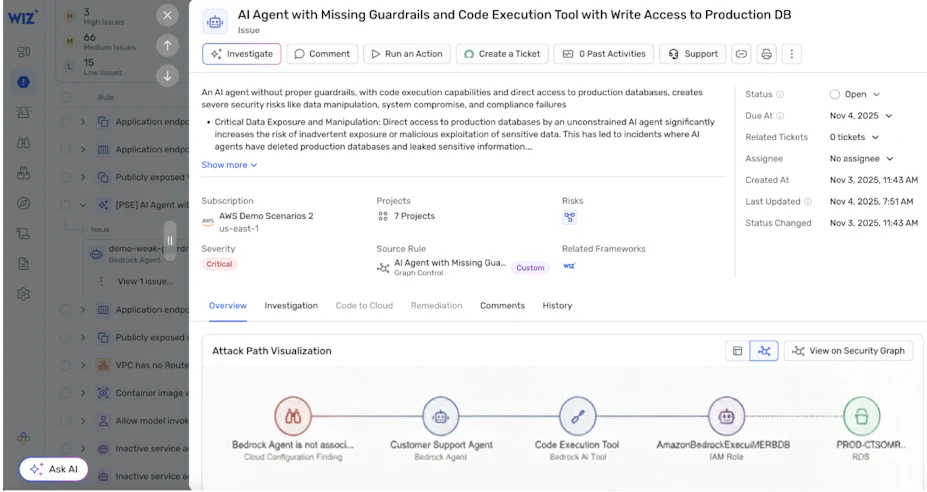
AI misconfigurations are security mistakes in how your AI systems are set up. They happen when AI infrastructure, models, or services have improper settings, excessive permissions, or insecure defaults that expose your organization to risk.
Traditional cloud misconfigurations typically affect compute, storage, or networking resources. You might see an open S3 bucket, a misconfigured security group, or a public database. AI misconfigurations involve AI-specific components that sit on top of these resources and add new layers of complexity.
Here's what makes AI different:
Training data stores: These hold the datasets your models learn from, and they often contain sensitive information.
Model registries: These store your trained models and artifacts, which represent significant intellectual property.
Inference endpoints: These are the APIs where your models receive requests and return predictions.
ML pipelines: These automate the flow from data to trained model to deployment.
AI services rely on the same cloud identity foundations – AWS IAM roles, Azure RBAC, and GCP service accounts – but they often add new credential patterns such as API keys, service tokens, and cross-service permissions. When these credentials are over-scoped, long-lived, or poorly governed, they can become a high-impact access path into AI systems and the data they touch.
AI workloads change frequently. Teams retrain models, update prompts, and spin up new inference pipelines constantly. This rapid pace increases the likelihood of configuration drift over time.
When AI services are misconfigured, you're not just exposing infrastructure. You could be exposing proprietary models, algorithms, or training data that define how your AI behaves and what it knows.
25 AI Agents. 257 Real Attacks. Who Wins?
From zero-day discovery to cloud privilege escalation, we tested 25 agent-model combinations on 257 real-world offensive security challenges. The results might surprise you 👀

Common Types of AI Misconfigurations
Most AI security incidents don’t stem from advanced exploits or novel attack techniques. They result from basic configuration mistakes that appear low risk in isolation, but become dangerous when combined with identity permissions, network exposure, and access to sensitive data.
Exposed AI Endpoints and Services
An inference endpoint is an API that accepts input and returns model predictions. When these endpoints are exposed to the public internet without strong access controls, anyone can interact directly with the model.
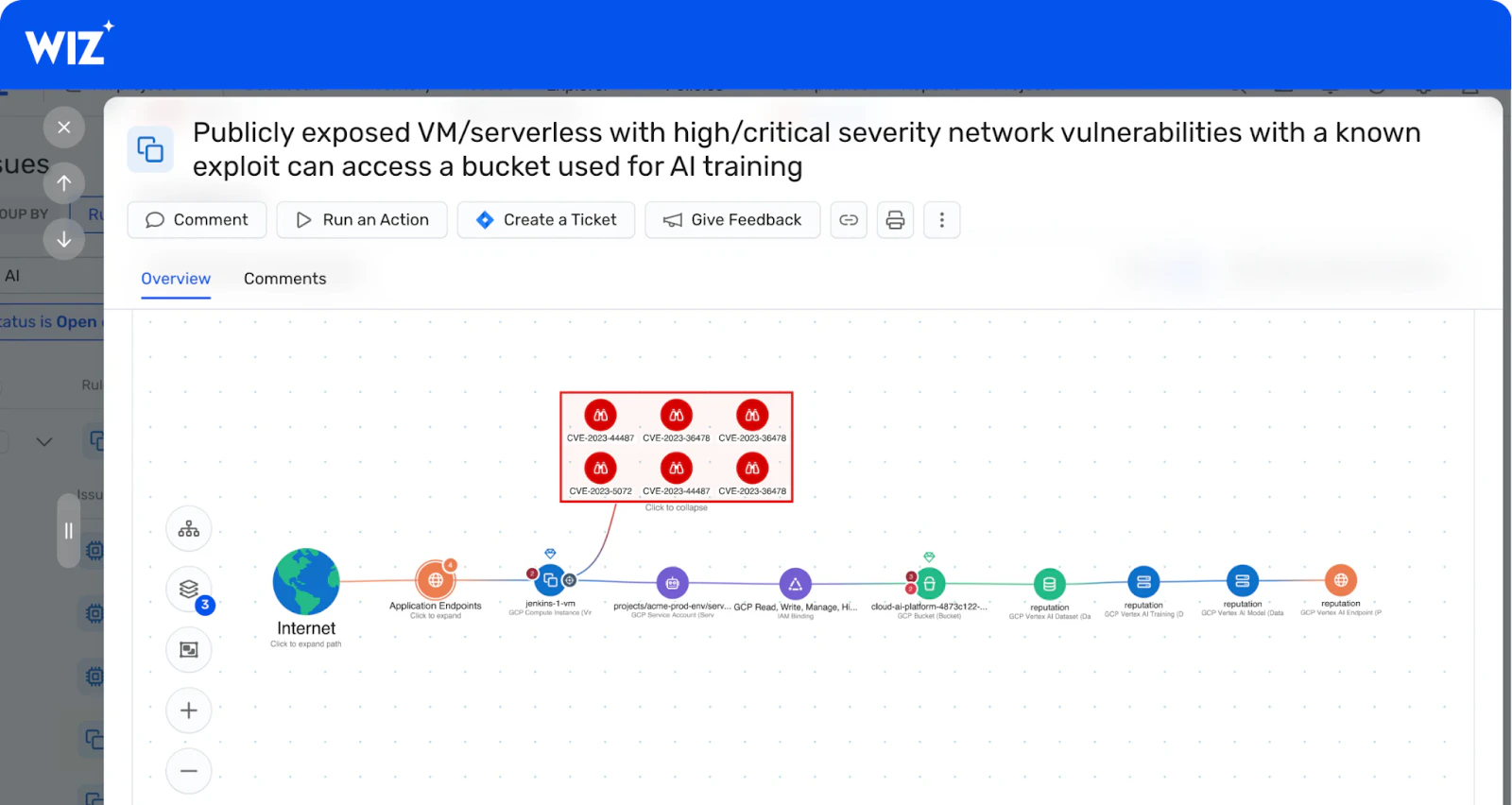
Publicly reachable inference endpoints or development environments often lack sufficient network restrictions or authentication. This creates an easy entry point into AI systems, allowing unauthorized users to query models, probe behavior, or attempt to extract sensitive information.
Overprivileged AI Service Identities
Every AI service runs under an identity, such as an IAM role or service account. When that identity has broader permissions than required, a single compromised workload can expose far more than the AI service itself.
Because AI workloads frequently interact with data stores, feature pipelines, and other cloud services, overprivileged identities can dramatically expand blast radius. If an AI service is abused, attackers inherit all of the permissions granted to that identity.
Insecure Training Data and Model Storage
Training datasets and model artifacts often contain proprietary or sensitive information. When storage configurations lack adequate encryption, access controls, or separation between environments, these assets become high-value targets.
Insecure access to training data or fine-tuned models can expose intellectual property, regulated data, or internal business logic embedded within AI systems.
Insufficient Logging and Visibility
Many AI services are deployed without comprehensive logging and monitoring. When AI service activity isn’t consistently captured by cloud-native logging systems, security teams lose visibility into how models, endpoints, and datasets are being accessed.
Limited visibility makes it difficult to distinguish normal usage from misconfiguration or active abuse—especially when AI systems interact with sensitive data or operate at scale.
Weak Authentication and Authorization
AI workloads often begin as experiments with relaxed security controls that persist into production. Public endpoints, shared credentials, or long-lived access tokens can remain in use well beyond initial development.
When authentication and authorization controls are inconsistent across AI services, attackers can exploit these gaps to gain unauthorized access or escalate privileges.
Insecure Model Deployment Configurations
Deploying AI models involves multiple layers, including containers, CI/CD pipelines, API gateways, and orchestration platforms. Misconfigurations at any of these layers can combine with identity or network issues to create serious exposure.
Poor isolation between model artifacts, runtime environments, or supporting services can unintentionally expose AI systems to broader parts of the cloud environment.
Cross-Tenant and Isolation Risks
Managed AI platforms operate on shared cloud infrastructure with strong provider-enforced isolation. Cross-tenant breaches at the provider level are rare.
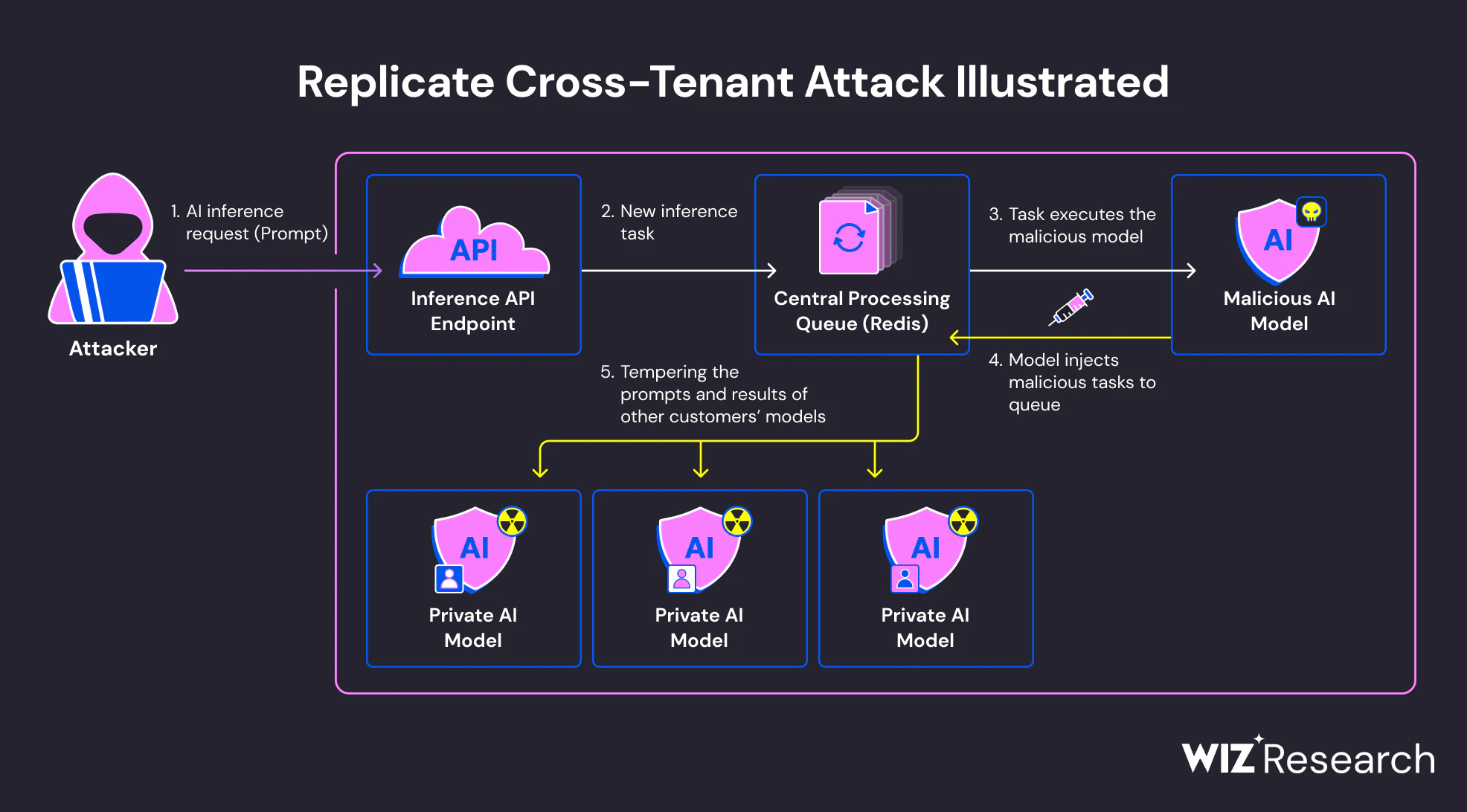
Most isolation risks stem from customer-side misconfigurations, such as overly permissive access controls, exposed network paths, or insufficient separation between projects, workspaces, or environments. These issues can lead to unintended access between internal teams or external parties.
How AI Misconfigurations Create Attack Paths to Sensitive Data
An attack path is the sequence of conditions that allows an attacker to move from an initial weakness to a high-value target. AI misconfigurations rarely cause incidents on their own, but they often form critical links within these paths.
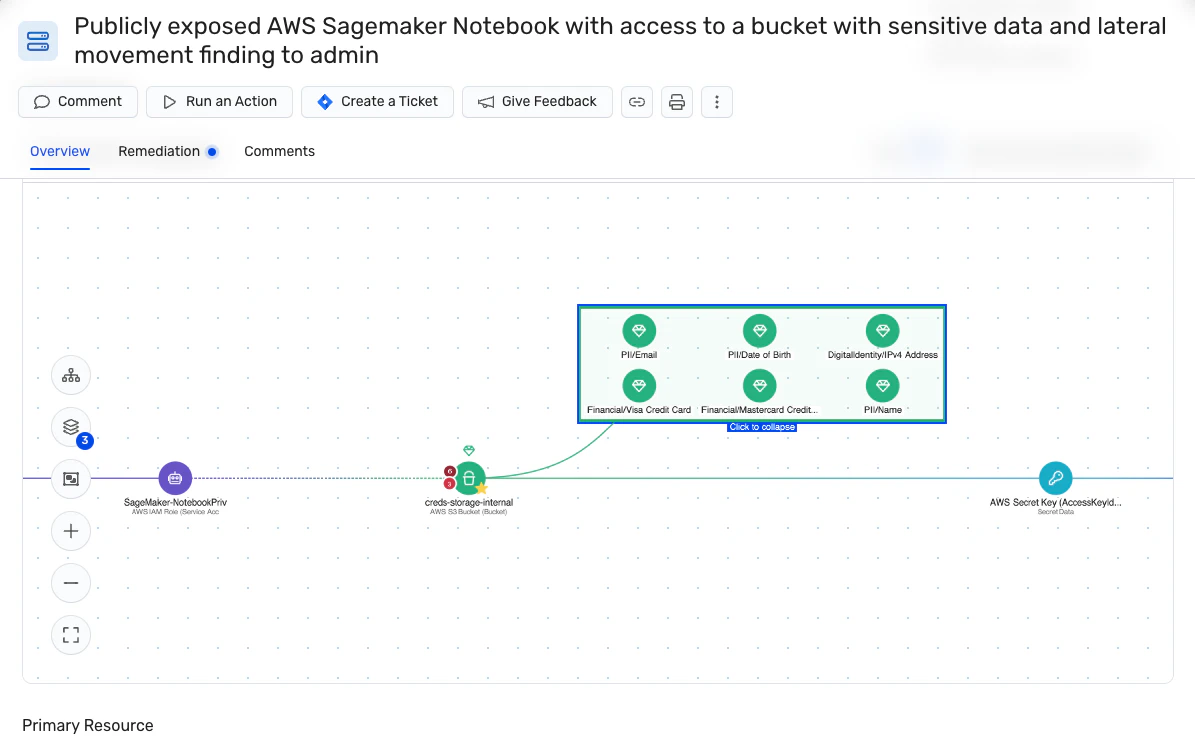
Unlike isolated infrastructure issues, AI misconfigurations frequently intersect with identity, data access, and network exposure. When these elements combine, they create toxic combinations that significantly increase the likelihood and impact of exploitation.
How Toxic Combinations Form
AI misconfigurations often compound existing cloud risks rather than introducing entirely new ones. Common combinations include:
Exposed endpoint + overprivileged service identity
A publicly reachable inference endpoint operating under a broadly scoped role can provide a path to data stores, feature pipelines, or downstream services the model depends on.Weak authentication + sensitive training data
Shared credentials or poorly governed access tokens can expose training datasets that contain customer, proprietary, or regulated information.Limited logging + high-volume inference activity
Without consistent logging, abnormal access patterns or large-scale data extraction attempts may blend into normal AI usage.
Individually, these issues may appear low risk. Together, they can create direct paths to sensitive data and AI assets.
Lateral Movement Through AI Services
Because AI workloads frequently integrate with storage systems, data pipelines, and other cloud services, misconfigured AI services can become effective pivot points.
An exposed or abused AI endpoint running under an identity with access to training data or internal services can enable lateral movement beyond the AI system itself. In these scenarios, attackers don’t need to exploit the model directly – misconfigured access paths do the work for them.
Unintended Data Exposure Through Inference
Misconfigurations can also cause sensitive information to leak through normal AI operation.
Inference workflows that log full prompts, responses, or intermediate data without proper controls may unintentionally store personal or confidential information. Over time, these logs can become secondary data stores that are less protected and more broadly accessible than the original datasets.
When combined with insufficient access controls or monitoring, this exposure can persist unnoticed.
Expanding Blast Radius
AI systems often act as connective tissue between multiple services. A single misconfiguration – such as an overly permissive service role or an exposed endpoint – can increase blast radius across:
Training data repositories
Model artifacts and registries
Feature stores and downstream analytics systems
Supporting cloud services and APIs
Because AI pipelines span development, deployment, and runtime environments, a weakness at one stage can propagate across the entire system.
Accelerate AI Innovation
Securely Learn why CISOs at the fastest growing companies choose Wiz to secure their organization's AI infrastructure.

Challenges in Managing AI Misconfiguration Risk
Even mature cloud security teams struggle to manage AI misconfigurations effectively. The pace of AI adoption, combined with fragmented ownership and limited tooling visibility, makes AI security posture harder to maintain than traditional cloud infrastructure.
Rapid AI Adoption Outpaces Security Controls: AI services are often deployed faster than security controls evolve. New model types, managed services, SDKs, and deployment patterns reach production before organizations have established consistent guardrails. As a result, AI workloads frequently inherit default configurations or ad hoc security decisions made during experimentation, increasing the likelihood of misconfiguration as usage scales.
Limited Visibility Into AI-Specific Resources: Many legacy cloud security tools were designed to monitor virtual machines, networks, and storage – not AI-specific assets such as model registries, training jobs, prompt stores, or inference pipelines. Without visibility into these AI-native components, security teams may be unaware of exposed endpoints, overprivileged identities, or sensitive datasets connected to AI workloads.
Fragmented Ownership Across Teams: AI services rarely have a single owner. Responsibility is often split across:
Data science teams managing models and notebooks
Platform teams operating clusters, pipelines, and CI/CD
Security teams defining policy and responding to incidents
Shadow AI and Unmanaged Deployments: AI services are frequently spun up outside formal security workflows. Teams may deploy models using managed cloud services, open-source frameworks, or third-party APIs without registering them in central inventories. These shadow AI deployments increase risk by introducing AI services that bypass standard access controls, logging, and monitoring, making them difficult to discover and assess.
Alert Fatigue Without Context: Raw security findings – such as “public endpoint” or “weak credential” – lack meaning without understanding what data the AI service can access or how it connects to other systems. When AI misconfiguration alerts are not correlated with identity permissions, network exposure, and data sensitivity, teams face alert fatigue and struggle to prioritize issues that pose real risk.
Evolving Compliance and Governance Requirements: Emerging AI regulations and governance frameworks introduce additional expectations around transparency, access control, and risk management. Organizations must now account for AI-specific controls alongside existing cloud, data protection, and compliance obligations, increasing complexity for teams already managing large cloud estates.
Scansione della sicurezza dei modelli IA: Migliori pratiche per la sicurezza cloud
La scansione della sicurezza dei modelli AI è il processo di verifica dei tuoi modelli e del loro stack circostante per eventuali problemi di sicurezza durante tutto il ciclo di vita.
Leggi di più
Why AI misconfigurations require a cloud-native security approach
AI doesn't exist in a vacuum. Every model, pipeline, and endpoint sits on top of cloud compute, networks, identities, and data services. You can't secure AI by looking only at model code or prompts.
AI systems depend on cloud infrastructure, identities, and data services. A model endpoint might be secure on its own, but if the service identity behind it can access sensitive data stores, you still have a problem.
Risks often span infrastructure, data, and AI layers simultaneously. You need to see how these layers connect to understand where your real exposures are.
Point-in-time reviews struggle to keep pace with changing AI environments. Prefer continuous assessment combined with private endpoints, network isolation (AWS VPC, Azure VNet, GCP VPC), customer-managed encryption keys (CMEK), and least-privilege IAM roles to maintain security posture as AI workloads evolve.
Continuous visibility across cloud resources helps reduce blind spots in AI risk. You need to answer questions like:
Where are all my AI services and model endpoints?
Which ones are exposed to the internet?
Which ones can reach sensitive data stores or high-privilege roles?
A horizontal, context-driven approach connects AI assets, identities, networks, and data so teams can see toxic combinations – not just individual findings. This cross-layer visibility reveals which misconfigurations create real attack paths versus isolated issues that pose minimal risk.
This cross-layer visibility is exactly what cloud-native application protection platforms (CNAPPs) and AI security posture management (AI-SPM) tools are designed to provide.
How Wiz Helps Identify and Prioritize AI Misconfigurations
AI misconfigurations are ultimately cloud security problems that happen to involve AI systems. Models, pipelines, and inference endpoints all rely on cloud infrastructure, identities, networks, and data services, which means understanding AI risk requires visibility across the entire cloud environment – not just the AI layer.
From an AI security perspective, this visibility is critical. Misconfigurations at the cloud layer often determine whether AI systems expose sensitive data, enable unauthorized access, or create attack paths that traditional security controls fail to detect.
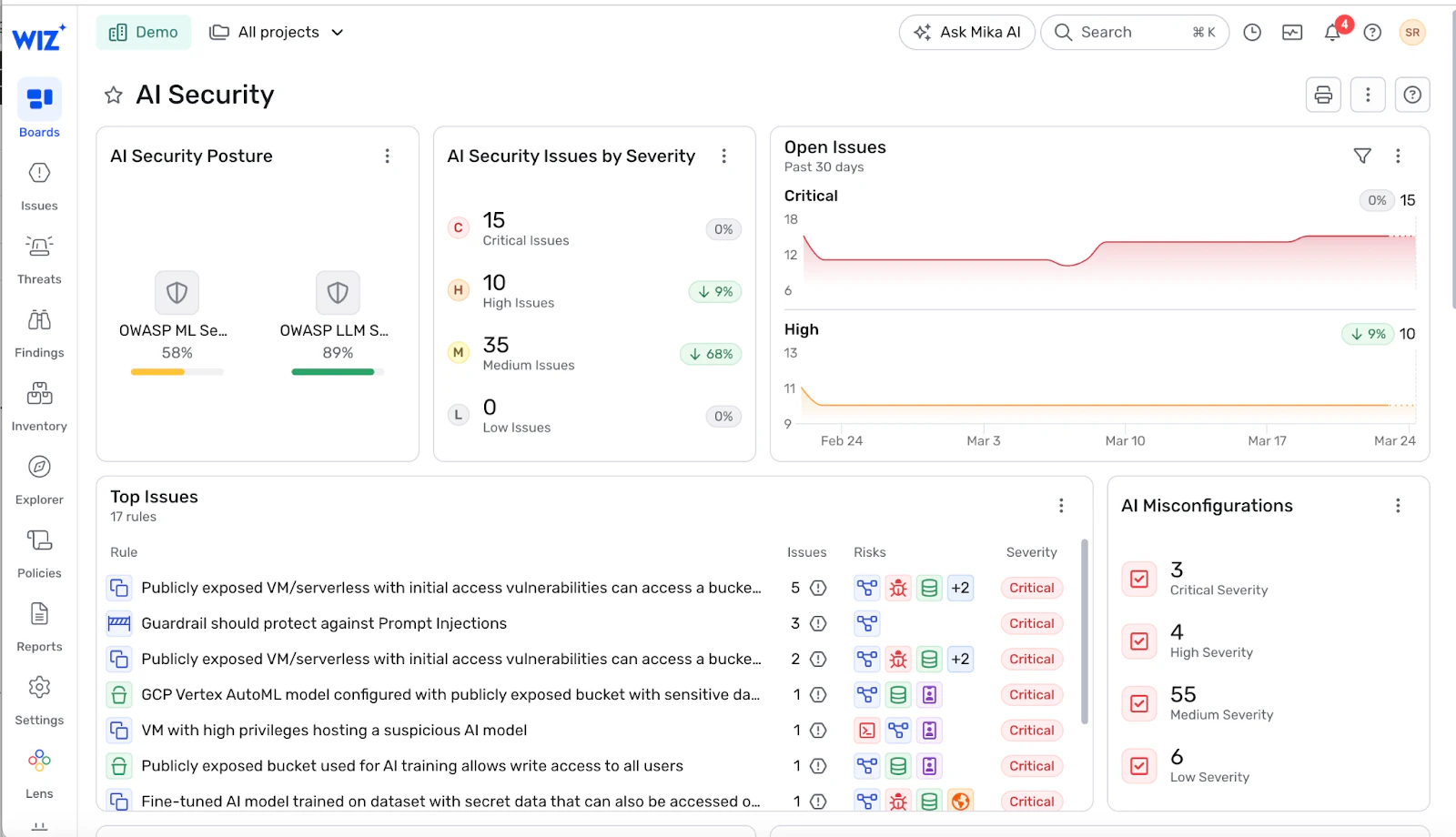
Wiz helps security teams identify AI misconfigurations by providing agentless visibility into AI services, models, and the cloud resources they depend on across AWS, Azure, and Google Cloud. This visibility covers both managed AI platforms and custom AI workloads running on Kubernetes, virtual machines, or serverless services, without deploying agents or impacting model performance.
What makes this approach effective is context. Wiz correlates AI misconfigurations with identity permissions, network exposure, and data sensitivity to show how individual issues combine into real attack paths. Instead of surfacing isolated findings like “public endpoint” or “overprivileged role,” Wiz shows how those conditions intersect – for example, when an exposed inference endpoint runs under a service identity that can access sensitive training data.
This correlation allows security teams to prioritize AI misconfigurations based on actual exposure and business impact, rather than severity scores alone. Teams can immediately see which AI services are reachable, what they can access, and which misconfigurations meaningfully increase blast radius.
Watch the video below to see how Genpact used Wiz AI-SPM to map all of its AI services, identify exposed endpoints tied to sensitive training data, and reduce high-risk AI misconfigurations while accelerating deployment of new AI-powered applications.
Wiz also connects AI misconfigurations back to their source. When a risky AI endpoint appears in production, teams can trace it to the infrastructure or pipeline that created it and address the root cause instead of repeatedly fixing symptoms. This code-to-cloud visibility helps prevent misconfigurations from reappearing as AI environments evolve.
By integrating AI misconfiguration detection into broader cloud security workflows, Wiz enables organizations to manage AI risk as part of a unified cloud security program – rather than as a separate, siloed discipline. This approach helps teams maintain visibility and control as AI adoption accelerates across cloud environments.
Request a demo to see how Wiz helps identify and prioritize AI misconfigurations across cloud environments.
Accelerate AI Innovation
Securely Learn why CISOs at the fastest growing companies choose Wiz to secure their organization's AI infrastructure.