

Understanding AI Social Engineering
AI social engineering is the use of artificial intelligence to manipulate people into granting access, approving actions, or sharing sensitive information. Traditional social engineering relies on deception and trust; AI dramatically increases its effectiveness by automating research, personalization, and message generation at scale.
Social engineering attacks target human behavior rather than technical vulnerabilities. Common techniques include phishing, where attackers send messages that appear legitimate to steal credentials; pretexting, where a fabricated scenario is used to build trust; and impersonation, where attackers pose as colleagues, executives, vendors, or service providers.
AI changes the mechanics of these attacks. Machine learning models can rapidly analyze public information, organizational structures, and communication patterns to generate messages that closely resemble normal business interactions. Instead of manually researching targets and crafting emails, attackers can launch thousands of tailored campaigns in minutes and continuously adapt based on responses.
This shift is especially dangerous in cloud environments. Cloud credentials and permissions act as the control plane for infrastructure, data, and automation. If an attacker convinces a developer to share an access token or persuades an employee to approve a permission request, they can move directly into cloud systems using valid, authorized access.
Cloud Attack Retrospective Report
In this report, we examine how threat actors target cloud environments and provide practical guidance on how Wiz helps detect and mitigate these threats.

How AI Is Changing Social Engineering Attacks
AI doesn’t invent new social engineering techniques – it removes the limitations that once kept them slow, generic, and easier to spot. What used to require hours of research and manual writing can now be automated, personalized, and distributed at scale, increasing both reach and effectiveness.
AI-powered content generation at scale
Generative AI enables attackers to produce large volumes of realistic emails, chat messages, and scripts that mimic normal business communication with precision. These messages are fluent, tailored to specific roles, and often reference real tools or teams, making them far more convincing than traditional phishing. In 2025, cybercriminals were reported to be using generative AI and synthetic media to scale phishing, vishing (voice phishing), and callback scams into high-precision operations that are harder to distinguish from legitimate messages.
These techniques have played out in the wild beyond experimental lab settings. Reports from security analysts show AI use in social manipulation and voice cloning that enhances the effectiveness of vishing and impersonation schemes, illustrating that attackers are already incorporating generative content to bypass familiar red flags.
Enhanced reconnaissance and targeting
AI also accelerates reconnaissance. Models can analyze public sources – LinkedIn, conference talks, GitHub profiles – to create rich victim profiles and identify who has elevated access, which tools are in use, and organizational structures. With that information, attackers craft hooks that align with a recipient’s real responsibilities, making deceptive messages especially effective.
This precision is reflected in documented deepfake scams where attackers exploit detailed targeting. For instance, a well-publicized attempt on the CEO of WPP involved cloning the executive’s voice and creating a fake Microsoft Teams meeting entry to solicit information and financial details from employees, showing how attackers leverage familiarity and trust to get past normal defenses.
Voice and video impersonation
Generative technology isn’t limited to text. Deepfake audio and video can convincingly imitate a trusted person’s speech or appearance. These synthetic media attacks often create urgency – such as a “CEO” voice call demanding immediate action – which undermines routine verification processes. In one widely covered case, attackers used AI-generated deepfakes of a company’s CFO and colleagues to convince a finance employee to execute multiple wire transfers totaling more than HK$200 million (about US $25.6 million), illustrating the real danger of AI-assisted impersonation in business fraud.
Automated multi-channel campaigns
AI also enables coordinated, multi-channel campaigns that maintain consistent personas across email, chat platforms, SMS, and even voice channels. If a phishing email fails to gain traction, an automated follow-up message on Slack or SMS may reinforce the same narrative – increasing the chance of engagement. Attackers can programmatically adapt messaging based on target responses, compounding urgency and reducing users’ time to question authenticity.
Why AI Social Engineering Is Hard to Detect
AI social engineering isn’t hard to detect because the messages are clever. It’s hard to detect because successful attacks don’t rely on obvious technical exploits – they rely on persuading real people to take valid actions.
Traditional detection still works in some areas. Campaign-level signals like infrastructure reuse, timing patterns, sender behavior, and delivery anomalies can help identify phishing operations at scale. However, content-level indicators are increasingly unreliable. AI-generated messages are fluent, varied, and context-aware, which makes static signatures, keyword matching, and grammar-based heuristics largely ineffective on their own.
At the same time, many high-impact social engineering attacks don’t depend on message content at all. Techniques like MFA fatigue, OAuth consent phishing, and credential approval abuse have been effective for years – even before generative AI. In these cases, there may be nothing suspicious in the message body to inspect. The attacker succeeds because a legitimate user completes a legitimate workflow.
AI amplifies both problems. It increases the volume and personalization of traditional phishing, making campaigns harder to filter reliably. And it enables attackers to scale social engineering techniques that already bypass content inspection entirely – targeting the exact users, roles, and workflows most likely to grant access.
From the cloud provider’s perspective, the resulting activity often looks normal. A real identity authenticates successfully, approves a permission, or grants an OAuth token. There’s no exploit attempt, no malware execution, and no broken authentication flow. Logs reflect valid access and authorized actions.
This creates a detection gap. The compromise isn’t visible in how access was obtained, but in how that access is used afterward. In cloud environments – where identity is the control plane – attackers can move laterally, escalate privileges, and access sensitive data without triggering traditional security alerts.
As a result, detecting AI-enabled social engineering shifts away from message inspection and toward identity behavior, permission scope, and blast radius. The key question is no longer “does this message look malicious?” but “does this action make sense for this identity, in this context, with this level of access?”
Detect active cloud threats
Learn how Wiz Defend detects active threats using runtime signals and cloud context—so you can respond faster and with precision.

Cloud-Specific Risks Created by AI Social Engineering
AI social engineering doesn’t invent entirely new cloud attack techniques. What it does is dramatically increase the likelihood that existing identity, access, and governance weaknesses will be exploited, by automating both target selection and message delivery at scale.
Targeting Cloud Identities and Credentials
In cloud environments, identity is the perimeter. Every user account, service account, and workload identity effectively acts as an API with permissions attached. When attackers compromise an identity through social engineering, they bypass most infrastructure-level defenses entirely.
AI amplifies this risk in two ways. First, it makes reconnaissance far more efficient. By rapidly analyzing public signals – job titles, GitHub repositories, conference talks, incident write-ups, on-call schedules, and org charts – attackers can identify and prioritize the identities that matter most: engineers with production access, CI/CD maintainers, platform admins, and identity administrators. This targeting no longer requires manual research; it can be automated and continuously updated.
Second, once a cloud identity is compromised, the impact is rarely limited to a single system. Valid credentials allow attackers to move laterally across services, accumulate additional permissions over time, and access data stores directly – often without triggering traditional perimeter alerts. Overprivileged roles and long-lived credentials turn a single human mistake into a multi-service incident.
Exploiting Trust in Cloud and SaaS Providers
Organizations place deep trust in communications from cloud providers and core SaaS platforms. Attackers exploit this trust by impersonating AWS, Azure, GCP, or widely used enterprise tools with messages that closely resemble legitimate workflows.
AI doesn’t change the underlying technique, but it increases precision and scale. Messages reference the correct tenant type, service name, or configuration issue, making them feel routine rather than suspicious. Requests are framed as compliance actions, security notifications, or operational fixes – things teams are accustomed to handling quickly.
These attacks deliberately blur the shared responsibility model. Cloud providers secure the underlying infrastructure, while customers are responsible for identities, configurations, and access. Social engineering pushes users to “fix” problems that providers would never ask them to resolve through email or chat, relying on familiarity rather than technical exploitation.
Abuse of API Keys and Automation Credentials
Automation credentials – API keys, CI/CD tokens, webhook secrets, and service accounts—are especially attractive targets. They often bypass interactive authentication and MFA entirely, and they frequently carry broader permissions than the humans who created them, assigned “just in case” to avoid breaking pipelines.
AI social engineering targets these workflows with messages that appear operational rather than malicious: fake bug reports, build failures, integration warnings, or support requests that prompt engineers to share logs, rotate secrets, or run diagnostic scripts. The objective is persistence, not immediate access.
Once compromised, automation credentials allow attackers to modify pipelines, inject backdoors, deploy shadow workloads, or exfiltrate data silently. Because these credentials are designed to operate continuously, abuse can persist long after the initial social engineering event – and often looks like normal automation activity.
Federated Identity as a High-Leverage Target
Federated identity systems – SSO platforms, SAML integrations, OIDC providers, and identity brokers—represent one of the highest-impact social engineering targets in cloud environments. A single compromised identity provider (IdP) admin account or a malicious OAuth application approval can cascade access across dozens or hundreds of connected services.
AI-enabled social engineering increases the risk here by crafting highly plausible requests related to “app reauthorization,” “SSO maintenance,” or “emergency access recovery.” From the attacker’s perspective, compromising identity governance yields far greater leverage than targeting individual cloud accounts.
Because federated identity sits above individual clouds and SaaS platforms, abuse at this layer can undermine otherwise strong security controls downstream.
Multi-Cloud and Organizational Complexity
Multi-cloud environments add ambiguity around ownership and responsibility. Different teams manage different accounts, subscriptions, and projects, often with inconsistent access models and approval processes.
AI social engineering exploits this uncertainty. Highly specific requests rely on gaps in shared context – counting on the fact that few individuals understand the full environment well enough to confidently challenge them. When no one is sure who should approve a change, attackers fill the gap with urgency and authority.
Politeness compounds the problem. People are often reluctant to challenge requests that seem plausible, especially when they come from adjacent teams, senior roles, or external partners. In complex organizations, social norms become part of the attack surface.
The core risk isn’t a lack of tools, but fragmented visibility. Without clear insight into who owns what, which permissions are normal, and which actions are truly sensitive, even experienced teams can be pressured into approving risky changes.
How Wiz helps reduce the impact of social engineering
Social engineering doesn’t break cloud defenses directly – it convinces people to use valid access in unsafe ways. Once credentials, OAuth grants, or automation tokens are compromised, attackers operate inside the cloud using legitimate identities. This is where traditional perimeter controls lose visibility, and where Wiz plays a critical role.
Wiz does not prevent phishing emails, deepfake calls, or impersonation attempts. Instead, it helps security teams detect, investigate, and contain the technical fallout when social engineering leads to cloud access misuse.
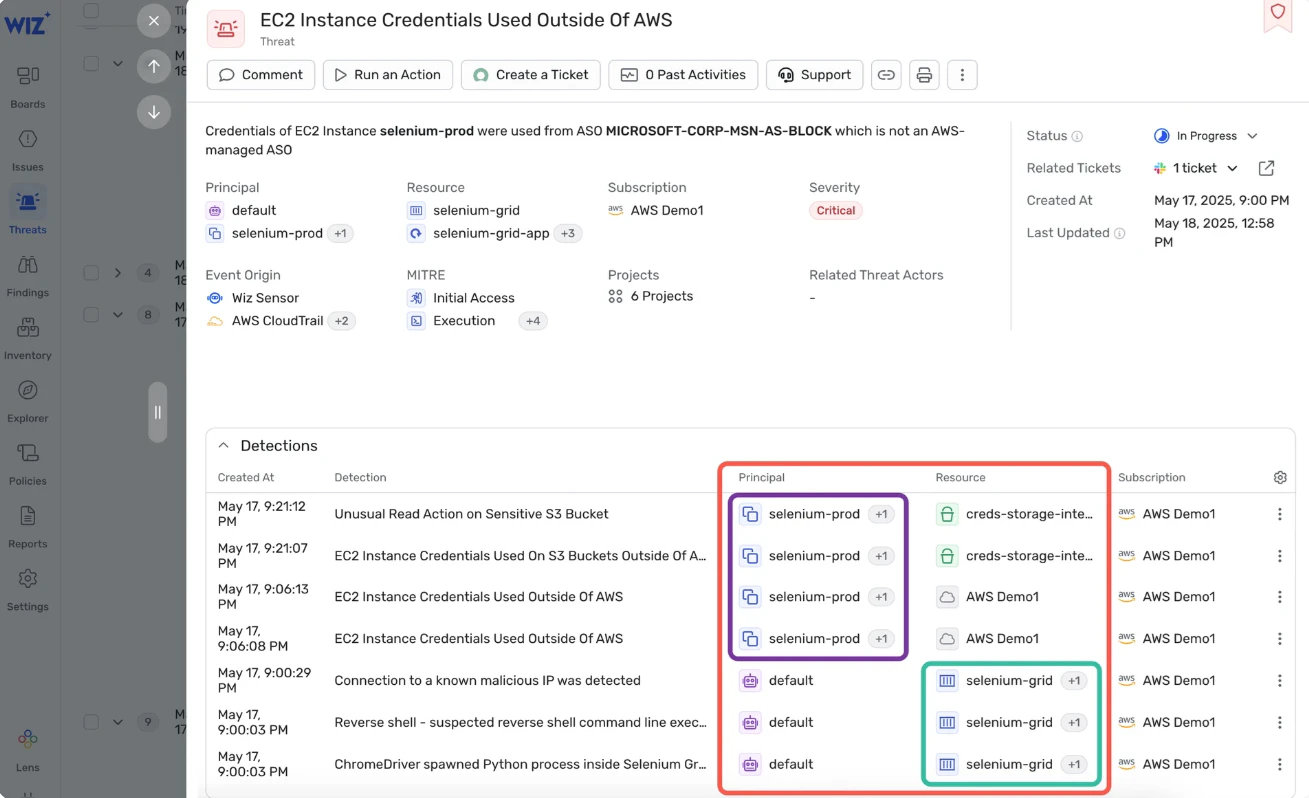
Once an attacker gains access, Wiz provides immediate visibility into what that identity can reach. By correlating cloud identities with permissions, network exposure, workloads, and sensitive data, Wiz shows whether a compromised user, service account, or OAuth application can access production systems, customer data, or high-impact infrastructure – and how far the blast radius extends.
Wiz threat research illustrates this pattern clearly. In campaigns like TraderTraitor, attackers used social engineering to harvest credentials and session tokens, then pivoted into cloud environments to enumerate permissions and move laterally. Wiz helps surface this post-compromise risk by identifying over-privileged identities, risky OAuth grants, and unexpected access paths that attackers depend on after deception succeeds.
Wiz also helps identify suspicious cloud activity that often follows social engineering, such as unusual OAuth consent flows or non-interactive sign-ins (which can indicate token theft or automation abuse rather than legitimate user activity). Rather than inspecting message content, Wiz correlates identity actions with workload access, data exposure, and configuration changes – allowing teams to spot misuse even when access appears technically valid.
Most importantly, Wiz prioritizes incidents where compromised access intersects with real impact – sensitive data exposure, internet-facing workloads, or privilege-escalation paths – instead of generating alerts on access events alone. This context-driven approach helps teams focus response efforts where social engineering is most likely to translate into material risk.
In short, while AI social engineering targets people, its damage materializes in the cloud. Wiz helps organizations limit blast radius, surface exploitable access paths, and accelerate response once attackers attempt to turn deception into cloud compromise – reducing the operational and data impact when human defenses fail.
Detect active cloud threats
Learn how Wiz Defend detects active threats using runtime signals and cloud context—so you can respond faster and with precision.