Artificial Intelligence has officially crossed the chasm from experimental pilot to foundational cloud infrastructure. In just a few years, AI systems have moved from limited rollouts to a core layer embedded across applications, developer workflows, and business operations.
But as AI becomes more autonomous and deeply connected to real systems and data, the security landscape is shifting. Securing AI is no longer just about protecting models; it is about understanding how AI interacts with infrastructure, identities, and automation.
The 2026 State of AI in the Cloud report analyzed hundreds of thousands of real world cloud environments to see how organizations are deploying and how attackers are targeting AI today.
Read the full report to see the full scope of data findings, but here are a few key takeaways you need to know.
1. AI is Now Core Cloud Infrastructure
AI adoption has stabilized at scale. At least 81% of cloud environments we observed use managed AI services, and 90% run self hosted AI software. AI is no longer a niche project; it is present within every major industry across development workflows and automation tooling.
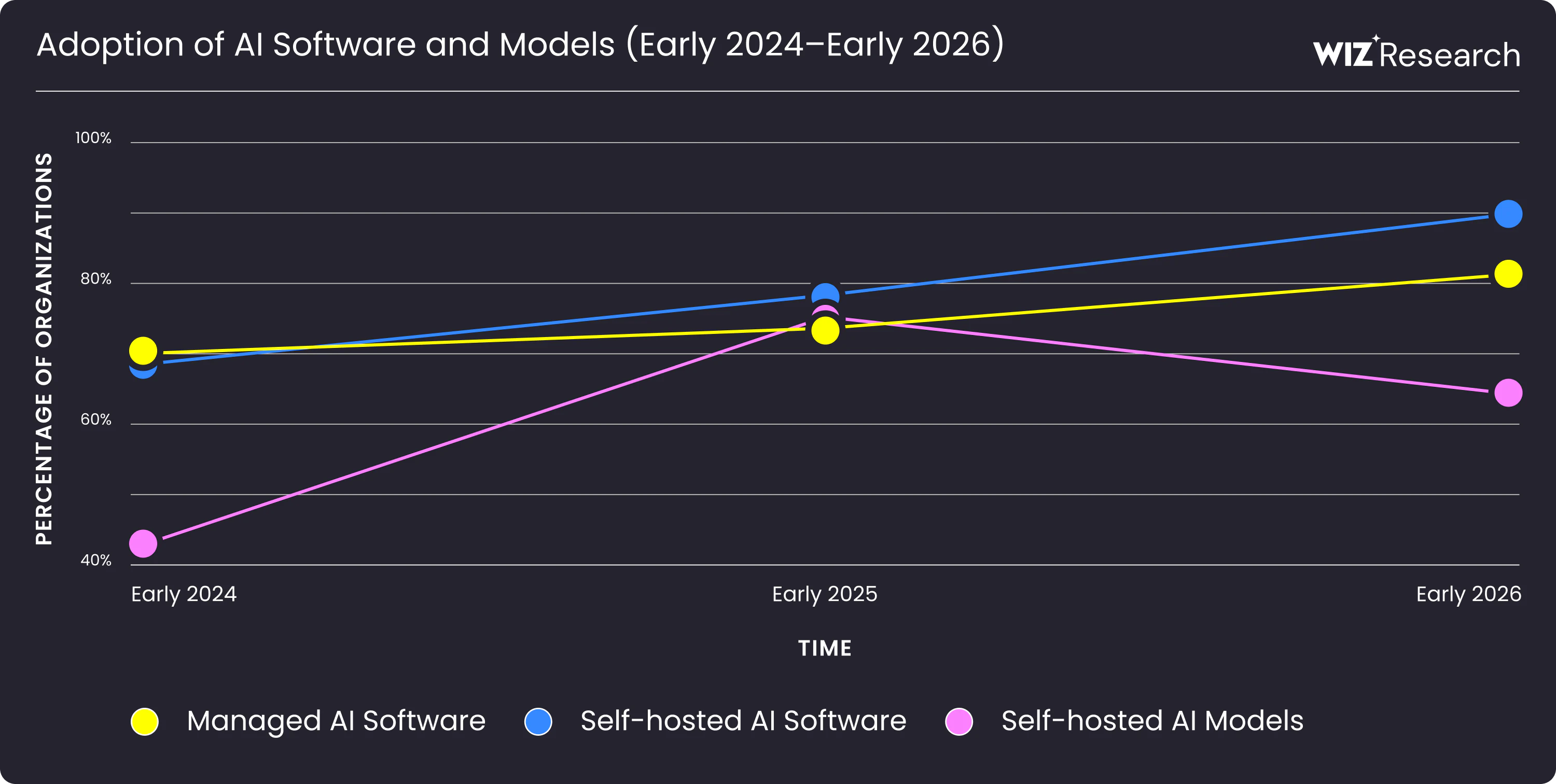
The shift is moving from pure consumption of managed services toward greater ownership. However, this ownership is often indirect: 68% of organizations running self hosted models ingest them through third party software. This suggests that some organizations may be operating self-hosted AI components without fully realizing it.
2. AI-Assisted Development Is the Default, with Systemic Effects Across Applications
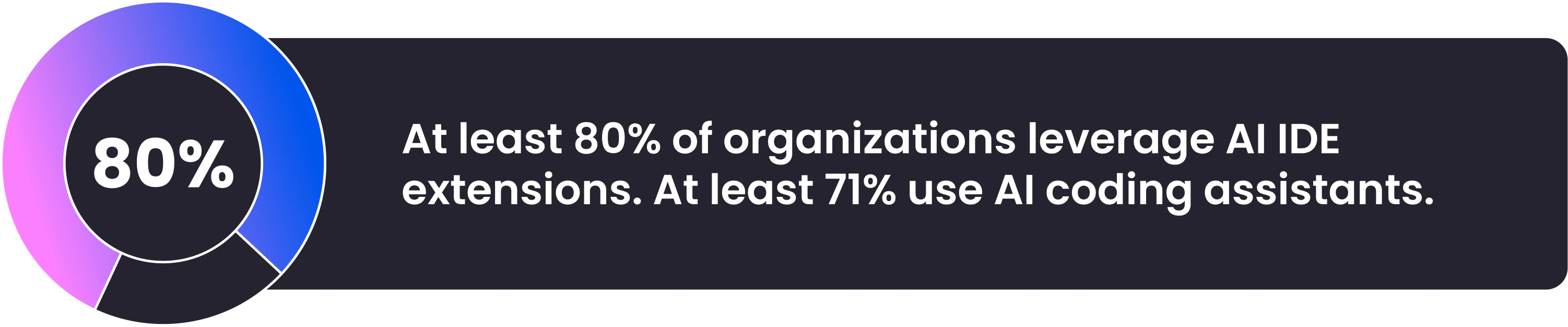
AI assisted development is now the default behavior for engineers. At least 80% of organizations have developers using AI IDE extensions, and 71% have at least one AI coding assistant present.
The risk here is structural. When AI generated code, configurations, and access patterns are repeated across projects, small mistakes become systemic weaknesses. In late 2025, Wiz Research found that roughly one in five organizations using AI powered "vibe coding" platforms had applications affected by systemic security issues rooted in shared generation patterns.
3. Agents and MCP Servers Expand the Attack Surface
We are seeing a rapid shift from AI that assists humans to AI that acts autonomously. At least 57% of organizations have deployed self hosted AI agent technologies, and Model Context Protocol (MCP) servers appear in 80% of environments.

These orchestration layers introduce new control plane risks. If an agent is overprivileged or connected to the internet without proper guardrails, it can create a "lethal trifecta" where an attacker hijacks an autonomous entity to move laterally through sensitive data stores.
4. AI is Changing the Economics of Exploitation
AI isn’t just part of the environment. It’s reshaping how attacks are executed.
As we explored in our 2026 Cloud Threats Retrospective, AI reduces the cost of discovery, accelerates exploit development, and enables attackers to scale familiar techniques more efficiently.
This shift is already visible. Research from Wiz and other vendors has documented malware using LLMs to dynamically generate commands and adapt execution logic at runtime, reducing reliance on static payloads. Attackers have also abused AI-enabled OAuth integrations to move laterally across SaaS environments by leveraging trusted automation paths.
AI is also accelerating vulnerability discovery. In the Zeroday.cloud research effort, AI-assisted analysis contributed to the discovery of 13 zero-day vulnerabilities in widely deployed cloud software. This trend is already visible in frontier models like Anthropic’s Claude Mythos, which has demonstrated the ability to autonomously discover zero-day vulnerabilities and generate working exploits, significantly compressing the time between discovery and exploitation.
These are not new attack classes. They are established techniques executed faster and at greater scale. As vulnerability discovery and exploit development become more automated, attackers can iterate more quickly, test more hypotheses, and reduce the cost of exploitation. The result is more attempts, faster cycles, and sustained pressure on defensive teams.
The Path Forward
AI security is not a future discipline. It is a present day extension of cloud security that must account for autonomy and the rapid spread of AI driven systems. To stay ahead, organizations must:
Inventory AI as core infrastructure: Treat AI components as first class citizens in your asset inventory.
Extend governance across distributed ownership: AI security cannot sit in a silo; it must be integrated into AppSec and data governance.
Use context to cut through the noise: Understand how AI assets connect to identities, permissions, and sensitive data to prioritize the risks that actually matter.
State of AI in the Cloud 2026
Download the full State of AI in the Cloud 2026 report to explore the data, trends, and practical steps needed to secure AI as core cloud infrastructure.