



What are runtime security tools (and why do you need them)?
Runtime security tools protect workloads after deployment by observing active system behavior. They track kernel-level system calls, process spawns, and unexpected network traffic to stop exploits that posture scans cannot see.
Modern cloud infrastructure moves too fast for pre-deployment posture scanning to be the whole story. Once code ships, workloads change by the minute, and real risk plays out in production. That is why teams pair posture scanning with active workload defense and real-time intervention.
This guide compares the top commercial and open-source runtime security tools across cloud compute, containers, Kubernetes, and AI environments, so you can decide which are worth a proof of concept.
Jump to a tool:
What capabilities to look for in a runtime security tool
Before comparing products, get clear on the criteria that separate modern runtime security tools. Most now rely on eBPF, a safe way to run monitoring code inside the Linux kernel without custom drivers.
Low-overhead kernel telemetry: Watches process execution, network connections, and system calls without slowing your applications or destabilizing production nodes.
Active workload defense: Goes beyond alerts to kill malicious processes, block unexpected container changes, and isolate workloads fast.
Contextual correlation: Connects each runtime alert to IAM permissions, public exposure, vulnerabilities, and data stores instead of leaving it in a vacuum.
Compliance and auditability: Maps detections and audit logs to frameworks like SOC 2, ISO 27001, and PCI DSS, and to the MITRE ATT&CK cloud matrix, so you can prove coverage during audits.
AI workload protection: Monitors live LLM pipelines and AI agents for prompt injection, model tampering, and resource hijacking.
Workload versatility: Runs consistently across Linux VMs, managed Kubernetes (EKS, GKE, AKS), and serverless containers like AWS Fargate.
Explore the Wiz Runtime Sensor
See how lightweight eBPF kernel monitoring delivers real-time workload protection with near-zero overhead.

Top runtime security tools at a glance
Solutions are listed in no particular order. CDR (cloud detection and response) finds and stops active threats across cloud workloads and the control plane, while a CNAPP (cloud-native application protection platform) bundles posture, workload, and runtime security in one product.
| Tool | Primary architecture | Core specialty | Best-fit environment |
|---|---|---|---|
| Wiz | Lightweight eBPF Sensor + agentless CDR | Real-time eBPF active defense and CDR correlated with cloud graph context | Multi-cloud teams needing unified posture, active prevention, and AI security |
| Sysdig Secure | eBPF / Falco engine | Deep container forensics and custom rule authoring | Kubernetes-heavy teams aligned with open-source Falco standards |
| Palo Alto Networks (Prisma Cloud) | Multi-modal agents (DaemonSet / VM / Defender) | End-to-end enterprise compliance and full-lifecycle CNAPP | Large enterprises with extensive Palo Alto Networks ecosystems |
| CrowdStrike Falcon Cloud Security | Falcon unified agent | EDR-heritage threat hunting and endpoint/workload parity | Teams wanting unified SecOps workflows across servers and endpoints |
| Datadog Cloud Workload Security | Datadog unified agent (eBPF) | Merging security telemetry into APM and observability | Engineering and SRE teams already standardized on Datadog |
| Upwind | eBPF Sensor | Runtime-first cloud topology and API visibility | DevOps and platform teams prioritizing real-time execution maps |
| Falco (open source) | Open-source eBPF / kernel module | Community-driven behavioral monitoring engine | Tech-forward teams building self-managed monitoring stacks |
The 7 best runtime security tools
Each profile below follows the same shape: a one-line snapshot, then architectural approach, core strengths, and best-fit scenario. That shape makes it easy to compare trade-offs before you shortlist runtime security tools for a proof of concept.
1. Wiz (Wiz Defend and Runtime Sensor)
Snapshot: agentless cloud visibility paired with a lightweight eBPF sensor and CDR, so runtime detections arrive already tied to cloud context.
Architectural approach: Wiz pairs 100% agentless cloud scanning with a lightweight eBPF Runtime Sensor for Kubernetes clusters and Linux hosts. It couples this with agentless cloud detection and response (CDR).
Core strengths:
Active workload defense: In-sensor Runtime Response Policies terminate malicious processes and container drift in real time, while Wiz Defend automated response playbooks can isolate compromised nodes, revoke cloud credentials, and capture forensic snapshots.
Graph-enriched alerts: Every runtime signal links to the Wiz Security Graph, showing exposure, IAM access, and data reach instantly.
AI workload security: Secures managed and self-hosted AI services against prompt injection, model tampering, and data exfiltration at runtime.
AI-Powered autonomous investigation: The Wiz Blue Agent automatically investigates and triages incoming threats in real time, leveraging the Security Graph and specialized sub-agents to deliver instant root-cause analysis and reduce analyst MTTR.
Best-fit scenario: Teams that want enterprise runtime defense wired into full cloud context, giving SOC and DevSecOps instant blast-radius clarity.
For a real example, Matillion consolidated their runtime tooling with the Wiz Runtime Sensor and Wiz Defend, bringing cloud detection in-house and determining whether a vulnerability is "actively being exploited in their runtime or just exists on a device."
2. Sysdig Secure
Snapshot: the commercial platform built on Falco, tuned for deep container and Kubernetes forensics.
Architectural approach: Built on the open-source Falco project, using eBPF and system-call instrumentation tuned for containerized environments.
Core strengths:
Deep Kubernetes context: Captures container-native detail like syscalls, namespaces, cgroups, and cluster metadata.
Mature rule ecosystem: Uses Falco rule syntax with thousands of ready-made behavioral detection rules.
Forensic capture: Generates pre- and post-attack capture files for detailed investigation.
Best-fit scenario: Kubernetes platform and container security teams that want low-level syscall visibility and customizable rules.
Sysdig is built for teams that author and tune their own Falco rules, so it fits best where a platform or security engineering group owns detection content.
3. Palo Alto Networks (Prisma Cloud)
Snapshot: a full-lifecycle CNAPP that folds runtime defense into a broad, single-vendor enterprise suite.
Architectural approach: Uses the Prisma Cloud Defender model (DaemonSets, serverless agents, host defenders) for full-lifecycle workload protection.
Core strengths:
Broad platform coverage: Manages legacy VMs, private cloud, bare metal, and multi-cloud from one place.
Strict policy enforcement: Supports process allowlisting, runtime binary protection, and admission control.
Enterprise ecosystem fit: Integrates with Cortex XSOAR and next-generation firewalls.
Best-fit scenario: Large enterprises with hybrid estates and existing Palo Alto Networks investments seeking a single-vendor suite.
Its breadth suits large teams that want one vendor across many workload types, and the platform is designed for a dedicated team to configure and operate.
4. CrowdStrike Falcon Cloud Security
Snapshot: Falcon's endpoint heritage extended to cloud workloads, so SOC teams keep one investigation workflow.
Architectural approach: CrowdStrike extends its Falcon endpoint sensor, rooted in endpoint detection and response (EDR), into cloud servers, containers, and Kubernetes nodes.
Core strengths:
Threat hunting: Falcon OverWatch adds expert human hunting alongside automated behavioral detections.
Consistent workflows: SOC teams investigate cloud workloads using the same consoles and queries they use for endpoints.
Strong prevention: Applies proven endpoint heuristics to block malicious execution and lateral movement.
Best-fit scenario: Organizations with a mature SOC already on Falcon that want EDR-style hunting across endpoints and cloud VMs.
Because it is agent-first, coverage follows where you deploy the Falcon sensor, so it fits teams that plan rollout across workload types, including serverless.
5. Datadog Cloud Workload Security (CWS)
Snapshot: runtime threat detection built into the Datadog Agent that many engineering teams already run.
Architectural approach: Built into the unified Datadog Agent, using eBPF to watch system activity alongside performance and infrastructure metrics.
Core strengths:
Observability synergy: Correlates security anomalies with APM (application performance monitoring) traces, host metrics, and logs in real time.
Shared workflows: Delivers security signals into dashboards developers and SREs already use daily.
Low added overhead: Existing Datadog users enable detection with little extra setup.
Best-fit scenario: Teams already standardized on Datadog that want runtime threat detection without deploying a new agent.
By routing runtime signals through its Cloud Security Management (CSM) suite, Datadog unifies SRE workflows, though teams should evaluate telemetry-ingestion planning at scale and the depth of cloud-identity correlation.
6. Upwind
Snapshot: a runtime-first platform that uses live eBPF telemetry to map your cloud and surface API activity.
Architectural approach: Upwind runs an eBPF sensor at the node level to collect live OS signals, network calls, and container processes.
Core strengths:
Runtime-first topology: Uses live traffic and process execution to map infrastructure, dependencies, and attack paths.
Built-in API visibility: Discovers active API endpoints and inspects live traffic from the runtime layer, with no separate gateway.
Lineage tracing: Pinpoints the exact process and container image version behind an unexpected execution path.
Best-fit scenario: DevOps and platform engineering teams that want runtime telemetry to drive API visibility, network mapping, and vulnerability prioritization.
Because Upwind anchors heavily on live runtime execution, teams seeking comprehensive code-to-cloud coverage often pair its real-time telemetry with dedicated application security (AppSec) and pipeline scanning tools.
7. Falco (open-source benchmark)
Snapshot: the open-source engine that set the standard for runtime threat detection on Linux and Kubernetes.
Architectural approach: A CNCF-graduated (Cloud Native Computing Foundation) open-source project that parses Linux kernel system calls using eBPF or a kernel module.
Core strengths:
Community standard: Large user base, broad plugin ecosystem, and open rule definitions.
No vendor lock-in: Full data ownership, with alerts routed to any SIEM, webhook, or automation pipeline.
Best-fit scenario: Engineering-heavy teams with DevSecOps resources that want a customizable, open-source monitoring layer without license costs.
Falco focuses on detection and alerting, and teams add their own response, correlation, and cloud context around it. Many pair Falco with a commercial platform when they want graph context and automated containment.
How modern runtime security works under the hood
These runtime security tools share a few building blocks. Knowing how they extend container runtime scanning into live detection helps you judge trade-offs during a proof of concept.
eBPF vs. legacy kernel modules
Modern tools adopted eBPF because it runs sandboxed, verifier-checked code inside the Linux kernel. That means deep visibility without the risk of kernel panics or unstable nodes, an approach explained well in this overview of eBPF in Kubernetes.
Older approaches used custom kernel modules that had to be compiled against specific kernel versions, and a bad build could crash a node. That fragility made DevOps teams nervous about every upgrade.
Because the kernel proves a program is safe before it runs, teams can roll a sensor across thousands of nodes without a maintenance window. Cloud workloads are often short-lived, sometimes lasting only a minute, so a sensor must capture behavior the instant it happens.
Deployment models: DaemonSets, sidecars, and host agents
Most tools support all three models below, and getting the choice right is central to practical Kubernetes runtime security.
DaemonSets: One sensor per Kubernetes node, monitoring every pod running on that node.
Sidecars: Used where node-level access is limited, such as AWS Fargate or other managed container runtimes.
Host agents: Protect standard Linux and Windows VMs like EC2, Azure VMs, and GCE.
Detection vs. active prevention and containment
Runtime tools sit on a spectrum of threat detection and response. On one end is passive detection, which alerts and collects forensics for incident response. On the other is inline blocking, which terminates processes or isolates containers with network policies.
The urgency is real, since vulnerability exploitation reached 20% of breaches as an initial access vector, according to Verizon's DBIR. The safe way to adopt prevention is gradual: start in alert-only mode, learn what normal behavior looks like, then graduate to automated blocking for high-confidence threats, after validating each rule against normal workload behavior so you do not disrupt legitimate processes. A cryptominer that spikes CPU on a production node is a good first candidate, because the signal is clear and false positives are rare.
Runtime Security Buyer’s Guide
Learn how to evaluate, select, and deploy the ideal runtime protection for your modern cloud stack.

Why runtime security needs cloud posture (agentless + sensor)
The strongest setups blend agentless scanning with a real-time sensor. Each one covers a blind spot the other leaves open.
Runtime alone lacks context: An alert shows what process ran, but not whether the container is internet-exposed or holds admin access.
Posture alone misses live attacks: Agentless CSPM (cloud security posture management) finds misconfigurations and vulnerabilities, but cannot catch a live exploit running in memory.
Together they give clarity: Linking runtime signals to cloud context (identity, network, data) shows teams which risks to fix first.
Tool sprawl makes this harder, not easier, because teams often run several runtime security tools that never share context. Wiz Research found the same at scale: applying cloud context eliminated more than half of high-priority findings, because most alerts lack the exposure or privilege to form a real attack path. The SeleniumGreed campaign Wiz documented shows why: attackers exploited an exposed Selenium service to run cryptominers, and pairing that runtime alert with cloud context revealed the public exposure and credentials the attacker could steal next.
How to choose the right tool for your stack
No single tool wins for every team. The best runtime security tools match how your stack runs and how your responders work, and the right choice depends as much on your operational maturity as it does on feature lists.
Choose Wiz if: you want runtime defense (eBPF sensor, active mitigation, CDR) unified with full cloud posture and AI workload security.
Choose Sysdig if: you run Kubernetes-heavy workloads and want deep container forensics with Falco customization.
Choose Palo Alto Networks if: you need one enterprise-wide footprint across legacy networks and multi-cloud.
Choose CrowdStrike if: your SOC runs on EDR and wants identical response workflows for servers and endpoints.
Choose Datadog if: you want DevOps and SRE teams to review security events inside their existing observability stack.
Choose Upwind if: your priority is runtime-derived network topology and real-time API discovery.
Choose Falco if: you are building your own detection pipeline and prefer an open-source standard.
Secure runtime with Wiz
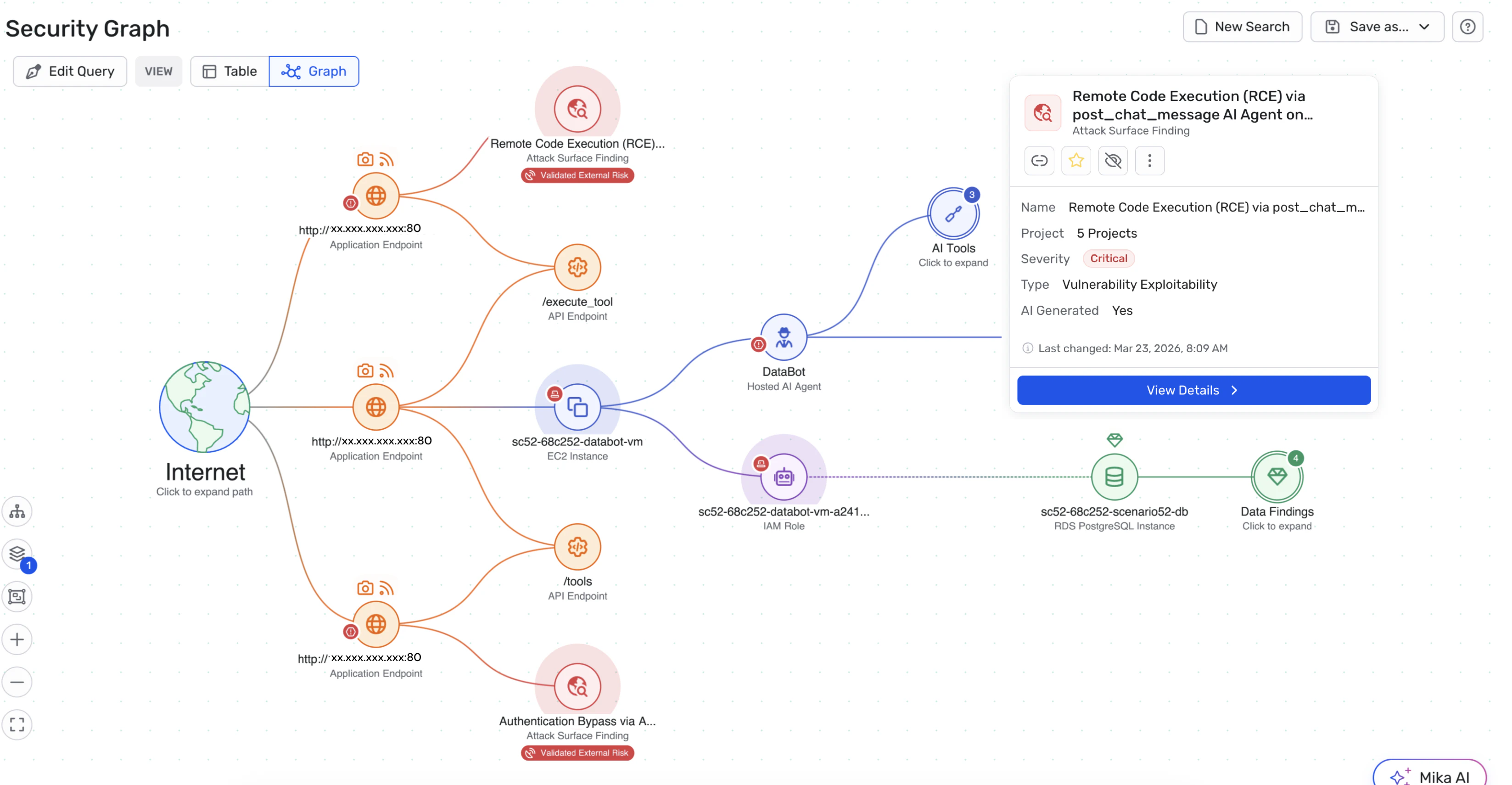
Traditional runtime protection often leaned on heavy host agents that slowed workloads, broke during kernel updates, and buried SOCs in alerts with no context. Wiz Defend takes a unified approach instead:
Zero-impact visibility with real-time depth: 100% agentless scanning plus a lightweight eBPF Runtime Sensor across containers, VMs, and serverless workloads.
Graph-powered context: Every runtime signal ties to the Wiz Security Graph, linking process activity to vulnerabilities, permissions, and exposure paths.
AI workload protection: Wiz Defend detects threats against managed and self-hosted AI services as part of the same runtime coverage.
Autonomous investigation & containment: The Blue Agent accelerates triage with automated root-cause analysis and verdicts on active threats, while Wiz Defend provides one-click containment playbooks to immediately isolate compromised nodes and terminate malicious processes.
Runtime detection is only as good as the context around it. See how Material Security supercharged cloud-native detection and response with Wiz Defend. Get a demo to experience how the Runtime Sensor, agentless CDR, and graph context connect across your own clusters.
See Wiz Defend in action
Watch how runtime signals, cloud context, and one-click response come together in a single platform.
