



What is microservices security?
Microservices security encompasses the strategies and controls that safeguard individual services, their communication pathways, and the overall architecture from threats and misuse. Because microservices operate as independent, loosely coupled components, they require multi-layered security spanning code, network, infrastructure, and runtime.
The goal is to protect sensitive data, ensure secure communication, prevent unauthorized access, and maintain the integrity of each service and its dependencies. Monolithic systems often rely on a single enforcement point, but microservices demand a decentralized security model with consistent, repeatable policy enforcement across every phase of the software development lifecycle.
Effective microservices security follows these core pillars:
Identity and access management (IAM): Enforce control over which users and services can access resources using fine-grained permissions, OAuth 2.0, JWTs, or mTLS.
Network and transport protection: Encrypt all network traffic with TLS, isolate traffic using network segmentation or a service mesh, and prevent unintended exposure.
Data protection: Implement robust encryption for data in transit and at rest. Prevent unauthorized exfiltration by enforcing strict data handling policies.
Secrets management: Use secure storage systems like secrets vaults to manage API keys, passwords, tokens, and other credentials. Avoid storing them in code or containers.
Runtime monitoring and response: Continuously monitor behavior for anomalies or unauthorized changes. Establish alerting and incident workflows tied to threat intelligence.
Software supply chain security: Scan container images and infrastructure as code (IaC) for vulnerabilities, validate third-party dependencies, and maintain an up-to-date SBOM.
Deployment hardening: Enforce security as code through automated pipelines, including policy as code checks, rate limiting, and image provenance validation.
These practices collectively enable teams to build secure microservices while preserving the agility and scalability microservices architectures provide.
Expose cloud risks no other tool can
Learn how Wiz Cloud surfaces toxic combinations across misconfigurations, identities, vulnerabilities, and data—so you can take action fast.

What are the benefits (and tradeoffs) of microservices?
Microservices provide agility and modularity for cloud-native development, though every advantage introduces unique security considerations. Key benefits include:
Resilience through isolation: Isolated services limit the blast radius of failures, which improves system availability. At the same time, each service introduces a new attack surface that requires strict authentication and access controls.
Granular scalability: Teams can independently scale resource-intensive services to prevent inefficiencies inherent in scaling an entire monolithic application. However, managing security policies across a fragmented architecture becomes more complex as the system expands.
Technology flexibility: Teams develop services using programming languages and frameworks tailored to their function. While this accelerates development, it also complicates standardizing encryption protocols, secrets management, and TLS configurations.
Portability via containerization: Running container-based services across cloud environments improves deployment flexibility. This portability also introduces risks if organizations neglect to harden container images or fail to regularly verify and scan dependencies.
Accelerated development and deployment: Independent teams deploy features faster and more frequently. Without consistent security testing, rapid iteration increases the likelihood of misconfigurations or unvetted dependencies.


What are best practices for securing microservices?
Microservices require a proactive, layered security model. Distributed services introduce more access points, complexity, and variability than monolithic systems with centralized controls. Effective microservices security encompasses the design, development, deployment, and runtime phases, where each layer plays a critical role in defending against exploitation and misconfiguration.
The following best practices ensure a robust security posture:
1. Designing services with security from the start
Embedding security at the design phase helps teams reduce technical debt and avoid patching foreseeable flaws later. Threat modeling encourages teams to map out potential adversaries, entry points, and sensitive functions early.
From there, enforcing input validation and output encoding protects services from injection attacks and cross-site scripting, especially when services exchange user-generated data. AI coding assistants often hallucinate insecure defaults—like missing authentication middleware—when generating boilerplate service code, making peer review and automated scanning mandatory before deployment.
2. Establishing identity for all users and services
Reliable authentication ensures that every user, system, and service is identifiable before it interacts with another component. In distributed systems, this includes external-facing APIs and internal service communication. Protocols such as OAuth 2.0, JWT, and mTLS provide the infrastructure to verify identity across environments. Within service mesh implementations like Istio, teams can automate and scale identity enforcement.
3. Limiting access through least privilege
Access controls ensure the minimum rights required for a service or user to execute its function. Role-based access control (RBAC) and attribute-based access control (ABAC) provide structured approaches to enforcement. Regular policy reviews prevent privilege creep, which occurs as services evolve and permissions remain unreviewed.
4. Encrypting all data in motion and at rest
Encryption is fundamental to protecting sensitive data regardless of where it resides or how it moves. Encrypting data in transit using TLS prevents interception during communication, while encryption at rest secures storage media against unauthorized access. These controls are essential when sensitive data crosses network boundaries or occupies multi-tenant environments.
5. Managing secrets and credentials securely
Secrets like API keys and tokens are frequent targets of attack. Storing them in plain text—whether in code or containers—exposes entire services to compromise. A centralized secrets manager supports encryption, access logging, and rotation, allowing teams to maintain consistent security policies across microservices.
6. Auditing and securing third-party components
Every dependency introduces potential API vulnerabilities. Whether it’s an open-source library or a base container image, teams should treat third-party code as untrusted by default. Software composition analysis tools help teams identify known vulnerabilities, while image signing and source validation prevent the unintentional introduction of malicious code. Teams that scan early in the CI/CD process reduce remediation time and cost.
Advanced API Security Best Practices [Cheat Sheet]
Fortify your API infrastructure with proven, advanced techniques tailored for secure, high-performance API management.

7. Controlling resource usage and request volumes
Rate limiting and throttling prevent abuse and help teams mitigate denial-of-service attacks. Teams apply these controls through API gateways, reverse proxies, or service mesh policies to cap the number of allowed requests per client or IP address. Resource limits also contain the blast radius of compromised workloads by restricting CPU, memory, or disk usage.
8. Monitoring behavior and detecting threats in real time
Real-time visibility is critical for detecting unauthorized activity and understanding incidents. Logging authentication attempts, data access, and configuration changes enables security teams to reconstruct events and respond quickly. Runtime threat detection tools further enhance observability by identifying container drift, unusual processes, or lateral movement between services.
9. Validating security through continuous testing
Security isn’t a one-time task on a checklist—it requires ongoing validation. Organizations embed static code analysis, container scans, and integration-level testing into CI/CD pipelines. Red team exercises and penetration tests complement automated efforts by exposing business logic flaws or assumptions that automated tools often miss.
10. Preparing for incidents with defined response playbooks
Even with strong preventive controls, incidents can happen. Maintaining a tested response plan ensures an organization responds quickly and methodically. Clear roles, runbooks, escalation paths, and post-incident reviews transform unplanned events into learning opportunities to avoid repeat failures.
11. Securing the software supply chain and pipeline
CI/CD pipelines and build systems are high-value targets because they maintain wide access to code, secrets, and environments. Enforcing signed commits, validating build artifacts, and restricting build agent permissions reduces the risk of tampering. Tracking an SBOM identifies exposure to vulnerable or unverified components.
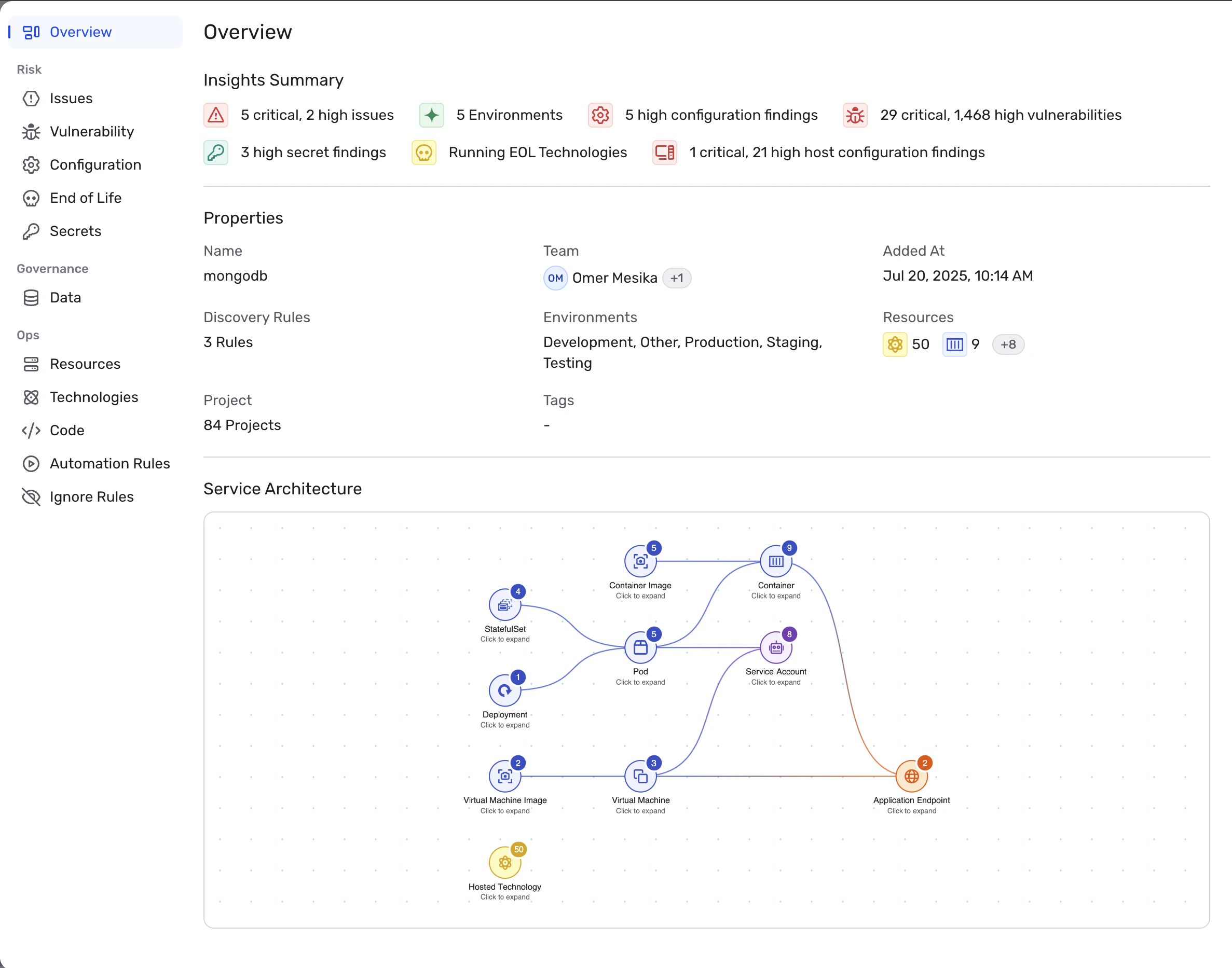
Microservices Security: Risks & Mitigations
Microservices offer flexibility but expand your attack surface. Use the following framework to identify architectural risks and implement the necessary safeguards.
1. The Perimeter & Lateral Movement
The Risk: An expanded attack surface with multiple APIs. If one service is breached, "Implicit Trust" allows an attacker to move freely through your internal network (East-West traffic).
The Mitigation: Implement Zero Trust. Use an API Gateway for external traffic and mTLS (Mutual TLS) or workload identities for all internal service-to-service communication.
2. Secrets & Identity Management
The Risk: Distributed systems require thousands of credentials. Hard-coding these or using static API keys creates a massive "leaked credential" risk.
The Mitigation: Use a centralized Secrets Manager (e.g., Vault). Automate secret rotation and ensure services use short-lived tokens rather than permanent keys.
3. The Software Supply Chain
The Risk: Diverse tech stacks lead to "dependency hell." One unpatched library in a single microservice can compromise the entire cluster.
The Mitigation: Maintain a live SBOM. Integrate automated SCA into your CI/CD pipeline to block builds with known vulnerabilities.
4. Visibility & Runtime Integrity
The Risk: Inconsistent logging and "black box" services make it impossible to detect a breach in real-time. Build-time scanning cannot catch zero-day exploits or container drift.
The Mitigation: Deploy Runtime Security sensors and centralized Observability (log aggregation). Monitor for anomalous network patterns or unauthorized process executions.
How can I get started with microservices security?
Securing a microservices architecture isn’t an all-or-nothing effort. Depending on organizational maturity and available resources, teams can adopt a phased approach that balances risk reduction with operational feasibility. Start by assessing current capabilities, then build toward a more robust security posture through deliberate steps.
The following framework outlines microservices security efforts based on maturity level:
For teams at low maturity
If you’re just starting out, prioritize visibility by implementing these foundational security practices:
Inventory all services, APIs, and data flows.
Enforce basic authentication and TLS for all service communications.
Store secrets in a secure vault rather than source code or containers.
Scan container images and code repositories for known vulnerabilities.
Early metrics to track include the time required to deploy new services securely, the coverage of TLS encryption, and the number of services lacking authentication.
For teams at medium maturity
As architecture scales, you should focus on tightening security controls and expanding automation:
Enforce least privilege access controls using RBAC or ABAC.
Integrate policy checks and security testing into your CI/CD pipelines.
Introduce runtime monitoring to detect anomalies or drift.
Maintain an SBOM for all services and environments.
Useful KPIs at this stage include vulnerability age, the number of secrets rotated, and the mean time to detect security events.
For teams at high maturity
Organizations with strong security foundations prioritize continuous improvement and operational resilience practices:
Conduct regular penetration testing and red teaming exercises.
Automate responses for specific alert classes based on severity and confidence.
Leverage behavior analytics and service catalogs to drive threat hunting.
Simulate incident response drills across teams and environments.
Advanced teams track the mean time to respond, policy enforcement rates, runtime monitoring coverage, and the reduction in open misconfigurations over time.
Regardless of your organization’s starting point, map security improvements to the most critical risks. Focus first on services that handle sensitive data, are exposed to public networks, or serve as identity or orchestration points.
Microservices patterns and technologies
Managing Traffic and Identity
When you have hundreds of services, you can't treat the internal network like a safe zone. These patterns help you control the flow of data:
Edge Gateways and BFFs (Backend-for-Frontend): Think of these as your first line of defense. By using an API gateway or a BFF, you isolate your internal services from the public internet. It gives you a single place to handle authentication, rate limiting, and logging before a request ever hits your core logic.
Service Mesh and Sidecars: This adds a layer of security (like mTLS encryption and identity-based auth) between services without forcing developers to rewrite their code. It’s the easiest way to secure "east-west" traffic in a complex environment like Kubernetes.
Zero Trust and Microsegmentation: The rule here is simple: never trust, always verify. By segmenting services based on their specific function, you ensure that if one service is compromised, the attacker is stuck in a tiny box rather than having the keys to the kingdom.
Building for Resilience
Security isn't just about blocking hackers; it's about keeping the system standing under pressure.
Circuit Breakers and Fallbacks: If one service starts failing, a circuit breaker stops the repeated calls that would otherwise crash your entire system. Providing a "fallback" response ensures your app stays functional (and secure) even when parts of it are down.
Bulkheads: Just like the compartments in a ship, bulkheads isolate resources. If one service starts consuming too much memory or CPU, it won't starve the rest of your architecture.
Automation and the "Noise" Problem
One of the biggest traps in modern security is "AI slop"—long, automated reports that look impressive but offer very little actual context. High-performing teams focus on high-fidelity alerts over raw volume.
Policy as Code (OPA): Managing security rules manually doesn't scale. By treating your security policies like code, you can version-control them and ensure they are enforced automatically across every deployment.
Shift-Left Validation: Don't wait until production to find a hole. Use automated container scanning and IaC (Infrastructure as Code) validation in your CI/CD pipeline to catch misconfigured settings or vulnerable libraries before they go live.
As security expert Ryan Nolette noted on the Crying Out Cloud podcast, the real enemies are speed and context. If your security tools are giving you 10-page reports to explain two insights, they are slowing you down. The best architecture uses tools like CNAPPs to bridge that gap, giving you a clear view of real risks rather than just a list of alerts.
Wiz’s approach to microservices security
Securing a microservices architecture requires clear visibility, continuous assessment, and scalable controls aligned with build and deployment workflows. Wiz resolves these challenges with a unified platform engineered for cloud-native environments, including containerized and orchestrated workloads running on Kubernetes.
Wiz deeply integrates across microservices ecosystems through these core capabilities:
Runtime sensor for real-time visibility: The Wiz Runtime Sensor continuously monitors workloads for suspicious behavior, such as privilege escalations, container drift, and unexpected outbound connections. It also surfaces context-rich alerts that help teams rapidly detect and respond to threats across both north-south and east-west traffic.
Container and Kubernetes security: Wiz scans container images throughout the build phase and after deployment to identify vulnerabilities, misconfigurations, and exposed secrets. The platform integrates with CI/CD pipelines to enforce shift-left practices while maintaining visibility into running workloads without performance overhead.
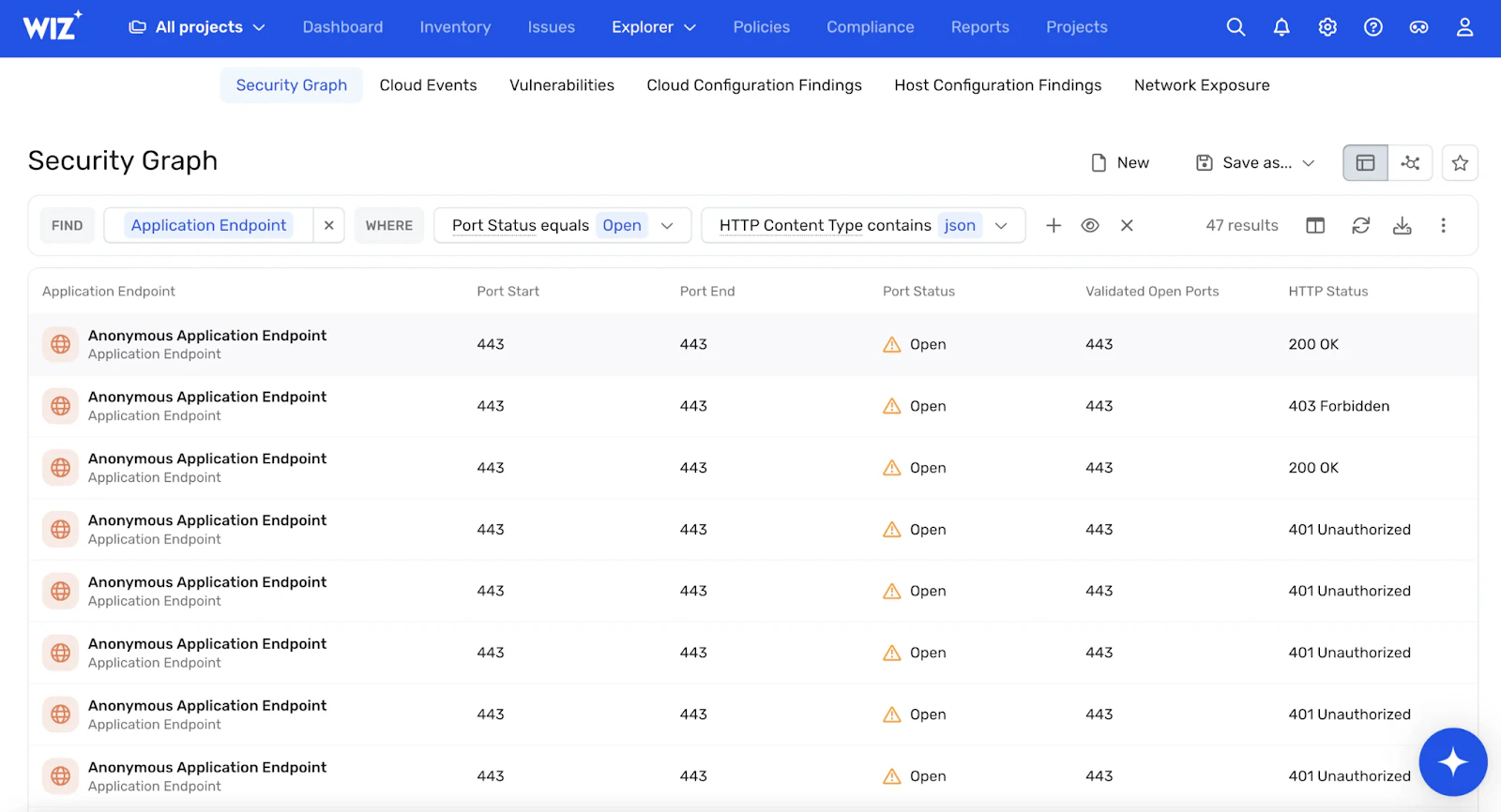
Graph-based risk correlation: The Wiz Security Graph models cloud environments to visualize how risks across identity, secrets, network, and workloads intersect. This correlation helps teams identify toxic combinations, such as exposed services with admin credentials, to support faster prioritization and response.
Policy as code integration and posture automation: Wiz automates checks for misconfigurations and policy violations across IaC and container manifests. Direct integration with tools like Terraform and Kubernetes ensures secure deployment configurations at scale.
Support for service mesh and internal communication scanning: The platform provides visibility into service-to-service communication across complex service mesh environments. This oversight supports authentication validation, detects unintended exposure, and maps critical paths that attackers might exploit.
These capabilities work together to help security and development teams secure microservices without sacrificing velocity. Wiz operates without agents or intrusive instrumentation, optimizing protection for dynamic, ephemeral workloads where traditional tools fail.
A single platform for everything cloud security
Learn why CISOs at the fastest growing companies choose Wiz to secure their cloud environments.
