What is a cloud architect?
A cloud architect is a senior IT professional who designs, builds, and oversees an organization's cloud computing strategy across public, private, and hybrid environments. They translate business goals into technical blueprints that determine how applications scale, how data flows, and how secure the environment actually is.
The distinction between cloud architects and cloud engineers matters. Architects design the blueprint while engineers build and operate what architects design. This strategic, business-aligned nature of the work separates architecture from hands-on implementation.
Modern cloud architects must now understand security posture, attack paths, and compliance requirements as core competencies. These aren't afterthoughts anymore. Architects work across multiple stakeholders including developers, security teams, operations, and business leadership to ensure that technical decisions align with organizational objectives.
2025 Gartner® Market Guide for CNAPP
Security teams are consolidating tools, aligning workflows, and prioritizing platforms that offer end-to-end context. The 2025 Gartner® Market Guide for Cloud-Native Application Protection Platforms (CNAPP) explores this shift and outlines what security leaders should consider as the market matures.

What does a cloud architect do?
Cloud architect responsibilities span design, security, collaboration, and ongoing optimization. The role varies by organization size, but core functions remain consistent across environments.
Core responsibilities
Designing infrastructure blueprints: Creating architecture diagrams and technical specifications that map business requirements to cloud services
Selecting cloud services: Evaluating and choosing appropriate compute, storage, networking, and managed services based on workload requirements
Capacity planning: Forecasting resource needs and designing for scalability without over-provisioning
Cost optimization: Architecting solutions that balance performance with cloud spending through right-sizing, commitment-based discounts (Reserved Instances on AWS, Committed Use Discounts on GCP, Reserved VM Instances on Azure), and efficient resource allocation, addressing the 84% struggling with cloud cost management
Documentation: Maintaining architecture decision records, runbooks, and technical documentation for operations and compliance teams
Migration planning: Designing strategies for moving legacy workloads to cloud environments while minimizing disruption
Security and compliance responsibilities
Security is now a core architect responsibility, not a downstream task. The most critical function of a modern architect is identifying and preventing toxic combinations—scenarios where a minor misconfiguration, an overprivileged identity, and a known vulnerability intersect to create a verifiable attack path to sensitive data.
Network segmentation decisions fall squarely on architects. VPC design, security groups, and controlling east-west traffic all require understanding how a misconfigured storage bucket might expose sensitive data. Encryption by default covers data at rest, in transit, and key management architecture.
Compliance requirements directly influence architecture choices. Architects design for specific frameworks based on industry and data sensitivity:
SOC 2: Requires audit logging, access controls, change management, and incident response capabilities built into infrastructure
ISO 27001: Demands documented security policies, risk assessments, and continuous monitoring architectures
HIPAA: Mandates encryption for protected health information (PHI), access audit trails, and network segmentation for healthcare workloads
PCI DSS: Requires cardholder data environment (CDE) isolation, encryption in transit and at rest, and vulnerability management processes
Architects must also understand the shared responsibility model: cloud providers secure the underlying infrastructure (physical data centers, hypervisors, network fabric), while architects design and enforce security for everything deployed on top (operating systems, applications, data, identity, network configuration). This boundary varies by service type, as IaaS requires more architect responsibility than managed PaaS services.
As architects move from IaaS toward Serverless and managed PaaS, their responsibility shifts away from OS hardening toward fine-grained application identity (IAM) and data entitlement. Architects who ignore security create technical debt that becomes expensive to remediate later.
Cloud architect vs. cloud engineer
These titles are often confused but represent different career stages and focus areas. Architects design while engineers build and operate.
| Aspect | Cloud Architect | Cloud Engineer |
|---|---|---|
| Primary focus | Strategic design and planning | Implementation and operations |
| Typical experience | 6–10 years in IT/cloud roles | 2–5 years in IT/cloud roles |
| Key deliverables | Core IaC modules and provider standards, Architecture Decision Records (ADRs), and security guardrails | Deployed infrastructure, automation scripts, monitoring |
| Stakeholder interaction | Business leaders, security teams, multiple engineering teams | Direct team members, operations |
| Decision authority | Technology selection, architectural patterns, security standards | Implementation approach within defined architecture |
Most architects started as engineers and advanced through senior engineer and solutions architect roles. Some organizations use "solutions architect" as an intermediate title between engineer and architect. In smaller organizations, these roles may overlap significantly.
Essential skills for cloud architects
The role requires both deep technical expertise and strong communication abilities. The balance shifts toward soft skills as architects become more senior.
Technical skills
Cloud platform expertise: Deep knowledge of at least one major provider (AWS, Azure, GCP) with working familiarity of others for multi-cloud scenarios
Networking: VPC design, load balancing, DNS, CDN configuration, and understanding how traffic flows between services
Containerization: Kubernetes architecture, container orchestration patterns, and when containers are the right choice
Infrastructure as Code: Terraform, Pulumi, CloudFormation, or ARM templates for reproducible, version-controlled infrastructure
Identity and access management: IAM policies, service accounts, federation, and role-based access control design
Security fundamentals: Encryption, network security, vulnerability assessment, and understanding common attack patterns
Architects don't need to be experts in everything but must understand enough to make informed design decisions.
Soft skills
Communication: Translating technical concepts for business stakeholders and business requirements for technical teams
Stakeholder management: Navigating competing priorities between security, development, operations, and finance teams
Problem-solving: Breaking down complex requirements into manageable architectural components
Business acumen: Understanding how architecture decisions impact cost, time-to-market, and competitive advantage
Documentation: Creating clear, maintainable technical documentation that others can follow
Communication skills often determine architect effectiveness more than technical depth.
What is a CISO? Chief information security officer explained
CISO is the executive responsible for developing, implementing, and managing an organization’s information security program, from policy to incident response.
Leia mais
Tools and technologies cloud architects use
Architects work across a broad tooling landscape spanning design, implementation, and validation. Tool selection varies by organization, but certain categories are universal.
Cloud platforms
Major cloud providers each offer architect-relevant services including networking (VPC, transit gateways), compute options, managed databases, and identity services. Multi-cloud expertise is increasingly valuable as organizations avoid vendor lock-in. Architects need to understand service limits, regional availability, and pricing models across providers.
Infrastructure as Code tools
IaC is central to modern architecture because it enables reproducibility, version control, peer review, and drift detection. Cross-platform IaC tools work across multiple clouds, while cloud-native options integrate deeply with specific providers. Architects define IaC standards and patterns that engineering teams follow. Scanning templates before deployment catches misconfigurations early.
Security and visibility tools
Architects need visibility into deployed environments to validate that reality matches design. Modern teams are moving away from agent-based security that creates friction. Instead, they favor agentless scanning to achieve 100% code-to-cloud visibility, ensuring security insights are gathered without impacting the performance or deployment speed of the underlying architecture.
For architects, the point isn't more alerts. It's validating that real deployments still match architectural intent and understanding which deviations create meaningful exposure. A misconfigured security group matters more when it's attached to a workload with access to sensitive data and reachable from the internet.
Collaboration and documentation tools
Diagramming tools support architecture visualization. Documentation platforms house architecture decision records. Version control workflows and peer review processes govern infrastructure changes. Architects spend significant time in these tools communicating designs to stakeholders.
How to become a cloud architect
There's no single path to becoming a cloud architect, but common patterns exist. Most architects build expertise over years rather than entering the role directly.
Education and background
Degrees in computer science, information technology, or related fields are helpful but not mandatory. Common backgrounds include software engineering, systems administration, network engineering, and DevOps. Many successful architects learned through certifications, hands-on projects, and on-the-job experience. Practical experience matters more than credentials in hiring decisions.
Career progression path
Entry-level cloud roles (1-2 years): Cloud support, junior cloud engineer, or infrastructure analyst
Cloud engineer (2-4 years): Building and operating cloud infrastructure, gaining hands-on experience
Senior cloud engineer (2-3 years): Leading projects, mentoring juniors, making design decisions within defined scope
Solutions architect (1-3 years): Designing solutions for specific projects or customer engagements
Cloud architect (ongoing): Enterprise-wide architecture responsibility, setting standards, strategic planning
Timelines vary significantly based on organization size, learning velocity, and opportunities. Some professionals accelerate by working at cloud-native companies or consulting firms with diverse projects.
Certifications that matter
AWS Solutions Architect (Associate and Professional): Most recognized; Professional level valued for senior roles
Azure Solutions Architect Expert: Required for Azure-focused organizations
Google Professional Cloud Architect: Valued in GCP environments
Terraform Associate: Demonstrates IaC competency across cloud providers
Certifications show baseline knowledge, but hands-on experience and project portfolios carry more weight. Certifications are most valuable early in career or when transitioning to a new cloud platform.
Guided Tour
See Wiz Cloud in Action
Cloud architect salary and job outlook
Entry-level architects earn at the lower end of senior engineering compensation, while mid-level architects compete with senior engineering management salaries. Senior and principal architects rank among the highest-paid individual contributor roles in IT.
Geographic variation exists, with major tech hubs commanding premium compensation, though remote work has partially leveled this. Multi-cloud experience commands premium over single-cloud expertise. Security skills are increasingly valued as organizations prioritize secure architecture. Financial services and healthcare often pay more due to compliance complexity.
Cloud adoption continues accelerating, creating sustained demand for architecture expertise. Architects with security skills are particularly sought after as organizations recognize that secure architecture is cheaper than remediation.
Common challenges cloud architects face
The role involves navigating competing priorities and constant change across multiple dimensions.
Multi-cloud complexity
Managing different providers with different services, APIs, and best practices creates ongoing challenges for organizations using multi-cloud strategies. Each cloud platform has distinct IAM models, networking constructs, and monitoring tools that architects must normalize into coherent security and operational standards. The challenge isn't just managing different APIs; it's the lack of a unified risk context—the ability to determine if a 'High' severity vulnerability in an Azure VM is more dangerous than a misconfigured S3 bucket in AWS based on their actual exposure.
Balancing security with velocity
Tension between engineering speed and security requirements is constant. Designing secure defaults rather than adding security after deployment prevents friction later. Architects create guardrails that enable developers to move fast within safe boundaries. Those who block deployments without providing alternatives lose credibility with development teams. Strong cloud security architecture creates guardrails that enable speed within safe boundaries.
Keeping pace with cloud evolution
Cloud providers release new services constantly. AI integration means architects now need to understand AI/ML service architecture and associated security considerations. Kubernetes has become a common platform for AI inference workloads, which adds cluster security, workload identity, and data access design constraints to the architect's responsibilities. What was recommended architecture two years ago may be outdated. Architects must filter signal from noise because not every new service requires adoption.
Architectural drift and validation
The gap between designed architecture and deployed reality grows over time. Manual changes, emergency fixes, and undocumented modifications create drift. Wolt uses visibility tools to detect issues before they become larger problems as their infrastructure expanded rapidly.
The most damaging drift is the kind that creates an attack path: small identity, network, and exposure changes that combine into a reachable blast radius. A security group change that opens port 22, combined with an overprivileged service account and an unpatched vulnerability, creates a chain that no single change would have triggered alone. Drift detection that understands these relationships helps architects prioritize what actually matters.
What is a cloud security specialist?
Cloud Security Specialist is a cybersecurity professional who protects cloud infrastructure, apps, data, and identities from threats and misconfigurations.
Leia mais

Securing cloud architecture from design to deployment
Cloud architects need comprehensive visibility and validation capabilities to ensure their designs translate into secure, compliant environments. Modern cloud security platforms help architects bridge the gap between intended architecture and deployed reality across multi-cloud environments. Key capabilities that support architectural validation include:
Real-time infrastructure visibility: Understanding how resources connect and where risks exist across deployed infrastructure gives architects continuous insight into actual environments versus intended designs.
Agentless validation: Validating that environments match intended designs (especially control plane configuration, resource relationships, and identity permissions) without requiring agents on every workload reduces operational overhead while maintaining broad coverage of architectural compliance.
Pre-deployment scanning: Scanning IaC templates for Terraform, CloudFormation, and other frameworks during development catches misconfigurations before they reach production.
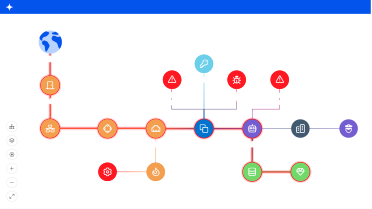
Attack path analysis: Understanding the security implications of design decisions by visualizing how misconfigurations or vulnerabilities could be chained together to create exploitable paths.
Multi-cloud normalization: Getting consistent visibility across AWS, Azure, and GCP without managing separate tools for each provider. Organizations use cloud security platforms to validate cloud environments and create connected development pipelines with consistent security rules.
Drift detection: Identifying when deployed resources diverge from intended designs helps architects maintain architectural standards as environments evolve.
Wiz provides cloud architects with these capabilities through a unified platform that helps validate architecture in real deployed environments and prioritize the risks that create actual exposure. Get a demo to see how Wiz supports secure cloud architecture at scale.
See Wiz in Action
Learn how Wiz Cloud surfaces toxic combinations across misconfigurations, identities, vulnerabilities, and data—so you can take action fast.