



What is application security testing?
Application security testing (AST) is a collection of techniques and tools used to identify security vulnerabilities in software applications before they can be exploited. AST spans the entire software development lifecycle, examining source code, third-party dependencies, running applications, and APIs to uncover weaknesses that could lead to data breaches, unauthorized access, or service disruptions. Frameworks such as the NIST Secure Software Development Framework recommend integrating these practices into every SDLC implementation to reduce the number of vulnerabilities in released software.
Rather than relying on a single method, AST combines multiple approaches, such as static analysis, composition analysis, and dynamic testing, to provide layered coverage. Each technique targets a different attack surface: source code flaws, vulnerable open-source components, runtime misconfigurations, and more. By integrating these tests into development workflows and CI/CD pipelines, teams can catch issues early, prioritize remediation based on real risk, and ship software with greater confidence.
Get the Application Security Best Practices [Cheat Sheet]
This 6-page guide goes beyond basics — it’s a deep dive into advanced, practical AppSec strategies for developers, security engineers, and DevOps teams.

Why application security testing matters
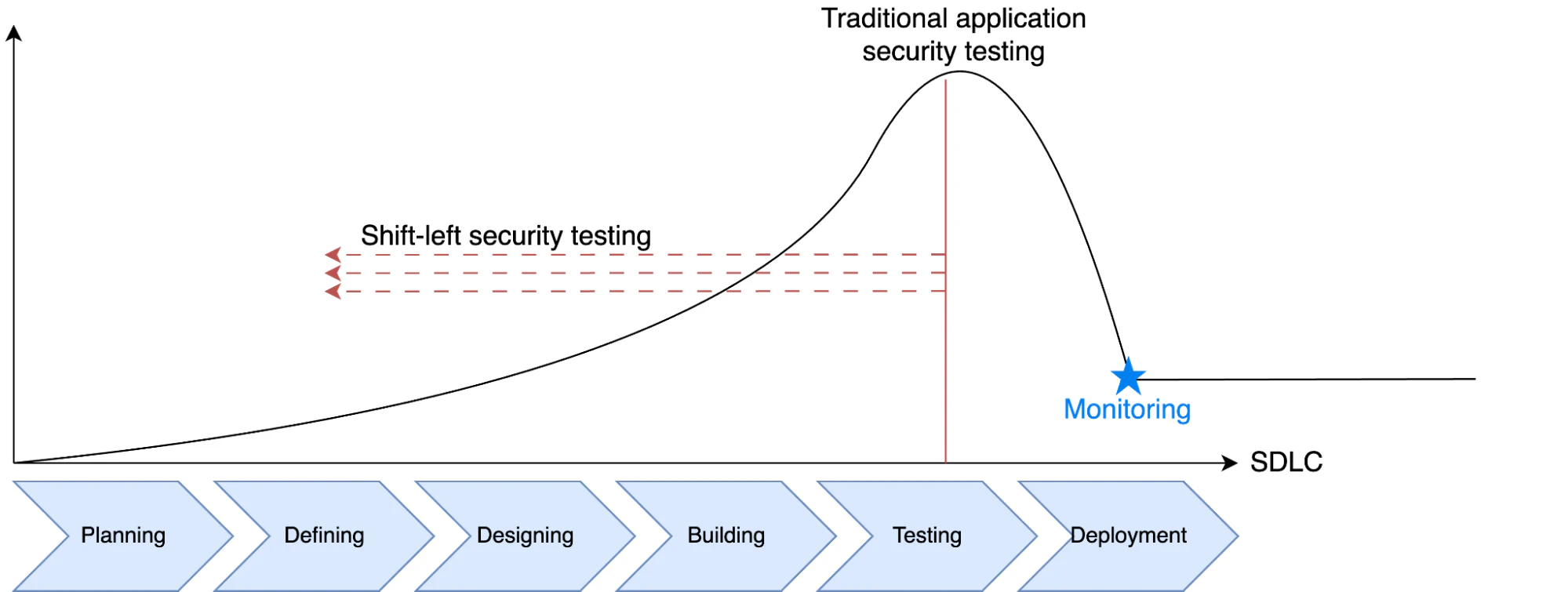
Application security testing matters because vulnerabilities discovered late in the software development lifecycle are exponentially more costly to fix and can cause widespread damage. Identifying software security vulnerabilities late in the SDLC can cost you time, money, and the stress of an expanded blast radius.
For example, the high-profile vulnerability at SolarWinds (CVE-2020-10148) cost approximately $90 million, which experts say could have been avoided with early detection. Attackers first accessed the SolarWinds network in September 2019 and injected their malicious code, known as the SUNBURST backdoor, starting in February 2020. But the vulnerability wasn't discovered until December 2020, meaning attackers had been in the system for more than a year.
The 3CX attack is another example that highlights the danger and high cost of late detection in the software lifecycle. In this attack, the 3CX Desktop App platform was trojanized, resulting in what SecurityWeek called "the first known cascading supply chain attack." As in the SolarWinds attack, the compromise was discovered only after the malicious updates had been distributed and had been active for some time.
Attacks like these prove the critical importance of shift-left security, which is a fundamental aspect of application security posture management.
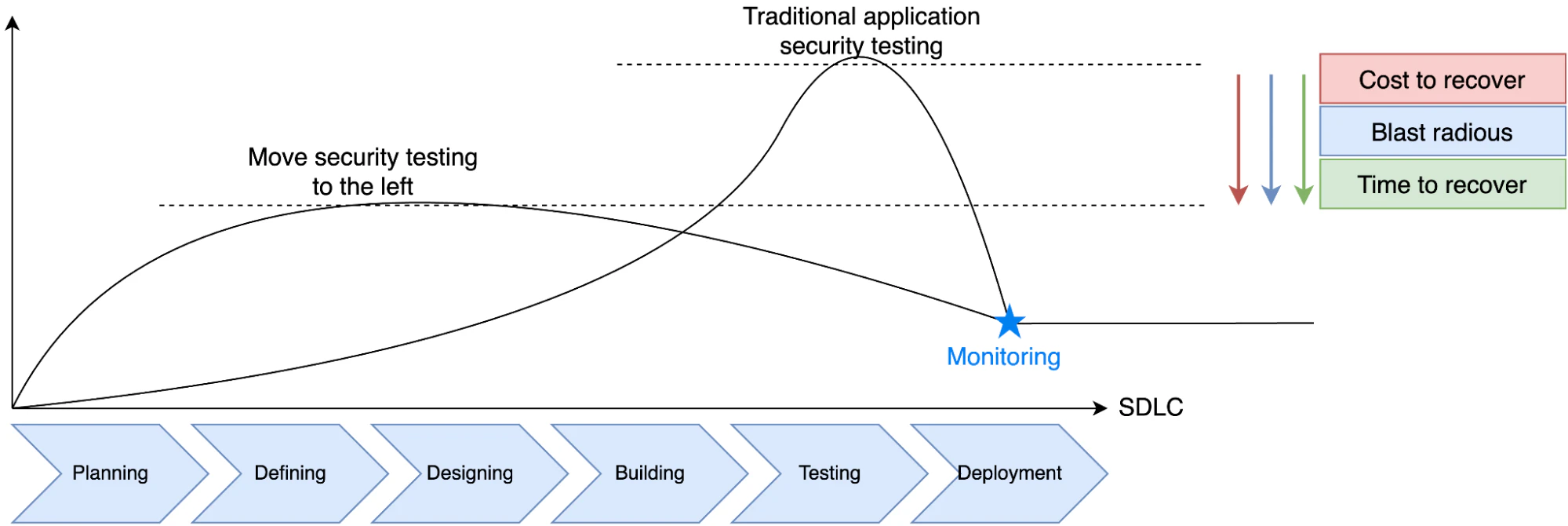
Start-left security takes the shift-left concept further. Coined by Wiz, "start left" means embedding security from the planning and design phases of the software development lifecycle. This ensures security is a foundational part of how software is conceived. This approach, a key feature of Wiz Code, allows teams to catch and fix security issues early on, reducing the delays when you have to backtrack to fix security flaws later.
Watch 5-minute demo
Watch the demo to learn how Wiz Code scans infrastructure as code, container images, and CI/CD pipelines to catch risks early—before they reach the cloud.

Types of application security testing
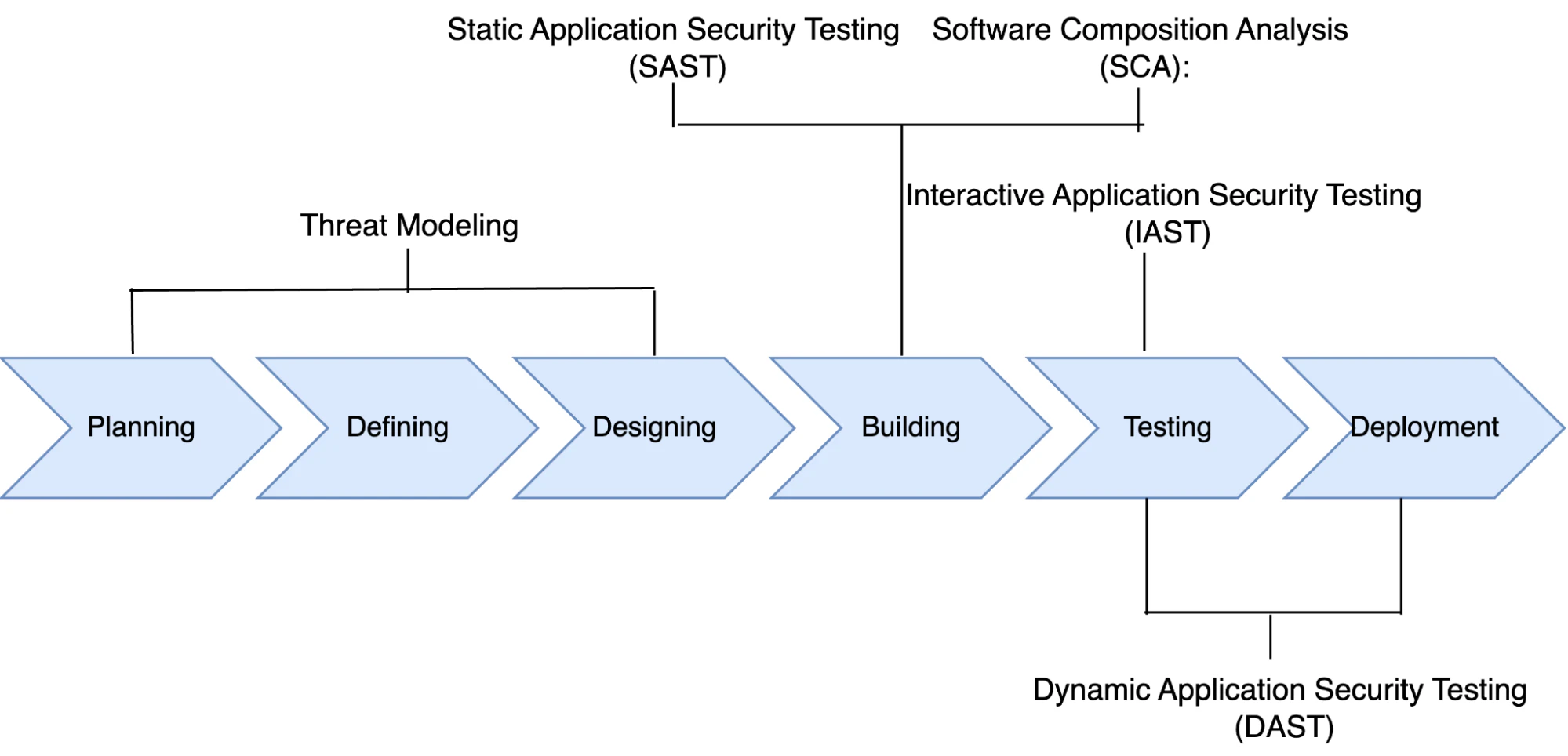
The OWASP Web Security Testing Guide 4.2 provides a structured framework for understanding the testing types available across the SDLC. Most modern programs layer multiple methods, each targeting a different attack surface.
Threat modeling
Threat modeling is a structured process that uses vulnerabilities, organizational values, and application needs to shape a clear security profile. This aids in making informed decisions throughout the designing, building, testing, and deployment stages. (The Threat Modeling Manifesto, developed in 2020, emphasizes the need for threat modeling during the earliest stages of the SDLC.)
Static application security testing (SAST)
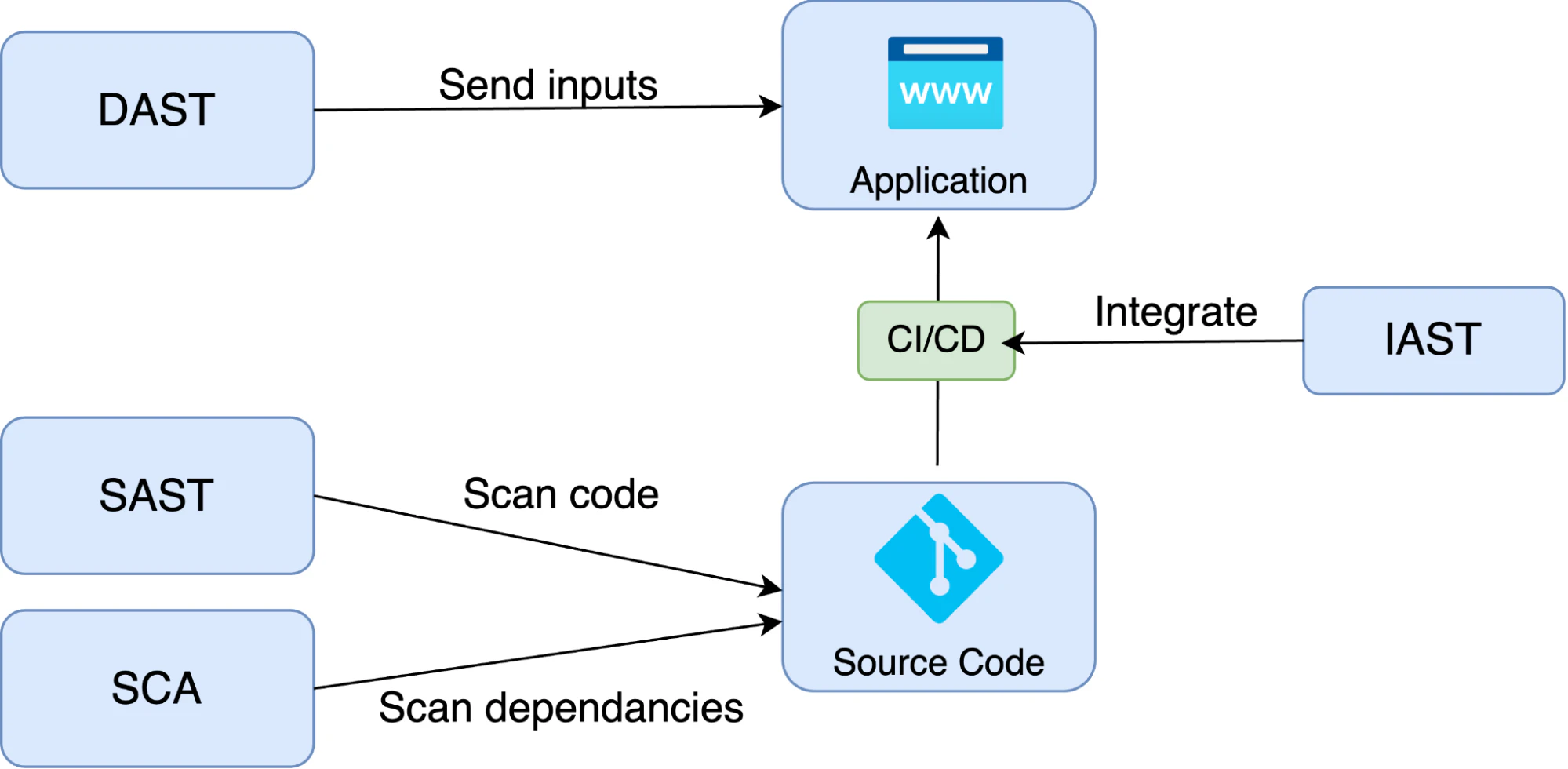
Static application security testing (SAST) is a white-box testing method that uses automated code analysis tools to scan application source code, binaries, and byte code for known vulnerabilities, without executing the application. Because SAST tools don't interact with applications externally but instead scan the application code to identify any known vulnerabilities, it's considered a form of passive testing.
Static application security testing enables early detection because SAST tools can integrate into IDEs and CI/CD pipelines to catch issues early, though efficiency depends on rule tuning and reducing false positives. SAST is also significantly faster than manual code review because these tools have access to a large database of syntactic and semantic flaws that lead to known vulnerabilities.
AI-enhanced SAST tools are evolving to reduce false positives and improve detection accuracy by learning from past vulnerabilities, refining their detection models based on historical security incidents. This advancement helps developers focus on high-impact security findings rather than sifting through large volumes of noisy results.
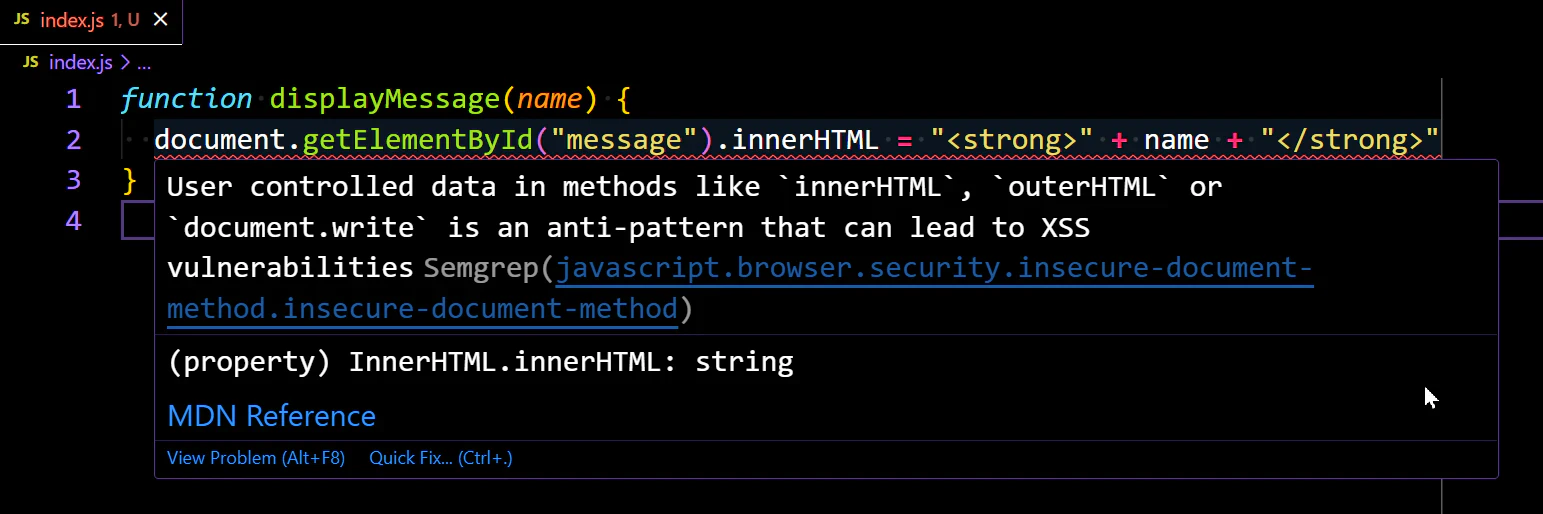
Popular open-source tools like Semgrep, SonarQube, and CodeQL are specifically built with SAST in mind. These tools support almost all modern programming languages and can integrate into a developer's favorite IDE, making the process easier for developers. (There are also some language-specific SAST tools, such as nodejsscan for JavaScript, Brakeman for Ruby, gosec for Go, and Bandit for Python.)
Advanced SAST tools can also analyze an application's control flows, surfacing vulnerabilities that simpler pattern-matching rules miss.
Software composition analysis (SCA)
Software composition analysis (SCA) is a testing method that increases code visibility by indexing all open-source dependencies and associated packages into an inventory known as a software bill of materials (SBOM). Secret scanning extends this coverage to credentials and tokens that may be inadvertently committed alongside code. Modern applications rely on many open-source dependencies that may contain malicious code; in fact, 90% of malicious packages originated from public registries, making SCA (and SBOMs) crucial.
For example, in March 2022, the Spring4Shell vulnerability (CVE-2022-22965) was found in the popular Spring Framework with a 9.8/10 severity level. Integrating an SCA tool early in the SDLC would help you identify the use of a vulnerable version of the Spring Framework, which could lead to earlier detection, quicker remediation, and a smaller blast radius.
Popular open-source tools like OpenSCA and OWASP dependency-check are specifically built with SCA in mind. These tools support dependencies associated with modern programming languages, including JS, Java, Python, Ruby, .NET, Go, Scala, PHP, and many more. There are also some language-specific SCA tools, such as Retire.js for JS and Bundler-audit for Ruby.
Dynamic application security testing (DAST)
Dynamic application security testing (DAST) is a black-box testing method that identifies application runtime vulnerabilities by testing the application externally while it is running, without requiring access to the source code. DAST tools are also commonly applied to API endpoints, testing for authentication flaws, injection vulnerabilities, and excessive data exposure.
Because it works on applications as they run, DAST often comes late in SDLC, after SAST and SCA. Michael Felderer, a pioneering security researcher, organizes DAST into four categories:
Penetration testing simulates an attack on a system similar to how a hacker would in order to discover and fix security vulnerabilities. Pen testing uses only the system's public interfaces, so the target application has to be in a production/production-ready state. Open-source tools like Metasploit Framework are popular for application penetration testing.
Vulnerability scanning tools can detect security weaknesses by systematically sending predefined attack payloads to an application. OpenVAS is one of many open-source vulnerability scanners for network services and software packages.
Dynamic taint analysis tracks how data from untrusted sources moves through the application and flags if there are any security vulnerabilities (e.g., cross-site scripting, SQL injection). Open-source tools like libdft are a good choice for tracking data flow in running applications.
Fuzzing involves feeding random data into a program to identify vulnerabilities by observing how the system handles unexpected or erroneous inputs. AFL is an open-source tool specifically built for fuzzing.


Interactive application security testing (IAST)
Interactive application security testing (IAST) is a gray-box testing method that monitors the application testing process in real time to identify vulnerabilities in data flow, control flow, and the runtime environment; all at once. Unlike SAST, which analyzes static code, or DAST, which tests externally, IAST works internally by monitoring an application as it runs in a test environment, using agents, to provide deeper insights into data flow and control logic.
The State of Code Security Report [2025]
Open-source dependencies are a major attack surface. The State of Code Security Report 2025 found that NPM and PyPI were heavily targeted by supply chain attacks, with dependency confusion and malicious packages leading to severe breaches.
Download report
Mobile application security testing (MAST)
Mobile application security testing (MAST) is a specialized discipline focused on identifying vulnerabilities unique to mobile applications on iOS and Android platforms. MAST evaluates risks such as insecure local data storage, improper session handling, weak encryption, and unsafe communication with backend APIs. Because mobile apps operate in diverse environments with varying OS versions, device capabilities, and network conditions, MAST combines static, dynamic, and behavioral analysis techniques tailored to the mobile context.
Runtime application self-protection (RASP)
Runtime application self-protection (RASP) is a security technology that runs inside an application to detect and block attacks in real time. RASP complements pre-deployment testing methods rather than replacing them: it catches what slips through into production, not what should have been caught earlier.
Unlike perimeter-based defenses such as web application firewalls, RASP instruments the application runtime itself, giving it visibility into actual execution context, data flows, and user behavior. This enables RASP to identify and respond to threats like injection attacks, unauthorized data access, and exploitation of known vulnerabilities with high accuracy and minimal false positives.
Application security testing best practices
Building a strong application security testing program requires more than adopting individual tools. The OWASP Top 10:2025 highlights that broken access control and software supply chain failures remain among the most critical risks, reinforcing the need for a layered approach. The following best practices help teams create a sustainable, effective approach:
Start left from the beginning. Embed security considerations into the planning and design phases of every project, not just the coding stage. Threat modeling during architecture reviews helps identify risks before a single line of code is written.
Layer multiple testing types. No single method catches every vulnerability. Combine SAST for code-level flaws, SCA for dependency risks, DAST for runtime issues, and IAST for deeper behavioral analysis to achieve comprehensive coverage.
Automate testing in CI/CD pipelines. Integrate security scans into your continuous integration and delivery workflows so that every code change is tested automatically, reducing manual effort and ensuring nothing slips through. Adopting a DevSecOps culture helps teams make automation a shared responsibility.
Prioritize findings by risk context. Not every vulnerability carries the same weight. Use contextual factors, such as whether the affected component is internet-facing or handles sensitive data, to focus remediation on the issues that matter most.
Track security metrics over time. Measure mean time to remediation, vulnerability recurrence rates, and coverage across your application portfolio to identify trends and continuously improve your security posture. According to the Wiz State of Code Security Report 2025, 61% of organizations have secrets exposed in public repositories, highlighting the urgency of consistent monitoring.
Consolidate tools onto a unified platform. Managing separate tools for each testing type creates silos and increases complexity. A unified platform gives teams a single view of findings across the full application lifecycle, making it easier to prioritize and act.
How Wiz secures the full application lifecycle
Managing multiple tools for different stages of application development creates security silos, putting an extra burden on developers to manage complexity. Wiz Code offers a unified solution for all stages of the SDLC, covering threat modeling, SAST, SCA, DAST, and IAST:
Threat modeling: Wiz Code uses the Wiz Security Graph to connect to the infrastructure where the application will be hosted, mapping out cloud assets, configurations, and API security risks.
SAST: Wiz IDE Extension, WizCLI, and pull request scanning integrate directly with developer workflows to automate code analysis with immediate, actionable remediation. Wiz's SAST integration partners, such as Checkmarx, provide developers with real-time, prioritized feedback directly in their IDEs.
SCA: With agentless scanning and automated SBOM generation, Wiz gives you an inventory of all application dependencies at a glance.
DAST: Wiz Code ingests DAST findings from the Wiz Integration (WIN) Platform.
IAST: By integrating into CI/CD pipelines, Wiz Code offers real-time monitoring of the application testing process. With consolidated findings across testing tools, teams get a unified view of application risk without switching between platforms.
Wiz delivers detailed visibility across all stages of the application development lifecycle and all your infrastructure, going beyond traditional application security testing. For example, Cushman & Wakefield addressed critical code issues within 1 hour after consolidating their security tooling with Wiz.
Get a demo to see how Wiz Code covers the full application security lifecycle in a single platform.
Secure your SDLC from start to finish
See why Wiz is one of the few cloud security platforms that security and devops teams both love to use.
