



What is cloud forensics?
Cloud forensics is a branch of digital forensics focused on collecting, preserving, and analyzing evidence from cloud environments via APIs, provider logs, and workload snapshots rather than physical hardware. This capability is critical because the cloud is now the primary target for attackers, with cloud supply chain incidents increasing nearly four times over the last five years. When a breach occurs, your ability to map lateral movement and data exposure depends entirely on having forensic processes established before the incident.
Forensics is growing even more complex as AI transitions into the default infrastructure. According to the Wiz State of AI in the Cloud 2026 report, 81% of cloud environments now utilize managed AI services, and 90% run self-hosted AI software, creating an entirely new, highly interconnected layer of cloud infrastructure that investigators must be prepared to audit.
The 2026 Cloud Threat Report
See how real-world cloud threats are evolving across AI and traditional infrastructure.

Key objectives of cloud forensics
Effective forensics programs serve four core purposes that extend beyond understanding what happened during an incident:
Root cause identification: Determine exactly how attackers gained initial access and moved through your environment to enable targeted remediation rather than guesswork.
Blast radius assessment: Quantify which systems, data, and identities were compromised to scope your response efforts accurately.
Legal and regulatory support: Produce evidence that meets chain-of-custody requirements for litigation, insurance claims, and compliance investigations.
Prevention guidance: Translate findings into specific security improvements that prevent similar attacks in the future.
The critical insight most organizations miss is that forensic readiness must be established before an incident occurs. You cannot collect evidence from resources that no longer exist or logs that were never configured to capture the right events.
Cloud forensics vs. digital forensics
Traditional digital forensics assumes investigators can physically access hardware, image drives, and control the environment under investigation. Cloud environments break these assumptions, creating challenges like the following that legacy tools like endpoint detection and response (EDR) were never designed to handle.
No physical hardware access: Investigators can’t seize servers, image drives, or isolate machines. All evidence must be collected through cloud provider APIs and logging services.
Multi-tenancy constraints: Shared infrastructure means your forensic access is limited to your tenant's data. Provider cooperation may be required to access certain logs or artifacts.
Distributed data: Evidence is scattered across regions, availability zones, and services, often with inconsistent logging formats and retention policies.
Ephemeral resources: Containers, serverless functions, and auto-scaled instances can disappear in seconds, taking potential evidence with them.
Massive scale: Cloud environments generate log volumes that overwhelm traditional forensic tools designed for single-system analysis.
Diverse attack surface: VMs, containers, identities, serverless functions, and managed services each require different collection and analysis approaches.
These challenges explain why traditional EDR and SIEM tools struggle in cloud environments. Timeline reconstruction becomes particularly difficult when correlating CSP audit logs with workload runtime events across different time zones and logging formats. The solution requires purpose-built methods that account for cloud native architectures from the start.
What are the key stages in a cloud forensics investigation?
Every cloud forensics investigation follows three core stages: data acquisition, examination, and analysis with reporting.
Data acquisition
This is when evidence is gathered to support the investigative process. Speed is critical during acquisition because ephemeral cloud resources can disappear before evidence is captured.
Investigators must immediately collect data from multiple sources: CSP audit logs (AWS CloudTrail, Azure Activity Logs, GCP Audit Logs), network telemetry from VPC Flow Logs or runtime sensors, and memory dumps from affected workloads.
The key requirement is that collection mechanisms must already be configured and tested. If you wait until an incident to enable CloudTrail logging or configure snapshot automation, the evidence you need may already be gone.
Examination
During this stage, designated file system assets are tested for any modifications (add, delete, modify). The solution looks for tell-tale signs left by an attacker that could lead to future compromise, such as hidden files and malware droppers (a category of Trojan horse). This process can be aided with a file integrity monitoring tool.
All critical environments and storage must be tested to determine the presence of viruses and other malware. Persistence checks are also critical at this stage, identifying processes and accounts (such as secret backdoors) that leave your organization compromised or exposed to future attacks, including changes to system settings or network configurations.
In the cloud, identity plays a major role in this analysis, and examination of CSP IAM activity is key to ensuring persistence is eliminated.
Analysis and reporting
Following examination, the solution interprets and reports on findings, providing as much information as possible to aid in classifying the incident (type, timeline, methods, and scope, meaning what exactly has been compromised). It will also analyze data that could help identify the perpetrator: IP, country, tell-tale indicators of compromise (IoCs), techniques, or tools associated with known threat actors.
Forensic analysis provides insights in five essential categories:
| Category | Examples of relevant data points for forensics |
|---|---|
| Initial access | User ID, IP address, login attempts, login credentials used |
| Lateral movement | Signs of privilege escalation, container escape, suspicious network traffic, other IOCs |
| Persistence | Process creation, startup and/or backdoor scripts, suspicious processes, autorun locations |
| Breach impact | Least privilege IAM violation (e.g., access granted to sensitive resources), evidence of unauthorized access, file properties, encrypted/cleartext storage |
| Future prevention | Accounts used, exposed cloud services, access controls, container privileges, encrypted/cleartext data storage, misconfigurations |
A cloud forensics report should provide recommendations wherever possible, such as:
Vulnerabilities to address
Suggestions to remedy misconfigurations
Additional controls needed
Recovery and restoration steps
Reporting the results of cloud forensics techniques provides useful evidence to security investigations or legal teams, arming you to take appropriate next steps.
Forensic teams must be particularly equipped to analyze autonomous entities. Wiz’s 2026 data shows that 57% of organizations have deployed self-hosted AI agents and 80% have adopted Model Context Protocol (MCP) servers. If compromised, these overprivileged control planes allow attackers to move laterally and exfiltrate sensitive data at machine speed.

Real-life example: Cloud forensics in action
In this simulation of an actual attack scenario on a development environment running an Apache Web server on Google Cloud Platform's (GCP) Kubernetes Engine (GKE), the forensics workflow was triggered by a runtime alert of a possible reverse shell attack taking place on a website-hosting pod. The runtime sensor flagged suspicious behavior that would have given attackers control over part of the system.
Here's how the cloud forensics solution kicked into action.
Data acquisition in action
The environment was prepared ahead of time to collect cloud provider audit logs, network flow logs, container orchestration logs, and workload runtime events. When the suspicious activity was detected, previously defined automation playbooks immediately began gathering image snapshots and other forensic artifacts before ephemeral data was lost.
Watch 5-min demo
See how Wiz Defend turns threat intelligence into real-time detection and response across your cloud environment.

Examination in action
File system, malware, and persistence analysis revealed the attacker's IP address in the reverse shell command line, indicating that initial access was via the WordPress web interface. Searching for this IP address in the Apache logs indicated that the threat actor's IP address had accessed the web interface, including an admin login and a file upload request.
The file upload enabled privilege escalation, and the attacker attempted to escape the container to gain direct access to the host. Once this succeeded, the attacker attempted to create a pod. Although this failed, an inspection of Docker images and containers revealed the attacker had created a privileged container that could execute a backdoor at startup. This attacker also performed lateral movement and exfiltrated privileged user data.
Analysis and reporting in action
Using cloud forensics tools, the team was able to derive the following information about this breach:
| Category | Examples of evidence collected |
|---|---|
| Initial access point | Weak WordPress credentials |
| Spread of attack | Lateral movement via container escape, sensitive data accessed |
| Persistence achieved | Yes, privileged pod created providing backdoor access |
| Breach impact | SERIOUS - S3 data event logs show a GetObject request from a malicious pod to the client-records bucket, indicating that sensitive client data was successfully exfiltrated |
| Future prevention | Take steps to secure weak WordPress credentials, exposed admin panel, internet-facing service on a privileged container, and sensitive data stored in cleartext in an S3 bucket |
Legal and compliance considerations
Forensic findings are only valuable if they can withstand legal scrutiny, which can be challenging for multi-jurisdiction companies. For example, if your data spans AWS regions in Frankfurt, Azure availability zones in Singapore, and GCP projects in Virginia, you may be subject to conflicting legal frameworks.
GDPR, CCPA, and local data sovereignty laws all affect what evidence you can collect, retain, and transfer across borders, as seen when major providers have faced challenges when ordered to provide access to data protected by foreign privacy laws.
Every piece of evidence must have documented provenance showing who collected it, when, how, and that it remained unaltered. Cloud native evidence collection must produce tamper-evident logs and cryptographic verification to meet this standard. Frameworks like PCI DSS, HIPAA, and SOC 2 increasingly require demonstrated forensic capabilities as part of incident response programs.
The foundational principle remains: preserve evidence integrity first. Any investigative action that modifies the original evidence compromises its admissibility in legal proceedings.
Types of cloud forensics tools and technologies
After a security breach, rapid root cause identification is critical. Organizations still take an average of 64 days to contain an incident, a time that allows ephemeral cloud resources to disappear along with critical evidence. Manual forensic processes cannot keep pace with cloud environments, which is why IT and data security engine Cribl used automation to reduce investigation time from days to minutes.
Cloud investigation and response automation (CIRA) addresses this gap by automating evidence collection and using AI to analyze massive data volumes in real time. With 62% of organizations prioritizing automation for the next year, automated forensics capabilities have become essential for containing incidents before they escalate.
Several tool categories support forensic analysis in cloud environments:
| Tool category | Forensic capabilities |
|---|---|
| Cloud provider tools | Management consoles to collect and analyze IAM audit logs, snapshots of virtual machines, and other artifacts for further analysis |
| Network analysis tools | Capture and analyze network traffic for suspicious activity |
| Log analysis tools | Parse and analyze cloud platform logs |
| Memory forensics tools | Acquire and analyze the contents of a cloud instance's memory |
| Data carving tools | Extract deleted or fragmented data from cloud storage for additional analysis |
| Virtual machine image analysis tools | Analyze virtual machine disks and extract evidence from the guest operating system |
Some cloud providers have introduced their own native cloud forensics tools. For example, Amazon has published a comprehensive guide to digital forensics in AWS cloud environments. Additionally, Google Cloud offers configuration tips to provide for forensic analysis.
Multi-cloud and hybrid forensics
Most enterprise environments now span AWS, Azure, GCP, and on-premises infrastructure. This fragmentation creates forensic challenges that single-cloud tools can’t address.
Each provider uses different logging schemas, timestamp formats, and API structures. Correlating an IAM role assumption in AWS with a service principal action in Azure requires normalizing data across incompatible formats. Without a unified investigation platform, analysts spend more time translating between systems than investigating.
The practical requirement is a forensic solution that can ingest, normalize, and correlate evidence across all your cloud environments from a single interface. Manual correlation across provider-specific consoles is too slow when attackers are actively moving through your environment.
How Wiz supports cloud forensics investigations
Wiz automates the forensic capabilities that make the difference between a contained incident and a prolonged breach.
Cross-cloud correlation: Investigate incidents spanning AWS, Azure, GCP, OCI, Kubernetes, and hybrid environments from a unified console.
Automated evidence collection: Capture disk snapshots, memory dumps, and log artifacts immediately when threats are detected, before ephemeral resources disappear.
Secure chain of custody: Maintain cryptographically verified evidence integrity that meets legal and regulatory requirements.
Response automation: Execute pre-built playbooks to isolate compromised resources, revoke credentials, and preserve evidence simultaneously.
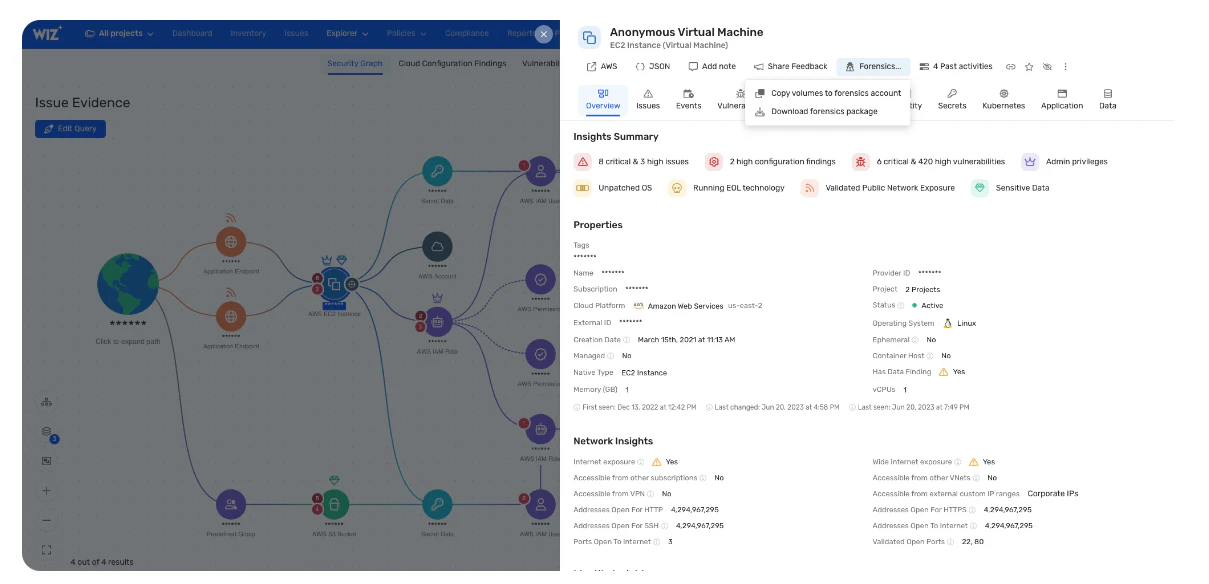
As you deploy AI workloads alongside traditional infrastructure, forensic investigations increasingly need to trace data flows through training pipelines and model endpoints. This is critical given that 68% of organizations running self-hosted models ingest them via third-party software, inheriting transitive supply chain risks they might not even be tracking. Furthermore, with 80% of organizations adopting AI IDE extensions, vibe coding has led to systemic security flaws in 1 in 5 environments.
Wiz extends forensic visibility into these AI components as part of your broader cloud security posture, ensuring shadow AI doesn't leave blind spots in your incident response.
Book a demo to see how Wiz simplifies forensic investigations across your entire cloud environment.
See Cloud Forensics in action
Wiz maps threats to real cloud assets, identities, and data paths — so your team can prioritize what matters most.
