

What is enterprise AI?
Enterprise AI is the use of AI technologies across an entire organization to automate tasks, support better decisions, and drive measurable business results. It is not a single tool but a set of capabilities embedded into the systems that employees and customers already use.
In practice, this means AI is wired into key business platforms such as enterprise resource planning (ERP), customer relationship management (CRM), HR systems, and supply chain tools. Instead of a separate “AI app” on the side, intelligence is infused into existing workflows so users get recommendations, predictions, and automation inside their normal tools.
Because enterprise AI systems are embedded into core business platforms and handle sensitive data, AI security becomes a foundational requirement. Securing enterprise AI means protecting not just models, but the data pipelines, identities, and cloud infrastructure that AI systems depend on.
Several core technologies make up modern enterprise artificial intelligence:
Machine learning (ML): Finds patterns in historical data to predict things like demand, churn, or fraud.
Natural language processing (NLP): Understands and generates human language to power document analysis, chatbots, and sentiment analysis.
Computer vision: Interprets images and video for use cases such as quality inspection or identity verification.
Generative AI and large language models (LLMs): Create content, write code, summarize documents, and act as “copilots” for employees.
Enterprise AI also operates at a much larger scale than typical side projects. Models may serve thousands of users, process millions of events per day, and run across multiple regions and clouds. Because of this, they must be built and managed with strong reliability, security, and regulatory controls in mind, along with clear data residency policies, privacy safeguards, and defined shared-responsibility boundaries with cloud AI providers (AWS Bedrock, Azure OpenAI Service, Google Vertex AI).
The 4-Step Framework for AI Threat Readiness
Wiz has designed a 4-step framework to help organizations defend against rapid, automated exploitation in a post-Mythos world.

How enterprise AI shows up across the organization
Enterprise AI is easiest to understand by looking at where it shows up in day‑to‑day work. Most teams will experience AI through the applications they already use rather than a separate “AI platform” screen.
Operations and process automation use AI to read documents, classify them, and route them without human intervention. For example, intelligent document processing can extract data from invoices or contracts, validate it, and push it into back‑office systems.
Sales and marketing teams use enterprise AI solutions to score leads, segment customers, and personalize offers. Models learn which actions and messages lead to closed deals or higher engagement, and then suggest next best actions for sales reps.
Customer support teams see AI in chatbots that handle common questions and smart routing that sends tickets to the right team. This reduces handling time and surfaces cases that truly need a human expert.
Finance and risk functions use enterprise machine learning to detect fraud, assess credit risk, and monitor regulatory compliance. Models look for unusual patterns in transactions and alert teams when something drifts outside of policy.
Engineering and IT teams benefit from AI copilots that assist with code generation, test creation, and infrastructure automation. Research shows these tools deliver a 31.8% reduction in PR review cycle time, directly accelerating software delivery. AI can propose configuration changes or help troubleshoot incidents by summarizing logs and suggesting likely root causes.
Manufacturing and logistics rely on computer vision and time‑series models to power predictive maintenance and quality inspection. These applications directly affect uptime, cost, and safety.
Knowledge management is transformed with LLM‑based enterprise search, document summarization, and internal Q&A assistants. Instead of digging through wikis and PDFs, employees can ask questions and get context‑aware answers grounded in company content.
Across all of these use cases, AI is working with sensitive data, core business logic, and critical infrastructure. That is why governance, architecture, and security need to be part of the design from the start, not bolted on later.
What makes enterprise AI different from smaller-scale AI use
Enterprise AI differs from small experiments or consumer tools because of how deeply it is embedded into the organization and how much impact it can have when something goes wrong.
At the enterprise level, AI systems operate at significant scale. Models may train on years of historical data and serve predictions or recommendations to thousands of users at once. These workloads often run continuously and support core business functions rather than isolated use cases.
Enterprise AI is also built on shared platforms and infrastructure. Models commonly rely on centralized data lakes, shared GPU clusters, and common messaging systems. While this improves efficiency, it also increases risk: a single misconfiguration in a shared service can affect multiple teams and business units simultaneously.
Deployments are typically distributed across regions and clouds. The same AI platform may support finance teams in Europe, marketing teams in North America, and operations teams in Asia, each with different regulatory and data residency requirements. Security and governance controls must account for this complexity from the start.
Unlike short-lived proofs of concept, enterprise AI systems are long-running production services. They require versioning, monitoring, and incident response processes similar to other critical infrastructure. Over time, these systems accumulate dependencies on data pipelines, identities, and downstream applications, which expands their potential blast radius.
Finally, enterprise AI routinely processes high-value and regulated data, including customer records, financial information, and intellectual property. A single exposed model endpoint or over-permissioned service account can impact multiple systems and users at once. This is why enterprise AI demands clear ownership, accountability, and governance that go far beyond what is needed for smaller-scale AI use.
Security and governance implications of enterprise AI
When AI becomes part of core business workflows, security risks extend beyond individual models. Enterprise AI systems inherit the access, privileges, and trust of the platforms they integrate with, which means failures can have organization-wide impact.
Data access and exposure risks
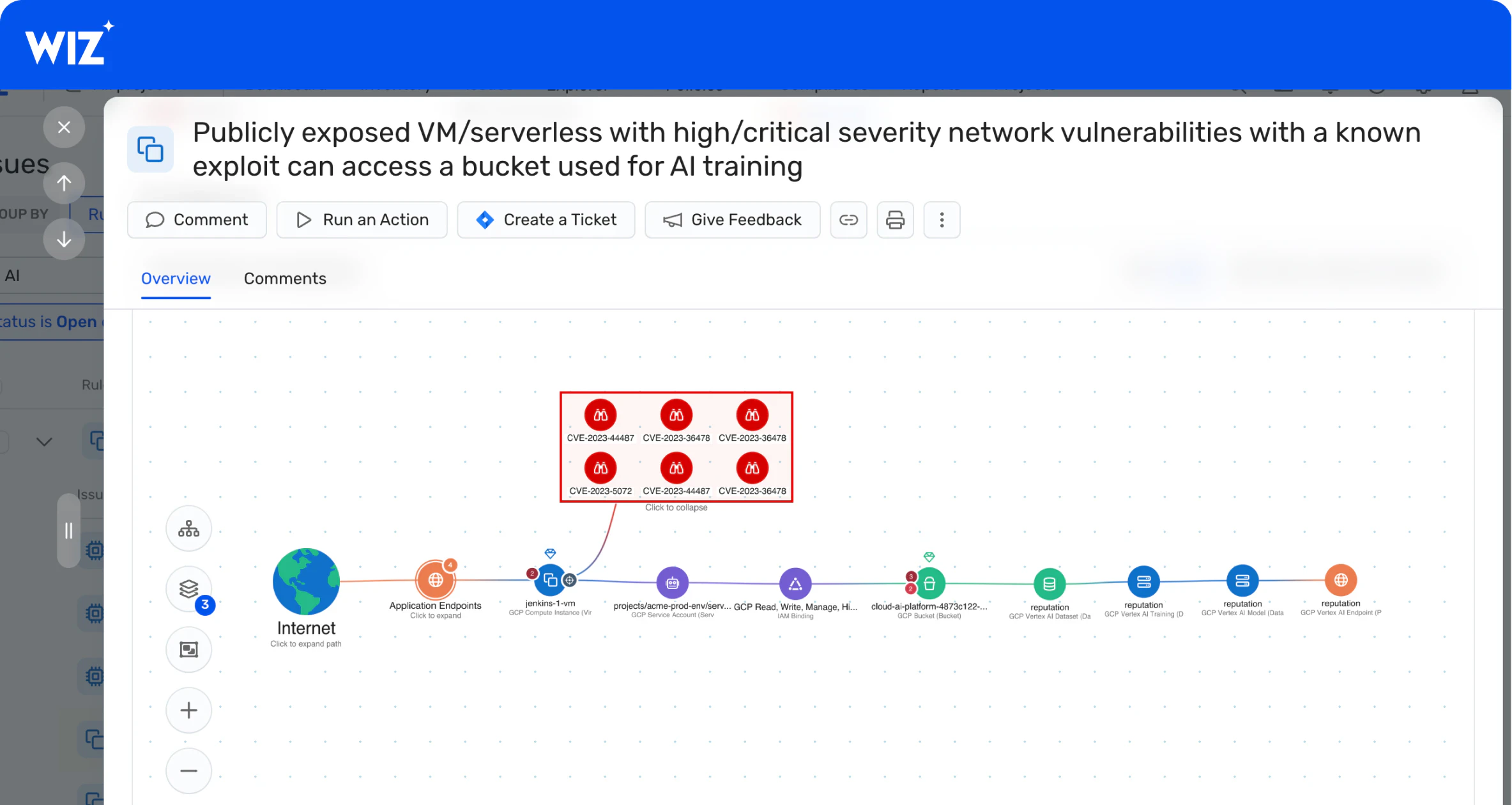
Enterprise AI systems routinely interact with sensitive business data, including customer records, financial information, and intellectual property. Training datasets, feature stores, prompts, and retrieval sources all introduce potential exposure points. Without strong data governance, sensitive information can be leaked through misconfigurations, overly broad access, or unintended model outputs.
Managing this risk requires visibility into how data flows through AI pipelines and which identities are authorized to access it.
Identity and permission management
AI workflows depend on service accounts, API keys, and managed identities to retrieve data and call downstream services. When these identities are over-permissioned, they create lateral movement opportunities across cloud environments. In large enterprises, a single misconfigured AI service identity can expose multiple systems and datasets.
Least-privilege access and continuous permission review are essential to limiting blast radius.
AI-specific attack patterns
Enterprise AI introduces security challenges that traditional application controls do not fully address. Retrieval-augmented generation pipelines expand the attack surface by dynamically pulling data into model context. Prompt injection attacks can manipulate retrieval logic or tool execution to access unauthorized data sources or exfiltrate information.
At scale, integrity risks also emerge. Poisoned training data can alter model behavior, while adversarial inputs may produce misleading outputs without obvious failure signals. In some cases, attackers can infer sensitive training data from model responses even when systems appear to function normally.
Inside MCP Security: A Field Guide
Explore emerging AI security risks including protocol-level attack surfaces and tool execution threats.

Governance and compliance requirements
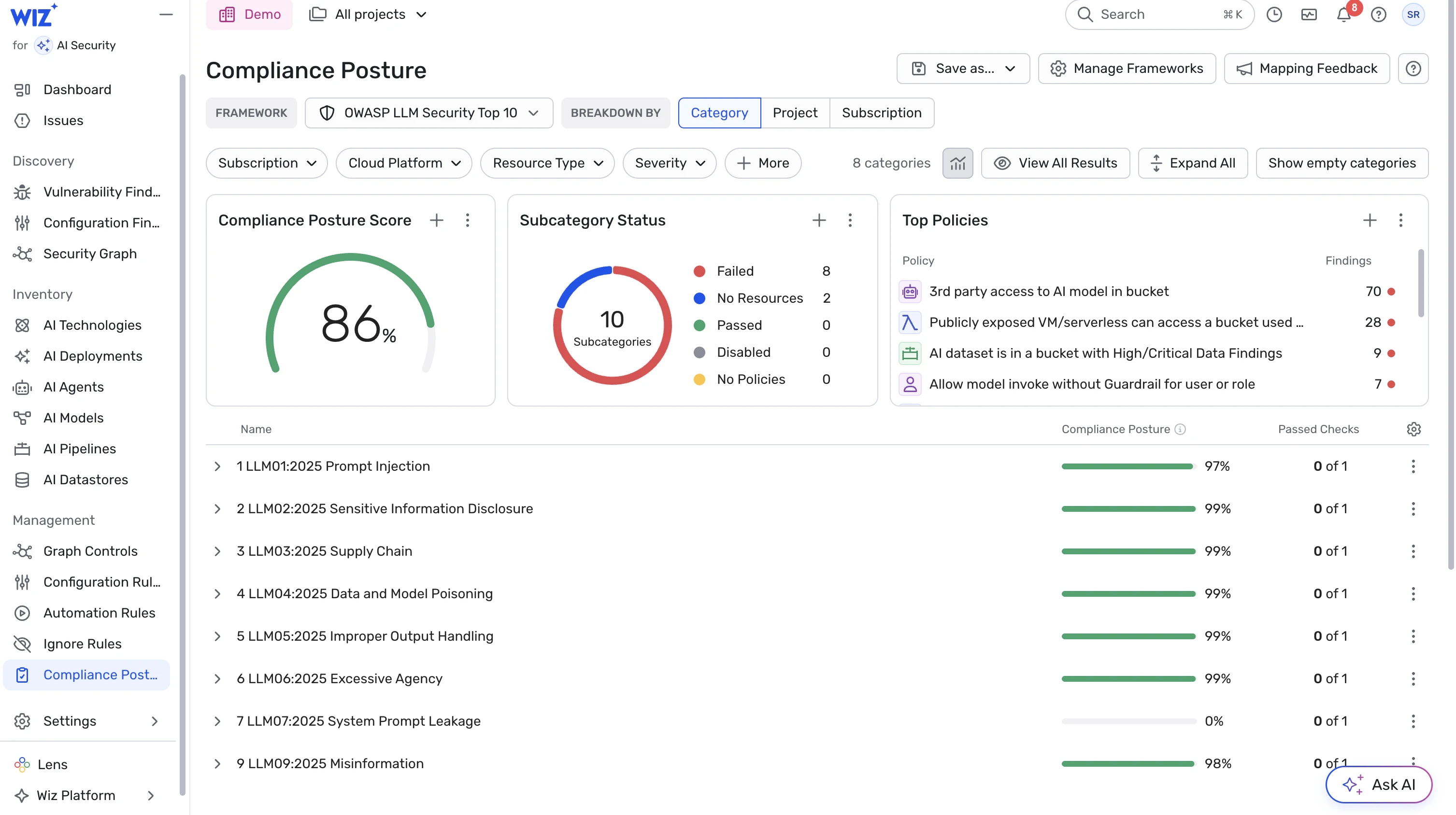
As AI systems influence decisions and automate workflows, governance becomes mandatory. Organizations must define who can deploy models, what data they can access, and how outputs and decisions are logged and reviewed. Without clear ownership and auditability, it becomes difficult to investigate incidents or demonstrate compliance.
Enterprise AI deployments must also align with regulatory and governance frameworks such as GDPR, CCPA, SOC 2, ISO/IEC 27001, ISO/IEC 42001, the NIST AI Risk Management Framework, and, in some regions, the EU AI Act.
The objective is not to slow innovation, but to ensure AI systems remain trustworthy and controllable as they scale across the organization.
Implementation challenges enterprises face with AI adoption
Even when the value of enterprise AI is clear, turning pilots into production systems is difficult. Most challenges come from integrating AI into existing environments rather than from the models themselves.
Integrating AI with legacy systems
Many enterprises rely on legacy databases and applications that were never designed for real-time analytics or AI-driven workflows. Connecting modern AI services to these systems requires careful architecture, data normalization, and access controls. Without this groundwork, AI projects struggle to move beyond experimentation.
Scaling from pilot to production
AI proofs of concept often succeed in isolated environments but fail to scale. Production deployments must handle reliability, failover, monitoring, and regional availability. Industry research shows that only a small percentage of organizations successfully operate AI systems at scale, highlighting the gap between experimentation and enterprise readiness.
Data quality, access, and governance
AI systems depend on high-quality data, but enterprises must also enforce strict access controls over sensitive datasets. Teams often struggle to balance model accuracy with data minimization and compliance requirements. Conflicting goals between data availability and security slow adoption and increase operational friction.
Fragmented ownership across teams
Enterprise AI initiatives span data engineering, data science, application development, and security teams. When ownership is unclear, responsibilities such as model retraining, access reviews, or incident response can fall through the cracks. Consolidating visibility and policy enforcement reduces handoffs and shortens time to remediation.
Inconsistent environments and configurations
AI systems frequently behave differently across development, staging, and production environments due to configuration drift or inconsistent access policies. These differences make troubleshooting harder and introduce risk when changes are promoted to production without full visibility into their impact.
Shadow AI and uncontrolled tooling
Developers can easily adopt AI tools through SaaS platforms without centralized approval. While this accelerates innovation, it also introduces shadow AI pipelines that operate outside established governance and security controls. Without visibility into these tools, organizations cannot accurately assess risk exposure.
Visibility and cost management challenges
Many organizations lack a centralized view of their AI workloads, models, and data flows across cloud environments. This makes it difficult to assess security posture, enforce consistent policies, or control costs. Without observability, AI infrastructure spending can grow faster than business value.
These challenges explain why enterprise AI adoption often stalls after early success. Addressing them requires not just better models, but clearer ownership, stronger visibility, and security controls that scale alongside AI workloads.
Secure enterprise AI reference architecture
A secure enterprise AI architecture connects data, models, and applications with clear security boundaries at each layer. The goal is not to lock everything down, but to ensure access is intentional, observable, and auditable across the AI lifecycle.
Data sources, ingestion, and residency
Enterprise AI systems ingest data from operational platforms such as CRM, ERP, logs, and third-party services into centralized data lakes or lakehouses. Data should be classified and tagged at ingestion so sensitivity and access policies propagate downstream.
For multi-region or regulated environments, it is also important to define where data is processed and stored. Data residency and sovereignty controls ensure that training, inference, and retrieval pipelines comply with regional requirements and contractual obligations.
Feature engineering and feature stores
Processed features used for machine learning models are stored in centralized feature stores to ensure consistency between training and inference. Access controls restrict which models and teams can read specific feature sets, while lineage tracking links features back to source datasets for auditing and incident investigation.
This layer helps prevent models from unintentionally consuming sensitive or restricted data.
Model training, validation, and registry
Models are trained in isolated environments using approved datasets and temporary credentials. All data access is logged, and outbound connectivity is restricted to reduce blast radius.
Before promotion to production, models should pass security and integrity checks. This can include scanning for unintended data leakage, validating model cards and documentation, and performing adversarial testing to detect backdoors or unsafe behavior. Approved models are registered with metadata covering training data, performance metrics, and intended use.
Deployment, inference, and input validation
Models are deployed to managed inference endpoints or containerized environments through controlled CI/CD pipelines. Network policies and API gateways enforce authentication, authorization, and rate limiting.
At inference time, input validation and sanitization are critical. User inputs and upstream signals should be inspected for prompt injection attempts or malformed requests before reaching the model. This reduces the risk of attackers manipulating model behavior or triggering unauthorized actions.
Retrieval-augmented generation pipelines
When retrieval-augmented generation is used, vector databases store embeddings derived from approved sources only. Retrieval services enforce access controls and validate which documents can be retrieved for a given user or application.
Retrieved context is clearly separated from user input to reduce indirect prompt injection risk. Output validation checks responses for sensitive data leakage or policy violations before returning results to users.
Observability, monitoring, and adversarial testing
Logs and metrics from across the AI stack feed into centralized monitoring systems. Security teams watch for unexpected data access, abnormal model usage patterns, or suspicious API behavior.
In addition to passive monitoring, organizations should perform periodic red teaming and adversarial testing of deployed models. These exercises help validate guardrails, uncover bypass techniques, and ensure controls remain effective as models and data evolve.
Policy enforcement across the stack
Policy enforcement relies on cloud-native identity and access management combined with platform-level controls. Least-privilege policies define who can access data, train models, deploy endpoints, or invoke inference.
Consistent enforcement across development, staging, and production reduces configuration drift and ensures security scales alongside enterprise AI adoption.
This layered architecture separates responsibilities across data, ML, platform, and security teams while maintaining shared visibility. Clear boundaries, continuous validation, and regular testing help enterprises deploy AI at scale without losing control over security and governance.
How Wiz supports secure enterprise AI adoption
Wiz helps organizations operationalize AI security by securing the cloud environments, identities, and data flows that enterprise AI systems depend on. Rather than treating AI as a separate security domain, Wiz evaluates enterprise AI workloads in the same code-to-cloud context as the rest of the organization’s infrastructure.
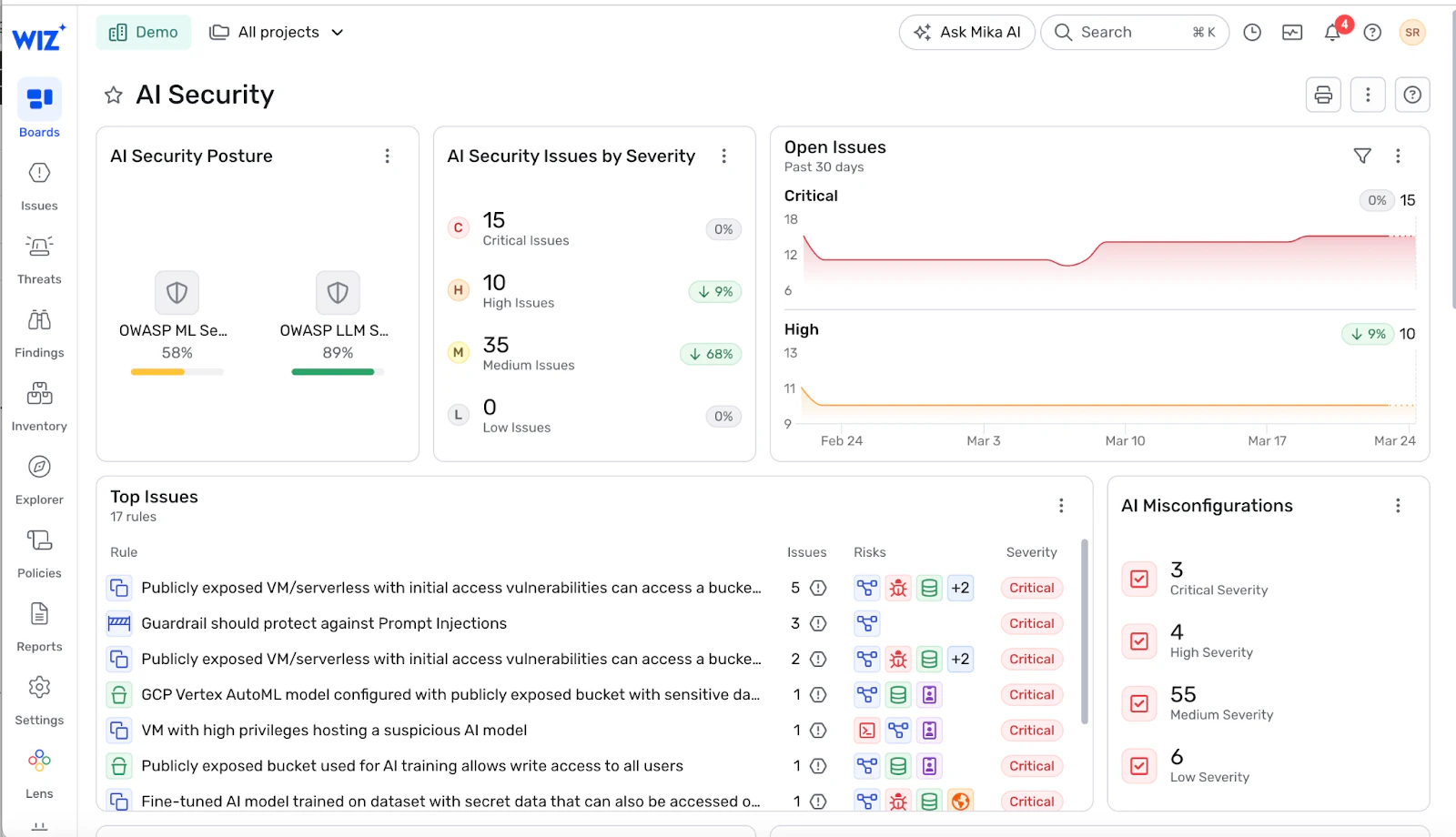
With Wiz AI Security Posture Management (AI-SPM), organizations gain visibility into AI-related cloud services across AWS, Azure, and Google Cloud, including managed AI platforms and self-hosted models running on Kubernetes or virtual machines. This makes it possible to inventory where models run, what data they can access, and which service identities are allowed to interact with them.
Wiz correlates this AI posture with cloud configuration, identity permissions, and data sensitivity using the Wiz Security Graph. Instead of surfacing isolated misconfigurations, Wiz highlights real attack paths, such as a publicly exposed inference endpoint that can reach sensitive training data through an over-privileged service account. This allows teams to prioritize remediation based on actual business impact.
Wiz also helps organizations continuously validate security posture as enterprise AI evolves. Changes to data pipelines, model deployments, or access policies are evaluated against existing exposure, reducing the risk that new AI capabilities introduce unseen security gaps. This approach enables teams to scale enterprise AI initiatives while maintaining control over security, compliance, and governance. Ready to see how Wiz secures enterprise AI across your cloud environment? Get a demo to explore AI-SPM and context-driven risk prioritization in action.
See how AI-APP connects the full stack
Experience Wiz's unified security graph mapping code, cloud, and runtime for your AI workloads.
