



What is attack path analysis?
Attack path analysis (APA) is a security methodology that identifies and maps the routes attackers could use to move through your environment and reach critical assets. This matters because individual vulnerability scans generate thousands of findings without showing which ones actually chain together into exploitable paths.
By modeling how misconfigurations, weak access controls, and security gaps connect, APA helps security teams understand not just what vulnerabilities exist, but which combinations pose the greatest threat.
The 2026 Cloud Threat Report
See which attack paths adversaries are actually exploiting in production cloud environments.

What are attack vectors and attack paths?
Understanding three related but distinct concepts helps clarify what APA actually does:
Attack path: The complete sequence of steps an attacker follows to compromise systems and reach high-value targets. Paths connect vulnerabilities, misconfigurations, and weak access controls into exploitable routes through your environment.
Attack vector: The initial entry point attackers use to gain access, such as phishing, unpatched software, or exposed credentials. Think of vectors as the door into your environment.
Attack surface: The total collection of all possible entry points and exposures in your environment. This includes every internet-facing service, API endpoint, identity, and misconfiguration that could be targeted, as the cloud-native attack surface expands to include runtime environments and supply chains.
The key distinction: vectors get attackers in, the attack surface defines where they can enter, andpaths show them where to go next.
How does attack path analysis work?
Attack path analysis works by modeling relationships between components in a cloud environment to identify potential chains of exploitation. The goal is to surface the paths that actually matter, not just list individual risks.
The process follows four stages:
Asset and risk discovery: Gain complete visibility into all cloud resources, including workloads, identities, configurations, and data. The system scans for vulnerabilities, exposed secrets, misconfigurations, and excessive permissions.
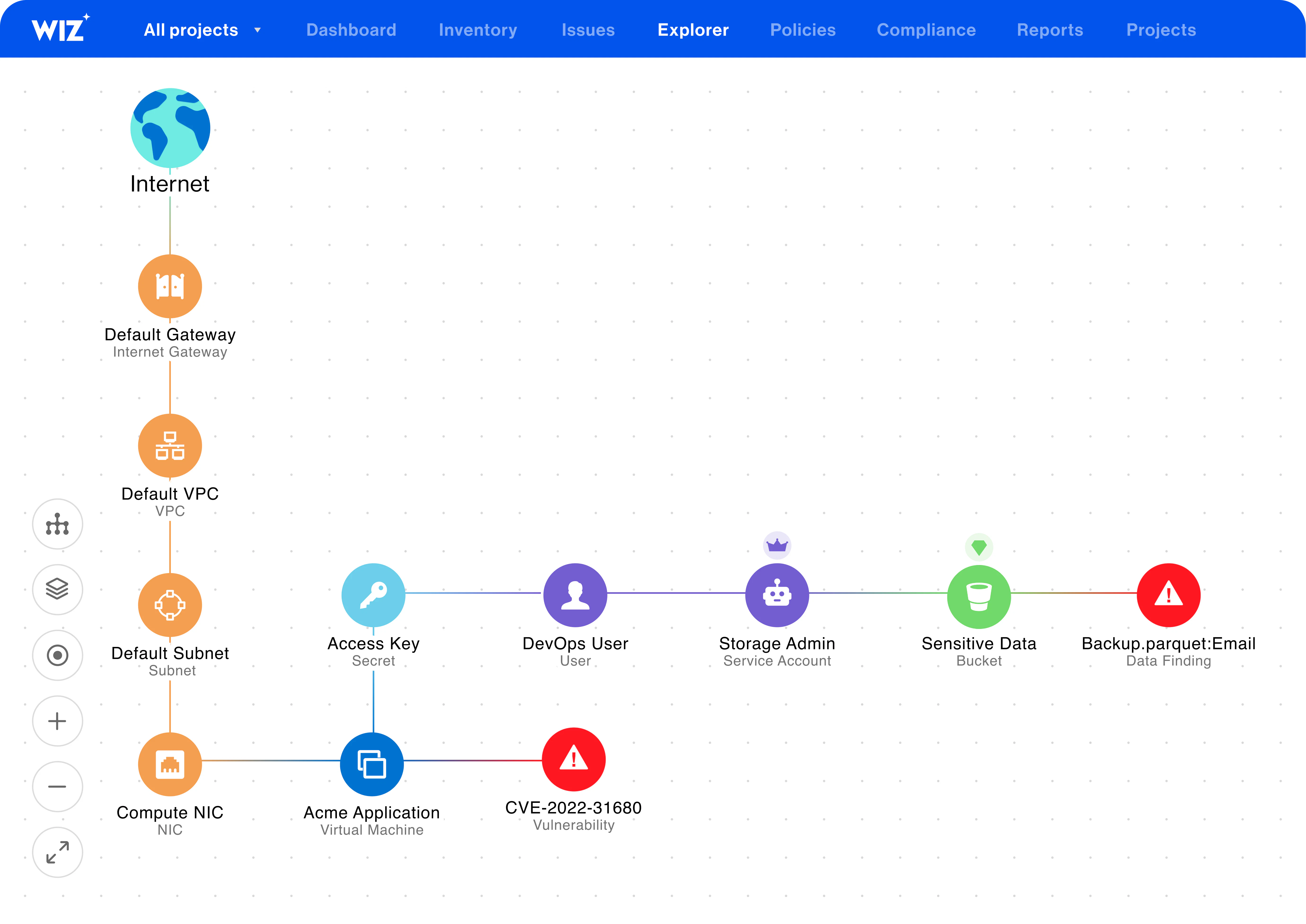
Graph-based mapping: Map identified risks onto a security graphthat connects resources and shows how different risks relate. For example, a VM with a public IP address and a high-severity vulnerability might link to an over-privileged identity.
Path identification: Analyze the graph to trace potential sequences of attacker actions. The system looks for toxic combinations where multiple low-risk issues chain together into a high-impact path to a critical asset.
Prioritization: Rank identified attack paths based on potential impact. Paths leading to crown jewel assets or elevated privileges are flagged as critical, focusing remediation on the threats that matter most.
CNAPP solutions automate this entire process, using a Security Graph to continuously map these connections and prioritize the attack paths that actually lead to your critical assets.
Benefits of attack path analysis
Attack path analysis transforms reactive security into proactive defense by revealing how individual vulnerabilities combine to create serious threats. Rather than managing thousands of isolated security findings, teams can focus on the combinations that actually matter.
Cloud environments amplify this challenge. Dynamic infrastructure and interconnected services create complex attack surfaces where traditional security approaches fall short. APA addresses this by mapping real-world attack scenarios, helping teams understand not just what's broken, but what's actually exploitable.
| Benefit | Description |
|---|---|
| Proactive threat management | Attack path analysis lets you anticipate potential threats and attack routes before an incident strikes. By evaluating your cloud resource configurations, vulnerabilities, and access controls, you can put essential guardrails in place before attackers find and exploit any weaknesses. |
| Prioritized vulnerability management | By understanding attack paths, you can prioritize vulnerabilities that should be mitigated first. Vulnerabilities that are on attack paths leading to critical assets pose a higher risk and need to be addressed immediately. |
| Targeted defense | Attack path analysis helps identify security gaps, your most vulnerable systems and open configurations. With information surfaced by attack path analysis, you can reinforce those specific areas. |
| Improved resource allocation | When a cloud estate is large or when security resources are limited, you have to prioritize where to invest in security. Attack path analysis helps allocate resources more efficiently so that you can address the most critical issues first. |
Watch 5-min demo
See how Wiz Defend detects and validates exploitable attack paths at runtime.

Wiz: Closing the Loop From Detection to Remediation
[Lottie Block] 1708593948-cnapp.json
Wiz's attack path analysis has evolved beyond static graph-based risk mapping into a full code-to-cloud-to-runtime loop. The Security Graph remains the foundation, connecting assets, identities, permissions, vulnerabilities, and threat activity into a single contextual model. It's now fed by runtime signals from the Wiz eBPF sensor that validate which paths are actually exploitable in production, not just theoretically risky.
When a confirmed attack path is found, Wiz traces it back through the cloud environment to the source code via Wiz Code and SAST, where AI-assisted remediation can open a fix PR directly. Combined with the outside-in perspective from Attack Surface Management, this gives security teams a closed loop: discover exposure externally, correlate it with internal misconfigurations and identity risks, confirm exploitability at runtime, and remediate at the code level.
AI Agents: Autonomous action across attack paths
Wiz's attack path analysis has evolved beyond static graph-based risk mapping into a full code-to-cloud-to-runtime loop. The Security Graph remains the foundation, now fed by runtime signals from the Wiz eBPF sensor that validate which paths are actually exploitable in production. When a confirmed attack path is found, Wiz traces it back to source code via Wiz Code, where AI-assisted remediation can open a fix PR directly. Combined with the outside-in perspective from Attack Surface Management, this gives security teams a closed loop: discover exposure externally, correlate it with internal misconfigurations and identity risks, confirm exploitability at runtime, and remediate at the code level.
Wiz AI Agents now bring autonomous action into every stage of this loop. The Red Agent continuously probes web applications and APIs for exploitable logic flaws, validating whether attack paths are genuinely reachable from the outside. The Blue Agent automatically investigates threats detected in Wiz Defend, correlating runtime signals, cloud telemetry, and identity context to produce a clear verdict with full reasoning. The Green Agent traces confirmed issues to their root cause, identifies ownership, and generates environment-specific remediation steps, including opening pull requests in code. These agents are orchestrated through Wiz Workflows, where teams define how and when AI acts, and where human approval is required, creating a continuous cycle of validation, investigation, and remediation. Ready to see how Wiz maps attack paths from code to cloud to runtime? Get a demo and see the full closed-loop in your environment.
See attack path analysis in action
Discover how Wiz connects exposure, identity risk, and runtime signals into prioritized attack paths.
