

What Vulnerability Management Means in Modern Cloud Environments
Vulnerability management is the continuous process of identifying vulnerabilities, assessing their exploitability, and prioritizing remediation. In simple terms, it is how you find and fix weaknesses in your software before attackers use them. In modern cloud environments, this process is much harder than it was in traditional data centers because the infrastructure changes constantly.
Cloud environments introduce new problems like ephemeral workloads, managed services, and shared responsibility models. Ephemeral workloads are temporary computing resources that spin up and shut down in minutes, often disappearing before a traditional scan can find them. Managed services shift some security duties to the cloud provider, meaning you must know exactly which risks you own.
Many organizations still rely on periodic vulnerability scans, such as weekly or monthly assessments common in legacy VM tools which leave gaps in fast-changing cloud environments where containers and serverless functions can deploy and scale within minutes.
Cloud security requires continuous analysis to catch issues the moment a new container or server launches. Vulnerability management alone does not answer exposure. Knowing a CVE exists in a package does not reveal whether the workload is reachable (externally from the internet or internally via network paths and IAM roles), whether it runs with elevated privileges, or whether it connects to sensitive data stores. These are all factors that determine if an attacker can exploit the flaw to cause business impact.
Vulnerability Management Buyer's Guide
This guide helps your security and dev teams finally start speaking the same language while giving you everything you need to objectively choose or replace your VM solution.

From Traditional Vulnerability Management to Unified Vulnerability Management (UVM)
Legacy vulnerability management failed because it overwhelmed teams with lists of problems they could not fix. Security teams faced "CVE overload," where tools flagged thousands of Common Vulnerabilities and Exposures (CVEs) without telling them which ones mattered.
With tens of thousands of new CVEs disclosed annually (over 25,000 in recent years according to NVD data), CVSS scores alone are poor predictors of real-world exploitation. Incorporating exploit likelihood signals (such as EPSS, Exploit Prediction Scoring System) and known-exploited vulnerability catalogs (such as CISA KEV) alongside runtime context materially improves prioritization accuracy, helping teams focus on the 2-5% of CVEs that attackers actively target. These tools relied on CVSS scores, which rate severity based on technical traits rather than real-world risk in your specific environment.
Unified Vulnerability Management (UVM) solves this by adding context to the raw data. UVM is a modern approach that combines vulnerability data with exploit context, runtime visibility, and infrastructure relationships. It looks at the vulnerability and asks if the workload is actually running, if it has dangerous permissions, or if it connects to sensitive data.
It is important to understand the boundary between UVM and exposure management.
UVM answers: “Which vulnerabilities matter based on internal risk?”
Exposure management answers: “Which of those risks are externally reachable by an attacker?”
UVM acts as a foundational input to exposure management by prioritizing vulnerabilities based on internal risk factors: runtime state, permissions, network reachability, and data access. Exposure management then validates which of those prioritized risks are reachable from external attack surfaces (internet-facing endpoints, third-party integrations) or exploitable through real-world attack paths, combining UVM's internal context with external threat intelligence.
Core Criteria for Evaluating Vulnerability Management (UVM) Vendors
When you evaluate vulnerability management platforms, you need to look for specific capabilities that handle the speed of the cloud. The following criteria cover the essential features a modern vendor must provide.
1. Asset Discovery and Coverage Across Cloud Environments
You cannot secure what you cannot see. A strong vendor must provide automatic discovery across all your cloud assets, including virtual machines (VMs), containers, Kubernetes clusters, serverless functions, and managed cloud services. If a tool misses parts of your environment, it leaves you exposed.
Agentless, cloud-native visibility is essential for rapid breadth of coverage across cloud APIs, container registries, and infrastructure-as-code templates. Organizations can complement agentless scanning with optional lightweight sensors (such as eBPF-based agents) to capture real-time workload telemetry, process-level visibility, and runtime blocking capabilities where deeper observability is required.
Support for multi-cloud environments is critical. Your tool should work seamlessly across AWS, Azure, and GCP without needing separate consoles for each one. It must also see ephemeral workloads that exist for only a short time.
Look for pre-deployment scanning capabilities that analyze container images, infrastructure-as-code templates (Terraform, CloudFormation), and software bill of materials (SBOM) within CI/CD pipelines. This catches vulnerabilities and misconfigurations before workloads reach production environments. Integration with your CI/CD pipeline ensures early detection, stopping risks before they reach production.
2. Cloud-Native Detection and Scanning Capabilities
Detection capabilities determine how deep the tool can look into your systems. The vendor should offer OS and package vulnerability detection to find flaws in your operating systems and installed software. It must also perform container image and registry scanning to check your software libraries.
Infrastructure as Code (IaC) scanning is vital for catching misconfigurations in your deployment templates. The tool should produce or ingest a Software Bill of Materials (SBOM) in standard formats (SPDX, CycloneDX) to inventory all components, including open-source libraries, base images, dependencies, across container images, builds, and registries, enabling supply chain risk tracking.
Speed is also a major factor. Vendors should rapidly incorporate new CVEs from the National Vulnerability Database (NVD), ideally within hours of disclosure, and immediately cross-reference them against exploit likelihood scores (EPSS), known-exploited vulnerability catalogs (CISA KEV), and your runtime context to deliver timely, signal-rich triage that separates urgent threats from theoretical risks. Continuous reassessment ensures that as your environment changes, your security posture remains up to date.
3. Accuracy and Contextual Vulnerability Prioritization
Modern tools must move beyond CVSS scores by incorporating multiple prioritization signals: runtime context (is the vulnerable package loaded and executing?), identity permissions (what can a compromised workload access?), network reachability (can other systems reach it?), sensitive data access (does it connect to PII or financial data?), exploit likelihood (EPSS scores predicting weaponization probability), and known-exploited catalogs (CISA KEV listing actively targeted CVEs).
A high CVSS score does not always mean high risk if the vulnerable asset is isolated. The right tool correlates vulnerabilities with runtime state, identity permissions, network reachability, and access to sensitive data.
Runtime state: Checks if the vulnerable package is actually loaded and running.
Identity permissions: Analyzes what a compromised workload could do.
Network reachability: Determines if other internal systems can reach the workload.
Access to sensitive data: Verifies if the workload connects to critical databases.
This context distinguishes theoretical risk from exploitable risk. Organizations using integrated prioritization frameworks report dramatic reductions in urgent remediation workload while preserving coverage of truly dangerous issues, allowing teams to focus engineering effort on vulnerabilities that combine exploitability, reachability, and business impact. This supports business-aware prioritization, where you fix the most critical assets first.
4. Attack Path and Blast Radius Analysis (UVM Scope)
Attack path analysis helps you understand how an attacker could move through your system. Attack path analysis examines how vulnerabilities enable lateral movement in cloud environments. For example, pivoting from a compromised container to other pods via Kubernetes RBAC permissions, or assuming IAM roles to access S3 buckets. It also identifies privilege escalation opportunities, such as exploiting a vulnerable Lambda function with overly permissive execution roles to gain admin access across AWS accounts.
Visualizing the blast radius helps you see the potential impact after access is obtained. This analysis identifies "toxic combinations," which occur when a vulnerability is paired with a misconfiguration or high privileges. This creates a much higher risk than the vulnerability alone.
Avoid conflating internal attack paths with external exposure. UVM focuses on the internal damage an attacker can do once they are inside. External exposure is a separate layer of analysis.
5. Remediation Workflows That Reduce Risk
The best vulnerability remediation providers in cloud security do more than just find problems; they help you fix them. Your vendor should provide clear, actionable remediation guidance that tells developers exactly what to do.
Tracing vulnerabilities back to source code or infrastructure-as-code templates enables root-cause fixes rather than runtime patches. Platforms should infer ownership by correlating cloud resource tags, Git repository metadata, CI/CD pipeline configurations, and organizational structure (teams, cost centers) to route findings to the likely responsible team, then integrate with ticketing systems (Jira, ServiceNow) to enforce remediation SLAs.
Integration with tools like Jira, ServiceNow, and Slack streamlines the process. Automated remediation can handle simple fixes without human intervention. Finally, enabling shift-left prevention in CI/CD pipelines stops bad code from being deployed in the first place.
AWS Vulnerability Management Best Practices Cheat Sheet
Secure your AWS environment with this definitive guide to cloud defense. From agentless visibility to automated patching, get the essential blueprint for hardening your workloads and neutralizing risks before they scale.

Integration With Security and DevOps Ecosystems
Vuln management tools must fit into your existing workflows, not create new ones. Integration is key to adoption by engineering teams.
Developer and DevOps Workflow Integration
Developers live in their IDEs and code repositories. The platform should provide feedback directly in pull requests, alerting developers to issues before they merge code. CI/CD policy enforcement ensures that security gates block unsafe deployments.
Self-service remediation allows developers to fix their own issues without waiting for the security team. DevSecOps-friendly workflows make security a shared responsibility, reducing friction between teams.
Security Platform Integration
Integrate with SIEM (Splunk, Chronicle, Sentinel) and SOAR (Palo Alto Cortex XSOAR, Torq) to centralize alerts and automate response workflows. Expose APIs and webhooks for custom automation. Share context bidirectionally with CSPM (misconfigurations), CIEM (identity permissions), and DSPM (data classification) to unify posture, exposure, and vulnerability views. This enables cross-domain risk correlation that reveals toxic combinations invisible to siloed tools.
Context sharing is vital. The vulnerability tool should share data with other security tools like Cloud Security Posture Management (CSPM) and Cloud Infrastructure Entitlement Management (CIEM). Data export capabilities allow you to pull data into custom reports or data lakes.
Collaboration and Ownership Management
Security is a team sport. The platform should support cross-team collaboration, allowing users to comment on findings and tag colleagues. Automated routing ensures that the right team gets the ticket based on who owns the asset.
Support for different organizational models is important. Whether you organize by product, region, or function, the tool should adapt to your structure.
How Wiz Delivers Unified Vulnerability Management
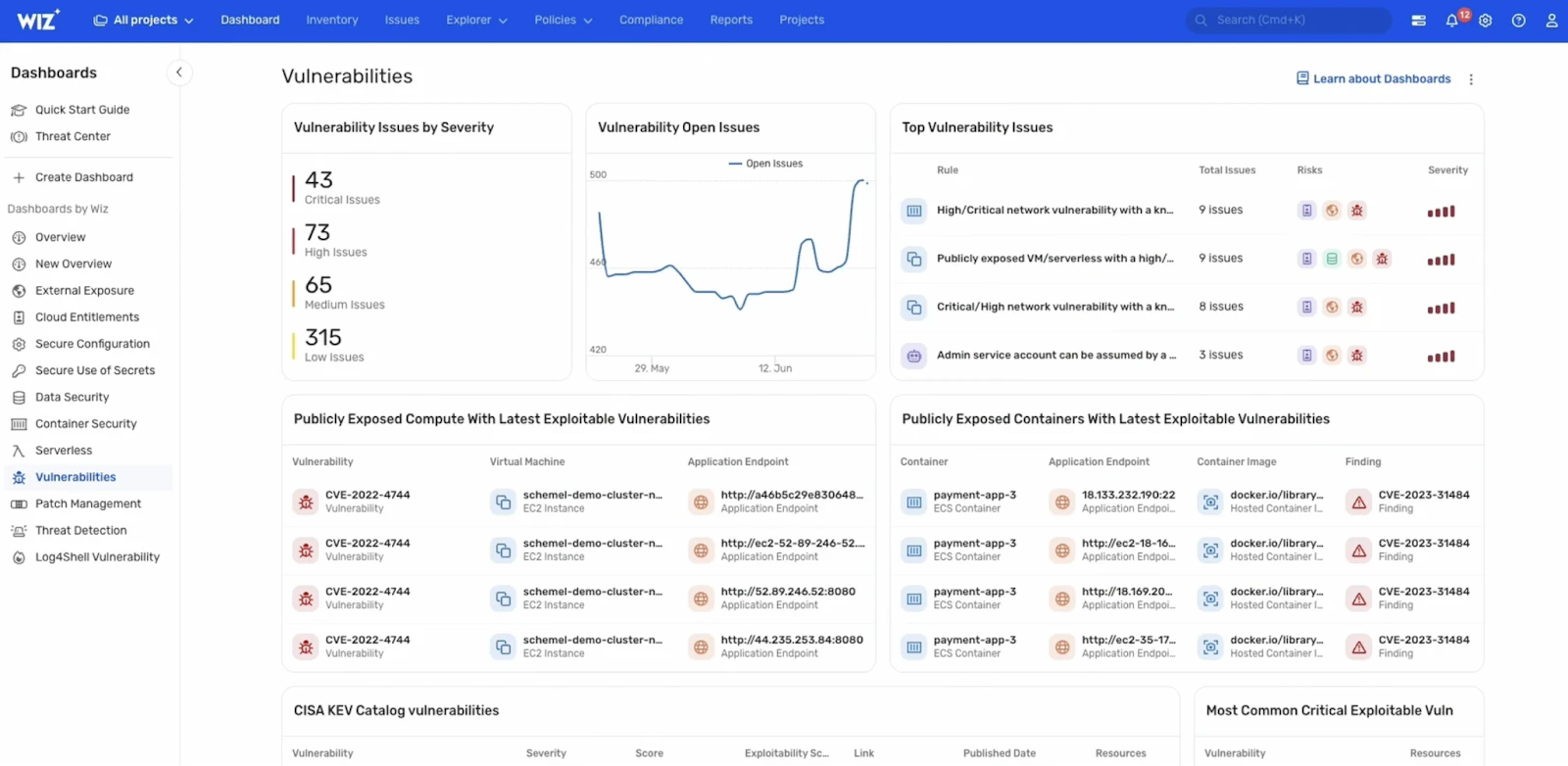
Wiz provides agentless visibility across cloud environments, connecting in minutes via API. This approach removes the need for agents and provides instant coverage. Wiz UVM correlates vulnerabilities with runtime context, identity permissions, and network relationships to show you which risks are real.
The platform performs attack-path analysis to show the internal blast radius of a vulnerability. Code-to-cloud correlation traces affected workloads back to source repositories, CI/CD pipelines, and likely owners (teams, individuals) by analyzing Git commit history, cloud resource tags, and deployment metadata. This accelerates remediation by routing findings to the teams most capable of fixing root causes.
Runtime detections surface behavior consistent with exploitation attempts against vulnerable workloads, such as unexpected process execution, privilege escalation system calls, or network connections to known malicious infrastructure, helping teams validate urgency and prioritize incident response for vulnerabilities showing signs of active targeting.
Wiz UVM integrates with Wiz ASM (Attack Surface Management) to enable full exposure management. This combination answers both "which vulnerabilities matter?" and "which are reachable from the outside?" As a unified CNAPP platform, Wiz reduces tool sprawl by bringing all these capabilities into one interface.
Guided Tour
See Wiz in Action
Learn how Wiz Cloud surfaces toxic combinations across misconfigurations, identities, vulnerabilities, and data—so you can take action fast.