

What is data security?
Data security is the practice of protecting digital information from unauthorized access, corruption, theft, and misuse throughout its entire lifecycle. This means safeguarding data wherever it lives, whether in cloud infrastructure, SaaS applications, or on-premises systems.
Traditional approaches focused on perimeter firewalls and disk encryption. That's no longer enough. Modern data security requires real-time monitoring, least-privilege access controls, automated discovery of sensitive data, and contextual risk analysis across hybrid and multi-cloud environments.
The scope has also expanded. Attackers now target source code, cloud configurations, and machine-generated logs just as aggressively as personal information like PII and PHI.
The Data Security Best Practices [Cheat Sheet]
No time to sift through lengthy guides? Our Data Security Best Practices Cheat Sheet condenses expert-recommended tips into a handy, easy-to-use format. Get clear, actionable advice to secure your cloud data in minutes.

Data security vs. data privacy vs. data protection
These terms get mixed up a lot, especially when security and compliance teams are talking past each other. They are related, but they solve different problems.
| Term | Focus | Example |
|---|---|---|
| Data security | Keeping data safe from unauthorized access, change, or deletion. | Encrypting an object store, restricting access to a database, and monitoring unusual downloads. |
| Data privacy | Rules for how data is collected, used, shared, and kept. | Limiting who can use customer data for analytics and honoring deletion requests. |
| Data protection | The broader practice of preventing data loss and misuse across security and privacy. | Backups, retention controls, and recovery plans, plus access controls and privacy rules. |
Common data security threats
The threat landscape has shifted from perimeter breaches to identity-based and cloud-native attacks. Attackers exploit fragmented environments, over-permissioned access, and the gaps between disconnected security tools. Here are the most pressing risks organizations face today.
Advanced persistent threats (APTs)
Advanced persistent threats are long-running, targeted attack campaigns designed to evade detection while maintaining access to your environment. Unlike opportunistic attacks, APTs can persist for months or years, blending into normal network traffic while attackers map your infrastructure.
What makes APTs dangerous is their patience. Attackers identify your most valuable data, understand who has access to it, and design tools specifically to bypass your security controls. By the time they act, they already know exactly where to strike.
Ransomware and data destruction
Ransomware has evolved beyond simple encryption. Attackers now use triple extortion, combining data encryption, data theft, and threats to leak or destroy information if demands aren't met. This means paying the ransom no longer guarantees recovery.
Ransomware-as-a-Service platforms have lowered the barrier to entry. Less technically skilled attackers can now purchase ready-made ransomware kits, expanding the pool of threat actors targeting organizations of all sizes.
Insider threats
Insider threats come in two forms: accidental and malicious. Accidental insiders might upload sensitive data to a public repository or share credentials through messaging apps without realizing the risk. Malicious insiders deliberately steal data or sabotage systems.
Both types become catastrophic when insiders hold overprivileged accounts. The common thread is excessive access, which is why least-privilege controls matter regardless of intent.
Credential leaks and privilege escalation
Credential theft remains one of the most common entry points for attackers. Phishing, brute force, and credential stuffing attacks are widespread, accounting for nearly 20% of all authentication attempts. AI-powered phishing lures have made these attacks more convincing, fooling even experienced users.
Once attackers obtain valid credentials, privilege escalation follows. They move laterally through your environment, harvest additional credentials, and work toward accessing sensitive data or critical systems. A single compromised account can quickly become a full-blown breach.
Shadow IT and uncontrolled SaaS
Shadow IT has expanded rapidly as teams adopt SaaS tools and cloud resources without going through official channels. Unvetted AI tools, unsanctioned file-sharing apps, and rogue cloud instances all create blind spots in your security posture.
The core problem is visibility. You can't protect data you don't know exists, and shadow IT creates pockets of sensitive information that fall outside your security controls entirely.
Regulatory non-compliance
Regulatory non-compliance adds another layer of risk. Failing to secure data can trigger significant fines under frameworks like GDPR, HIPAA, and PCI DSS, along with lasting reputational damage.
Data Governance Guide
Data governance and compliance are central to the DSO mandate. This guide makes it simple.

Types of data that need protection
Modern data security must protect far more than customer records and payment information. Attackers target source code, configuration files, secrets, and machine-generated logs with equal intensity. Here are the main categories of data that require protection.
Personally identifiable information (PII)
PII covers any information capable of pinpointing someone's identity. Think names, email addresses, government IDs, phone numbers, or even biometric data. Organizations must know where PII lives, who has access, and how it's secured, especially as global regulations tighten.
Protected health information (PHI)
Healthcare data is in a league of its own. PHI covers medical records, health insurance details, lab results, and anything else tied to a patient's identity.
Proposed updates to the HIPAA Security Rule are set to raise the bar, making encryption, multi-factor authentication, and regular vulnerability scans of at least every six months essential for anyone handling PHI. These requirements are expected to come into force in 2026.
Payment data
If your systems handle credit card numbers, bank details, or payment tokens, PCI DSS 4.0 is the rulebook you need to follow. Role-based access, unique user IDs, and strong authentication are all table stakes for protecting payment data.
Intellectual property and source code
Attackers target code repositories and build pipelines, looking for secrets, vulnerabilities, or even opportunities to inject malicious code. To protect intellectual property, lock down access, monitor for suspicious activity, and ensure that only trusted personnel can touch your most sensitive projects.
Configuration files, secrets, and credentials
APIs, cloud keys, and environment variables together compose the skeleton keys to your infrastructure. Exposed secrets can lead to full-blown breaches, lateral movement, and data exfiltration—with Wiz's State of Code Security Report finding that 61% of organizations have secrets exposed in public repositories. Some key data security best practices are to treat secrets as sensitive data, store them in secure vaults, and rotate them regularly. Automated scanning for hardcoded credentials in codebases is a great start.
Machine-generated data and logs
Logs and telemetry data often contain sensitive information such as user activity, error traces, and even fragments of PII or PHI. All attackers know this and often rely on unsecured log stores as a starting point.
Types of data security
Protecting data requires layered controls that address different attack vectors and failure modes. No single technique covers everything, which is why mature security programs combine multiple approaches across the stack.
Encryption transforms data into unreadable ciphertext, protecting it both at rest and in transit. Even if an attacker gains access to storage or intercepts network traffic, encrypted data remains unusable without the correct keys. The challenge is managing encryption keys at scale across multi-cloud environments without introducing new exposure paths.
Access controls and identity management enforce who can reach what data and under what conditions. This includes role-based access control (RBAC), attribute-based access control (ABAC), and just-in-time access provisioning. The goal is least privilege: every identity, whether human or machine, should have only the permissions it needs and nothing more.
Data masking and tokenization replace sensitive values with non-sensitive equivalents while preserving usability for development, testing, and analytics workflows. Tokenization swaps real data for tokens that map back to the original through a secure vault, while masking irreversibly obscures data. Both reduce the blast radius if a non-production environment is compromised.
Data loss prevention (DLP) monitors and controls data movement across endpoints, networks, and cloud services. DLP policies can block unauthorized transfers, flag anomalous download patterns, and prevent sensitive data from leaving approved environments. In cloud-native architectures, DLP needs to account for API-driven data flows and ephemeral workloads, not just traditional egress points.
Backup and disaster recovery ensure data availability and integrity after incidents, whether ransomware, accidental deletion, or infrastructure failure. Effective backup strategies follow immutable storage practices and test recovery procedures regularly. Without validated backups, even a minor incident can become a catastrophic data loss event.
Network security and segmentation restrict lateral movement by isolating workloads and limiting which systems can communicate with each other. In cloud environments, this extends to VPC configurations, security groups, and service mesh policies that control traffic between microservices.
Auditing and monitoring provide continuous visibility into how data is accessed and by whom. Comprehensive audit logs, combined with anomaly detection, help teams spot unauthorized access patterns before they escalate into breaches. This layer also supports compliance by providing the evidence trail regulators require.
Data security solutions
The data security market has evolved beyond standalone tools into platforms that combine multiple capabilities. Understanding the categories helps teams choose the right stack for their environment.
Data security posture management (DSPM) discovers and classifies sensitive data across cloud environments, maps exposure paths, and prioritizes risks based on context. DSPM answers the foundational questions: where is your sensitive data, who can access it, and how is it exposed?
Cloud-native application protection platforms (CNAPP) unify workload protection, configuration management, and runtime security into a single platform. The strongest CNAPPs connect data security findings to infrastructure context, so teams can trace a misconfigured storage bucket back to the identity that created it and the sensitive data it contains.
Identity and access management (IAM) and privileged access management (PAM) control who can authenticate to systems and what they can do once inside. These tools enforce least privilege, manage credentials, and provide session monitoring for high-risk access.
Cloud access security brokers (CASBs) sit between users and cloud services to enforce security policies on SaaS usage. CASBs provide visibility into shadow IT, control data sharing, and apply DLP policies across sanctioned and unsanctioned applications.
Security information and event management (SIEM) and security orchestration, automation, and response (SOAR) aggregate security telemetry, correlate events, and automate response workflows. These tools are the operational backbone of the SOC, but their effectiveness depends on the quality of data and context they receive from upstream tools.
Key management services (KMS) centralize the creation, rotation, and revocation of encryption keys across environments. Cloud providers offer native KMS solutions, but multi-cloud organizations often need a unified key management layer to maintain consistent encryption policies.
The biggest challenge with data security solutions is not choosing individual tools but ensuring they share context. A DLP alert is more actionable when it is enriched with DSPM data showing the sensitivity of the file, IAM context showing who accessed it, and network context showing where it was sent.
AI and data security
AI is reshaping data security from both sides: as a force multiplier for defenders and as a growing attack surface that needs protection.
AI as a defensive tool. Machine learning models excel at detecting anomalies in data access patterns that rule-based systems miss. AI-driven classification can scan petabytes of unstructured data to identify sensitive information, including PII, secrets, and intellectual property buried in logs, code repositories, and SaaS applications. AI also accelerates incident response by correlating signals across disparate sources and recommending containment actions tailored to the specific environment.
AI as an attack surface. The rapid adoption of AI tools introduces new data security risks. Training data, model weights, prompt histories, and RAG (retrieval-augmented generation) knowledge bases all contain sensitive information that needs the same protection as any other data asset. Organizations deploying internal AI tools must classify and monitor these data stores with the same rigor they apply to production databases.
AI-powered threats. Attackers are using AI to craft more convincing phishing lures, generate polymorphic malware, and automate reconnaissance at scale. AI-assisted credential attacks are faster and harder to detect, and deepfake technology adds a new dimension to social engineering. Defenders need to assume that the sophistication floor for attacks has risen permanently.
Shadow AI. Just as shadow IT created visibility gaps, shadow AI, employees using unauthorized AI tools and feeding them company data, is creating new exfiltration risks. Sensitive data entered into third-party AI models may be stored, used for training, or exposed through vulnerabilities in the provider's infrastructure. Data security programs need policies and technical controls that govern AI tool usage without blocking legitimate productivity gains.
Securing AI pipelines. Protecting AI systems requires securing the full pipeline: training data provenance, model access controls, prompt injection defenses, and output filtering. Organizations building or fine-tuning models need data governance that tracks what data was used, who approved its inclusion, and whether it complies with privacy regulations.
The bottom line is that AI does not change the fundamentals of data security, it amplifies them. Organizations that already have strong data discovery, classification, and access controls are better positioned to adopt AI safely. Those that don't will find that AI accelerates both their capabilities and their exposure.
Unified cloud data security with Wiz
Data now lives across multiple clouds, dozens of SaaS tools, and constantly changing workloads. Managing security across this fragmented landscape requires unified visibility and context-aware prioritization.
Wiz addresses this challenge with agentless data discovery, graph-based risk prioritization, and runtime monitoring in a single platform.
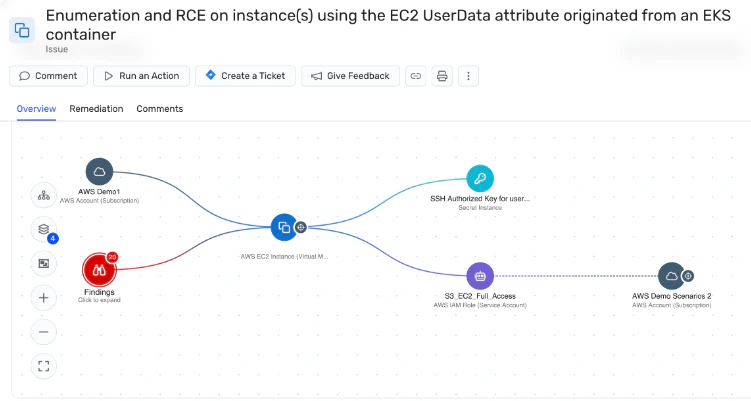
Agentless, multi-cloud data discovery and data classification: Wiz DSPM uses agentless scanning to discover and classify sensitive data across AWS, Azure, GCP, SaaS, and even code repositories.
Contextual exposure-path mapping with the Wiz Security Graph: Wiz’s Security Graph can visually map how sensitive data is exposed by correlating identity permissions, network reachability, and infrastructure misconfigurations. Imagine being able to trace how a leaked key in a CI/CD pipeline could be used to reach sensitive PII in an S3 bucket—with all the lateral movement paths in between.
Risk prioritization based on real exploitability: Unlike tools that drown you in alerts, Wiz combines vulnerability, identity, and network context to prioritize risks that are truly exploitable in your environment.
Automated least-privilege enforcement: Wiz analyzes effective permissions across all your cloud identities and resources, surfacing excessive access paths.
Continuous runtime threat detection and compliance automation: Wiz continuously monitors all access to your data for suspicious runtime behaviors and emerging AI-related risks.
👉 Book a demo to see how Wiz helps you discover, protect, and monitor sensitive data.
Protect your most critical cloud data
Learn why CISOs at the fastest companies choose Wiz to secure their cloud environments. Get a demo
