
Will AI take over cybersecurity?
No, AI won’t fully take over cybersecurity. While machine learning and AI-driven systems can automate threat detection, analyze massive data sets, and identify patterns that humans might miss, they lack the contextual understanding that’s necessary to interpret novel threats and make nuanced security decisions. Ultimately, AI is a powerful tool that should augment human cybersecurity expertise rather than replace it in today’s rapidly evolving threat landscape.
Think of AI in cybersecurity as a force multiplier. It handles the heavy lifting of data analysis and pattern recognition, which frees security teams to focus on strategic initiatives, complex problem-solving, and decisions that require human intuition. In fact, the most effective security programs combine AI’s speed and scale with human analysts’ contextual awareness and creative thinking.
AI Security Starter Pack
Build a practical foundation for securing AI systems, services, and connected cloud resources.

Why does this question keep coming up?
These factors drive ongoing debates about AI potentially replacing cybersecurity professionals:
The explosion of generative AI and enterprise automation: Tools like ChatGPT and other large language models have demonstrated AI’s ability to perform tasks that were once uniquely human. This visibility has sparked both excitement and concern about AI’s role across industries, including cybersecurity.
Sensational headlines versus real industry changes: Media coverage often positions AI as either a cure-all or an existential threat to jobs, but the reality sits somewhere in between. While AI is transforming cybersecurity operations, it’s also creating new roles and responsibilities rather than eliminating the need for cybersecurity experts.
Persistent talent shortages and increasing complexity: The cybersecurity industry faces a significant skills gap—there are over 4 million open positions worldwide. Meanwhile, attack surfaces continue expanding as organizations move to cloud environments and adopt new technologies. This combination makes automation through AI increasingly attractive, but it also highlights why human oversight remains essential.
What are the current applications of AI in cybersecurity?
AI is already transforming how security teams detect threats, respond to incidents, and manage vulnerabilities. When these innovations first emerged, many admirers viewed them, as Arthur C. Clarke described in his 1962 book, Profiles of the Future: “Any sufficiently advanced technology is indistinguishable from magic.” But security professionals have since bridged that gap, forging a symbiotic relationship that harnesses AI’s power while fully understanding its risks and practical use cases.
The below applications showcase AI’s strengths—such as speed, scale, and pattern recognition—while underscoring the areas where human expertise remains irreplaceable:
| Application | How AI helps | Where humans are necessary |
|---|---|---|
| Threat detection | Analyzes logs, network traffic, and user behavior to identify anomalies and potential cyber threats in real time | Validating alerts, investigating complex threats, and determining appropriate response actions |
| Incident response | Automates initial containment steps like isolating compromised systems and blocking malicious IPs | Overseeing response strategy, handling nuanced situations, and ensuring proper remediation |
| Behavioral analytics | Establishes baselines for normal activity and flags deviations that could indicate compromise | Interpreting findings within organizational context and distinguishing between genuine threats and acceptable anomalies |
| Vulnerability management | Scans environments, identifies risks, and prioritizes based on potential impact and exploitability | Determining remediation strategies, balancing risk with business needs, and validating fixes |
| Phishing prevention | Examines emails for suspicious indicators and filters malicious messages before user interaction | Reviewing sophisticated social engineering attempts and updating detection rules |
Along with these applications, it’s critical to understand these key pillars of AI-powered human security:
Predictive threat intelligence leverages AI to analyze patterns across large data sets of known threats and emerging trends. This proactive approach helps security teams identify potential vulnerabilities before attackers exploit them. And for cloud environments, this capability proves particularly valuable, given the rapid pace of change and scale of infrastructure.
Cloud and container security benefits significantly from AI-enabled monitoring since AI systems can flag breaches, compliance gaps, and unusual behavior across sprawling cloud infrastructure. However, while AI provides real-time insights, cybersecurity professionals still need to address unique risks, refine strategies, and make decisions about AI security best practices.
Automated policy enforcement across cloud accounts uses AI to ensure consistent security configurations and detect drift from established baselines. This automation reduces the risk of misconfigurations while allowing security teams to focus on more strategic security initiatives.
What are the key risks and limitations of AI in cybersecurity?
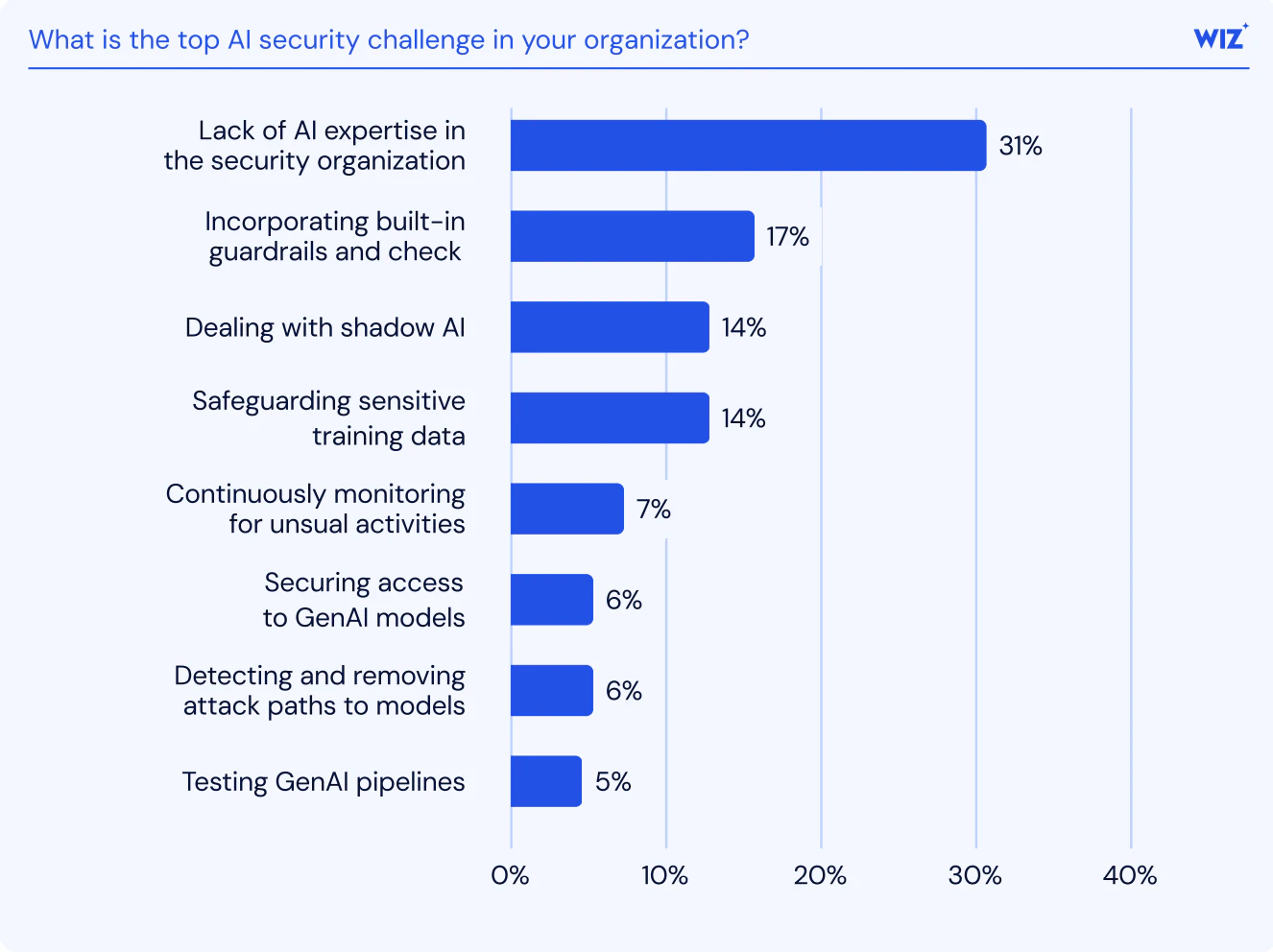
AI systems depend on data quality, proper configuration, and continuous oversight to function effectively. But with these innovations, cloud security professionals need to become even more vigilant. As Ami Luttwak, chief technologist at Wiz, told TechCrunch, “If there’s a new technology wave coming, there are new opportunities for [attackers] to start using it.”
In light of this, understanding the following limitations can help organizations implement AI security tools more successfully:
Dependency on human oversight: AI requires human oversight and guidance to reliably identify threats and prevent attacks, especially novel attack methods. For instance, supervised machine learning models that have trained on known, labeled threats can achieve high accuracy for familiar patterns but struggle with zero-day vulnerabilities, which makes human involvement critical. Additionally, unsupervised models can discover both known and novel threats but may generate high false-positive rates that require extensive expert analysis.
Adversarial attacks on AI systems: Attackers can feed misleading data into AI systems and manipulate them to ignore real threats or generate floods of false alarms. These crafted inputs often appear legitimate, which makes detection challenging without human validation.
Struggles with zero-day attacks: AI often relies on historical data to predict and defend against threats, so when completely new exploits emerge, AI models may lack prior examples to learn from. This gap leaves organizations exposed to novel attack methods and underscores the need for adaptive strategies that combine AI with skilled human analysts who can tackle unknown threats.
Implementation complexity and costs: Deploying and maintaining AI systems requires skilled cybersecurity professionals, robust infrastructure, and continuous updates. Smaller organizations may find these costs prohibitive, while larger enterprises might face complexity in integrating AI into existing security workflows.
False positives and false negatives: False positives flood security teams with unnecessary alerts, causing alert fatigue and potentially masking real threats. Additionally, false negatives allow dangerous activities to slip through, which creates security gaps. Striking the right balance here requires continuous tuning, rigorous testing, and integration with human oversight.
Lowered barriers for cybercriminals: AI-powered tools aren’t exclusive to defenders. Cybercriminals also use AI to craft convincing phishing emails, generate malware, and automate attacks. This democratization of sophisticated attack capabilities means security teams must stay ahead of increasingly AI-driven threats.
Ethical and privacy concerns: Collecting and managing large data sets often introduces privacy risks. As a result, organizations must balance AI capabilities with ethical data practices and compliance requirements like GDPR and CCPA.
AI and cybersecurity: A symbiotic future
The most effective approach to AI in cybersecurity is a “human in the loop” model, where AI serves as a co-pilot rather than a replacement for security analysts. This collaboration amplifies the strengths of both AI systems and human expertise.
Here’s a breakdown of what this approach typically looks like:
AI as a co-pilot accelerates threat triage: Machine learning algorithms can process thousands of security alerts in seconds and prioritize the most critical threats for human review. This automation reduces mean time to resolution (MTTR) by ensuring that analysts spend time on genuine security incidents rather than chasing false positives.
Alert fatigue changes to focused action: Security teams that are drowning in alerts often struggle to identify real threats among the noise. To resolve this issue, AI-driven systems can filter out low-priority items, correlate related events, and surface patterns that indicate actual compromise. This shift allows cybersecurity professionals to move from reactive firefighting to proactive threat hunting.
Collaboration between AI and analysts improves over time: As security teams validate AI-generated alerts and provide feedback, machine learning models become more accurate. This continuous improvement cycle creates a symbiotic relationship where AI learns from human expertise while humans benefit from AI’s pattern recognition capabilities.
Organizations that implement this collaborative model see tangible benefits like faster incident response, more efficient use of security team resources, and improved detection of sophisticated threats that they might not otherwise notice. The key is recognizing that AI enhances, rather than replaces, human decision-making in cybersecurity.
How can you safely integrate AI with cybersecurity?
Successfully integrating AI into your security program requires thoughtful planning, continuous oversight, and a clear understanding of both AI’s capabilities and limitations. Here’s how you can integrate AI into your security process:
Pair AI with human oversight at every stage: AI excels at data analysis and pattern recognition but can miss context or subtle indicators of sophisticated threats. That’s why security teams should validate AI-generated alerts, refine detection strategies, and make judgment calls that algorithms can’t. This oversight ensures that contextual understanding guides automated responses.
Enhance existing tools rather than replacing them: You should integrate AI into your current security stack, including firewalls, intrusion detection systems, and vulnerability scanners. This approach automates repetitive tasks, prioritizes alerts, and spots anomalies faster while maintaining your layered defense strategy. AI also augments these tools’ effectiveness without creating dependency on a single technology.
Keep AI models current with continuous training: Cyber threats evolve daily, so your AI systems must keep pace. Regular model training with updated data—including new attack vectors and behavior analytics—ensures detection accuracy. Without these continuous updates, AI risks missing emerging threats that use novel techniques.
Monitor for biases and tune detection thresholds: AI systems can develop biases based on training data or may miss genuine threats while flagging harmless activities. Regular audits, performance reviews, and threshold adjustments improve accuracy and maintain your team’s trust in AI-generated alerts. This ongoing refinement also prevents both complacency and skepticism.
Maintain transparency and ensure compliance: Your AI-driven defenses must follow privacy laws and regulations. To this end, document how your organization collects, processes, and uses data and secure sensitive information with encryption and access controls. Clear communication about AI’s role also builds stakeholder trust while keeping your program compliant with evolving data protection requirements.
Inside MCP Security: A Field Guide
Examine how MCP servers connect AI agents to tools and data, and learn which security controls matter across those trust boundaries.

For organizations that want to deploy AI in their cloud environments, Wiz’s AI Security Posture Management (AI-SPM) provides visibility into AI models, training data, and AI services to accelerate adoption without introducing undue risk.
Looking for AI security vendors? Check out our review of the
Looking for AI security vendors? Check out our review of the most popular AI Security Solutions ->
Practical use cases where AI enhances cybersecurity
Understanding how organizations apply AI in practice demonstrates its value as a complement to human expertise rather than a replacement. Here are some use cases to show AI’s effectiveness:
Threat detection in cloud workloads
AI-powered monitoring continuously analyzes activity across cloud infrastructure and identifies suspicious patterns that could indicate compromise. For example, an AI system might detect unusual data exfiltration attempts or unauthorized access to sensitive resources, then alert security teams to investigate. This AI-enabled real-time visibility proves essential as organizations scale their cloud footprint and face increasingly sophisticated cyberattacks.
AI application: AI agents in cloud environments can correlate events across multiple services and accounts and identify attack chains that human analysts might miss when examining individual alerts in isolation.
Automated policy enforcement across cloud accounts
Organizations that manage hundreds or thousands of cloud accounts often face challenges in maintaining consistent security configurations. That’s why modern AI automation ensures that security controls remain effective, even as infrastructure changes rapidly, while security teams focus on strategic risk management rather than manual configuration checks.
AI application: To help with policy enforcement, AI systems automatically detect policy violations, configuration drift, and non-compliant resources.
AI for vulnerability correlation and prioritization
Modern vulnerability management generates overwhelming numbers of findings across cloud workloads, applications, and infrastructure. To help with this, platforms should integrate AI at the heart of security operations to transform vulnerability management from a check-the-box exercise into strategic risk reduction.
AI application: AI helps here by correlating vulnerabilities with active threats, exploitability data, and asset criticality. This intelligent prioritization ensures that teams address the most dangerous exposures first to improve overall security posture despite limited resources.
Security model testing for AI deployments
As organizations deploy their own AI applications and large language models, they need to secure these systems against unique threats like prompt injection, data poisoning, and model extraction attacks.
AI application: AI-SPM tools that secure AI agents help security teams test AI models for vulnerabilities, monitor AI service usage, and ensure proper access controls around training data and model endpoints.
AI will elevate, not replace, cybersecurity
The future of cybersecurity isn’t about choosing between AI and human expertise but recognizing how they work best together. Organizations that embrace this partnership position themselves to tackle talent shortages more effectively, respond to threats faster, and adapt to emerging attack methods.
Rather than fearing AI’s impact on cybersecurity jobs, it's important to focus on how AI enables security teams to work at a higher level. In practice, that means using platforms that connect code, cloud, and runtime context so teams can understand which AI and cloud risks are actually reachable, investigate them faster, and spend more time on decisions that require human judgment. Wiz’s AI Security Posture Management is part of that shift, helping organizations secure AI services and pipelines without treating them as a separate island from the rest of the environment.
That same model now extends further with the Wiz AI-Application Protection Platform (AI-APP), which maps relationships across AI code, infrastructure, models, agents, guardrails, MCP servers, and data in a single security graph. This helps teams uncover the toxic combinations that matter in real environments, while AI-powered workflows such as Red, Blue, and Green Agent can validate risk, investigate threats, and guide remediation with human oversight still in the loop.
Ready to see how AI can elevate your security program without adding noise? Schedule a Wiz demo today to explore how Wiz AI-APP, AI-SPM, and AI-powered workflows can give you visibility into AI models, agents, training data, and AI services from code to runtime. Or to get started with securing your AI deployments today, download our Azure OpenAI Security Cheat Sheet. Request a demo to explore how Wiz can secure your cloud environment.
See connected AI risk in context
Explore how Wiz connects AI assets, cloud exposure, identities, data, and runtime activity in one security graph.
