

Understanding the role of AI in cybersecurity
AI in cybersecurity is the use of artificial intelligence – combining data ingestion, behavior- and context-aware analysis, and automated actions – to detect, interpret, and respond to threats across today's cloud-native, dynamic environments.
In modern infrastructure, the volume, velocity, and complexity of data (cloud events, workload changes, identity activity, network flows, configuration drift) overwhelm traditional security tools and human capacity. AI enables continuous monitoring at scale: it spots anomalous behavior, correlations across data silos, and suspicious patterns that reveal potential threats even when signature-based rules don’t apply.
But the real power of AI emerges when it operates as part of a broader security architecture – where data from disparate sources is unified into a contextual graph of identities, resources, data, and privileges and where AI-driven agents or automation can act on insights. In this model, AI doesn’t just alert – it closes the loop: triaging incidents, gathering related data, executing containment steps, or surfacing high-priority risks for human review.
In short: AI for cybersecurity isn’t just about detection. It’s about context, correlation, and action at a scale and pace that matches today’s cloud-native threat surface.
AI Security Starter Pack
Get the essential frameworks and checklists to secure AI across your cloud environment.

Why AI is essential for modern cyber defense
Cybersecurity is facing three converging realities:
Cloud environments have become too complex to understand manually
Attacks unfold faster than human workflows can react
Teams are strained by the volume of alerts and the scarcity of experienced defenders
AI becomes essential not as a luxury, but as an approach that can operate at the speed and scale of today’s environments.
Cloud-native architectures change constantly. New workloads deploy and terminate in minutes. Identities, privileges, and network paths evolve through CI/CD pipelines, not change tickets. Traditional tools that rely on static inventories and fixed rules were designed for a world where infrastructure was predictable. In a multi-cloud environment where each provider has its own APIs, identity model, and configuration patterns, blind spots are inevitable without automated systems that can map and understand the environment continuously.
At the same time, attackers now use automation and AI to scan for exposures, generate targeted phishing at scale, and adapt malware faster than signature-based defenses can learn. What used to be a manual campaign now looks like a continuous pipeline: reconnaissance, initial access, lateral movement, and exfiltration can all be scripted. When adversaries operate at machine speed, defenders cannot rely on manual triage, log searches, or ad-hoc scripts alone.
Teams feel this gap directly. Even mature organizations struggle with short staffing and alert fatigue. Analysts spend most of their time collecting context – pulling logs, searching for recent changes, checking identity history – rather than deciding what to do. AI changes the equation by handling the heavy workflows around detection and investigation, allowing teams to focus on risk and response rather than reconstruction.
In this context, AI is not simply “better detection.” It is the way to keep pace with both the scale of the cloud and the speed of attackers. AI systems continuously map environments, learn behavioral baselines, surface suspicious deviations, and automate the early phases of incident response. Humans still make the critical decisions, but AI closes the loop between signal and action far faster than traditional tools allow.
How AI transforms modern security operations
AI changes security operations by closing the loop between detection, investigation, and remediation. Instead of isolated alerts and manual context gathering, AI systems unify signals, understand how risks connect across your cloud, and help teams act more quickly on what matters. The impact shows up in three core areas.
1. Detection and Prioritization
In dynamic cloud environments, most critical risks don’t present as static patterns – they emerge from relationships: a misconfigured identity tied to an exposed service that has access to sensitive data. AI systems learn normal behavior across workloads, identities, network flows, and configuration changes so they can surface deviations that indicate risk, not just known indicators.
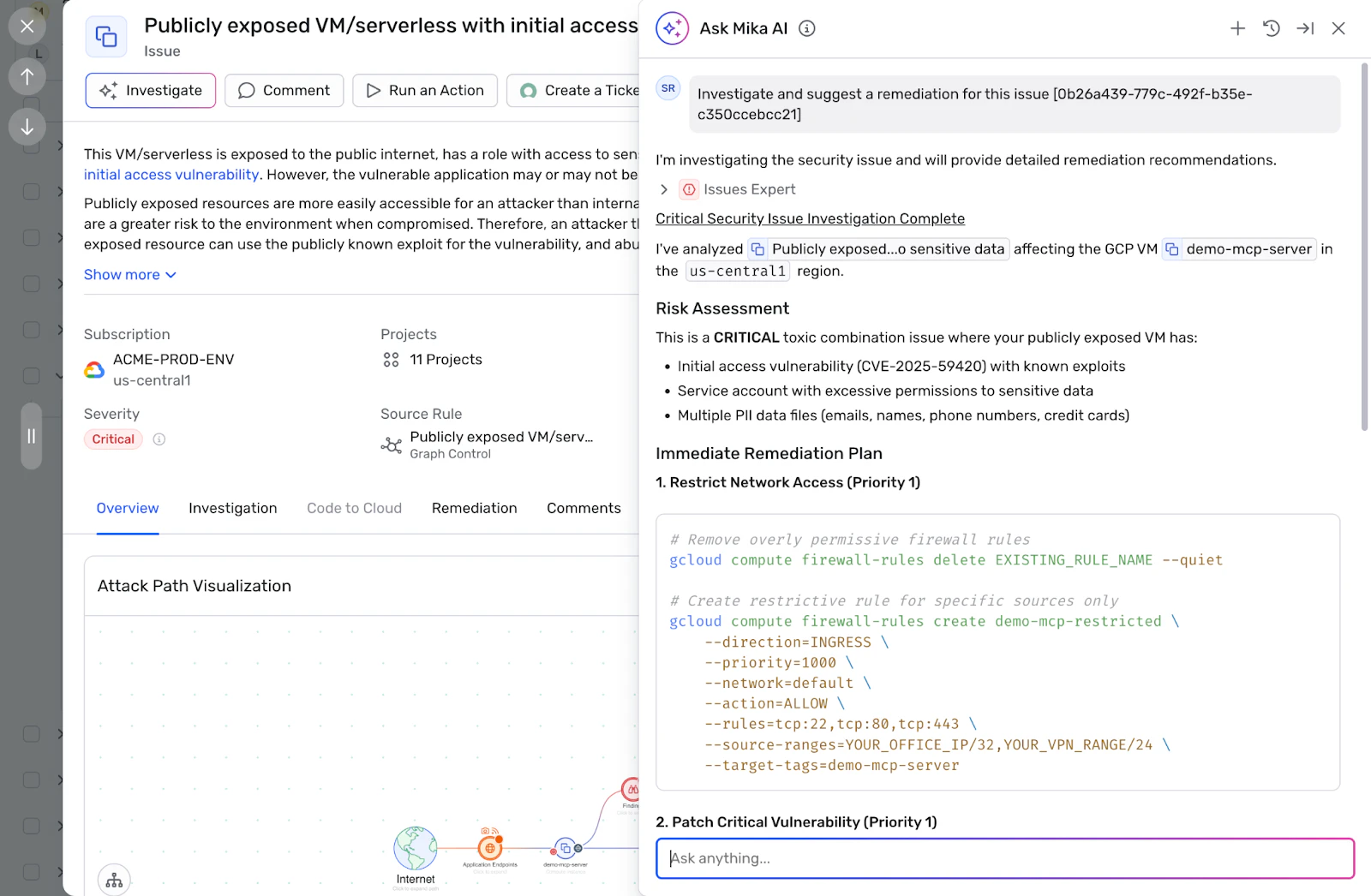
The priority shift isn’t “What vulnerabilities exist?” but “Which risks create real attack paths?” By correlating signals from cloud events, deployment changes, entitlements, and threat intelligence, AI highlights toxic combinations rather than lists: a recently deployed workload with a critical CVE, reachable from the internet, running with excessive privileges. That correlation cuts false positives and gives teams a clear focus: fix the issues that change exposure, not everything that could theoretically be exploited.
Detection becomes contextual. Instead of hundreds of alerts, AI builds a small number of risk narratives –each one representing an impactful path an attacker could take. That is the foundation for faster downstream response.
2. Investigation and Response
Most investigation time isn’t spent deciding – it’s spent collecting information. Analysts pivot between tools to look up recent changes, analyze logs, check identity activity, or reconstruct how an alert started. AI collapses that work. When a signal fires, the system gathers evidence automatically, builds a timeline, and shows how identities, workloads, and configurations interacted before and after the event.
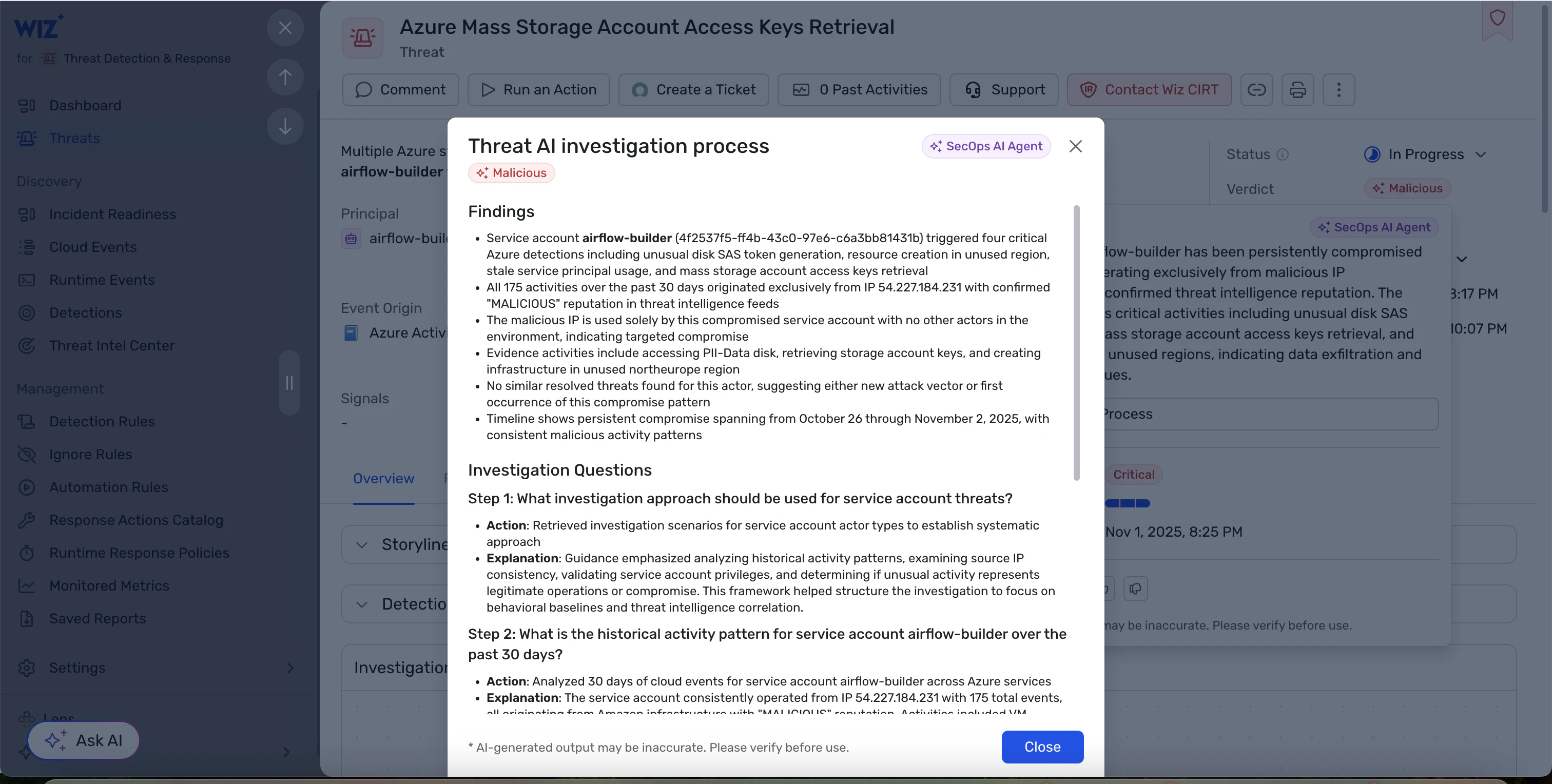
This turns alerts into stories:
what changed,
who or what triggered it,
where lateral movement could occur,
what data is exposed,
and what response options exist.
The analyst starts from insight, not raw data. AI can also suggest initial response actions based on the situation – isolating a workload, revoking a token, or rolling back a configuration in IaC – always requiring human approval in high-risk environments. The result is faster mean-time-to-respond without increasing the burden on teams.
Importantly, AI doesn’t act blindly. It uses the same behavioral baselines and graph context that informed detection to explain why an event matters, helping humans trust and validate recommendations.
3. Remediation – with AI-assisted, code-aware fixes
Once a risk is identified, remediation needs to happen as close to the source as possible. Fixing an exposed container in production helps today, but preventing that same misconfiguration from being redeployed tomorrow is what creates durable security. AI supports that shift by connecting detection signals to the specific code, IaC, or identity policy that introduced the issue.
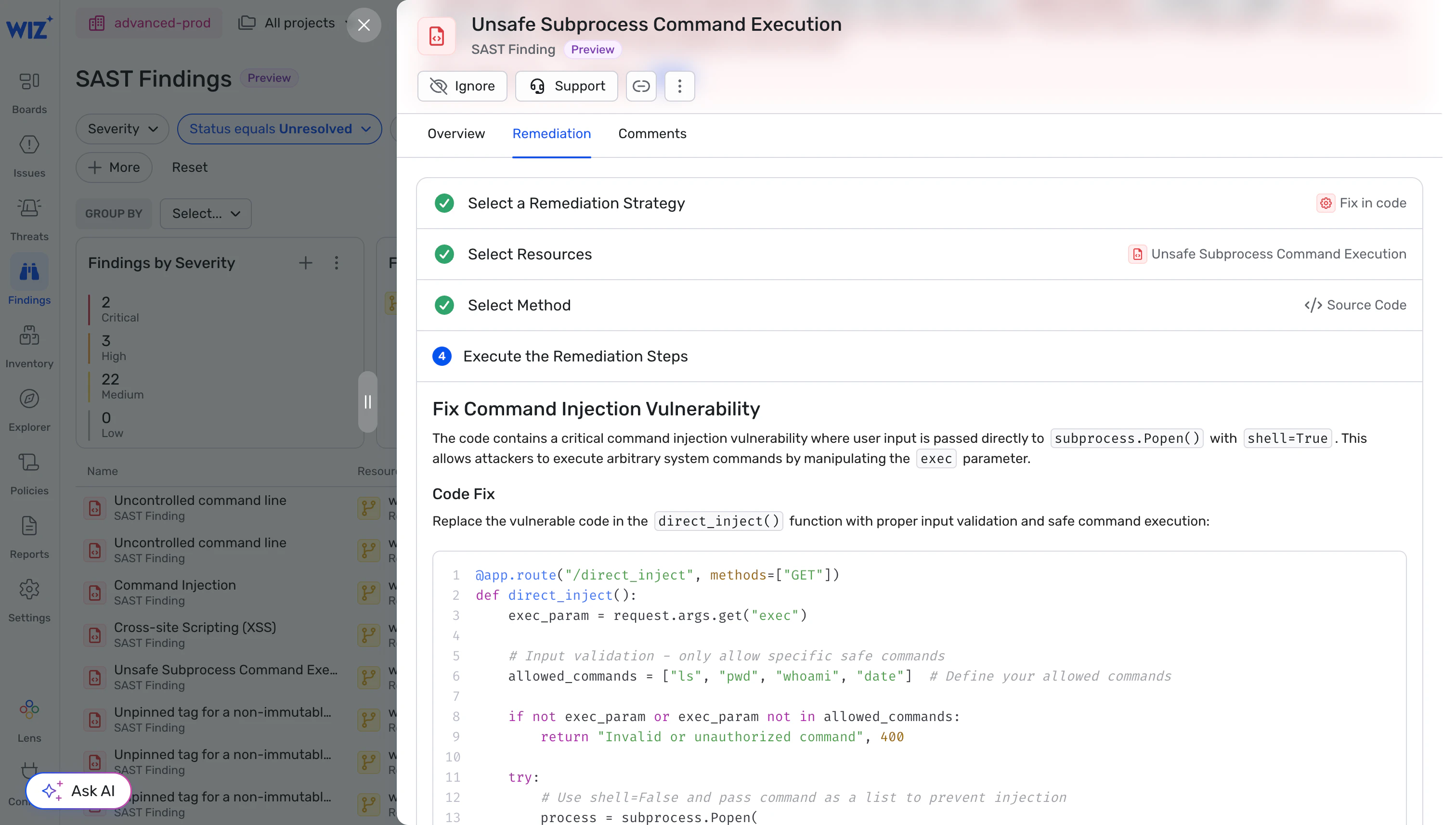
Rather than returning a generic recommendation, modern AI systems can provide a suggested fix grounded in the context of your codebase. For AppSec and development teams, this means guidance that reflects actual dependencies, configuration patterns, and secure-coding practices – not one-size-fits-all advice from a vulnerability database.
For example, when a vulnerable package is detected in a running workload, AI can:
identify the repository and commit where it was introduced,
show which other services depend on it,
and suggest a secure upgrade path or code change aligned to common secure patterns.
That context helps teams choose the right remediation strategy – whether that’s patching a container image, refactoring code, tightening an IAM role, or updating IaC. Instead of handing developers a raw vulnerability ID, security delivers an informed recommendation plus the reasoning behind it.
The outcome is faster, more confident remediation, with fewer cycles spent deciphering where a risk originated or what the safest fix looks like. Security and engineering work from shared context, not parallel systems, which reduces drift and prevents the same issue from resurfacing through another code path or pipeline.
The dual challenge: AI accelerates both defense and attack
AI is reshaping cybersecurity from two directions at once. On the defensive side, it gives security teams a way to make sense of modern cloud environments: continuously mapping resources and identities, learning normal behavior, correlating signals into coherent attack paths, and automating the early phases of investigation. It helps teams focus on risk, not raw alert volume.
At the same time, attackers benefit from the same underlying capabilities. Large-scale reconnaissance that once required custom tooling can now be automated: scanning cloud assets, ranking potential exposures, and chaining misconfigurations into viable entry points. Generative models make phishing and social engineering far more convincing by mimicking organizational tone, roles, and urgency. Malware and exploit payloads are also easier to adapt, testing variations until they evade static signatures.
This creates a speed gap. Defenders who rely only on manual workflows are outpaced by attackers who operate at machine speed. A phishing campaign that used to take days to craft can be generated in minutes; a runtime exploit can be iterated hundreds of times in the span of a traditional detection cycle. Defense strategies built around static rules or delayed investigation loops break down when threat actors can change tactics faster than a signature can be updated.
AI also introduces new attack surfaces. When organizations deploy agents, large models, or natural-language interfaces into production systems, those components become targets. Prompt injection, data poisoning, model extraction, and misuse of overly empowered agents can create vulnerabilities that didn’t exist when systems were purely deterministic. Adversaries don’t need to “hack the cloud” if they can steer an AI system into leaking sensitive data or escalating privileges through an internal action pathway.
Inside MCP Security: A Field Guide
Explore emerging risks in AI agents and model context protocols, and how to defend against them.

If attackers can automate reconnaissance, accelerate phishing, or mutate payloads rapidly, defenders need automation to keep pace – and must protect the AI systems they deploy just like any other high-value asset. This dual reality is what drives the next evolution of cloud security architecture: applying guardrails to AI models and agents, and treating AI workloads as part of the attack surface rather than a bolt-on feature.
How Wiz integrates AI across the cloud security lifecycle
AI only becomes useful in cybersecurity when it operates with context. In the cloud, risk is rarely a single CVE or a misconfiguration in isolation – it’s a combination of workload exposure, identity permissions, code paths, and sensitive data. Wiz’s Security Graph provides that context by continuously mapping relationships across cloud resources, identities, and data so AI can reason about actual attack paths, not individual alerts.
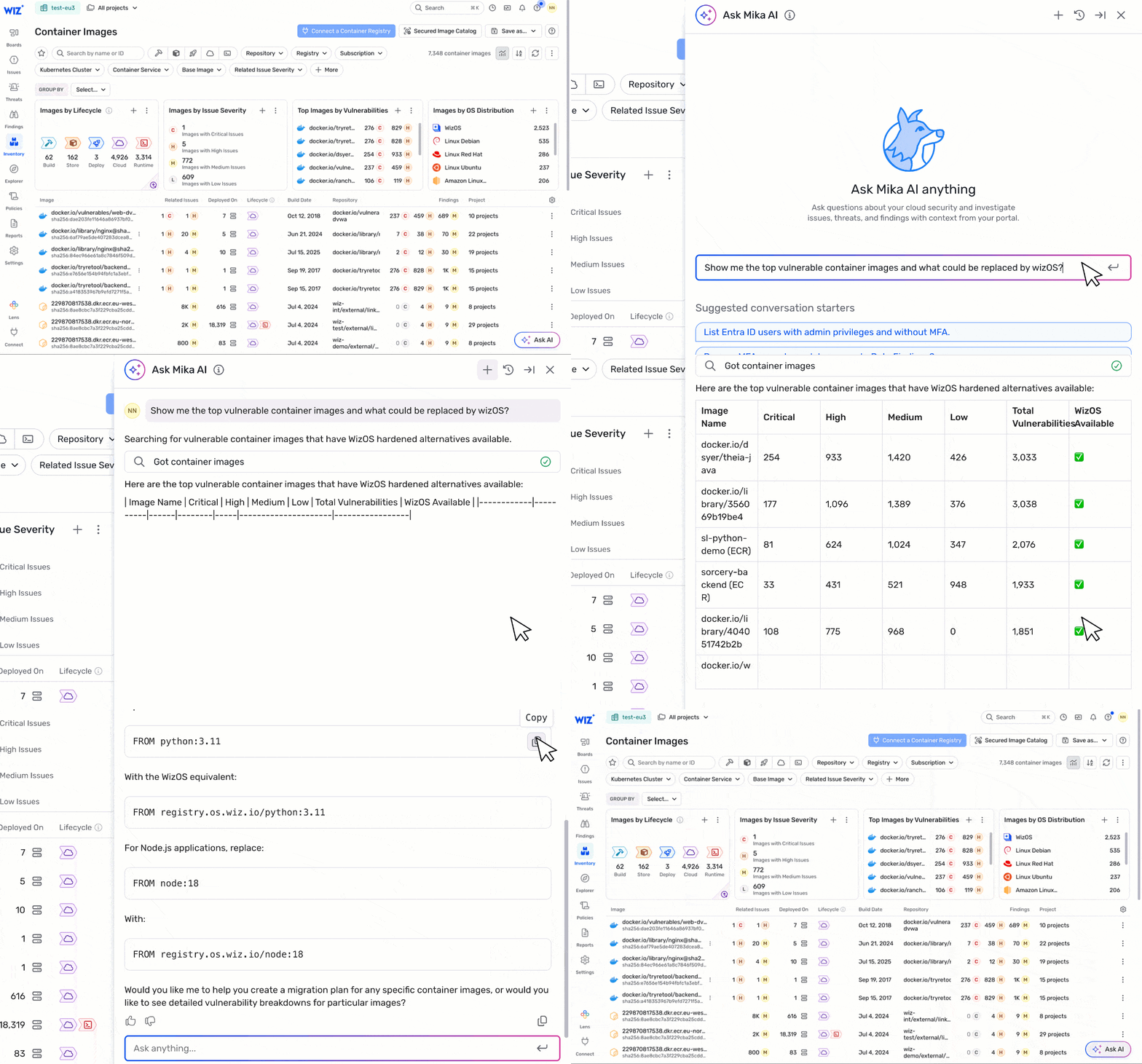
Wiz applies AI across the security lifecycle, not as a point feature but as a horizontal capability: the same graph powers detection, investigation, and remediation. For detection and prioritization, AI highlights the small number of toxic combinations that matter rather than hundreds of theoretical exposures. For investigation and response, the SecOps AI Agent uses the graph to assemble timelines, show why behavior is risky, and guide decisions with evidence. For remediation, Wiz connects runtime risk back to the repositories, commits, and IaC definitions that introduced it, and provides AI-assisted remediation guidance grounded in the actual code and cloud context.
This illustrates Wiz’s horizontal security philosophy: one platform, one graph, and one policy fabric applied from code to cloud to runtime. Instead of separate tools for CNAPP, threat detection, AppSec, and AI governance, Wiz provides a unified control plane where teams see risk the same way attackers move – laterally, through relationships. Horizontal security replaces fragmented point solutions with shared context, so AI isn’t bolted onto individual tools but operates across the entire environment.
The result is an operating model where AI accelerates scale, and the Security Graph ensures correctness. Detection becomes contextual, investigation becomes faster, and remediation becomes rooted in code and configuration — with AI acting as a force multiplier rather than a separate workflow. Horizontal security makes AI a native part of cloud defense: consistent controls, consistent context, and one place to understand and improve your security posture.
Explore a live Wiz demo and experience how horizontal security—powered by the Security Graph—prioritizes real attack paths, accelerates investigation, and guides code-level fixes. Ready to see horizontal security in practice? Request a demo to explore how Wiz can secure your cloud environment.
Want to see it in action?
Experience how the Security Graph prioritizes real attack paths and guides code-level fixes.
