Featured
The Pwn Request Reckoning: What Still Works Against GitHub Actions


GitHub's 2026 Actions changes make pull_request_target attacks harder, but not impossible. Here's the residual attack surface and how to audit for it.
GitHub's 2026 Actions changes make pull_request_target attacks harder, but not impossible. Here's the residual attack surface and how to audit for it.
An automated campaign is planting secret-dumping workflows in every repository that stolen GitHub tokens can reach. It uses no C2 server, is actively evolving, and has been significantly disrupted by recent GitHub security improvements.
Detect and mitigate CVE-2026-111497, a critical Brotli decoder vulnerability enables remote code execution.
Reduce triage times and focus on the risks that matter most by combining context across code, infrastructure, and runtime
Wiz Research is tracking an ARTEX-using actor, overlapping with Storm-0940, across multiple targeted software vendors. Learn how the AI agent attacks Okta, Entra, and Cognito, and what it left behind in the logs.
Core PHP engine flaws enable remote code execution and Heartbleed-style memory disclosure across the web.
In a new incident, a malicious version (1.107.0) of the LiteLLM package was uploaded to PyPI and Docker on October 21. The malicious version includes a credential stealer targeting browser, cloud and AI secrets as well as a dormant C2 capability.
Enable native runtime protection for GKE in just one click. The Wiz Runtime Sensor add-on now automates deployment and credential management while delivering predictable, kernel-level eBPF threat detection for your GKE Kubernetes fleets.
How a single Google Search ad click leads to credential theft, hijacking of cloud billing account, and hundreds of thousands of dollars incurred in unauthorized AI API usage
When trusted packages are compromised, malicious code can quickly spread throughout and beyond developer environments. See how Wiz’s supply chain pipeline identifies compromised packages at publication, helping teams detect zero-day supply chain compromises in Wiz Defend before a CVE is published
Wiz CIRT responded to AI-driven attacks spanning cloud, Kubernetes, CI/CD, and identity. Learn how these attacks behave and how to detect them.
Integrate your existing code scanners into Wiz for a unified view of application risk across your environment.
Wiz AI Agents elevate traditional CNAPP, empowering public sector security teams to accelerate security and innovation.
Traditional DSPM and classification tools scan from the inside out. Thinking like an attacker, the Red Agent found a public page exposing sensitive data in minutes.
Find, validate, and fix complex business logic flaws with an AI code scanner backed by Wiz Research, operationalized within your existing security program.
Build your Service Catalog faster, keep service context current, and give teams a clearer path from cloud risk to accountability
Secure your Kubernetes supply chain with WizOS Helm Charts. Eliminate hidden CI/CD risks and unmaintained dependencies with hardened, signed, and CVE-scanned charts for seamless Kubernetes deployment.
See how the Blue Agent investigated a multi-platform attack in minutes, following evidence across AWS and GitHub to uncover compromised credentials, stolen source code, and custom data exfiltration tooling
Empowering managed services partners to deliver world-class cloud and AI security at scale
Wiz Research analyzes NordStellar data to map the credentials targeted by infostealer families and assess their potential impact across cloud, code, and AI environments.
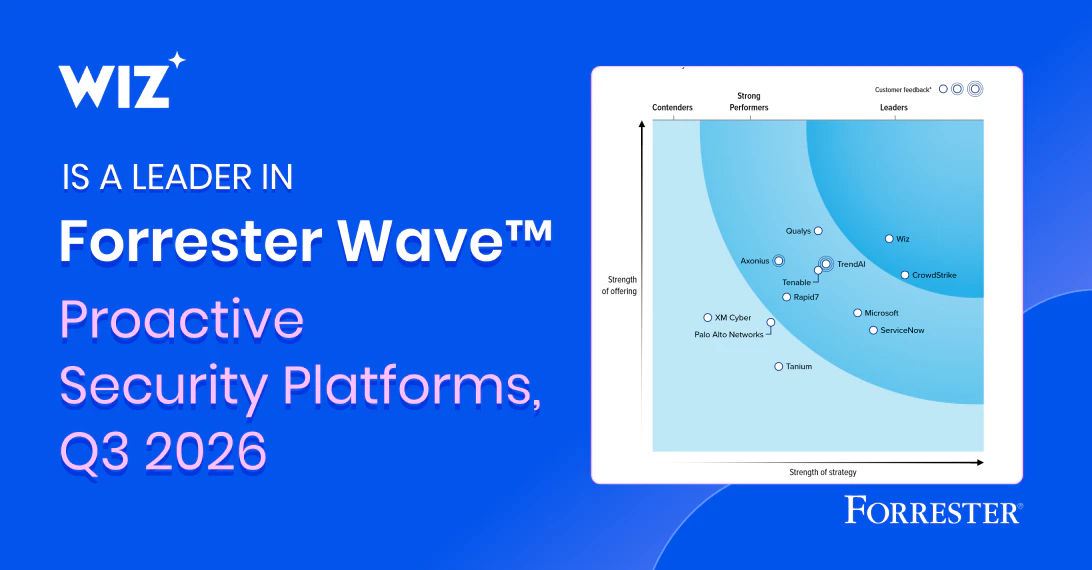
Forrester’s Proactive Security Platforms evaluation rated Wiz with top scores across eight areas, reflecting our commitment to securing the AI era
New initiative partners with under-resourced organizations to uncover, remediate exploitable risk at scale.
WINning AI with AI: How the Wiz MCP for WIN partners accelerates a connected ecosystem
This post will explore what this new concept does, how it works with the new Account Access capability, and why a strong security posture still requires upgrading out of the sandbox.
Analyzing model input and output logs in an AI-native detection pipeline to understand and uncover malicious AI agent behavior