


What is cloud application security?
Cloud application security helps teams protect apps across the development lifecycle, from code to build to deployment, in dynamic cloud environments defined by constantly changing infrastructure, decoupled services, and rapidly evolving risks.
It includes both cloud-based apps (migrated or partially adapted to the cloud) and cloud-native apps (built using microservices, containers, infrastructure as code (IaC), and CI/CD).
A core principle of cloud application security is shift-left security, which integrates security early in development to catch issues before they reach production. This approach reduces risk and remediation costs.
In cloud-native development, application security focuses on the following principles:
Securing APIs with proper authentication and input validation
Scanning container images and enforcing runtime security
Validating IaC for misconfigurations before deployment
Embedding security checks into CI/CD pipelines for continuous protection
These practices reduce the cloud attack surface and enable organizations to scale quickly and securely.
Get the Application Security Best Practices [Cheat Sheet]
This 6-page guide goes beyond basics — it’s a deep dive into advanced, practical AppSec strategies for developers, security engineers, and DevOps teams.

What are common cloud application threats and vulnerabilities?
When securing cloud-based and cloud-native applications, it’s critical to focus on threats at the application layer that exploit APIs, components, IaC, containers, and CI/CD pipelines. The following risk categories are crucial for security teams to understand and defend against:
APIs can expose sensitive data or functionality when authentication, authorization, or input validation is missing.
Open-source and third-party components introduce supply chain risk, where one compromised dependency can impact the entire app. SBOMs help, but gaps remain without full visibility and context.
Insecure IaC leads to misconfigurations like open ports or over-permissive roles, which attackers readily exploit.
Configuration drift occurs when deployed environments deviate from secure templates, creating unnoticed exposure over time.
Containers may run with insecure defaults or outdated packages, making them vulnerable to privilege escalation or runtime attacks.
Attackers can exploit CI/CD pipelines to insert malicious code or exfiltrate secrets when access controls or integrity checks are weak.
Secrets leakage from pipelines or repos grants attackers persistent access to cloud environments.
Each of these threats reinforces the need for integrated, proactive security throughout the cloud application lifecycle.
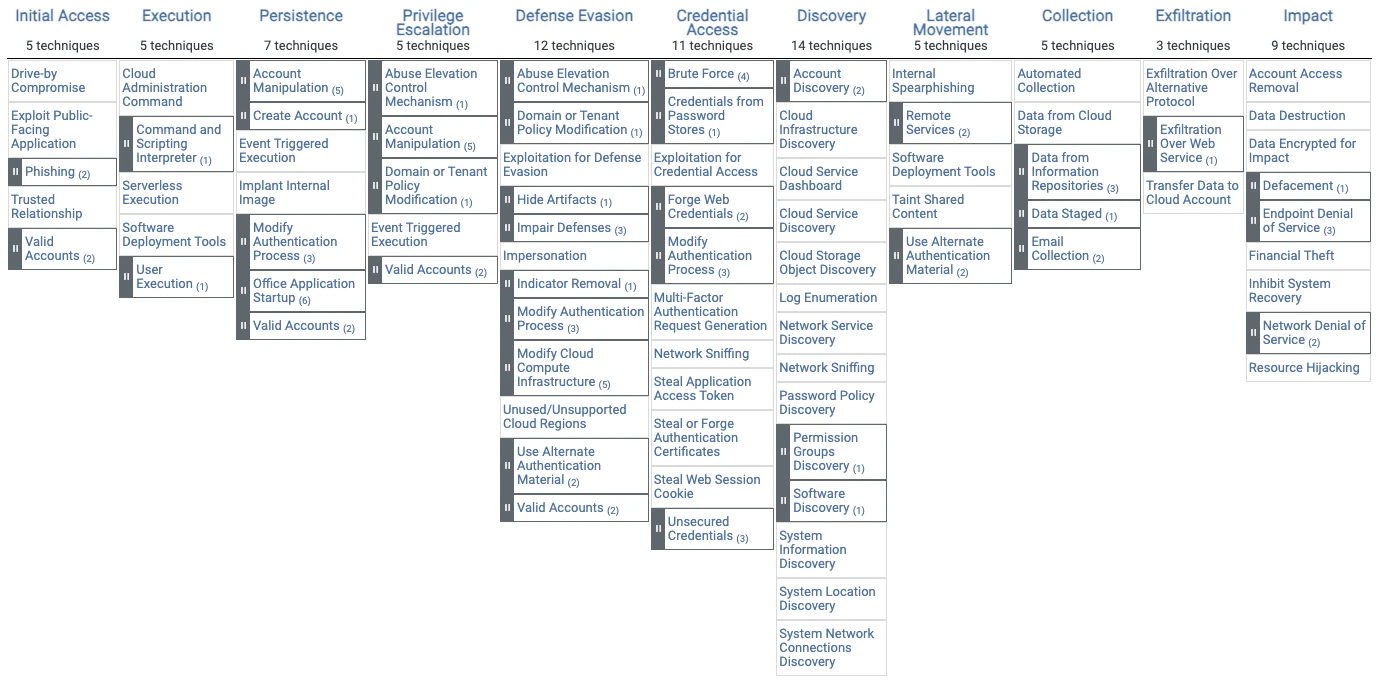
One way to evaluate the cloud threat landscape is by using Wiz’s cloud incidents catalog, which has reported on more than 250 exploits since 2010. MITRE provides a comprehensive view of the threat landscape with 237,725 total CVEs reported across various sectors, including cloud applications.
Foundational models and concepts
Companies must clearly define their security and management responsibilities relative to the cloud service provider (CSP). This crucial division of labor is governed by principles designed to safeguard data. The following cloud models and concepts distinguish between the customer and CSP responsibilities:
Shared responsibility model

The shared responsibility model clarifies which security and compliance tasks CSP handles and which are the customer’s responsibility.
For example, the CSP typically secures the physical infrastructure, virtualization layer, and managed services, while the organization secures cloud data, access controls, application configuration, and identity management.
Understanding this model helps security teams avoid gaps in coverage or misplaced assumptions about who is protecting what. It’s essential that the customer clarify the responsibilities matrix for their cloud deployment and ensure teams control the elements they must secure.
Zero trust and least privilege

Zero trust is a cybersecurity strategy that operates on the principle of “never trust, always verify.” It insists that every access request, whether inside or outside the network, is authenticated, authorized, and continuously validated.
The principle of least privilege supports zero trust by granting users and services only the access required to perform their tasks. In a cloud context, this means treating every API call, service account, and device as untrusted until proven otherwise.
🛠️ Action step: Adopt least-privilege access policies, just-in-time (JIT) permissions, and micro-segmentation to limit exposure and lateral movement.
DevSecOps and the secure software development life cycle
DevSecOps merges development, security, and operations into a unified workflow, integrating security throughout the software development lifecycle instead of treating it as a separate phase. The SSDLC embeds security into every stage (design, code, build, test, and deploy), using automated controls like static analysis (SAST), dynamic testing (DAST), dependency scanning (SCA), and secrets detection.
By shifting security left and integrating it into the same velocity engine as DevOps, you can reduce vulnerabilities, accelerate release cycles, and improve developer ownership. However, this shift can create tension between speed and security, particularly in fast-moving cloud environments. The key is to strike the right balance, making security continuous, scalable, and aligned with how your teams already work. When done right, DevSecOps becomes a force multiplier for secure, high-velocity cloud-native development.
Catch code risks before you deploy
Learn how Wiz Code scans IaC, containers, and pipelines to stop misconfigurations and vulnerabilities before they hit your cloud.

Essential best practices for cloud application security
To effectively secure cloud applications, organizations must go beyond frameworks and tools. They also need to adopt practices that align data security with how cloud-native development actually works. This means applying proactive, automated, and context-aware controls across the software lifecycle.
Below are seven foundational best practices that will help you implement a strong cloud application security posture:
1. Secure development and testing
Shifting security left means identifying and addressing issues early—during planning, coding, and testing—before they reach production.
By integrating SAST, DAST, SCA, and container scanning into CI/CD pipelines, teams can detect insecure code, vulnerable dependencies, and misconfigurations early in the development process. This reduces future remediation efforts, lowers cost, and minimizes the risk of vulnerable releases.
See for yourself...
Based on an analysis of hundreds of thousands of repositories across major platforms, our research uncovers common security pitfalls in modern software development.

2. Identity and access management
Because cloud environments scale fast and change constantly, identity controls must evolve at the same pace. It’s not just about enforcing MFA or setting RBAC. Today’s environments face service identity sprawl, token overuse, and short-lived access that’s difficult to track.
Automating least-privilege access, applying JIT and just-enough access policies, and auditing ephemeral tokens are key to limiting exposure. Fine-grained permissions ensure only the right identities, human or machine, can access sensitive resources, with every action logged and traceable.
3. Data protection and encryption
Data is a primary target in most multi-cloud breaches. Due to the importance of data, encrypting sensitive information at rest and in transit using strong algorithms (such as AES-256 and TLS), managing keys securely, and classifying data to apply appropriate controls are crucial for protecting data confidentiality and integrity.
These approaches ensure that even if an attacker gains unauthorized access, the data remains unreadable, limiting exposure and preserving privacy and trust. Security tools, like data loss prevention (DLP), masking, and tokenization, can further reduce the risk of data leaks.
4. API, container, and supply chain security
While APIs and containers form the backbone of cloud-native apps, they introduce significant risk if not secured. To reduce the attack surface, enforce strict authentication and validation for APIs, scan container images for vulnerabilities, and use minimal base images. At the same time, securing the software supply chain, including IaC templates and dependencies, prevents the spread of malicious code and ensures that you deploy only trusted artifacts.
5. Monitoring, logging, and incident response
Detecting security threats in real time requires centralized visibility into cloud resources. Centralized visibility is achieved by logging all user behavior, API activity, and workload telemetry feeds into SIEM or XDR systems. Teams must define and rehearse incident response playbooks, leveraging automation where possible to quickly contain and resolve threats and data breaches.
6. Patch, update, and resilience automation
Attackers often exploit known vulnerabilities that remain unpatched. Your team can prevent this by automating patch management, conducting regular scans, and testing updates in controlled environments to close these gaps. Implement resilience strategies—like fallback systems, cloud-native failovers, and infrastructure redundancy—to protect against downtime and minimize the blast radius.
7. Compliance and governance as code
Manual compliance efforts don’t scale in the cloud. Implementing governance as code means using policy-as-code tools to continuously enforce and monitor regulatory controls, such as CIS, NIST, or GDPR. Automated audits, tagging, and reporting enable teams to maintain readiness and reduce the time required to meet internal and external standards.
Why a CNAPP is essential for cloud app security
Cloud application security demands visibility, context, and automation across every layer, from code to cloud. A cloud-native application protection platform (CNAPP) is essential because it consolidates multiple security capabilities into a single platform for modern cloud ecosystems.
While CNAPPs don’t replace best practices, they do serve as a critical enabler. For example, by integrating your CNAPP across security domains, such as vulnerability management, misconfiguration detection, identity security, and workload protection, the solution reduces silos and improves how teams prioritize and act on risk.
Key benefits of using a CNAPP in your AppSec strategy include the following:
End-to-end protection: CNAPPs cover the entire cloud-based application lifecycle, integrating security from development through runtime.
Unified risk visibility: By correlating issues across layers (like code, infrastructure, identity, and data), CNAPPs prioritize real, exploitable risks instead of isolated alerts.
Developer and DevOps integration: With shift-left capabilities, CNAPPs integrate directly into CI/CD pipelines and developer workflows, making it easier for teams to detect and fix issues early.
Operational efficiency: A single platform replaces fragmented tools, accelerating the time to remediation and improving collaboration across security, development, and operations.
Compliance automation: CNAPPs help teams enforce policies and prove compliance through built-in frameworks and automated assessments.
A CNAPP is the operational backbone you need to scale your cloud security at the speed of cloud-native development. Because it supports the practices outlined above, your teams can stay secure without slowing productivity.
Real-world impact: How Priceline operationalized shift-left security with Wiz
As Priceline, an online travel agency, migrated to AWS and GCP, its security team needed a better way to enforce best practices early in development. The company adopted Wiz to gain visibility into runtime risks and used those insights to define policies directly in its CI/CD pipelines.
By integrating Terraform and IaC scanning, Priceline’s builds automatically undergo checks, and any deployment with medium-severity or higher issues is blocked. The integration provides developers with instant feedback and minimizes the need for its security team to file tickets post-deployment.
With Wiz, Priceline shifted from reactive fixes to proactive prevention, freeing its team to focus on more strategic work, like securing new acquisitions, without disrupting development workflows.
Wiz’s approach to cloud application security
Wiz secures cloud applications by aligning visibility, context, and automation to the way teams build and operate in the cloud.
From the moment you connect your environment, Wiz provides full visibility into your code, workloads, identities, and data, all without agents. Our Security Graph then correlates risks (misconfigurations, vulnerabilities, exposed identities, and secrets) across layers, allowing you to prioritize real threats.
With Wiz, you’ll reduce risk, ship faster, and simplify compliance, all from one platform tailor-made for the cloud era.
Ready to get started? Run a free Wiz vulnerability scan today to strengthen your security posture and uncover the hidden security risks in your cloud applications before attackers find them.
Ruthless risk prioritization
See how Wiz analyzes configurations, vulnerabilities, network settings, identities, access, and secrets to discover critical issues that combined represent real risk

FAQ
Below are some common questions about cloud application security: