

Unpatched vulnerabilities are a common risk factor in cloud environments. They can be introduced during development, persist in deployed workloads, or become exploitable as environments change – making visibility and prioritization ongoing challenges for security teams.
As a result, many organizations look beyond standalone scanning tools and toward approaches that support vulnerability management across the full lifecycle. These approaches often aim to:
✅ Block vulnerabilities at the source
✅ Continuously assess live environments
✅ Detect and respond to active threats
Unified vulnerability management helps connect these efforts. Rather than treating code, cloud configuration, and runtime findings as separate problem sets, a unified approach brings vulnerability data together and adds context such as exposure, ownership, and potential impact. This helps teams move from long, static lists of findings to more informed remediation decisions.
This article examines leading vulnerability management platforms through a three-pillar framework, comparing how they approach visibility, prioritization, and response. The goal is to highlight differences in coverage and capabilities, and to explain how Wiz brings these elements together within a single platform.
The Ultimate Vulnerability Management Playbook
Actionable steps to identify, assess, and mitigate AWS vulnerabilities, ensuring your cloud infrastructure is protected.

The three pillars of modern vulnerability management
In cloud-native environments, vulnerability management often extends beyond periodic scanning to include continuous assessment and prioritization across a dynamic attack surface. Wiz’s point of view is that effective vulnerability management programs tend to bring together multiple, connected capabilities that address risk across development, deployment, and runtime.
1. Code-to-cloud visibility
This pillar focuses on identifying potential risks earlier in the development lifecycle, including insecure code patterns, vulnerable dependencies, and misconfigured infrastructure as code (IaC). The goal is to surface issues before deployment, while maintaining visibility into how those risks may carry forward into production environments.
Key capabilities:
Scanning IaC, containers, and software packages for misconfigurations and CVEs
Generating software bills of materials (SBOMs) for supply chain transparency
Surfacing risks directly in CI/CD workflows with developer-friendly context
Mapping pre-production risks to what gets deployed in production
This approach supports “shift-left” practices while helping teams understand how development-time risks may translate into operational exposure.
2. Unified cloud risk posture
This pillar emphasizes visibility and prioritization across deployed cloud environments. Rather than focusing solely on vulnerability counts or severity scores, it looks to incorporate contextual factors such as exposure, access, and configuration.
Key capabilities:
Agentless scanning of cloud workloads (VMs, containers, serverless, PaaS)
Asset inventory enriched with exposure, identity, and network reachability context
Prioritization using toxic combinations (e.g., internet-exposed + vulnerable + admin access)
Continuous posture monitoring across multicloud environments
By adding environmental context, this pillar helps teams assess which vulnerabilities may warrant closer attention based on how assets are actually configured and used.
3. Exploit detection and response
This pillar focuses on identifying when vulnerabilities intersect with suspicious or malicious activity, and on supporting investigation and response workflows. The intent is to help teams move from awareness to action when risk conditions change.
Key capabilities:
Runtime threat detection linked to known vulnerabilities
Integration of threat intelligence (e.g., KEV, EPSS) with cloud telemetry
Guided response: isolate, re-scan, verify, and auto-generate remediation tickets with owner mapping
Signal correlation across runtime, cloud config, and code layers
This pillar helps connect vulnerability data with active security signals, supporting more informed response and remediation decisions.
How to evaluate vulnerability management solutions
When evaluating vulnerability management solutions, organizations often look beyond standalone scanning to understand how findings are centralized, enriched with context, and translated into remediation actions. Wiz’s point of view is that unified vulnerability management helps teams correlate signals across code, cloud, and runtime, while reducing duplication and clarifying ownership.
1. Coverage across development, runtime, and exploitability
Many teams assess whether a solution can support vulnerability management across different stages of the lifecycle, including:
Development: Scanning infrastructure as code (IaC), container images, software packages, and third-party components prior to deployment
Runtime: Ongoing assessment of deployed workloads – such as virtual machines, containers, and serverless functions – for known vulnerabilities and configuration risks
Exploitability: Visibility into whether vulnerabilities intersect with suspicious or malicious activity within the environment
Solutions that correlate findings across these phases can help reduce blind spots and provide continuity from development through production.
2. Risk-based prioritization using cloud context
Because vulnerabilities vary widely in impact, many organizations prioritize solutions that incorporate environmental context alongside severity scores. Common prioritization inputs include:
Exposure: Whether an asset is publicly accessible or internet-facing
Reachability: Whether attackers could access the asset through lateral movement or internal network paths
Permissions: The level of privileges associated with identities tied to the asset
Threat intelligence: Use of sources such as Known Exploited Vulnerabilities (KEV), EPSS, or runtime security signals
By considering combinations of these factors, platforms can help highlight scenarios where multiple conditions together may increase risk.
Risk Based Vulnerability Management: How to Prioritize the Threats That Actually Matter
Leia mais

3. Agentless or hybrid deployment aligned to your workloads
Deployment approach is another common evaluation factor, particularly in dynamic cloud environments. Options may include:
Agentless approaches: Using cloud APIs and metadata to assess resources without installing software, which can be well-suited for elastic or short-lived workloads
Agent-based approaches: Providing deeper runtime visibility in certain scenarios, with additional setup and operational considerations
Hybrid models: Combining agentless coverage with optional agents where deeper inspection is required
Different organizations may prefer different models depending on architecture, security requirements, and operational constraints.
4. Built-in support for remediation and response
Detection is typically only one part of vulnerability management. Teams often evaluate how well a solution supports resolution, including:
Identifying vulnerabilities that may be associated with active or emerging threats
Correlating vulnerability findings with runtime or configuration signals
Supporting verification steps, such as rescanning after remediation
Integrating with ticketing systems, SIEM platforms, or automation workflows
These capabilities can help security and engineering teams collaborate more effectively on remediation..
5. Scalability and operational fit
As environments grow, organizations often look for solutions that align with their scale and workflows, such as:
Support for multiple cloud accounts, regions, and providers
Role-based access and integrations with CI/CD, ITSM, and collaboration tools
Deduplication and prioritization mechanisms to reduce noise
Many teams prioritize platforms that present a consolidated view of risk, rather than fragmented or uncoordinated findings.
Watch 12-min demo
Learn about the full power of the Wiz cloud security platform. Built to protect your cloud environment from code to runtime.

10 Vulnerability management platforms
The vulnerability management landscape includes platforms with different strengths, deployment models, and areas of focus. The right choice depends on factors such as cloud footprint, development practices, compliance requirements, and how vulnerability data is operationalized.
The platforms below are presented in no particular order. Each is described based on publicly available information, user feedback, and how it generally aligns with the three vulnerability management pillars discussed earlier.
#1: Wiz
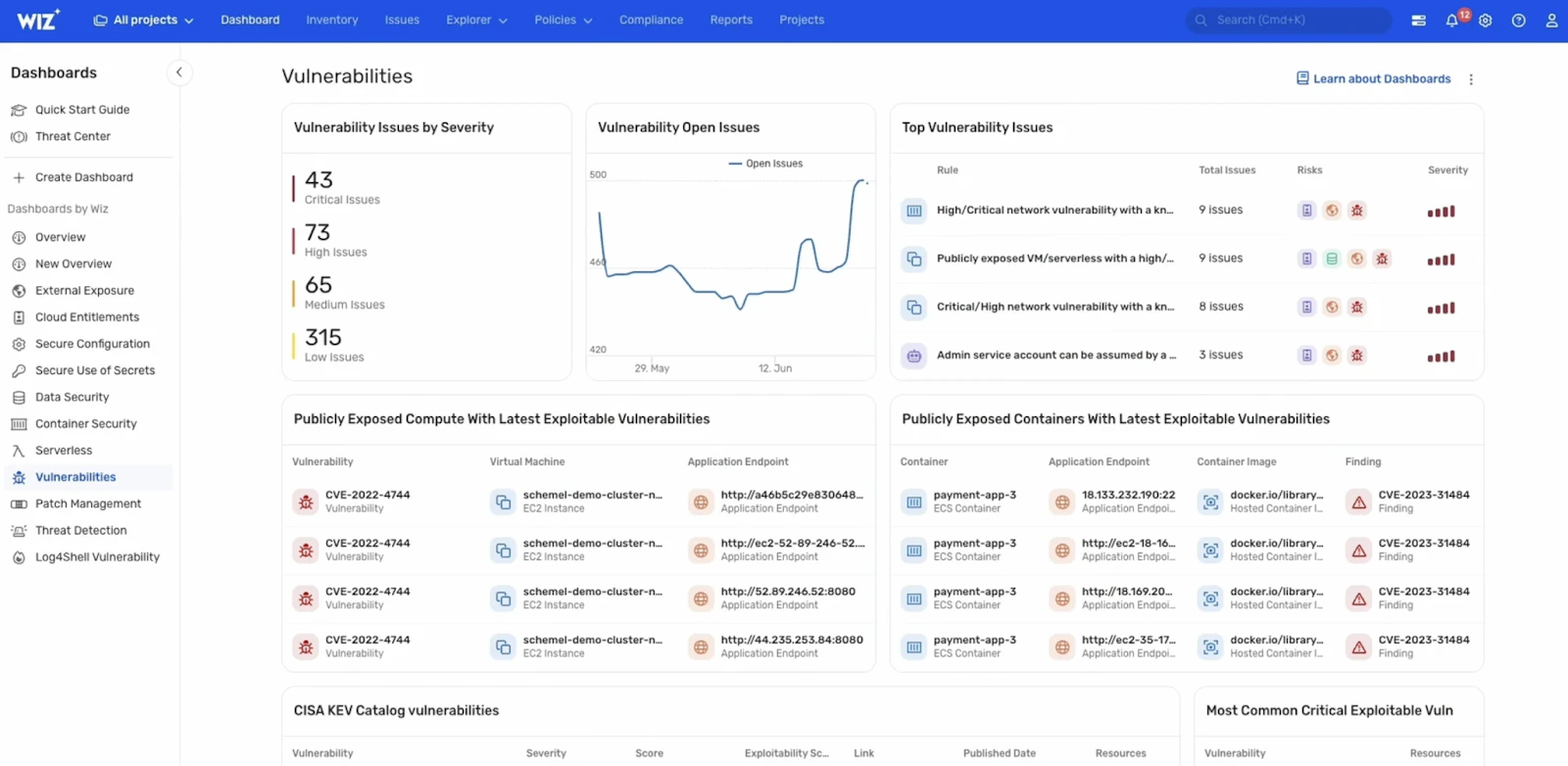
Wiz’s vulnerability management solution provides a cloud-native vulnerability management approach that connects development, cloud posture, and runtime context. Wiz’s point of view is that vulnerability management is most effective when findings from code, cloud configuration, identity, and runtime activity are evaluated together rather than in isolation.
Ratings:
Highlights:
Security Graph–powered risk prioritization: Correlates CVEs with misconfigurations, exposed identities, internet exposure, and sensitive data access to identify the small set of vulnerabilities that actually matter.
Wiz Code for shift-left protection: Scans IaC templates, open-source libraries, and hardcoded secrets pre-deployment—then blocks risky PRs in CI/CD with developer-friendly fix suggestions.
Agentless scanning across cloud environments: Instantly scans VMs, containers, and serverless apps without installing agents—delivering full-stack coverage in minutes, not months.
Runtime threat detection and blocking: Optional eBPF-based sensor detects and blocks active exploits in real time by killing malicious processes like reverse shells and file-tampering attempts.
Developer-ready remediation: Generates merge-ready PRs and remediation guidance directly in CI pipelines and ticketing tools like Jira to speed up MTTR and reduce back-and-forth between security and dev teams.
Reviews
“Quick setup, fast value, clear visibility, and actionable cloud security”—Steven B. (Security Manager)
“Wiz has been a game-changer for our hospital's cloud security strategy…The transition from our previous Prisma solution was smooth, and the ongoing enhancements, such as the ServiceNow integration, continue to add value. I highly recommend Wiz to organizations looking to streamline their cloud security operations without sacrificing depth or quality in their monitoring and response processes.”—Nathan M. (Senior Security Engineer)
#2: Qualys VMDR
Qualys VMDR combines vulnerability scanning with risk quantification and remediation tracking, primarily through agent-based assessment.
Ratings:
Highlights:
Proprietary risk quantification framework, TruRisk™: Detects live threat indicators and measures business risk posed by vulnerabilities
Runtime SCA: Discovers open-source dependency risks introduced during development or after deployment
CIS Benchmark–based evaluation: Identifies vulnerabilities and misconfigurations to align IT environments with vulnerability management best practices
Review:
“So much more efficient than managing via Windows and MS Office."—Tina T. (Group Quality Systems Manager)
#3: Tenable Nessus
Tenable Nessus focuses on vulnerability scanning and exposure management across networks and cloud environments.
Ratings:
Highlights:
High-priority exposure detection: Normalizes vulnerability data across 50 trillion data points to discover and alert on vulnerabilities being exploited in the wild
PCI-certified vendor: Scans internet-facing assets in compliance with PCI DSS
Asset identification algorithm: Ensures no asset goes unscanned
Review:
“Tenable Nessus is easy to set up and easy to navigate. The reporting gives good detail to help remediate the vulnerabilities.”—Verified user in banking
#4: Microsoft Defender Vulnerability Management
Microsoft Defender Vulnerability Management is integrated into the Microsoft security ecosystem, with strong alignment to Azure and Microsoft 365 environments.
Ratings:
Pillar coverage:
Secure development ✅
Secure runtime posture ✅
Exploit detection and response ✅
Highlights:
Comprehensive security: Has a unified dashboard that integrates endpoint detection and response (via Defender XDR) and SIEM (via Microsoft Sentinel) with Microsoft Defender Vulnerability Management, supporting all three pillars of modern vulnerability management
Lightweight and customizable: Adds little to no resource overhead, and scanning can be customized very quickly for enterprise-specific workloads
Support for integrations: Offers flexible plans and integration APIs that let users choose any of the Microsoft Defender standalone products (e.g., EDR or cloud vulnerability management) with third-party tools
#5: ManageEngine Vulnerability Manager Plus
ManageEngine Vulnerability Manager Plus is a Zoho product designed to secure enterprise endpoints with continuous scanning, remote troubleshooting, data hardening, and automated patching.
Ratings:
PeerSpot: 9.4/10.0 (3 reviews)
Highlights:
Data hardening: Secures enterprise attack surface from internal and external threats
Patch management: Automatically patches servers and endpoints
Baseline monitoring: Identifies configurations and user activities that deviate from baseline specifications
Review:
“We use the solution to patch our servers. We also use it to monitor and fix vulnerabilities.”—Srijith Chandran (Senior Manager)
#6: Pentera
Pentera focuses on exposure management to minimize risks and also enhances root cause analysis for faster incident response.
Ratings:
PeerSpot: 7.8/10.0 (9 reviews)
Highlights:
Multi-layered pen testing: Validates the security of various layers of enterprise stacks, including internal networks, cloud environments, and external attack surface
Automated scanning and remediation: Fixes repetitive issues without human intervention, letting teams focus on more critical risks
Review:
“Great innovative tool for testing your environment”—Andey B. (Information Security Specialist)
#7: Intruder
Intruder incorporates scanning engines from multiple vulnerability and attack surface management tools to enable live exploit detection and response.
Ratings:
PeerSpot: N/A (no reviews)
Highlights:
Automatic discovery and remediation: Lets teams configure Intruder to automatically scan new internet-facing assets, discover the exact source of the risk within hours, and offer remediation steps to shorten the attack window
Private pen testers: Has an elite pen testing team that enterprises can pay extra for, to find exploits that scanning can’t dig out
Customer support: Offers rapid response to issues and provides forums where end users get to vote on product enhancements
Reviews:
"Convenient but thorough penetration and vulnerability testing wrapped in an affordable package!"—Roy M. (Director of IT)
#8 Scrut Automation
Scrut Automation excels at managing governance and compliance risks in cloud-native workloads.
Rating:
PeerSpot: N/A (no reviews)
Highlights:
Drift detection: Continuous monitoring to detect non-compliance with internal policies
Compliance audit trails: Ready-to-use audit trails demonstrating compliance and security posture
Collaborative workflows: Built-in and custom workflows with alerts and daily tasks to get all teams involved in internal policy and regulatory standards compliance
Review:
“Easy to use, great support, got us audit-ready fast.”—Naureen A. (CEO)
#9: NinjaOne
NinjaOne imports vulnerability intelligence, deploys AI-driven prioritization, and automates patching.
Rating:
PeerSpot: 8.2/10.0 (18 reviews)
Strengths:
360-degree endpoint visibility: Detects vulnerabilities and applies zero-touch patching
Endpoint hardening: Provided through predefined conditional processes and endpoint security workflows
Review:
"Excellent endpoint management tool."—Greg S. (IT Manager)
#10: RiskProfiler
RiskProfiler scans enterprise networks and external attack surfaces to uncover exploits, prioritize high-risk attack paths, and fix security risks.
Rating:
Highlights:
Dark-web monitoring: Discovers exploits and attacker TTPs (tactics, techniques, and procedures) in real time for accurate risk prioritization
Fast reconnaissance: Detects new and shadow assets as well as phishing and spoofing attempts
Attack path analysis: Continuous attack surface surveillance maps asset relationships and visualizes attackers’ entry points
Review:
“Enhancing threat response with impact-based prioritization"—Valentina J. (HR Operations Associate)


Why does Wiz stand out?
Many vulnerability management platforms focus on a single layer – such as scanning code, assessing runtime assets, or tracking CVEs. Wiz’s point of view is that vulnerability management is most effective when these signals are connected and evaluated together. Wiz brings vulnerability data into a unified cloud security platform that links development, cloud posture, and runtime context in a single model.
Wiz integrates capabilities across Wiz CNAPP, Wiz Security Graph, Wiz Code, and Wiz Defend to support vulnerability management across the full lifecycle. This integration allows teams to assess vulnerabilities alongside configuration, identity, exposure, and runtime signals—helping them better understand where vulnerabilities exist and how they relate to real-world cloud risk.
To support prioritization, Wiz combines vulnerability data with widely used frameworks such as CVSS, EPSS, and Known Exploited Vulnerabilities (KEV), along with environmental context like exposure, permissions, and asset ownership. This approach helps teams focus attention on vulnerabilities that may warrant closer investigation, rather than working through long, uncontextualized lists.
Wiz also supports remediation workflows across security and engineering teams. Vulnerability findings can be surfaced in CI/CD pipelines, ticketing systems, and developer tools, with guidance that links issues back to infrastructure-as-code, configuration, or dependency sources. This helps teams coordinate fixes across development and cloud operations without introducing separate tools or processes.
Wiz is designed to support a unified vulnerability management approach –bringing together agentless cloud assessment, optional runtime telemetry, development-time scanning, and contextual prioritization. By connecting detection with investigation and remediation workflows, Wiz helps organizations operationalize vulnerability management within modern cloud environments.See for yourself how Wiz shrinks your exploitable risk surface – and helps your teams fix what matters fast. Get a demo today.
From Reactive Patching to Machine-Speed Defense
See how Wiz turns thousands of raw vulnerability alerts into a prioritized list of actionable, code-to-cloud fixes.
