

What is an AI developer?
An AI developer is a specialized software professional who designs, builds, and deploys artificial intelligence applications and machine learning models that enable software to learn, adapt, and perform tasks that traditionally required human intelligence. This matters because AI developers are the practitioners who turn research breakthroughs into production systems that power everything from recommendation engines to fraud detection to generative AI chatbots.
In modern software teams, AI developers serve as the vital link between theoretical data science and practical application. While data scientists may focus on statistical validity and experimental models, the AI developer ensures those models function reliably within a product ecosystem. They work alongside ML engineers, who handle the underlying infrastructure, and traditional software developers, who build the user-facing applications that consume AI outputs.
The role has seen rapid growth, with 78% of organizations adopting AI according to Stanford's AI Index, driven by the widespread adoption of generative AI and the shift toward AI-powered products across nearly every industry. As organizations move from experimenting with AI to deploying it in production, the need for developers who can manage the full AI lifecycle (from data preparation and model training to integration and monitoring) has become critical.
Watch 10-min AI Guided Tour
Interactive walkthrough of how Wiz helps security teams secure AI workloads across the cloud with full visibility.

What does an AI developer do?
The day-to-day responsibilities of an AI developer span data work, model development, and production integration. Typical tasks include:
Building inference APIs that serve model predictions to applications via REST or gRPC endpoints
Implementing feature pipelines that transform raw data into model-ready features using tools like Feast or Tecton
Adding evaluation and guardrails for LLM-powered features, including prompt validation and output filtering
Setting up A/B tests and canary deployments to safely roll out new model versions
Debugging model performance issues when accuracy degrades or latency spikes in production
Integrating third-party AI services (OpenAI, Anthropic, Cohere) into application workflows
AI developers spend roughly 60-70% of their time on data preparation and integration work, with the remainder on model development and optimization.
AI developer vs. AI engineer vs. data scientist
While titles often overlap in smaller organizations, distinct differences exist between these three roles in mature engineering teams.
| Feature | AI Developer | AI Engineer | Data Scientist |
|---|---|---|---|
| Primary Focus | Application integration & model implementation | Scalable infrastructure & MLOps | Exploratory analysis & research |
| Key Deliverables | AI-powered features & functional apps | Deployment pipelines & serving infrastructure | Insights, reports & experimental models |
| Technical Depth | Software engineering + ML frameworks | Systems engineering + Cloud/DevOps | Statistics + Mathematics |
| Infrastructure Involvement | Consumes APIs & managed services | Builds & maintains clusters/pipelines | Varies (notebooks, SQL, some prod) |
| Typical Background | CS or Software Engineering | DevOps or Backend Engineering | Math, Stats, or Physics |
AI developers typically sit between research and production. They take a trained model, or train one themselves using established architectures, and make it work inside a real application. In contrast, AI engineers focus on the "plumbing" that allows models to run at scale, such as setting up Kubernetes clusters or optimizing inference latency. Data scientists focus on the "why" and "what if," using statistical modeling to derive insights, often without the constraint of building production-ready software.
Core skills AI developers need
AI development requires programming expertise, ML fundamentals, and practical engineering skills. The role is shifting from writing raw algorithms toward orchestrating cloud services and APIs.
Programming and AI frameworks
Python dominates AI development. Developers must master frameworks like PyTorch, TensorFlow, Keras, Hugging Face Transformers, and Scikit-learn to structure projects, debug training issues, and optimize performance.
Machine learning and deep learning fundamentals
Strong ML foundations are non-negotiable: supervised vs. unsupervised learning, neural network architectures, training/validation splits, loss functions, gradient descent, and regularization. Deep learning knowledge—CNNs for images, RNNs for sequences, Transformers for NLP—allows developers to debug effectively and select the right approach.
Data handling and preparation
Most development time goes to data work: cleaning, transforming, and validating datasets. This includes feature engineering (selecting and transforming variables to improve performance) and handling missing data or outliers. Proficiency with Pandas, NumPy, SQL, and ETL processes is essential.
Cloud infrastructure and deployment
AI deployment is mostly cloud configuration: identity permissions, network exposure, data access paths, and runtime guardrails. Developers need skills in managed services (AWS SageMaker, Vertex AI, Azure ML), containerization (Docker, Kubernetes), cost optimization, and monitoring. Understanding these decisions builds more secure systems by default.
Problem-solving and continuous learning
AI development involves constant experimentation. ML models fail in subtle, probabilistic ways, requiring strong analytical thinking. The field evolves rapidly, so developers must stay current and communicate technical concepts to non-technical stakeholders. Curiosity and persistence are essential.
Get a 1-on-1 AI Security Assessment
We'll give you full-stack visibility into your AI pipelines to uncover misconfigurations and attack paths that actually matter.
Request assessment
How to become an AI developer
There is no single path into AI development. Practitioners come from diverse backgrounds including computer science, mathematics, physics, and increasingly, self-taught routes. The most important factor for hiring managers is demonstrable skills through projects and experience, rather than specific credentials.
Education and formal training
Traditional degrees: Most AI developers hold degrees in computer science, mathematics, statistics, or related fields. While a graduate degree can provide deeper theoretical foundations helpful for research-heavy roles, it is not strictly required for many application-focused developer positions.
Alternative learning paths: The rise of bootcamps and online courses has democratized access to these skills, with platforms like Coursera, fast.ai, and DeepLearning.AI offering high-quality, practical education.
Building a portfolio
Projects over credentials: Portfolio projects are often more important than formal credentials. Building and documenting projects—such as competing in Kaggle competitions, contributing to open-source tools, or creating personal applications that solve real problems—demonstrates practical ability.
Show end-to-end skills: Projects should cover data preparation, model building, evaluation, and deployment, rather than just model training. Documenting this work on GitHub or writing about it on blogs helps establish expertise.
Certifications that matter
Cloud-specific credentials: Certifications can validate skills and help candidates stand out, particularly for cloud-specific roles. Relevant credentials include AWS Certified Machine Learning – Specialty, Google Cloud Professional Machine Learning Engineer, and AWS Certified AI Practitioner. Credential availability changes over time, so prioritize hands-on project experience alongside certifications to demonstrate practical ability.
Combine with experience: These are most valuable when combined with hands-on experience, as they prove familiarity with the enterprise tools used in production environments.
Community engagement
Stay current and find mentorship: Engaging with the AI community through meetups, conferences, and online forums like Reddit or Discord helps developers stay current and find mentorship.
Network for opportunities: Many roles are filled through networking and referrals, so contributing to open-source projects or sharing knowledge on platforms like LinkedIn or X (formerly Twitter) can create significant career opportunities.
What is a chief AI officer (CAIO)?
CAIO (Chief AI Officer) is a C-suite executive who leads AI strategy, governance, and enterprise-wide adoption across an organization to scale AI use.
Mehr lesen
AI developer salary and career outlook
AI developer roles command premium compensation due to the specialized skill set required. Salaries vary by geography, industry, and experience level, but consistently exceed standard software development positions.
| Experience Level | Typical Salary Range (US) | Key Responsibilities |
|---|---|---|
| Entry-Level | $90K–$130K | Model implementation, data preprocessing, basic integration |
| Mid-Level | $130K–$180K | End-to-end model development, production deployment, optimization |
| Senior/Lead | $180K–$250K+ | Architecture design, complex systems, technical leadership |
Career progression offers multiple paths: senior IC roles, AI engineering or architecture, management, or specialization in areas like NLP or computer vision.
Demand remains strong as enterprises integrate AI into core products. 92% of organizations plan to recruit for GenAI skills in 2025, with developers who combine AI expertise with cloud and security awareness particularly valuable.
Why AI developers need security awareness
A critical gap exists in the industry today: most AI developers focus heavily on functionality and model performance but lack awareness of the security risks their work introduces. AI systems connect to sensitive data, cloud resources, and production infrastructure, creating new attack surfaces. Gartner reports 32% of organizations faced AI application attacks, and traditional application security programs may not fully cover these risks without cloud, data, and identity context.
AI developers must understand specific risks inherent to their workflow. Model supply chain vulnerabilities from public repositories can introduce malicious code or backdoors. Data exposure in training pipelines risks leaking sensitive information through misconfigured storage. Overprivileged AI services with excessive permissions create lateral movement risks, while Shadow AI bypasses organizational controls entirely. AI developers who understand these security implications are far more valuable to their organizations, helping adopt AI responsibly without compromising data or infrastructure.
Wiz's approach to securing AI development
As organizations adopt AI at scale, security teams need visibility into the AI services, models, data, and pipelines that AI developers introduce. Security works best when it's integrated into the development workflow, not bolted on at the end. Teams that build security into their AI pipelines from the start spend less time on remediation and move faster to production.
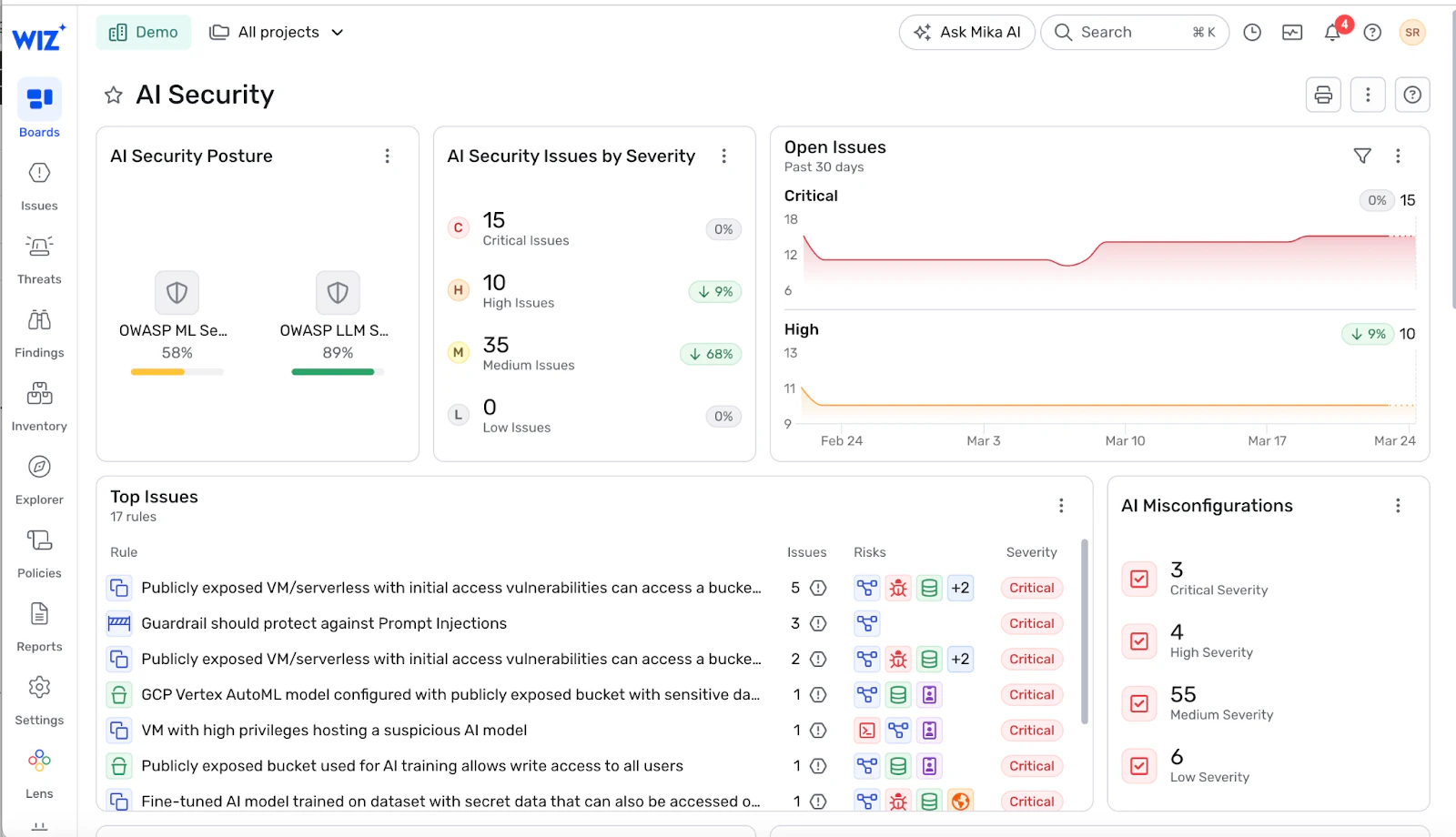
Wiz AI-SPM (AI Security Posture Management) provides an AI Bill of Materials (AI-BOM) view that helps discover and inventory AI services, related components (such as managed AI services like Amazon SageMaker, Azure AI, and Google Vertex AI), and AI-relevant configurations across cloud environments without requiring agents. This gives organizations immediate visibility into what is running, from managed services like Amazon SageMaker, Google Vertex AI, and Azure AI to self-hosted models running on virtual machines.
Wiz extends Data Security Posture Management (DSPM) to AI training data, helping organizations identify where sensitive data is being used in AI pipelines and ensuring it is not exposed publicly. Wiz Code further shifts security left by scanning for vulnerabilities in AI dependencies and related build artifacts before they are deployed to production environments.
Get a demo to see how teams connect AI services, cloud infrastructure, and data context to prioritize what's actually risky, from code to cloud.
See for yourself...
Learn what makes Wiz the platform to enable your cloud security operation
