
What is a chief AI officer?
A chief AI officer (CAIO) is a C-suite executive responsible for leading an organization's artificial intelligence strategy, governance, and enterprise-wide adoption. This role exists because AI initiatives frequently fail when no single leader owns the outcomes, leading to fragmented pilots, wasted investment, and ungoverned risk. Instead of treating AI as just another IT project, the CAIO elevates it to a strategic business imperative that requires dedicated oversight.
The emergence of this role has accelerated due to government mandates and rapid market shifts. For example, the U.S. Office of Management and Budget (OMB) mandated that federal agencies designate a Chief AI Officer to manage AI risks and innovation. Similarly, private sector enterprises are appointing CAIOs to navigate the complexity of generative AI adoption.
The CAIO meaning extends far beyond technical oversight. While they must understand the technology, their primary focus includes ethics, compliance, cultural change, and cross-functional alignment. They ensure that AI systems are not only technically sound but also ethically deployed and aligned with business goals.
Titles for this position vary across industries. You might see this role listed as "Head of AI," "Artificial Intelligence Director," or "Chief Data and AI Officer." Despite the variation in titles, the core accountability remains consistent: unifying the organization's approach to artificial intelligence.
Watch 10-min AI Guided Tour
Interactive walkthrough of how Wiz helps security teams secure AI workloads across the cloud with full visibility.

Why organizations are creating CAIO roles
The CAIO role emerged from a gap between AI ambition and organizational readiness. Previously, AI was distributed across IT, data science, and business units with no unified accountability; now organizations recognize the need for dedicated leadership to drive outcomes. Without a central leader, AI efforts often become disjointed science experiments rather than scalable business solutions.
Most cloud environments already use AI services, but many deployments happen without security or leadership visibility—a phenomenon known as shadow AI. Microsoft's Work Trend Index reported that 78% of AI users bring their own tools to work. This ungoverned AI creates compliance violations, data exposure, and security blind spots. CAIOs need discovery mechanisms to identify what AI exists before they can govern it.
Traditional leadership structures compound the problem. CIOs focus on infrastructure, CTOs on technology architecture, and CDOs on data; none have explicit accountability for AI outcomes. CAIOs provide a single point of accountability that accelerates decision-making and removes organizational friction.
Regulatory pressure is also driving CAIO adoption, with government mandates requiring CAIOs in U.S. federal agencies and the EU AI Act imposing strict transparency obligations globally.
Core responsibilities of a chief AI officer
The CAIO role is multi-dimensional, spanning strategy, governance, implementation, and collaboration. While responsibilities vary by organization size and AI maturity, they typically fall into four interconnected areas:
| Responsibility Area | Key Stakeholders | Primary Outcomes |
|---|---|---|
| AI strategy and roadmap | CEO, Board, Business Unit Leaders | Aligned AI investments, prioritized use cases |
| Governance, risk, and ethics | Legal, Compliance, CISO | Policy frameworks, regulatory compliance |
| Enterprise implementation | IT, Data Science, Engineering | Scaled AI adoption, production deployments |
| Cross-functional collaboration | All C-suite, Department Heads | Unified AI vision, reduced organizational friction |
How the CAIO role differs from CIO, CTO, and CDO
The CAIO is complementary to other technology leadership roles, not competitive. While there is overlap, each role has distinct scopes and accountabilities:
| Role | Primary Focus | AI Accountability | Typical Background |
|---|---|---|---|
| CIO | IT infrastructure, operations, enterprise systems | AI infrastructure and operations | IT management, enterprise systems |
| CTO | Technology architecture, product development, innovation | AI technology selection and integration | Engineering, product development |
| CDO | Data strategy, data governance, analytics | Data quality for AI, data governance | Data science, analytics |
| CISO | Security strategy, risk management, compliance | AI security posture, threat detection | Security operations, risk management |
| CAIO | AI strategy, governance, enterprise adoption | End-to-end AI outcomes and governance | AI/ML research, data science, business strategy |
Skills and qualifications for a chief AI officer
CAIOs require a rare combination of technical depth, business acumen, and leadership capabilities. They must be able to debate model architecture with data scientists one hour and discuss ROI with the board the next. Backgrounds vary but typically include experience in AI/ML, data science, or technology leadership.
Technical foundation
CAIOs need deep understanding of AI/ML technologies, including model development, training, and deployment. They must understand the lifecycle of an AI model, from data ingestion to inference, and the nuances of generative AI versus predictive analytics.
They must also be familiar with cloud platforms, data infrastructure, and AI services from major providers. While CAIOs don't need to code daily, they must understand technical trade-offs to evaluate AI solutions credibly. This includes awareness of AI security considerations, such as model vulnerabilities and data protection requirements.
Business and strategic acumen
CAIOs must translate AI capabilities into business outcomes and ROI. They need to look past the novelty of a technology to determine if it actually drives revenue, reduces cost, or improves customer experience.
This requires the ability to identify high-value use cases and build business cases for AI investments. They must also have experience with enterprise transformation and change management, as well as financial literacy for budget management and investment prioritization.
Governance and risk management
CAIOs need expertise in AI governance frameworks, ethics, and compliance. They must understand how to balance the speed of innovation with the necessity of safety and control.
This includes understanding regulatory requirements and emerging AI legislation globally. They must be able to assess and mitigate AI-specific risks, including bias, security vulnerabilities, and operational failures, and establish policies that enforce safe usage.
Leadership and change management
CAIOs must build coalitions, influence without direct authority, and drive cultural change. AI adoption often faces internal resistance, and the CAIO must be the champion who brings the organization along.
This requires strong communication skills for translating technical concepts to boards and executives. They must have experience building and leading cross-functional teams and the political savvy to navigate organizational complexity.
Get a 1-on-1 AI Security Assessment
We'll give you full-stack visibility into your AI pipelines to uncover misconfigurations and attack paths that actually matter.
Request Assessment
Chief AI officer salary and career outlook
Chief AI officer compensation varies significantly based on organization size, industry, reporting structure, and scope of responsibility.Compensation packages typically include base salary, performance bonuses, and equity, reflecting both the strategic importance of the role and the scarcity of qualified talent who combine technical depth with executive leadership experience.
Several factors influence CAIO compensation levels and structure:
| Factor | Impact on Compensation | Typical Range Influence |
|---|---|---|
| Organization size | Enterprise CAIOs (10,000+ employees) command higher compensation than mid-market roles | Significant premium for large enterprises |
| Industry | Financial services, healthcare, and technology sectors pay premium rates due to AI strategic importance | 15-30% higher in high-value sectors |
| Reporting line | CAIOs reporting to CEO have larger packages than those reporting to CIO or CTO | CEO reporting adds 20-40% premium |
| Scope | Roles with P&L responsibility or product ownership command higher total compensation | P&L ownership increases equity component |
| Public vs. private | Public companies include significant equity components; private companies may offer higher base salaries | Equity vs. cash mix varies significantly |
| Regulatory environment | Highly regulated industries (banking, healthcare) value governance expertise and compensate accordingly | Governance expertise adds 10-25% premium |
Many CAIOs come from data science leadership, AI research, or technology executive backgrounds. As the role is still emerging, career paths are not yet standardized, and professionals may enter the C-suite from product, engineering, or strategy roles depending on the organization's focus.
When does an organization actually need a CAIO?
Not every company needs a C-level executive dedicated to AI. Organizations should evaluate their need based on AI maturity and strategic importance.
Signs it is time to create the role include:
AI initiatives are fragmented across multiple teams with no unified strategy.
AI projects stall due to unclear ownership or competing priorities.
Regulatory requirements demand dedicated AI governance.
AI spending is significant but ROI is unclear.
Shadow AI is creating ungoverned risk.
For organizations not ready for a dedicated CAIO, alternatives exist. Some assign AI accountability to an existing executive like the CIO, CTO, or CDO. Others create an AI steering committee with shared accountability or hire a fractional or advisory CAIO to guide strategy. Organization size matters less than AI strategic importance; smaller companies with AI-centric business models may need a CAIO before larger companies with only peripheral AI use.
How CAIOs partner with CISOs
AI security is often under appreciated in the CAIO role. While CAIOs focus on performance and adoption, ignoring security creates blind spots that generate real business risk. Most AI governance discussions emphasize ethics and compliance but overlook foundational security requirements. Effective CAIOs partner with CISOs to address four critical areas: securing cloud infrastructure that powers AI workloads, protecting sensitive training data, discovering shadow AI deployments, and mitigating AI-specific attack surfaces like prompt injection and model extraction. This collaboration ensures AI systems are secure by design, not bolted on afterward.
Wiz's approach to AI security for enterprise governance
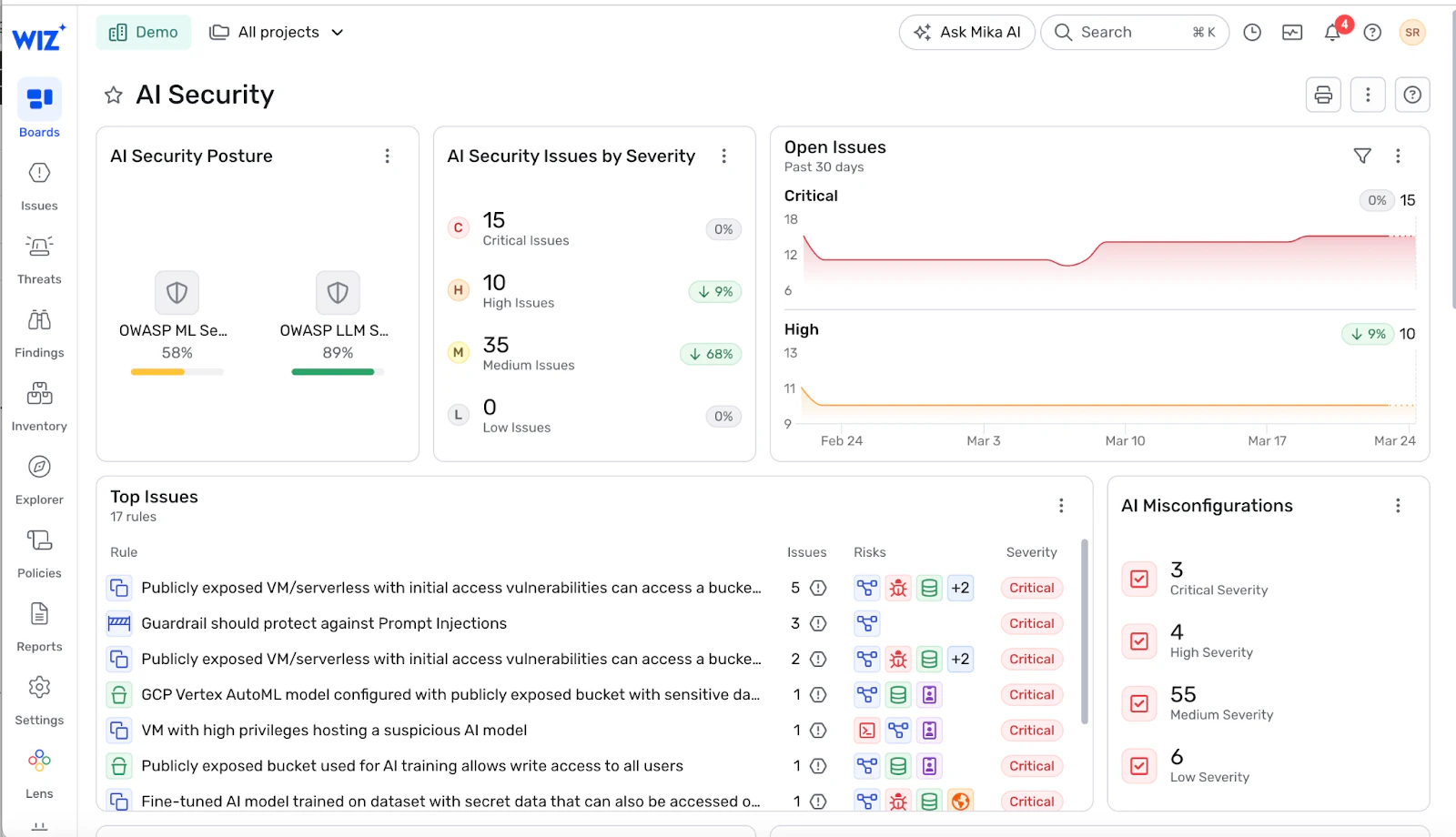
Wiz AI-SPM provides visibility across cloud environments to support CAIO governance needs. It reduces blind spots caused by shadow AI and disconnected tools by grounding AI governance in cloud context, correlating identity permissions, network exposure, and data access paths to show how AI risks connect to broader infrastructure vulnerabilities.
The platform creates an AI-BOM (AI Bill of Materials) for a complete inventory of AI services, models, SDKs, and pipelines. This agentless discovery helps identify AI deployments without requiring manual tracking or developer reporting, improving the CAIO's accuracy and timeliness of AI estate visibility across connected cloud environments.
Wiz connects this inventory to Data Security Posture Management (DSPM) for protecting sensitive training data and identifying data exposure risks. It correlates AI risks with cloud context (such as misconfigurations, identities, and network exposure) to show true attack paths. This allows CAIOs to govern AI adoption without blocking innovation by providing visibility rather than creating friction. Security teams and CAIOs can share a common view of AI risk across the organization.
Get a demo to see how AI inventory, cloud context, and risk prioritization can support CAIO governance without slowing teams down.
See for yourself...
Learn what makes Wiz the platform to enable your cloud security operation
