


What makes agentic AI different from traditional AI systems
Traditional AI systems are typically passive. They receive an input, generate an output, and stop. From a security perspective, this maps cleanly to familiar patterns: inference endpoints, model artifacts, and data access that can be monitored and controlled as discrete events.
Agentic AI systems change this model by introducing autonomy. Rather than responding to a single request, agents are designed to pursue goals over time. They plan actions, invoke tools, and interact with cloud services using delegated identities – often without human approval at each step.
Securing AI Agents 101
Learn what AI agents are, how they work, and how to keep them secure, all on one page. This flashcard-style guide breaks down where AI risk hides and what steps actually reduce it.

The security impact comes from capability, not cognition. Agentic systems frequently require:
Persistent or shared state to track progress
Access to infrastructure APIs, data stores, and external services
Non-human identities with broad permissions to operate across systems
Individually, none of these elements are new. Security teams already manage service accounts, automation, and long-running workflows. The difference is that agentic AI combines these elements into a single system that can act continuously and across boundaries.
This is where traditional assumptions begin to fail. Controls designed for short-lived, human-driven actions struggle when decisions, execution, and state are distributed across systems and executed automatically. What looks like routine automation at the individual action level can represent meaningful risk when viewed as a goal-driven sequence.
In practice, agentic AI does not introduce exotic attack techniques. It removes friction from existing ones, making familiar cloud misconfigurations – over-privileged identities, unclear trust boundaries, and excessive data access – easier to exploit and harder to reason about without contextual visibility.
Why agentic AI breaks traditional security assumptions
Most cloud security controls are built on a set of implicit assumptions: that actions are human-initiated, bounded in time, and constrained to a single domain. Identity usage is expected to be intermittent, permissions are reviewed periodically, and workflows tend to follow predictable paths.
Agentic AI systems challenge these assumptions – not by behaving unpredictably, but by operating continuously and across boundaries. An autonomous system may use the same identity repeatedly, invoke multiple services in sequence, and maintain state across sessions, all as part of normal operation.
This creates blind spots for controls designed around isolated events. A single API call, database query, or configuration change may appear benign in isolation. Risk only becomes visible when those actions are correlated across identities, resources, and time.
Agentic systems also blur trust boundaries. They often bridge environments that were not designed to implicitly trust one another – such as data stores and execution environments, internal tools and external services, or CI/CD pipelines and production infrastructure. When these boundaries are crossed automatically, misconfigurations propagate faster and are harder to contain.
From a security perspective, the challenge is not that agentic AI introduces unknown behavior. It’s that existing control gaps become harder to reason about when execution is automated, persistent, and distributed.
OWASP agentic AI threat domains (cloud-translated)
The OWASP Agentic AI project categorizes these risks into specific threat domains. To make these concepts actionable, we can translate them into the cloud security terms you already know.
Excessive agency and authorization failures
Excessive agency occurs when an agent is granted more authority than is required to safely perform its function. In cloud environments, this most often manifests as over-privileged service accounts, broad API permissions, or unrestricted tool execution.
Agentic systems frequently require access to multiple services to operate effectively. When those permissions are not tightly scoped, the agent inherits the same risk profile as any over-privileged automation: the ability to read sensitive data, modify infrastructure, or trigger downstream actions outside its intended role.
This is not a new failure mode. It mirrors the root cause of many cloud security incidents today. What changes with agentic AI is that excessive permissions can be exercised continuously and automatically, increasing blast radius when misconfigurations exist.
State and memory integrity failures
Many agentic systems rely on mutable state to function – such as vector databases, object storage, or shared context stores that persist information across interactions. When this state is not adequately protected, agents may consume untrusted or corrupted data as authoritative input.
The impact of this risk depends heavily on architecture. Systems that maintain shared or long-lived state are more exposed, as corrupted context can persist across executions. By contrast, stateless or tightly scoped agents are significantly less affected, since they do not reuse prior state or memory between tasks.
From a security perspective, this is best understood as a data integrity and access control problem, not a novel AI behavior. Protecting agent memory requires the same controls applied to other sensitive application data: restricting write access, validating inputs, and monitoring for unauthorized modification.
Tool execution and boundary crossing failures
Agentic systems often interact with external tools and services to accomplish tasks – deploying infrastructure, querying data sources, or triggering workflows. Risk emerges when agents are allowed to cross trust boundaries that were not designed for automatic execution.
In cloud environments, this commonly includes:
Data stores triggering execution paths
CI/CD systems interacting directly with production resources
Internal systems invoking external APIs without validation
When these boundaries are crossed programmatically, a misconfiguration in one domain can propagate rapidly into another.
Agentic supply chain and delegated trust
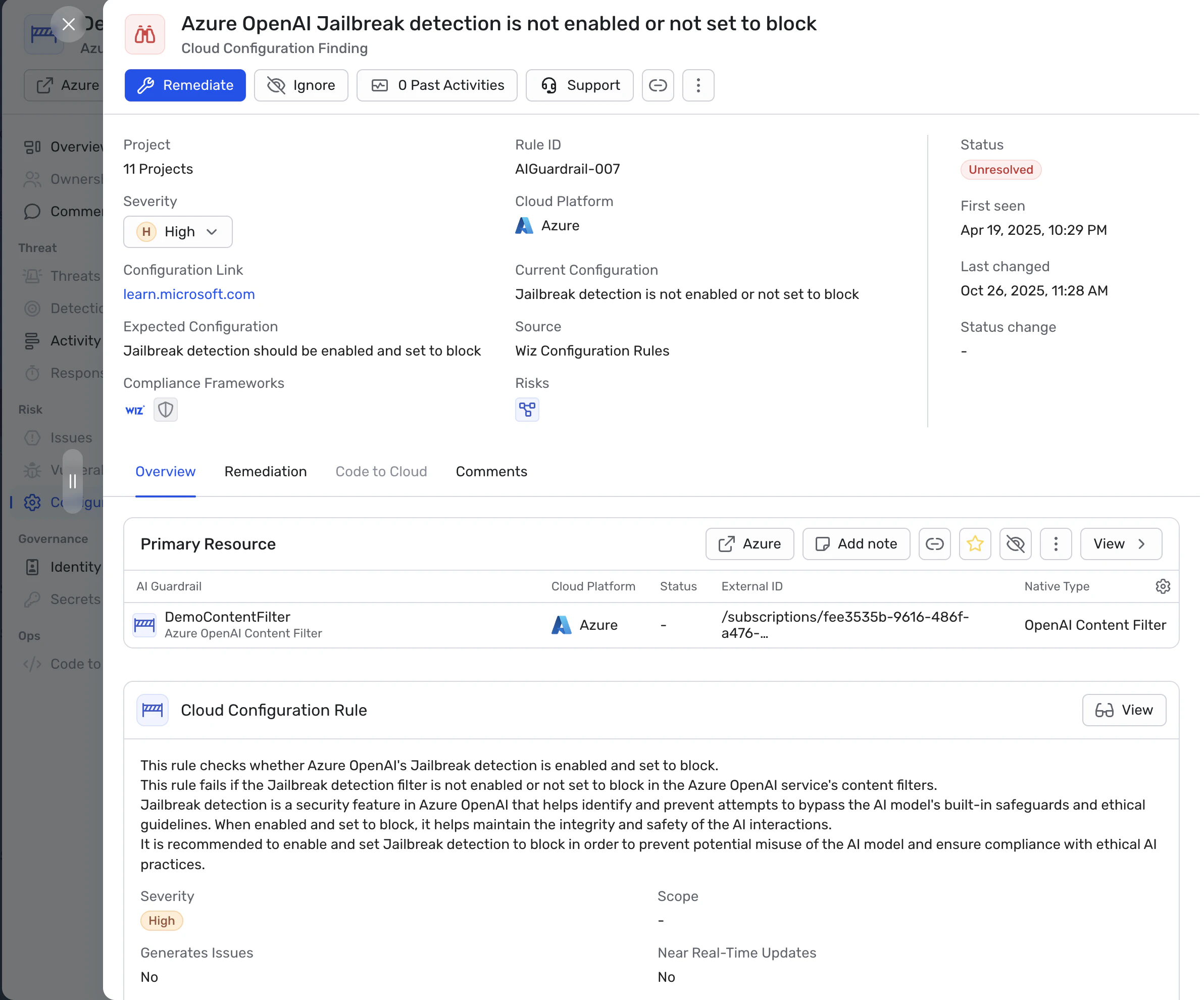
Agentic systems often rely on external components – such as third-party tools, APIs, models, or workflows – to accomplish tasks. When these dependencies are invoked automatically at runtime, trust decisions that were previously reviewed by humans become embedded into execution paths.
This introduces supply chain risk not because the components are inherently unsafe, but because agents can consume and act on external resources without contextual validation. A compromised dependency, misconfigured integration, or malicious update can propagate through agent workflows faster than traditional, human-gated processes.
From a cloud security perspective, this mirrors existing software supply chain challenges, amplified by automation. OWASP frames this as an agentic supply chain risk: a failure to explicitly control, validate, and monitor what autonomous systems are allowed to import, execute, or depend on.
Inside MCP Security: A Field Guide
Explore emerging risks in Model Context Protocol integrations and how they map to agentic supply chain threats.

Identity and non-human identity misuse
Agentic systems rely heavily on non-human identities such as service accounts, roles, and tokens to operate autonomously. These identities are often long-lived and broadly permissioned to support automation.
When mismanaged, non-human identities become a primary attack vector. Abuse of service accounts, leaked tokens, or OAuth misconfigurations can grant attackers the same level of access as a trusted agent.
This risk aligns directly with existing cloud identity attack patterns. Agentic AI does not introduce new identity threats—it increases the impact of identity failures by tying them to continuous execution.
Multi-agent trust and coordination failures
As organizations deploy multiple agents that communicate or delegate tasks to one another, new trust relationships emerge. These interactions often rely on shared queues, event-driven workflows, or implicit assumptions about message integrity.
When trust boundaries between agents are not explicitly defined, compromise or misconfiguration in one component can influence others. This is less about cascading AI behavior and more about distributed system trust.
The underlying risk mirrors long-standing issues in microservices and event-driven architectures, now applied to agent-based systems.
Detection and mitigation principles
OWASP’s approach to agentic AI security emphasizes control validation over prediction. Rather than attempting to anticipate every possible agent behavior, the focus is on ensuring that core security controls remain effective when autonomy, persistence, and automation are introduced.
At a foundational level, the same principles apply as in traditional cloud security – but they must be enforced more rigorously:
Least privilege for autonomous systems. Agentic workloads should operate with narrowly scoped permissions, explicit role separation, and regular review of non-human identities. In practice, this is challenging because automation often expands over time, accumulating permissions faster than they are audited.
Explicit trust boundaries between systems. Data stores, execution environments, CI/CD pipelines, and external services should not implicitly trust one another. When agents bridge these domains automatically, misconfigurations propagate faster and are harder to contain.
State integrity and access controls. Persistent memory and shared state must be treated as sensitive assets. Controls that work for application data—access restrictions, integrity protections, and monitoring—are equally necessary for agent memory and context stores.
Detection remains challenging for many organizations, particularly where security tooling is optimized for discrete, human-initiated events rather than continuous automation. Individual actions performed by an agent – API calls, data access, configuration changes – often look legitimate in isolation.
Effective detection therefore depends on correlation rather than signatures, including:
Linking identity usage to resource access over time
Understanding how permissions, exposure, and data intersect
Identifying sequences of actions that form meaningful risk, not isolated anomalies
Mitigation also requires prioritization. Not every misconfiguration in an AI system is equally dangerous. OWASP emphasizes focusing on conditions that create real attack paths, where autonomy intersects with excessive permissions, exposed services, or sensitive data access.
The 4-Step Framework for AI Threat Readiness
Wiz has designed a 4-step framework to help organizations defend against rapid, automated exploitation in a post-Mythos world.

How Wiz operationalizes the OWASP agentic AI threat model
Wiz operationalizes the OWASP agentic AI threat model by validating the cloud security controls that autonomous systems depend on. Rather than attempting to interpret agent intent or behavior in isolation, Wiz focuses on the identities, permissions, data access, and exposure paths that determine what an agentic system can actually do in a cloud environment.
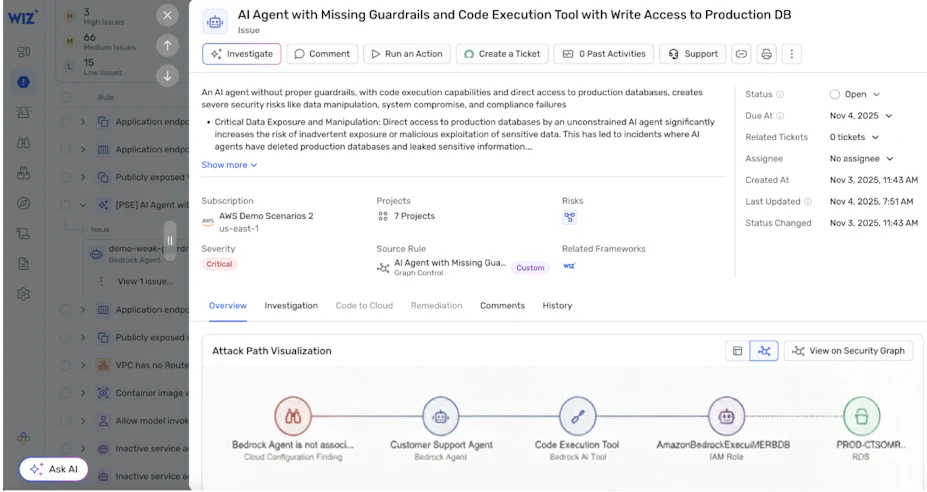
Using agentless discovery and a unified security graph, Wiz maps OWASP threat domains to concrete cloud risk. AI workloads – such as managed AI services, notebooks, pipelines, model storage, and supporting data stores – are treated as first-class cloud assets and analyzed alongside the infrastructure they rely on.
This makes it possible to evaluate agentic AI risk through familiar security questions:
Which service accounts and roles do AI workloads use?
Are those identities over-privileged or reused across environments?
What sensitive data can AI systems access, and from where?
Are AI services, APIs, or memory stores exposed to untrusted networks?
Wiz Research reinforces this model with real-world findings, uncovering exposed AI data stores, misused non-human identities, and AI infrastructure vulnerabilities that align directly with OWASP threat categories. These insights help ground agentic AI risk in observed cloud failure modes, not theoretical behavior.
By correlating AI workloads with cloud context, Wiz helps security teams prioritize remediation where autonomous systems intersect with real cloud attack paths. Get a demo to see how agentic AI risk becomes visible and actionable.
See how AI-APP connects the full stack
Experience Wiz's unified security graph mapping code, cloud, and runtime for your AI workloads.
