



APIs serve as the contractual interface that holds together distributed, cloud-native applications. But to be honest, they're also the source of some huge security headaches. The days of defending a simple monolithic perimeter are long gone: Today, attack surfaces are an ever-increasing, dynamic, and often chaotic mesh of API endpoints.
This is where API management steps in—not as another tool to add to the pile but as a strategic control plane for bringing order to that chaos. It's about moving from a reactive security posture to a proactive one where you can govern, secure, and observe every API transaction as part of a full lifecycle API management strategy. With effective API management, you can reduce incident response times, slash audit findings, and enable a true zero trust architecture at the application layer.
Advanced API Security Best Practices [Cheat Sheet]
Download the Wiz API Security Best Practices Cheat Sheet and fortify your API infrastructure with proven, advanced techniques tailored for secure, high-performance API management.

Why API management matters for cloud security
API security is a top priority because attackers are always on the lookout for open, unauthenticated APIs that they can use to gain entry into systems. And when threat actors find an API foothold, they can do massive damage. In 2022, the Optus breach demonstrated what’s at stake when a single unauthenticated API endpoint led to the exposure of nearly 10 million customer records. This wasn't a sophisticated zero-day exploit; it reflected a fundamental breakdown in API authentication and exposure governance. The exposed endpoint lacked proper authentication controls, and no monitoring system flagged the unusual access patterns before millions of records were exfiltrated.
More recently, in 2025 and 2026, we've seen similar patterns in AI-infrastructure APIs where unauthenticated 'shadow' endpoints exposed model weights.
API risks to know about
So what vulnerabilities are attackers looking for? The OWASP Top 10 API Security Risks list includes:
Broken object-level authorization: An authenticated user can access resources they technically shouldn't be able to, simply by changing an ID in the API call (e.g., /api/users/123/orders to /api/users/456/orders).
Broken authentication: Authentication mechanisms that are poorly designed or implemented provide attackers with the chance to impersonate legitimate users.
Broken object property level authorization: The API fails to filter the specific properties of an object based on the user's permissions, exposing sensitive data fields that the user shouldn't see (e.g., an admin-only field being returned to a regular user).
In addition to these, there’s also the issue of API sprawl. In the cloud, new services and endpoints spin up constantly. It’s easy for shadow APIs—endpoints that get created outside of the official governance process—to slip through the cracks in such a dynamic environment. Unfortunately, shadow APIs remain invisible to security teams, making each one an ungoverned, unmonitored potential backdoor.
A robust API management strategy should directly confront all of these issues. Your best bet? Implementing context-aware API security measures that move beyond simple allow/deny rules by correlating signals like the caller's identity, the API's network exposure, the sensitivity of the data being requested, and known vulnerabilities in the underlying service.
This holistic view allows API security to connect to broader frameworks like zero trust, where every request is explicitly verified and least-privilege access is enforced based on real-time risk, regardless of where the request originates.
Core API management capabilities
API gateway and traffic management
The gateway is the primary point of enforcement as it interacts with both the client and the server and acts as a single point of entry for all API traffic. Modern API gateways enforce baseline security controls including reverse proxying, protocol translation (HTTP to gRPC), OpenAPI schema validation, JWT verification, mutual TLS (mTLS) for service authentication, rate limiting (e.g., 1,000 requests per minute per client), and advanced routing based on headers, paths, or client attributes.
For a microservices architecture, you can use API gateways to enforce load balancing across service replicas, implement circuit breakers to prevent cascading failures, and integrate with service meshes like Istio or Linkerd to secure "east-west" (service-to-service) traffic in addition to "north-south" (client-to-service) traffic.
Authentication and authorization
An API management platform externalizes and centralizes authentication and authorization logic so that individual development teams don't have to reinvent the wheel. It essentially acts as a broker, integrating with multiple identity providers (IDPs) and supporting standards like OAuth 2.0, OpenID Connect (OIDC), and JWT for API authentication, with SAML typically used for web-based single sign-on (SSO) into developer portals or management planes rather than direct API calls.
More importantly, API management platforms enable fine-grained authorization. In other words, you can implement role-based access control (RBAC) and attribute-based access control (ABAC) and create dynamic policies that change based on context, such as user location, time of day, or the risk score of the device.
The platform you choose should also handle token management across the full lifecycle: secure issuance with short expiration windows (e.g., 15-minute access tokens), validation against JSON Web Key Sets (JWKS), automatic rotation, revocation endpoints for compromised tokens, introspection for real-time token status checks, and detection mechanisms for token leakage through log analysis and anomaly detection.
Monitoring and observability
Comprehensive API observability requires four foundational data types for every request: detailed logs with trace IDs for correlation, performance metrics (latency percentiles, error rates, throughput), security event data (authentication failures, authorization denials, rate limit violations), and distributed traces that follow a single request across multiple services. Forward all logs to your SIEM (Splunk, Sentinel) and SOAR platforms for automated incident response.
Developer experience and governance
A key function of API management is to provide a great developer experience. This starts with a developer portal, which serves as a self-service hub where developers can discover available APIs, read clear documentation, and obtain credentials for their applications in a sandboxed environment.
Focusing on developer enablement is one of the best ways to scale governance. By using integrated API governance tools to adopt a policy-as-code approach, you can define security policies (like required authentication methods or rate limits) in configuration files that are stored in Git and applied automatically. As a result, security is directly integrated into the DevSecOps workflow, and you’ve ensured consistency across hundreds or thousands of APIs.
Watch 12-min demo
Learn about the full power of the Wiz cloud security platform. Built to protect your cloud environment from code to runtime.

Overcoming API management challenges in cloud environments
API discovery and inventory management
Maintaining a complete and up-to-date inventory of all your APIs across dynamic, multi-cloud environments is incredibly difficult. Tracking APIs manually is cumbersome and nearly impossible. That’s why you need automated discovery, which modern platforms achieve by analyzing network traffic, scanning code repositories for API definitions, and integrating with cloud provider APIs to identify all running services and their exposed endpoints. The bottom line? Without automated discovery, shadow APIs will remain your biggest blind spot.
Multi-cloud and hybrid complexity
If you have workloads spanning multiple cloud providers, plus some on-premises infrastructure, how do you enforce a consistent security policy across all of them? This is where federated platforms like Azure API Management come into play. A federated platform cuts through multi-cloud and hybrid complexity by providing a central control plane that synchronizes and enforces policies on distributed gateway runtimes located in different environments.
Performance and scalability considerations
Any component you put in the request path will add latency. To minimize that overhead, lean on smart architecture: Use high-performance gateways, implement intelligent caching strategies at the edge, integrate with CDNs, and ensure your gateway infrastructure can auto-scale based on traffic load. Additionally, plan your capacity meticulously so that the management layer doesn’t choke during high-performance scenarios.
Security benefits and risk mitigation
When implemented correctly, the benefits of using an API management platform are tangible and measurable. Centralizing policy enforcement and monitoring drastically reduces your overall attack surface. You're no longer securing hundreds of doors inconsistently; you're hardening consolidated control points. For north-south traffic (client to service), edge gateways like AWS API Gateway or Azure API Management enforce authentication, rate limiting, and WAF rules. For east-west traffic (service to service), service meshes like Istio or Linkerd enforce mTLS, authorization policies, and traffic encryption between microservices.
As we’ve seen, the most advanced API management strategies rely on context. Instead of just analyzing traffic patterns in isolation, a contextual approach builds a multi-dimensional risk profile for every API call. It correlates signals like the user's identity and permissions, the API's network exposure (e.g., internal vs. public-facing), the sensitivity of the data being transacted, and known vulnerabilities in the underlying service. Armed with this rich context, platforms can distinguish a legitimate but unusual request from a truly malicious one, such as credential stuffing or data exfiltration.
When you operate in a cloud environment, multiple security vulnerabilities may occur simultaneously, and they can’t be fixed all at once. With context-aware security, you can filter out the noise by identifying "critical toxic combinations"—such as an API that is exposed to the internet, contains sensitive data, and has a critical vulnerability. This helps with risk prioritization and lets you focus on actual issues that have a large attack surface without drowning in a pool of low-priority alerts.
The result? A quantifiable improvement in your security posture. You can dramatically reduce the mean time to detect (MTTD) and mean time to contain (MTTC) for API-related incidents. And from a compliance perspective, there are other huge wins: API management platforms provide an automated audit trail of every request.

Developer experience and governance
Modern API management isn't a gatekeeper that slows things down; it's a guardrail that enables teams to move faster—safely. The key is integrating governance directly into the CI/CD pipeline.
Here’s how it works: Using a GitOps workflow, API configurations and security policies are treated as code. A developer makes a change in Git, a pipeline runs automated security checks (e.g., schema validation against the OpenAPI spec or compliance checks against organizational policies), and upon approval, the change is automatically deployed.
This approach conforms with the idea of DevSecOps best practices, provides immediate feedback to developers within the tools they already use, and prevents security issues from ever reaching production.
How Wiz enhances API security
Traditional API management platforms are fantastic at securing the runtime. They see the traffic, enforce the policies, and log the events. But when a runtime security issue is detected—say, an API is leaking sensitive data—where did that vulnerability actually come from? The platform can tell you what happened, but not why. The "why" is in the source code.
Wiz API SPM takes a different, modernized approach. By combining agentless cloud infrastructure scanning with the Wiz Runtime Sensor and gateway integrations (AWS API Gateway, Azure API Management, Kong, Apigee), Wiz analyzes cloud and runtime context from infrastructure to application layer. This delivers deep visibility into your API attack surface by automatically discovering managed APIs, unmanaged internal services, and shadow or zombie APIs that traditional inventories miss, while validating actual exposure through dynamic testing.
But visibility is just the starting point. The real power lies in the Wiz Security Graph. Instead of flooding you with alerts for every theoretical vulnerability, Wiz correlates signals across your environment to identify toxic combinations that create actual attack paths.
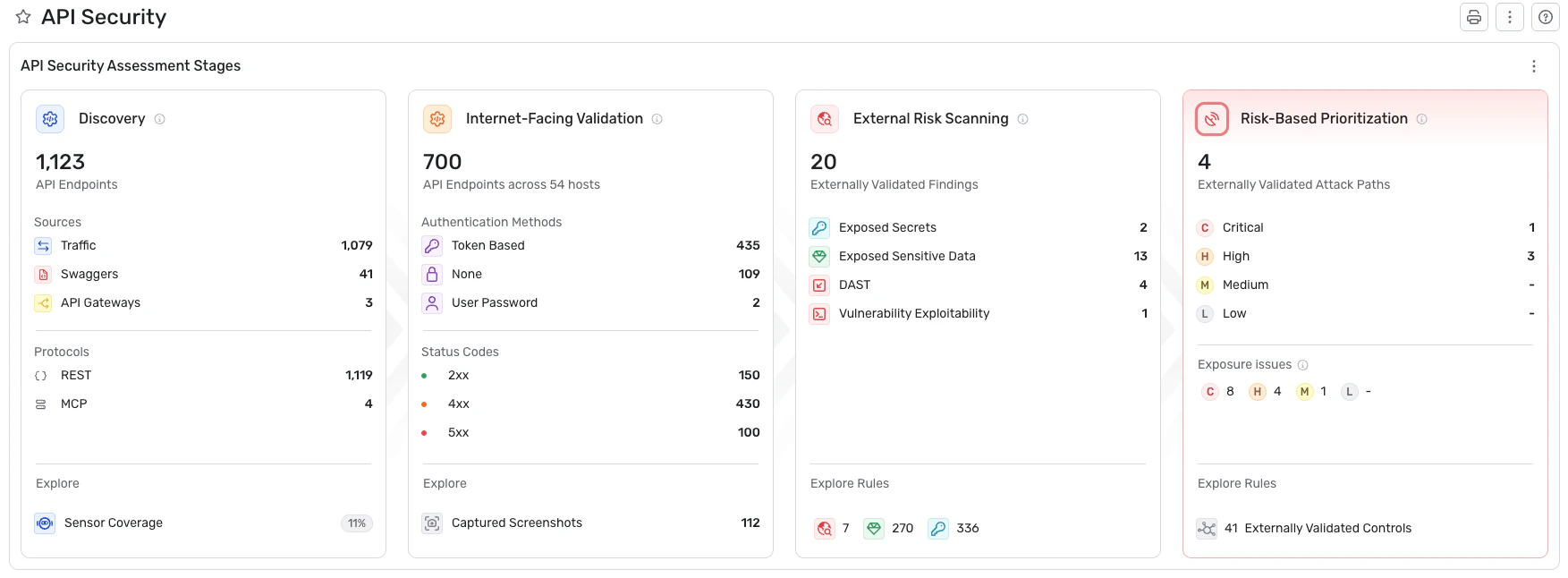
This context-aware approach enables security teams to:
See the full picture: Instantly inventory all APIs and understand their exposure and blast radius.
Prioritize what matters: Focus on the small subset of risks that actually pose a threat to your business—the toxic combinations where an API is internet-exposed, has a critical vulnerability, and accesses sensitive data.
Fix it at the source: Trace runtime risks back to the specific line of code or infrastructure configuration that caused them, enabling developers to remediate issues quickly and effectively.
Ready to secure your API ecosystem from code to cloud with full visibility and context-aware remediation? Get a demo to see how Wiz unifies API and cloud security with agentless infrastructure context, code-to-cloud attack path mapping through the Security Graph, and risk-prioritized remediation that focuses your team on the toxic combinations that actually threaten your business.
Secure APIs from code to cloud
Book a demo to see how Wiz helps security teams uncover API risks and attack paths in real time.
