What is SAST compared to SCA?
Static application security testing (SAST) inspects the proprietary code your developers write. Software composition analysis (SCA) inspects the open-source and third-party components they pull in.
The difference comes down to whose code each one checks. SAST inspects the code your developers write, while SCA inspects the open-source and third-party components they pull in. Both run before your application reaches production, and both flag security issues early, but they look at different halves of the same codebase.
That split matters because modern applications are mostly assembled, not written from scratch. Your team authors some logic, then leans on hundreds of libraries to move fast. Read together, they show you the full picture of where risk lives in an application before it ships.
Secure Coding Best Practices: SAST / DAST, and More
Learn how to evaluate application exposure, data sensitivity, and environment risk before writing code.

What is static application security testing (SAST)?
Static application security testing (SAST) is a white-box method that scans your source code for security flaws before the application runs. It breaks code into components to expose issues like SQL injection, cross-site scripting (XSS), and buffer overflows early in development.
SAST tools parse your source into an abstract syntax tree and trace data flow from untrusted inputs to sensitive sinks, which is how they surface injection and XSS paths, and how they rank findings by severity so teams know what to fix first. This detailed information helps development teams prioritize which code vulnerabilities to address first.
What is software composition analysis (SCA)?
Software composition analysis (SCA) scans the open-source and third-party code your application depends on (packages, libraries, and the binaries and container images they ship in) not the code your team writes. It inventories every dependency, checks each one against known vulnerability databases, and flags risky versions and license issues before deployment.
In other words, software composition analysis identifies code that the development team didn't create. SCA tools then create a comprehensive inventory of dependencies, scan them against known vulnerability databases, and alert developers to potential risks. These solutions also track license compliance to keep open-source usage on the right side of legal terms.
From there, an SCA tool generates a report highlighting vulnerabilities, license risks, and other issues, along with recommendations for remediation. Those findings feed back into the development workflow, letting developers address problems before deployment. Some examples of popular SCA tools are Wiz, JFrog Xray, and Xygeni.
Key differences between SAST and SCA
The two methods share a goal but split the work between your code and everyone else's. The table below breaks down where each one focuses, when it runs, and how you actually fix what it finds.
| Feature | SAST | SCA |
|---|---|---|
| Focus area | Proprietary code (i.e., code written by the organization's developers), identifying vulnerabilities that may arise from incorrect coding or unsafe practices | Open-source components or third-party libraries that are used in application development |
| Testing phase | Mostly used at the early stage of development | Mostly used during the build stage |
| Vulnerability types | Code-level vulnerabilities (e.g., XSS, SQL injection) | Vulnerabilities in third-party libraries (CVEs, exposures) |
| Remediation | Updating application source code | Upgrading or replacing dependencies |
Advantages of SAST
Shift-left security: SAST enables developers to identify and fix security issues early in the development cycle, reducing the possibility of large-scale security breaches and significantly strengthening an organization's security posture.
Secure coding: Using SAST promotes secure coding practices and helps developers write more resilient code. For example, a developer could be writing a function to handle user input. Without SAST, they might accidentally introduce a buffer overflow vulnerability by not properly validating the length of the input. However, a SAST tool would flag this as a potential security issue, prompting the developer to revise their code to include input validation checks. This helps prevent attackers from exploiting the vulnerability to execute malicious code.
Compliance: Several industries are required to adhere to regulatory standards for software security, including PCI DSS, FedRAMP, FISMA, SOC 2, and HIPAA. With SAST, organizations can meet the mandated requirements at the source-code level. SAST also facilitates documentation and audit trails as proof of compliance. These processes both eliminate the risk of legal penalties and also build customer trust.
Severity-ranked findings: SAST assigns severity to each finding, giving teams a starting point for triage. However, severity alone doesn't tell you whether the affected code is actually deployed and reachable.
Limitations of SAST
Though SAST has many benefits, it has a few downsides too:
Coverage gaps: SAST solutions can only detect vulnerabilities that exist in the code itself, which means there's no complete coverage for external dependencies. Also, SAST doesn't detect vulnerabilities in runtime applications.
A separate SAST instance for every coding language: Organizations that use more than one code language will need a different instance of SAST for each language. Because each SAST instance requires different maintenance and configuration processes, operating costs may stack up.
False positives: One major limitation of SAST solutions is that they are prone to false alarms. When scanning results return false positives, it can lead to alert fatigue.
Requires access to source code: You may not have access to the application's source code, and without source code, SAST won't work well, or at all.
Advantages of SCA
Efficiency: SCA tracks and identifies known vulnerabilities in open-source components quickly and efficiently, at the same time that development teams write code.
Supply chain coverage: Wiz Research found that 90% of malicious packages originate in public registries, which is exactly the exposure SCA is built to catch.
Automation: Many SCA tools offer automated remediation options for identified vulnerabilities.
Dependency management: SCA helps organizations manage their third-party dependencies, ensuring that they are using the latest versions and avoiding outdated or vulnerable components.
License compliance: SCA can help track license compliance for open-source components, preventing legal issues and ensuring that the organization is using components in accordance with their licensing terms.
Limitations of SCA
Just like SAST, SCA has a few drawbacks:
Ownership of risk: Components with flagged vulnerabilities can belong to different teams and projects, so when these risks are identified, it might be a challenge to determine who should take responsibility for fixing the security issue. This can lead to confusion and delays in addressing security issues, especially when teams are alerted to a large number of potential risks.
False positives: As mentioned above, SCA tools tend to generate long lists of potential risks, which may include irrelevant risks and false positives. Teams that review SCA results manually might waste extensive resources that could have been spent assessing real risks.
Technical debts: Technical debts are incurred when secure coding practices aren't prioritized from the beginning of the software development lifecycle. Technical debts can also arise when libraries or open-source components that were formerly used are abandoned. If left unaddressed, these debts can lead to increased development costs, delayed project timelines, and security vulnerabilities.
Coverage gaps: SCA tools require an up-to-date vulnerability database to be effective. Similarly, software composition analysis solutions may not be capable of identifying every third-party component in use nor every open-source project.
AppSec Best Practices: Incorporating SAST, DAST, and More [Cheat Sheet]
This cheat sheet is for developers, AppSec engineers, DevSecOps practitioners, and security-conscious teams who already know the basics—but want practical, advanced strategies they can apply immediately.

When to use SAST, SCA, or both
Most teams need both, because each method covers a blind spot the other cannot see. Run SAST early as developers write and commit code, then run SCA at build time to catch risky dependencies before they ship.
Both fit naturally into automated pipelines. Integrate SAST and SCA into CI/CD pipelines so scanning happens whenever code changes, without waiting on a manual review. SAST handles the logic your team owns, while SCA watches the open-source layer for known vulnerabilities and policy violations, which is also where a software bill of materials (SBOM) comes together.
The payoff shows up when you combine their findings. SAST gives you a detailed view of the developer's code, and SCA focuses on the external dependencies the application relies on, but the goal is the same: application security. Pulling both reports into one view turns two partial pictures into a single, reliable map of application risk, so teams can decide with confidence whether they need SAST, SCA, or both.
SCA is what populates your SBOM. As the scanner resolves your dependency tree at build time, it can emit a CycloneDX or SPDX inventory of every direct and transitive component. This is the artifact you'll need when the next critical CVE drops and someone asks "are we affected?"
Where DAST fits alongside SAST and SCA
SAST and SCA both work before the application runs, reading code and dependencies at rest. Dynamic application security testing (DAST) takes the opposite angle. It tests the running application from the outside, with no view of the source, probing live endpoints the way an attacker would to surface issues that only appear at runtime.
That black-box perspective is why the three methods complement rather than replace each other. SAST and SCA tell you what is wrong in the code and its dependencies, and DAST confirms how the application actually behaves once deployed. Used together, they cover the pre-runtime and runtime views of the same application, closing gaps that any single method would leave open.
How Wiz helps secure code with SAST and SCA
Traditional AppSec scanners tend to bury teams in noisy, theoretical alerts, leaving developers to guess which findings actually reach production. Wiz's code security solution gives teams the flexibility to secure code their way, whether they use our native SAST or integrate existing SAST and SCA tools. Either approach benefits from the same code-to-cloud context, unified prioritization, and faster remediation workflows. Through our Checkmarx integration, Wiz combines SAST and SCA to deliver complete visibility into code risk, all within a single platform.
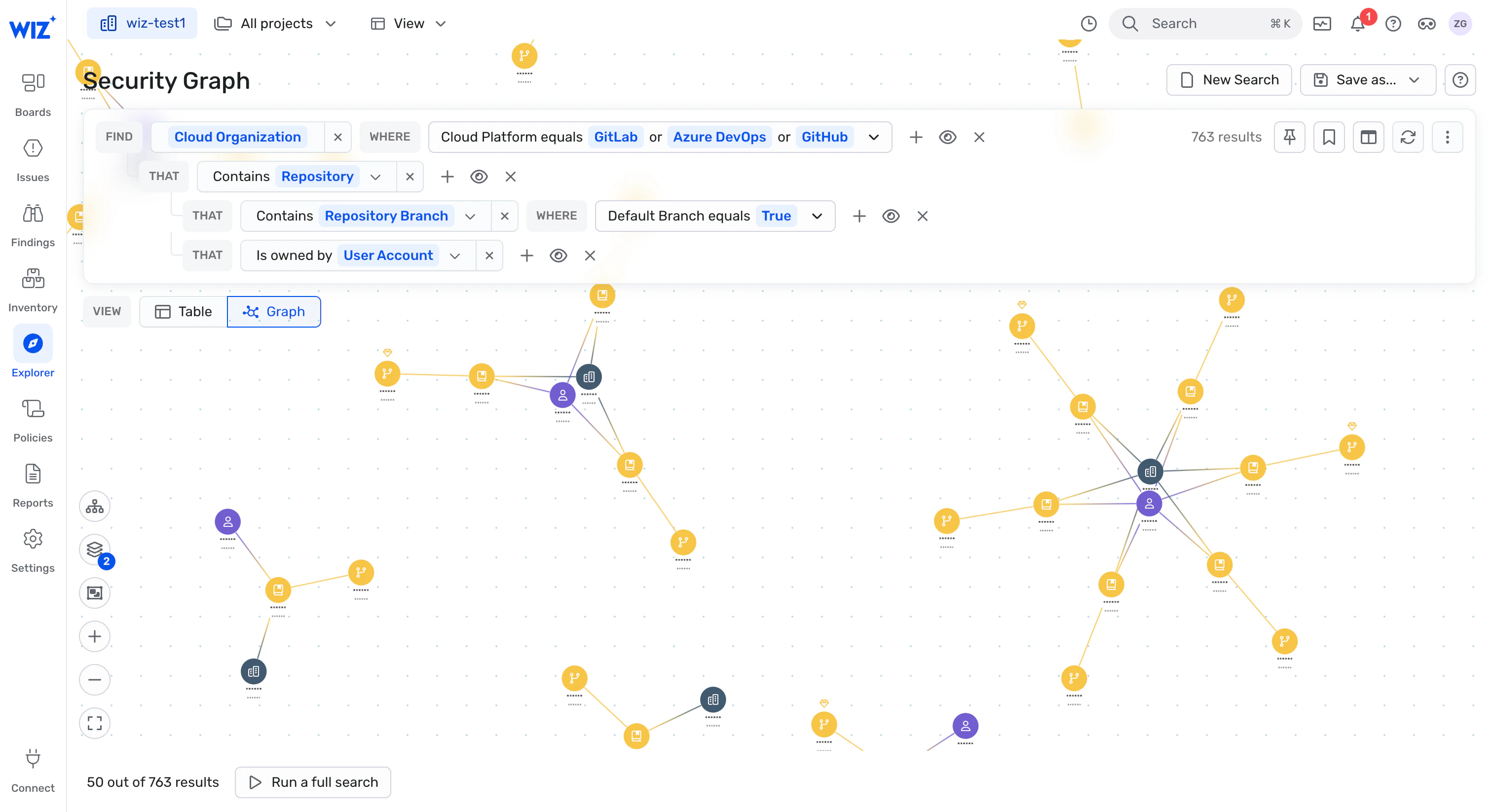
These capabilities live inside Wiz Code and connect through the Security Graph, so findings carry the context needed to prioritize them. Some key features and benefits of Wiz's code security solution include:
Wiz SAST: Wiz includes a native SAST engine and a dedicated SAST AI Agent that work together to surface code vulnerabilities with greater accuracy and less noise. Findings are enriched with cloud runtime context through the Wiz Security Graph, helping teams prioritize and remediate faster as part of Wiz AI-APP.
Advanced SAST integrations: Wiz's SAST engine can be powered by Checkmarx, a leading provider of application security testing solutions. Checkmarx's SAST capabilities enable us to detect a range of vulnerabilities, including SQL injection, cross-site scripting (XSS), and buffer overflows.
Deep SCA capabilities: Wiz's SCA engine identifies and manages vulnerabilities in open-source components and libraries used in your applications. We maintain an up-to-date vulnerability database and provide actionable recommendations for remediation.
SBOM visibility: Wiz generates comprehensive software bills of materials (SBOMs) without the need for additional agents. This gives you a complete view into all components within your software supply chain, enabling effective vulnerability management.
Integration: Wiz integrates with your existing development tools and processes, like CI/CD pipeline and GitHub, making it easy to incorporate code security into your daily routine.
Continuous monitoring: Wiz provides continuous monitoring of your codebase, alerting you to new vulnerabilities as they are discovered.
Remediation guidance: Our platform provides detailed guidance and recommendations for fixing identified vulnerabilities, helping you remediate issues quickly and efficiently.
Request a demo to explore how Wiz can secure your cloud environment.
Get a Wiz SAST demo
Learn how Wiz SAST correlates code flaws with real cloud context, then routes findings to the right owner with AI-powered remediation guidance, directly in pull requests.