



What is data risk management?
Data risk management is the practice of identifying, assessing, and treating risks to the confidentiality, integrity, and availability of sensitive data. In practice, that means identifying where sensitive data lives, understanding what could compromise it, and putting controls in place to protect it. Security, compliance, and data governance teams all share responsibility for the program.
The goal is straightforward: reduce the likelihood that sensitive data gets exposed, corrupted, or misused. That means continuously scanning for threats, ranking them by real-world impact, and acting on the ones that matter most. In cloud environments where data sprawls across accounts, regions, and services, this kind of structured approach is the difference between continuous defense and constant damage control.
Data Governance & Compliance Guide
Data governance and compliance are central to the DSO mandate.

Why data risk management matters
Teams that invest in data risk management gain something invaluable: confidence. Instead of reacting to breaches after the fact, they can spot exposure before attackers do and prove compliance before auditors ask. According to IBM, a single data breach cost businesses an average of $4.4 million. Losses at that scale make prevention far cheaper than recovery.
Regulatory pressure is also increasing. Laws like GDPR, HIPAA, CCPA, and PCI DSS impose steep penalties for mishandled data, and enforcement is only getting stricter. Meanwhile, cloud adoption and AI workloads are expanding the attack surface faster than manual processes can keep up.
New data stores spin up in minutes, AI pipelines ingest sensitive records without guardrails, and shadow data accumulates in forgotten snapshots. According to the Wiz CISO Security Budget Benchmark 2026, 85% of organizations increased cloud security spending and 77% increased data security spending, reflecting the growing urgency organizations place on protecting their data.
As cloud and AI keep expanding the data surface, a deliberate program lets teams focus their effort where it counts. This can turn a fast-growing risk surface into a manageable, prioritized set of actions.
Common data risk types
Data risks come in many forms, and the most dangerous ones often overlap. A misconfigured storage bucket might also be an access control failure and a compliance violation all at once. Understanding each category helps teams build layered defenses.
Insider threats
Not every data risk comes from outside the organization. Employees, contractors, and partners with legitimate access can accidentally leak sensitive records or, in rarer cases, act with intent. According to Verizon, 68% of security incidents involve a human element.
Privileged access and poor offboarding are the biggest enablers. Dormant accounts and lingering permissions give both accidental and intentional insiders more reach than they should have.
Third-party and supply chain risks
Every vendor, SaaS integration, and open-source dependency you rely on extends your data risk surface. A compromised supplier or an over-permissioned API connection can extend access to your crown jewel data, which is why third-party access deserves the same review rigor you apply internally.
Cloud misconfigurations and shadow data
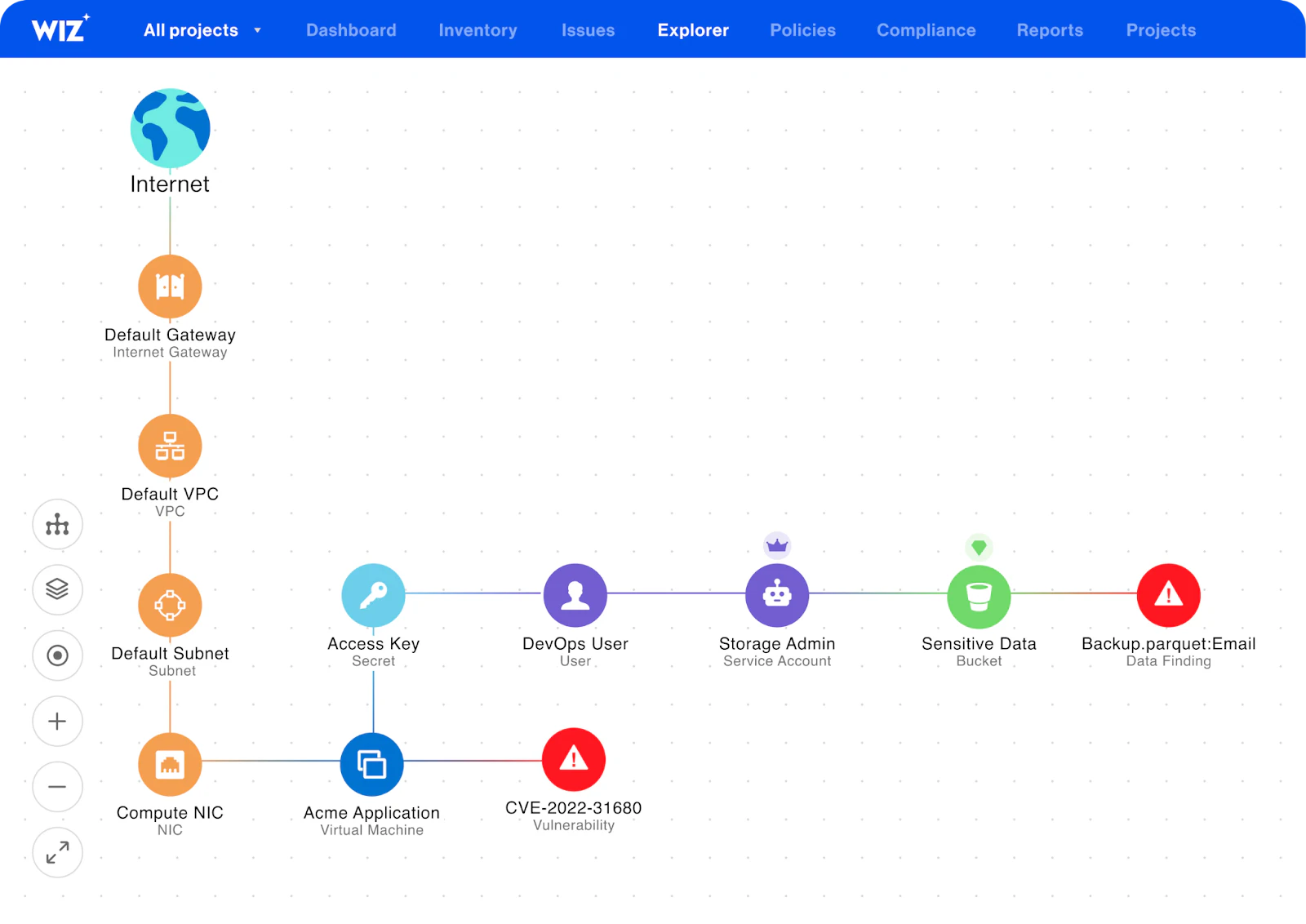
Misconfigured databases, storage buckets, VMs, and CI/CD tools create new data risks or make existing ones worse. A Wiz DSPM tool surfaces these misconfigurations and ties each one to the sensitive data it exposes, so you can see which shadow data stores actually put crown jewel data at risk. Research from the Wiz Cloud Data Security Snapshot found that 72% of cloud environments have publicly exposed PaaS databases lacking sufficient access controls.
Compounding the problem is shadow data: data your IT and security teams don't know about. If you can't see the data, you can't protect it.
Poor access controls
At any given time, there are hundreds, maybe thousands, of digital identities roaming your cloud. When identities carry more access than they need, that excess widens your exposure. Cloud infrastructure entitlement management (CIEM) tooling automates this, continuously mapping who can reach what and flagging identities with more access than they actually use.
Non-compliance and regulatory risk
GDPR, HIPAA, PCI DSS, CCPA: the list of compliance obligations is long, and staying ahead of them pays off. Regulators can impose significant fines and require breach notifications, so treating compliance as an ongoing program rather than a checkbox exercise keeps you audit-ready.
Regulatory and compliance context
Compliance requirements are one of the strongest drivers behind any data risk management program. Regulations like GDPR, HIPAA, PCI DSS, SOC 2, and CCPA each impose specific obligations around how sensitive data is stored, accessed, and protected. Failing to meet them carries real consequences: fines, legal action, and lost customer trust. Organizations subject to EU digital resilience requirements can use a DORA compliance checklist as a practical starting point for aligning their data risk controls with regulatory expectations.
In practice, these frameworks overlap more than they differ. Most require data discovery, access controls, encryption, audit logging, and incident response plans. A well-structured data risk management program naturally satisfies many of these requirements because the controls map directly to regulatory expectations. For example, a healthcare organization managing HIPAA and SOC 2 simultaneously can use a single data classification and monitoring workflow to cover both frameworks without duplicating effort.
The key is to treat compliance as a byproduct of good security, not as a standalone project. When your program is built around continuous visibility and risk-based prioritization, audit readiness follows.
Key components of a data risk management program
A strong data risk management program connects several capabilities into a continuous loop. Each component feeds the next, turning isolated activities into a system that improves over time.
Data discovery and classification
The first step is identifying data across your cloud platforms and repositories. Wiz DSPM automates this by discovering and classifying sensitive data across AWS, Azure, GCP, and other environments, so you start with a complete inventory rather than a partial one.
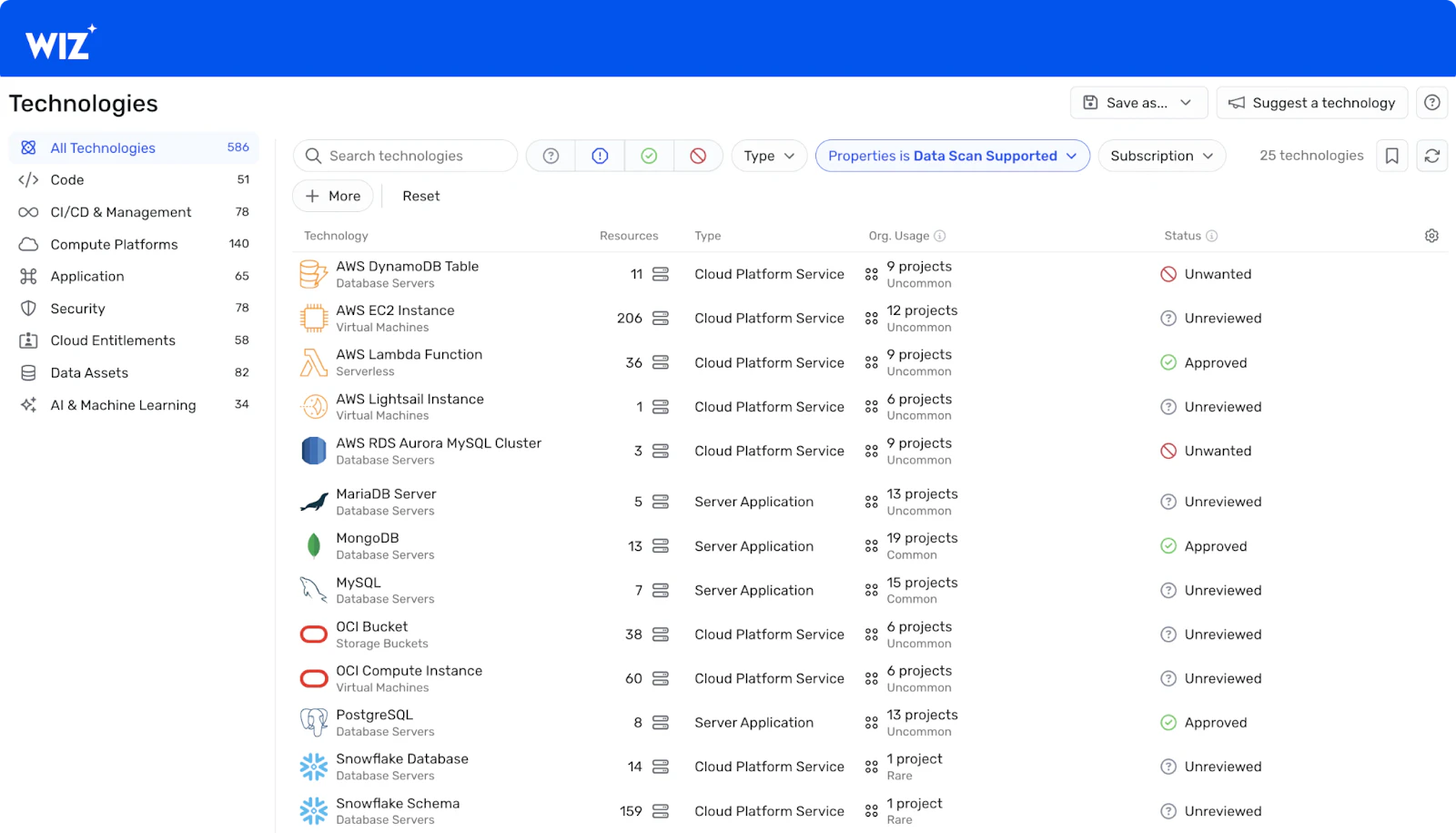
Once you discover your data, assign classifiers based on criticality and sensitivity, such as "PII" or "PHI." Custom classification gives you the flexibility to tag data in ways that match your actual risk profile.
Risk assessment and prioritization
A data risk assessment analyzes how data moves within your network and interacts with other resources. Data flow mapping helps teams trace exactly which systems and identities touch sensitive records, making it easier to spot unexpected exposure points.
Since not all data risks are equal, spending time on non-critical ones wastes resources. Identify which risks and attack paths lead to crown jewel data, and address those first.
Cloud Data Security Snapshot - Current Exposure Trends
Wiz Research analyzed hundreds of thousands of cloud accounts across organizations of all sizes to assess the current state of data security in the cloud.

Security controls and enforcement
With the right data security controls, only invited, relevant, and legitimate users have access to critical data, a core part of data breach prevention. Most teams build security controls around principles like least privilege and "never trust, always verify.
Encryption for data at rest and in transit
Role-based access controls (RBAC) to match permissions to roles
Multi-factor authentication (MFA) as a baseline identity control
Data loss prevention (DLP) solutions for exfiltration detection
Automated backup mechanisms for recovery readiness
Continuous monitoring and incident response
Data risk management has to be continuous. Real-time threat detection is the quickest way to discover, validate, and remediate suspicious activity and access.
Monitoring alone isn't enough. When an incident occurs, your team needs a clear playbook: who triages the alert, what data is at risk, how to contain the blast radius, and when to escalate. Wiz Defend provides the runtime detection and response layer, catching suspicious data access as it happens and connecting each alert to the identity involved, the data classification, and the recommended containment step in one view.

Cloud and AI data risk management
Cloud and AI adoption has changed the data risk equation. Data now sprawls across multiple providers, regions, and services, often without centralized visibility. AI workloads add another layer: training datasets may ingest sensitive records, model outputs can leak proprietary information, and AI pipelines create new identity and access patterns that traditional tools were never designed to monitor. The NIST AI Risk Management Framework offers a structured approach for organizations looking to govern AI-related risks alongside their broader data risk programs.
Shadow data is especially problematic in multi-cloud environments. Orphaned snapshots, duplicated datasets, and forgotten staging environments accumulate faster than manual reviews can catch them. Teams need agentless scanning that works across AWS, Azure, and GCP without requiring per-resource configuration. The Wiz Cloud Data Security Snapshot found that 54% of cloud environments have exposed VMs containing sensitive data. That's a sign of how common this blind spot is in practice.
Risk treatment strategies
Once you have identified and assessed data risks, you need a plan for each one. Risk treatment is not one-size-fits-all. The right strategy depends on the severity, the cost of action, and the business context.
Risk avoidance
Sometimes the best response is to eliminate the activity that creates the risk entirely. If a particular data flow is not essential to the business, removing it removes the risk. For example, if a development team copies production data into a test environment, switching to synthetic test data avoids the exposure altogether.
Risk mitigation
Mitigation means reducing the likelihood or impact of a risk without eliminating the activity. Encryption, access controls, and continuous monitoring all fall here. Most data risk management effort goes toward mitigation because the underlying data activities are necessary for the business to operate.
Risk acceptance
Some risks are low enough in severity that the cost of remediation outweighs the potential impact. In those cases, document the risk, assign an owner, and set a review date. Acceptance should always be a conscious, documented decision, never a default.
Risk transfer
Transferring risk means shifting the financial or operational burden to a third party. Cyber insurance is the most common example. Outsourcing data processing to a compliant vendor is another. Keep in mind that transferring risk does not transfer accountability; your organization is still responsible for protecting customer data.
Best practices for a strong data risk management strategy
Assess your organization's specific needs
While there are many data security and compliance risks that all enterprises face, your organization will have some that are unique to your industry, geography, and data-sharing practices. For example, if you are in healthcare, your data risk management strategy will revolve around frameworks like HIPAA. Similarly, if your enterprise stores or moves data across countries, your strategy must prioritize data sovereignty.
Prioritize data risks
With the amount of data flowing in and out of the cloud, it is impossible to stay on top of every single risk. Non-critical data risks, much of the time, are just noise. You can use your DSPM tool to get a prioritized view of data risks that represent real attack paths in your cloud environments. This prioritized queue is based on organization-specific risk factors and the complete context of your cloud.
Use data risk management frameworks
Data risk management frameworks provide rules, processes, and templates to mitigate data risks across the entire data lifecycle. By using them, you base your strategy on globally recognized guidelines. Here is a good starting point:
Use the right tools and technologies
You need solutions built for the cloud to tackle data risks in the cloud. Positioning unified cloud security tools at the center of your data risk management strategy is the best way to break down risk management silos, streamline risk mitigation, and enforce best practices.
There are countless options for cloud-native security tools, but keep an eye out for a unified platform with DSPM, Cloud Detection and Response (CDR), CSPM, Cloud Workload Protection Platform (CWPP), CIEM, and Wiz AI-APP.
Pick the right key performance indicators (KPIs)
Without the right KPIs, you will never know if your risk management strategy is working. If data risk alert volume is a KPI but most of your alerts are for non-critical risks, you will not be able to accurately evaluate your capabilities.
Common KPIs include mean time to detection and response (MTTD and MTTR) and the overall number of data security and non-compliance events. Regularly conduct security audits and penetration tests as well. The results of these tests are important KPIs for your risk management strategy.
Expand training, awareness, and democratization
For comprehensive data risk management, you need more than just security teams. It has to be a collective effort. Embed self-service capabilities across software development lifecycles so that your teams can discover and remediate data risks fast.
Going beyond data risks, it is also important to know what hurdles you might face en route to a new strategy. Common examples include:
Lack of visibility across an evolving data ecosystem
Siloed data management tools
Getting the buy-in of key stakeholders
Understanding multi-tenant environments
Navigating CSP shared responsibility models
How Wiz supports data risk management
A strong cloud security platform turns even the most complex data risks into manageable, prioritized actions. With a unified, agentless CNAPP platform like Wiz that integrates DSPM, CIEM, CSPM, Wiz AI-APP, and CDR capabilities, you can discover and classify all your data, remediate critical data risks with full context, and meet even the most complicated compliance requirements.
Wiz DSPM connects data classification to the Security Graph, so you do not just see where sensitive data lives. You see the full attack path: which identities can reach it, what misconfigurations expose it, and whether a vulnerability makes it exploitable. That context turns a list of findings into a prioritized action plan focused on your crown jewel data.
As AI workloads grow, Wiz AI-APP extends this same approach to AI pipelines, training datasets, and model endpoints. Teams can track whether sensitive data flows into AI systems and flag exposed AI services, all within the same unified view they already use for cloud security.
Get a demo to see how Wiz can reinforce your data risk management strategy and protect sensitive data across cloud and AI workloads.
Protect your most critical cloud data
Learn why CISOs at the fastest companies choose Wiz to secure their cloud environments.
