
What hiring managers should look for in GRC analyst candidates
A GRC analyst sits between technical security teams and business leadership. They turn complex cybersecurity issues into clear, risk-based recommendations that the business can act on.
You are not hiring a checklist auditor. You need someone who understands how your systems work and how risk travels through them. Modern environments have shifted from static servers to cloud-native infrastructure built from containers, serverless functions, APIs, and managed services. A good GRC analyst must be comfortable reasoning about cloud security posture management (CSPM), identity risks, and data exposure.
Expect candidates to know major compliance frameworks and how they map to each other—at minimum NIST 800-53, ISO 27001, SOC 2, and FedRAMP, plus PCI DSS or HIPAA depending on your industry. Strong candidates can explain how one access control policy supports multiple frameworks simultaneously and which portions can be inherited from cloud service providers through their attestations. They should understand continuous compliance and how to move from annual audits to always‑on monitoring.
The best GRC analysts think in terms of risk-based vulnerability management, not just compliance. They understand attack paths and how a vulnerability combined with a misconfiguration can turn into real business impact.
Soft skills matter as much as technical depth. Great GRC analysts can talk to developers about secure pipelines and to executives about financial impact. Listen for plain language and the ability to explain why a control exists.
Finally, look for an automation mindset. Manual evidence collection does not scale in multi-cloud environments where infrastructure changes daily. Great candidates understand that compliance should reflect real-time risk, not point-in-time snapshots, and they seek tools that unify posture, identity, vulnerability, and data context.
Guide to Data Governance and Compliance
This Guide to Data Governance and Compliance in the Cloud provides a straightforward, 7-step framework to help you strengthen your cloud governance approach with confidence.

10 GRC analyst internview questions
This section walks through ten focused GRC analyst interview questions for 2026. Together, they test fundamentals, hands‑on skills, and how well a candidate can communicate risk.
For each question, you will see what strong answers include and what red flags to watch for. You can adapt these to different seniority levels.
1. Walk me through how you would conduct a risk assessment for a new cloud application
This is one of the most important risk assessment interview questions you can ask. You are checking whether the candidate has a structured approach and understands cloud realities.
Good answers start by defining the scope and assets. The candidate should talk about identifying what the application does and where data lives. Listen for data classification in simple terms: what is public, internal, sensitive, or regulated.
From there, they should move into understanding the architecture. In 2026 that means asking if this runs on containers, serverless functions, or VMs. They should show awareness of common cloud attack surfaces like misconfigured storage buckets.
Then they should describe cloud-adapted threat modeling using frameworks like STRIDE (Spoofing, Tampering, Repudiation, Information Disclosure, Denial of Service, Elevation of Privilege) or LINDDUN (privacy-focused). They should focus on cloud-specific threats: IAM misconfigurations, publicly exposed storage buckets, supply chain risks in container images, and data flows across cloud boundaries.
Strong candidates will describe how they approach cloud risk management by estimating likelihood and impact. They might consider data sensitivity, exposure level, and existing controls. They should be able to translate that into a simple risk rating.
Finally, they should close the loop with continuous monitoring. In the cloud, risk assessments are not one-time documents. Great answers mention unifying posture, identity, vulnerability, and data context in a single model to continuously validate risk and control effectiveness. Listen for integration with CSPM or CNAPP platforms that correlate findings across these dimensions rather than treating each in isolation.
2. How do you map controls across multiple compliance frameworks like NIST, ISO 27001, and SOC 2?
This is one of the core NIST framework interview questions that tests compliance thinking. You want to see whether the candidate understands how to avoid duplicate work.
Strong candidates start by stating that most frameworks cover similar ideas using different language. Access control and logging appear in all of them. The goal is to create a unified set of internal controls that maps back to each framework.
They might mention using a common control framework (CCF). A good answer sounds like 'We define one access control standard and map it to NIST and SOC 2.' They should understand provider attestation and inherited controls. For example, relying on CSP SOC 2 Type II reports, ISO 27001 certificates, or FedRAMP authorization packages to satisfy physical security and infrastructure controls in a shared responsibility model.
You should also hear how they keep mappings current. Frameworks evolve, and cloud environments do too. Look for mention of using GRC platforms that support control mapping.
Practical examples help. They might describe a single logging standard that meets multiple requirements. Red flags include treating each framework as a silo.
Seniority expectations:
Junior (0–2 years): Can explain that frameworks overlap and describe basic control mapping concepts
Mid-level (2–5 years): Has mapped controls across 2–3 frameworks, understands inherited controls from CSPs
Senior (5+ years): Has designed or maintained a common control framework (CCF), can explain control rationalization methodology and how to keep mappings current as frameworks evolve
3. Describe your process for control testing and evidence collection
This question tests how deeply they understand control testing. It ties directly to vulnerability management interview questions and audit execution.
Good answers begin with the control objective. The candidate should say they first make sure they understand what the control is supposed to achieve.
They should then walk through different testing methods. These include inquiry, observation, inspection, and re‑performance. A mature candidate knows that relying on inquiry alone is weak.
Sampling also matters. You want them to describe how they choose samples and how often they test. For an automated CI/CD control, they might discuss continuous monitoring instead of manual samples.
Evidence collection is another key point. Strong candidates distinguish good from weak evidence. Configuration state and logs from services like AWS Config, Azure Policy, and Google Security Command Center provide authoritative, auditable evidence. System-generated compliance reports rank higher than ad-hoc screenshots, which rank higher than chat messages or self-attestation.
4. How would you handle a situation where developers push back on implementing security controls that slow down deployment?
This is both a technical and behavioral question. It is one of the most revealing cybersecurity GRC interview questions.
A good candidate will first validate the concern. They might say they understand that developers are under pressure to ship features. They do not immediately take an adversarial stance.
Then they explain how they would explore the details. They might ask what specifically is slowing things down. This shows a problem‑solving mindset.
Listen for solutions that use automation and shift‑left security. For example, moving some checks earlier in the CI pipeline or using risk‑based exceptions. A strong answer will reference quantifying risk in business terms.
You also want to hear collaboration. They should talk about working with DevOps teams to design guardrails developers can live with.
5. What GRC tools have you used and how did they help you scale compliance activities?
Here you are testing more than name‑dropping. You want to know if they used tools to improve outcomes.
A strong candidate will mention specific platforms like ServiceNow GRC or Vanta. They will quickly pivot into how they used them. Follow up with: 'How did you integrate GRC workflows with agentless CSPM or CNAPP platforms and ticketing systems to create a single prioritized queue of remediations?' Listen for answers that describe syncing cloud risk findings into GRC tools and routing them to the right owners based on business impact.
They should talk about automated evidence collection, such as pulling configuration data directly from cloud provider APIs (AWS Config, Azure Resource Graph, GCP Asset Inventory) or integrating with a CSPM or CNAPP platform to support continuous compliance monitoring instead of point-in-time manual collection.
Integration with other tools is another good sign. Candidates who explain how they linked GRC tools with vulnerability scanners are thinking in a modern way.
Also ask how they used dashboards and reports. Good GRC analysts can explain how they provided clear views for executives.


6. How do you assess and manage third-party risk?
Third‑party and supply chain risk has become central in GRC programs. This question tests whether the candidate can go beyond basic questionnaires.
Strong answers start with classification. The candidate should explain they segment vendors by criticality (business impact if unavailable), data sensitivity (what information the vendor accesses), and access level (network connectivity, system privileges). They should complement questionnaires with independent validation such as attack surface monitoring, security certifications (SOC 2, ISO 27001), and penetration test summaries.
They should discuss initial due diligence. This includes reviewing SOC 2 reports and looking for key details. For high‑risk vendors, they might mention deeper review of penetration test summaries.
Verification beyond self‑attestation is important. Listen for mentions of using attack surface monitoring to validate vendor claims.
Good candidates talk about ongoing monitoring. That can include tracking changes to a vendor’s security reports or watching for breach news.
SOC Reports Explained: Types, Trust Criteria & Compliance
SOC reports are third-party proof of your organization's security posture, validating its approach to controls around security, privacy, availability, data processing integrity, and confidentiality.
もっと読む
7. Explain the difference between inherent risk and residual risk
This question checks basic risk management understanding. It is simple, but many candidates mix these terms up.
You want to hear a clear, plain explanation. Inherent risk is the level of risk present before you apply any controls. Residual risk is what remains after you put controls in place.
They should then describe how controls reduce inherent risk. For example, encryption lowers impact (data remains unreadable if stolen), while access controls lower likelihood (fewer users can reach sensitive data). Residual risk reflects control effectiveness, including compensating controls when primary controls cannot be fully implemented, and determines whether additional mitigations are needed.
Good candidates will also mention risk appetite. They may describe how leadership sets thresholds for acceptable risk.
8. How do you stay current with evolving regulations and emerging threats?
GRC is not static. This question helps you see whether the candidate has a deliberate learning process.
Strong candidates will list specific sources. For regulations, that might include regulator bulletins or law firm briefings. For security threats, they might mention threat intelligence feeds.
You also want to hear how they turn updates into action. Good answers sound like “When new guidance came out, we updated our risk register.” They may mention creating simple internal summaries.
Peer networks and communities are another good sign. Candidates who attend local security meetups often have practical insight.
9. Describe a time you identified a significant compliance gap and how you addressed it
This behavioral question reveals how they operate in real situations. You are testing for problem‑solving and ownership.
Good answers follow a simple structure: context, action, and outcome. The candidate should describe the environment and the specific gap they found.
They should then walk through their investigation. That might involve checking whether the process ever existed. They should explain how they involved the right stakeholders.
Next, they should describe the remediation plan. That often includes both quick fixes and longer‑term changes. Communication is key here.
Finally, they should share results. Maybe audit findings were cleared or risk exposure was reduced.
10. How would you explain a critical security vulnerability to a non-technical executive?
This is one of the most important communication‑focused GRC questions. It shows whether the candidate can bridge security and business.
Strong candidates start by stripping away jargon. Rather than using technical terms, they might say “there is a flaw that lets attackers run their own code.”
They then tie the issue to business impact. This can include potential data loss or service downtime. They should be able to say something like “If exploited, this could expose customer data.”
Good answers also outline clear options. For example, patching immediately versus using temporary mitigations. They should explain tradeoffs in cost and speed.
You want to hear them emphasize what decision they need from the executive. Red flags include overloading with technical detail.
Red flags to look out for when hiring a GRC analyst
Even if a candidate sounds confident, certain patterns signal that they may struggle. Some of these are gaps in knowledge, while others are mindset issues.
Checkbox mentality without understanding risk context: The candidate talks only about “meeting requirements” and never about whether controls actually reduce real risk.
Inability to explain technical concepts simply: They cannot describe basic security ideas in plain language.
No experience with automation or modern tools: They rely entirely on manual spreadsheets and email for evidence.
Adversarial attitude toward developers: They see themselves as the “police” and brag about blocking changes.
Outdated cloud security model: They focus on perimeter controls (firewalls, network segmentation) with little awareness of identity-centric risk, least privilege access, zero trust architecture, or the shift from network-based to identity-based security boundaries in cloud environments.
Vague answers about past work: They describe “helping with audits” without specific examples of controls they led.
No questions about company's environment: They show no curiosity about your business model or tech stack.
Overconfidence without acknowledging complexity: They claim to “have all the answers” and do not recognize tradeoffs.
Cannot explain how to correlate identity, exposure, vulnerability, and data context: They treat each security tool (IAM, CSPM, vulnerability scanner) in isolation and cannot describe how to prioritize remediation by combining these dimensions. For example, they cannot explain why a medium-severity vulnerability on an internet-exposed server with admin privileges and access to sensitive data is more critical than a high-severity vulnerability on an isolated dev system.
Compliance made easy with Wiz
Stay compliant with Wiz’s 100+ compliance frameworks, generate quick compliance reports, and remediate issues faster with remediation guidance and auto-remediation.
もっと読む
How Wiz transforms GRC programs with unified cloud visibility
Many GRC programs still rely on manual evidence collection while their infrastructure runs in dynamic cloud environments. This mismatch creates blind spots and slow response times because traditional tools were not built to understand multi‑cloud architectures all at once. Cloud environments change too quickly for point‑in‑time assessments—a configuration that is compliant during an annual audit can drift out of alignment in a day. GRC teams need continuous visibility into cloud resources to map them back to their control framework.
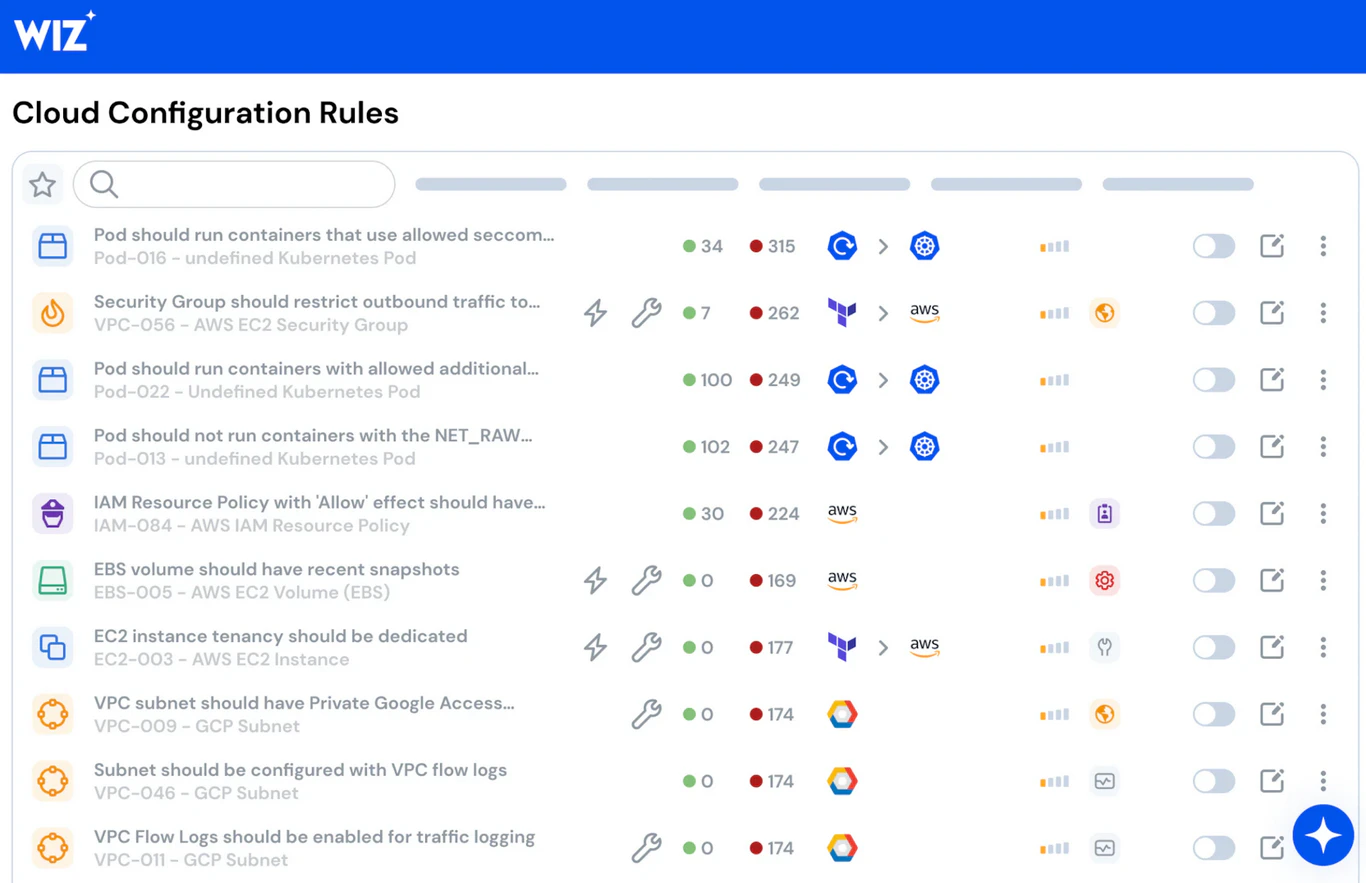
Wiz transforms GRC programs by unifying cloud security, automating compliance, and providing continuous, risk-prioritized visibility across complex cloud environments. We bring together all cloud security functions into one platform, automating compliance assessments and continuous monitoring across more than 200 regulatory frameworks including NIST, HIPAA, SOC 2, FedRAMP, and CMMC. Instead of chasing screenshots, GRC analysts can see up‑to‑date control status pulled directly from AWS, Azure, and GCP, with audit-friendly views like compliance heatmaps that turn compliance into a daily, low‑friction process.
Under the hood, the Wiz Security Graph correlates misconfigurations, vulnerabilities, and identity risks. Rather than giving you a flat list of issues, it uses over 1,400 built-in Graph Controls to identify "toxic combinations" and show how they connect into real attack paths. For GRC teams, this means they can prioritize findings based on true business riskand context like network exposure, not just severity scores. Wiz also provides broad coverage across key domains that matter to GRC, including CSPM for cloud configuration and CIEM for identity and permissions, giving GRC analysts a consistent view of controls in a single platform.
The platform's agentless scanning model is especially valuable because Wiz connects through cloud provider APIs to inventory resources without deploying agents, eliminating common blind spots and scaling as your cloud footprint grows. Wiz Code extends governance into the development lifecycle by scanning infrastructure as code (IaC)templates, container registries, and CI/CD pipeline configurations. It applies policy-as-code guardrails before deployment and traces runtime issues back to source code for precise ownership and faster remediation. Organizations can also create custom frameworks to fit their unique needs, and for regulated environments, Wiz for Gov speeds up compliance by automating discovery and reporting for inventory, vulnerabilities, and risky configurations.
Wiz enhances existing GRC tooling, especially for infrastructure controls, rather than replacing dedicated GRC platforms. We connect with leading GRC platforms like ComplianceCow, 6clicks, and LogicGate's Risk Cloud, as well as ServiceNow and Jira, allowing GRC teams to route findings to the right ownersand sync live cloud risk data into their GRC processes for more efficient continuous control monitoring and centralized compliance management. Organizations like Genpact have used Wiz to get 100% visibility across their multi‑cloud environments, turning security from reactive fire drills into proactive programs.
If you want to see how this could work in your own environment, request a demo to explore how Wiz can secure your cloud environment. A short guided session will show how unified cloud visibility can make your GRC program much more effective.
100+ Built-In Compliance Frameworks
See how Wiz eliminates the manual effort and complexity of achieving compliance in dynamic and multi-cloud environments.
