



What is CSPM (Cloud Security Posture Management)?
CSPM used to mean running a scan, generating a compliance report, and handing a list of findings to whoever owned the affected resource. That model is changing.
According to the 2026 CISO Budget Benchmark, the average organization now spends at least $5 million a year on cybersecurity, yet 56% of security professionals doubt that's enough, and 49% point to cloud complexity as the top inhibitor to effective cloud security.
Cloud Security Posture Management (CSPM) is a category of cloud security tools that continuously monitors configurations to identify and remediate misconfigurations across IaaS, PaaS, and SaaS environments, catching mistakes before attackers can exploit them.
This matters because cloud environments operate under the shared responsibility model: providers secure the infrastructure, while customers must configure their services securely. Rather than flagging every deviation from a benchmark, modern CSPM analyzes how configuration issues combine with exposure, identity, and data to create real risk.
The CSPM Buyer's Guide
Navigating the alphabet soup of cloud security tools is challenging – CSPM? CNAPP? CDR? We've simplified your decision-making process and laid all the criteria for a modern CSPM solution.

Why CSPM matters
Cloud risk is rarely created by a single misconfiguration sitting in isolation. It's created by how configuration issues combine with exposure, identity, and data across highly dynamic, multi-cloud environments. As organizations expand their cloud footprint, identity usage, and cloud-native services, understanding which risks actually matter becomes harder without continuous, contextual analysis. CSPM addresses four challenges that make traditional approaches fall short in the cloud.
Limited visibility creates blind spots in multi-cloud environments.
Resources are created, modified, and decommissioned constantly across multiple cloud providers, often outside the visibility of centralized security teams. Without continuous discovery, organizations lose track of cloud assets, permissions, and exposure points as they accumulate. CSPM provides a unified view of cloud resources and configurations across environments, so teams maintain visibility into what exists, how it's configured, and where risk is building up.
Alert noise buries the findings that actually matter.
Most cloud environments contain thousands of configuration issues at any given time, but only a small subset can realistically lead to an incident. Traditional tools surface findings without enough context, forcing teams to manually figure out what's worth fixing first. CSPM enables risk-based prioritization by evaluating misconfigurations in context, factoring in internet exposure, identity permissions, sensitive data, and potential attack paths, so security teams can avoid alert fatigue and focus on the issues most likely to affect the business, rather than chasing low-risk alerts.
Compliance violations carry steep financial penalties.
In May 2025, Ireland's Data Protection Commission fined TikTok €530 million under GDPR for transferring European users' personal data to servers in China without adequate safeguards. In 2025, the UK's Information Commissioner's Office fined Capita £14 million after a ransomware attack, traced back to inadequate access controls, exposed personal data belonging to more than 6.6 million people.
CSPM automates compliance monitoring across frameworks like NIST, PCI DSS, HIPAA, SOC 2, and CIS benchmarks, continuously scanning configurations against regulatory standards and flagging violations as compliance risks before they become audit failures or fines.
Friction between security and cloud teams slows everyone down.
Security controls that delay development ultimately fail to scale, and when issues surface late or without context, remediation becomes a bottleneck. CSPM reduces this friction by integrating into cloud and DevSecOps workflows, clarifying ownership, and providing actionable remediation guidance, which helps teams resolve the issues that matter without sacrificing development speed.
How do CSPM tools work?
CSPM tools secure cloud infrastructure by continuously translating configuration data into an understanding of real risk. Rather than functioning as a periodic scan or a static checklist, modern CSPM operates as an always-on system that keeps pace with how cloud environments actually change. At a high level, CSPM works by maintaining visibility across the environment, evaluating risk in context, and helping teams remediate the issues that matter most. Here’s a closer look.
1. Discovery and visibility
CSPM solutions perform continuous discovery through cloud provider APIs and cloud asset inventory services, such as AWS Config, Azure Resource Graph, and GCP Cloud Asset Inventory. These services provide programmatic access to resource metadata, configuration state, and relationship data across cloud accounts. The most effective approach is agentless scanning, which requires no software installation on workloads and provides full coverage without deployment friction.
CSPM evaluates new assets in near real time as they appear in cloud provider inventories, which eliminates the blind spots that occur when resources are created faster than security teams can track them. This discovery process builds a complete inventory of cloud resources, identities, network configurations, and data stores, establishing a baseline of what exists in the environment.
2. Risk assessment and prioritization

Once cloud resources are discovered, CSPM evaluates their configurations to determine where risk actually exists. Instead of treating every misconfiguration as equally urgent, modern CSPM focuses on context. Risk assessments weigh factors including internet exposure and network reachability, identity permissions and privilege scope, the presence of sensitive or regulated data, and relationships between resources that could enable lateral movement.
Context transforms how teams view severity. An S3 bucket with public read access might be low priority when it's empty. When that same storage bucket contains personally identifiable information, connects to a production database, and is accessible through an overprivileged IAM role, it becomes a critical attack path.
Modern CSPM uses graph-based analysis to map resources as nodes with relationships showing how they connect, which reveals attack paths that flat lists of findings miss.
In practice, the fastest way to reduce noise is to prioritize posture issues only when they connect to a real path: external exposure leads to a reachable workload, which carries meaningful permissions, which leads to sensitive data or a high-value control plane. By identifying the small percentage of issues that could realistically lead to a breach, CSPM helps security teams ignore the noise and fix what matters.
With Wiz, developers have the solutions they need to understand and address issues promptly. We can remediate issues within three days.
Andy Yap, Senior Cyber Security Engineer, OFX
3. Remediation and risk reduction
CSPM is only effective if identified risks can be addressed efficiently. Rather than surfacing findings in isolation, CSPM connects prioritized risks to clear remediation paths. This typically includes guided remediation that explains why an issue matters and how to fix it, and automated remediation for common or high-confidence misconfigurations. It also integrates with infrastructure-as-code and DevOps workflows to catch issues before they're introduced.
4. Compliance monitoring and reporting
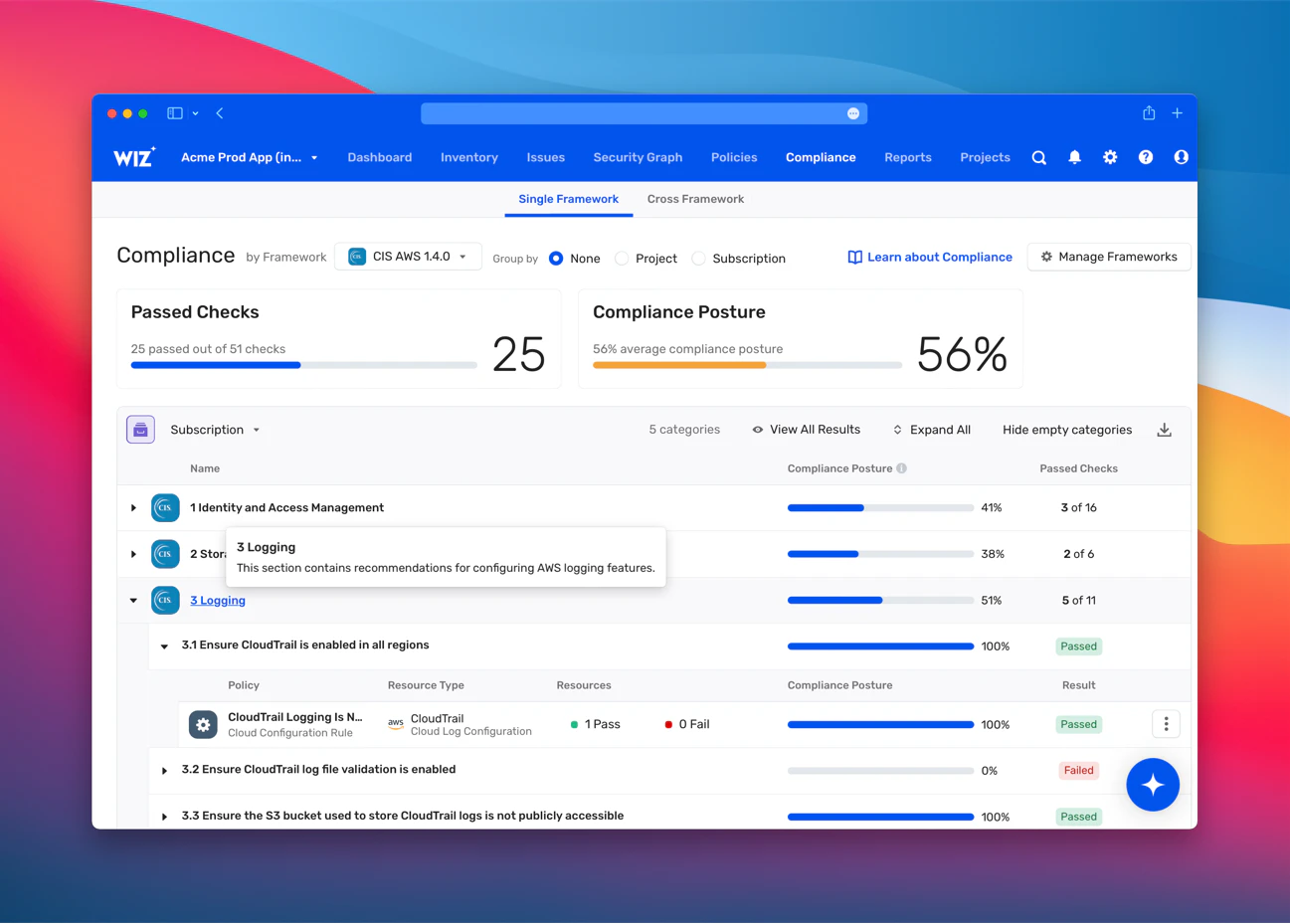
CSPM continuously evaluates cloud configurations against regulatory frameworks, industry standards, and internal policies. Instead of treating compliance as a periodic exercise, CSPM embeds it into day-to-day posture management. This includes ongoing assessment against standards such as CIS benchmarks, NIST, PCI DSS, and SOC 2, support for custom policies that reflect organizational or regional requirements, and automated reporting and audit trails that provide visibility into posture over time. As a result, teams can maintain compliance and audit readiness without relying on manual reviews or disruptive point-in-time assessments.
5. Continuous monitoring and change detection
Cloud environments are never static. Configuration drift, newly exposed resources, and permission changes happen constantly, so CSPM must continuously monitor for changes and re-evaluate risk as the environment evolves. Monitoring prioritizes alerts based on impact rather than just the occurrence of a change, since not every change is a security event. The system needs to distinguish between routine updates and modifications that introduce genuine risk, which requires real-time or near-real-time visibility rather than periodic scans. When something does need attention, CSPM feeds directly into threat detection and incident response workflows.
Watch 12-min demo
Watch how Wiz protects cloud environments from code to runtime.

6. Integration with the broader cloud security ecosystem
CSPM rarely operates alone. It typically integrates with CNAPP platforms to provide a unified approach to securing the entire cloud ecosystem, combining configuration findings with workload protection, identity management, and vulnerability scanning. Identity-centric integration matters in particular, since misconfigured identities are a leading cause of data breaches. A November 2025 ReliaQuest analysis found that 99% of cloud identities carry excessive permissions, and that 44% of true-positive alerts in the third quarter of 2025 traced back to identity-related weaknesses such as over-permissioning, misconfigured roles, and credential abuse.
CSPM also integrates with other tools, such as security information and event management (SIEM) systems and DevSecOps pipelines, to enable automated detection and remediation across the environment. A detected misconfiguration can trigger automated actions in other security systems to minimize exposure. When integrated into a broader CNAPP framework, CSPM extends beyond infrastructure to cover workloads, containers, and serverless functions, securing cloud-native applications and detecting malware across every layer.
Together, these six functions give CSPM continuous visibility, contextual risk assessment, automated remediation, and compliance management. When integrated with a broader security stack, CSPM becomes part of a unified, automated, approach to cloud security. This sets up the next question: how does this differ from the CSPM tools organizations were using five years ago?
Modern vs. legacy CSPM
Modern CSPM has moved from compliance reporting to risk context and action. Early CSPM tools focused on identifying misconfigurations and mapping them to benchmarks, but as cloud infrastructure grew more complex and business-critical, that approach struggled to keep pace.
Legacy CSPM tools evaluate cloud resources in isolation, surfacing large volumes of findings and leaving teams to manually determine what matters, which often results in alert fatigue and slow remediation. Modern CSPM instead analyzes how misconfigurations interact with exposure, identities, workloads, and data to form potential attack paths, letting teams concentrate on the small number of issues that pose meaningful risk.
The table below highlights the practical differences.
| Features | Modern CSPM | Legacy CSPM |
|---|---|---|
| Compliance standards and custom frameworks | Yes | Yes |
| Near-real-time configuration evaluation | Yes | Yes |
| Agentless cloud workload scanning | Yes | No |
| Contextual cloud risk assessment | Yes | No |
| Offline workload scanning | Yes | No |
| Agentless and contextual vulnerability detection | Yes | No, requires an agent |
| Agentless and contextual secure use of secrets | Yes | No, requires an agent and cannot identify lateral movement |
| Agentless and contextual malware detection | Yes | No, requires an agent installed on the workload and manual correlation |
| Data security posture management | Yes | No |
| Kubernetes security posture management | Yes | No |
| Effective network analysis | Yes | No |
| Attack path analysis | Yes | No |
| Effective identity analysis | Yes | No |
| Multi-hop lateral movement | Yes | No |
| CI/CD scanning | Yes | No |
| Comprehensive RBAC support | Yes | No |
The biggest practical difference is what happens after a finding appears:
Legacy CSPM stops at the finding.
Modern CSPM connects it to everything else in the environment, which is also what determines where CSPM fits relative to the other tools in a cloud security stack.
CSPM vs. other cloud security solutions
CSPM is one component of a broader cloud security ecosystem, and understanding where it fits relative to adjacent tools helps organizations build a security program that covers all bases without unnecessary overlap.
| Tool | What it secures | How it relates to CSPM |
|---|---|---|
| CWPP (Cloud Workload Protection Platform) | Workloads themselves, including VMs, containers, and serverless functions | CSPM monitors the infrastructure configurations surrounding those workloads. Together they cover both the infrastructure and what runs on it. |
| CIEM (Cloud Infrastructure Entitlement Management) | Identities and entitlements across cloud environments | CSPM identifies misconfigurations. A misconfigured resource becomes critical when it's attached to an overprivileged identity, which is the toxic combination CSPM and CIEM together can catch. |
| DSPM (Data Security Posture Management) | Sensitive data wherever it lives in the cloud | CSPM secures infrastructure configurations. Combined with DSPM, teams can determine whether a misconfigured resource actually exposes sensitive data. |
| CNAPP (Cloud-Native Application Protection Platform) | The full cloud-native stack, unified in a single platform | CSPM is a foundational capability within CNAPP. Configuration data from CSPM informs every other security domain inside the platform. |
| SIEM (Security Information and Event Management) | Security events for incident detection and response | CSPM is preventive, fixing misconfigurations before exploitation. SIEM is detective, identifying and investigating incidents after the fact. |
| CASB (Cloud Access Security Broker), including SSPM | Cloud application access, particularly SaaS | CSPM monitors IaaS and PaaS configuration. SSPM (SaaS Security Posture Management) is the SaaS-focused equivalent of CSPM. |
| KSPM (Kubernetes Security Posture Management) | Kubernetes-specific posture, including cluster configuration, RBAC, and workload security | Often treated as a specialized sub-domain of CSPM, focused on container orchestration rather than general cloud infrastructure. |
| AI-SPM (AI Security Posture Management) | AI pipelines, including model endpoints, training data, and connected services | Extends CSPM logic to AI workloads, applying the same configuration and exposure analysis to models and pipelines. |
The CNAPP row matters most for where this is all heading. As CSPM, CIEM, DSPM, and CWPP increasingly converge into a single platform, the question for most organizations shifts from which point tools they need to how they consolidate without losing depth in any one domain.
CSPM vs. SSPM: Key differences and when you need both
This post discusses CSPM and SSPM in depth to reveal their respective use cases. You'll also learn how CSPM and SSPM complement each other to strengthen your overall security posture.
Read more
What analyst firms say about CSPM
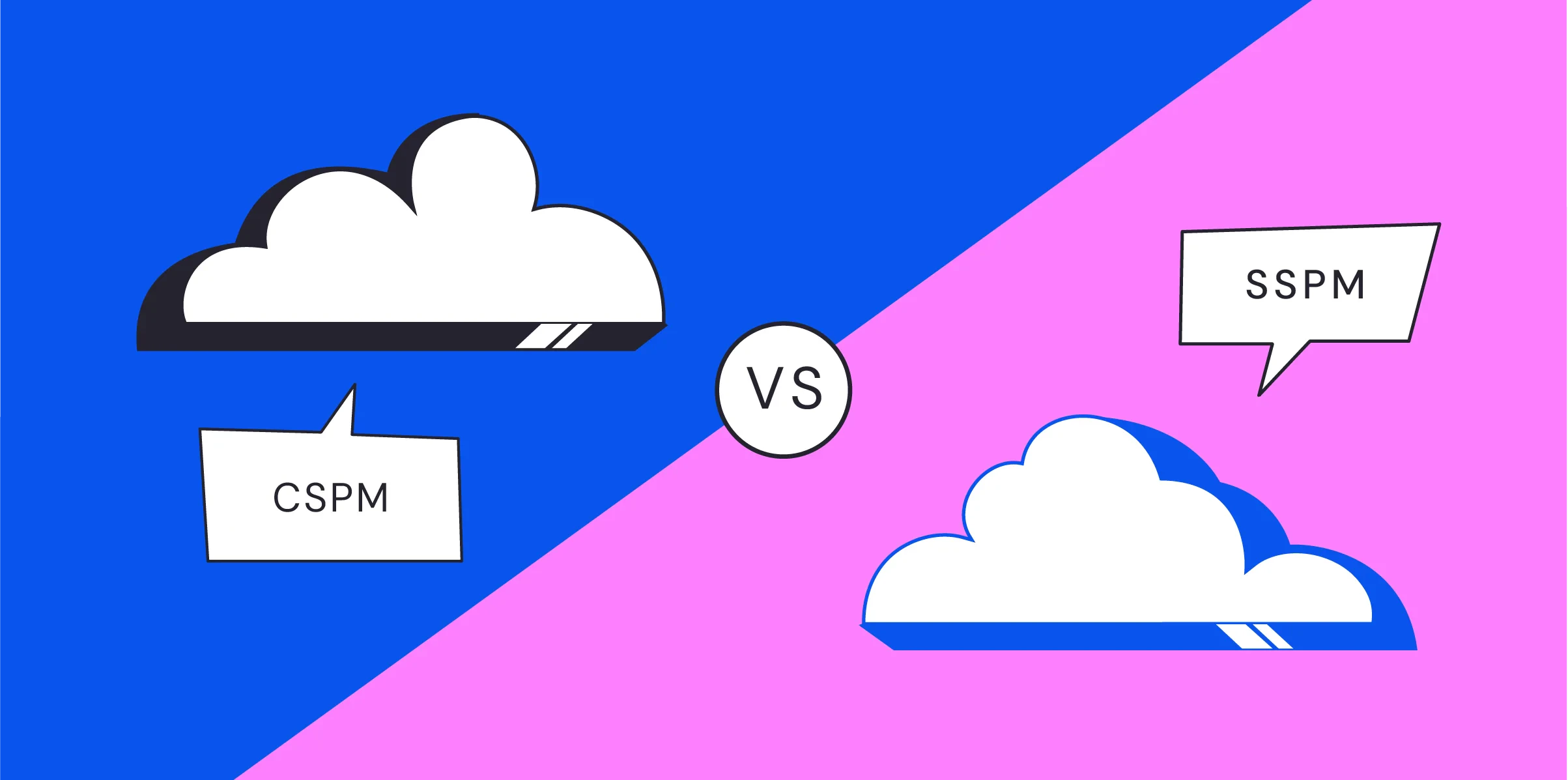
Major analyst firms agree that CSPM is no longer judged as a standalone reporting tool, but on how well it feeds context into a broader cloud security platform. The table below summarizes where each firm stands.
| Analyst firm | Key position on CSPM |
|---|---|
| Gartner | Positions CSPM as a foundational cloud security capability for any cloud-based organization, and notes it's increasingly being absorbed into CNAPP platforms, citing contextual prioritization and attack path analysis as key differentiators. |
| Forrester | Evaluates CSPM as part of CNAPP. Its Q1 2026 Forrester Wave for Cloud-Native Application Protection Solutions assessed vendors on agentless cloud workload protection, CIEM, and infrastructure-as-code security, reflecting how posture analysis now sits inside a unified evaluation. |
| KuppingerCole | Emphasizes continuous monitoring and automation for managing cloud risk, highlighting CSPM's role in configuration visibility, vulnerability identification, and compliance with regulatory standards. Its Leadership Compass for CSPM evaluates vendors on product strength, market presence, and innovation. |
The common thread across all three firms: CSPM is judged on how well it feeds context into a broader security platform.
How to choose a CSPM solution
Choosing a CSPM solution comes down to a handful of criteria that determine whether the tool reduces real risk or just adds another dashboard to check.
Agentless coverage across your cloud footprint. Without agentless deployment across AWS, Azure, GCP, OCI, and Kubernetes, you're left with deployment friction and blind spots in ephemeral workloads.
Contextual prioritization over raw benchmark deviations. A tool that just lists every deviation from a benchmark produces the same alert fatigue as a legacy tool, burying real risk in noise.
Attack path analysis connecting exposure, identity, and data. This turns a list of findings into a list of risks, showing whether a misconfiguration is theoretical or a step an attacker could actually take.
CNAPP consolidation instead of stacking point tools. Consolidating CSPM with CWPP, CIEM, and DSPM in one platform means findings from each domain inform the others automatically.
Wiz AI-APP extension for model endpoints and training pipelines. As AI workloads expand, posture management needs to cover models, training data, and pipelines before they become a shadow AI problem.
CNAPPs like Wiz deliver all five of these capabilities inside a single platform, consolidating posture management across the full lifecycle rather than asking teams to stitch together point solutions.
Wiz's approach to CSPM
We built CSPM as part of a unified cloud security platform, with contextual risk prioritization at the core. Wiz Cloud connects through an agentless, API-based architecture, so you get immediate, complete visibility across AWS, Azure, GCP, OCI, and Kubernetes without deploying a single agent.
From there, the Wiz Security Graph takes over. It correlates configuration findings with vulnerabilities, identity permissions, network exposure, and data sensitivity to surface the toxic combinations that form real attack paths. Instead of drowning you in unranked alerts, we zero in on the small percentage of posture issues where a misconfiguration could actually let an attacker reach sensitive assets. That's the difference between CSPM as a compliance checkbox and CSPM as a tool that actually shrinks your attack surface.
We also bring configuration findings into the same platform as vulnerability management, identity security, and data protection, so your team works from one shared view of risk instead of stitching together reports from different tools. And because AI workloads bring their own posture risks, we extend that same logic through Wiz AI-APP, covering model endpoints, training pipelines, and connected data stores.
If you want a vendor-neutral way to compare CSPM solutions before you commit, The Definitive CSPM Buyer's Guide (RFP Template Included) walks through evaluation criteria and includes an RFP template you can adapt for your own buying process. Or try the Wiz demo and see how a full security suite for your cloud strengthens your posture.
A unified approach to cloud security
Learn why CISOs at the fastest growing companies unify their cloud security needs with Wiz.

FAQs about CSPM
These are the questions that come up most often once teams start evaluating CSPM tools against their own environment.