

What CIEM Really Is (and Why It Matters in Modern Cloud and AI Environments)
Cloud infrastructure entitlement management (CIEM) is the practice of discovering, analyzing, and controlling what identities in your cloud environment can actually do.
This includes human users, service accounts, workload identities, CI/CD roles, API keys, and federated identities across cloud providers, Kubernetes, and supporting platforms.
CIEM exists because cloud identity risk cannot be understood by looking at roles or policies in isolation.
Traditional IAM systems are essential for managing access. They answer administrative questions such as which roles are assigned, who approved access, and when it was granted. But they do not continuously answer the security question that matters most:
Which identities can actually reach our critical resources today, and how?
In cloud environments, access is shaped by multiple factors working together:
Direct and indirect role assignments
Group membership and nested groups
Role assumption and trust relationships
Cross-account and cross-project access
Network exposure and workload placement
CIEM calculates effective permissions by resolving these relationships into a practical view of access. It shows what identities can do in reality, not what policy documents say they should be able to do.
This distinction matters because identity has become the primary control plane in the cloud. Sensitive systems such as data platforms, AI training pipelines, and inference endpoints are increasingly driven by non-human identities. These identities operate continuously and often retain broad permissions granted during development that are never revisited.
A compromised service account with access to training data or model weights can cause damage that persists long after the credential is rotated.
Identity is the new perimeter. Least privilege and zero trust are not achievable without understanding effective access and reachability.
CIEM is not an identity governance add-on. It is a foundational cloud security capability that enables teams to measure identity blast radius, identify real attack paths, and reduce the impact of inevitable credential compromise.
Guided Tour
See Wiz Cloud in Action
How Cloud and AI Architectures Redefine Identity Risk
Cloud-native architectures multiply identities by design. Every microservice, serverless function, container, and automation job typically runs under its own identity with its own set of permissions.
Over time, this creates thousands of roles, service accounts, and trust relationships that no single team fully understands or actively manages.
Several architectural patterns drive this expansion:
Microservices and distributed systems
Each service needs permission to communicate with databases, queues, APIs, and other services, often across accounts or projects.Serverless and managed services
Functions and managed workloads frequently run with broad permissions to avoid breaking dependencies, especially during early development.CI/CD and infrastructure automation
Build and deployment systems require access to modify infrastructure, push artifacts, and manage secrets, making them high-impact identities if compromised.Kubernetes environments
Service accounts, cluster roles, and role bindings can unintentionally grant wide access across namespaces or entire clusters.
AI workloads introduce a second wave of identity risk.
Training pipelines, feature engineering jobs, model registries, and inference services are typically powered by non-human identities with access to large volumes of sensitive data. To move quickly, teams often grant these identities expansive permissions that persist long after the initial project ships.
Common identity risks in AI environments include:
Over-privileged training jobs that can read entire data lakes instead of scoped datasets
Automation roles that can modify both model code and the infrastructure that serves it
Identity chains where one role can assume another, eventually reaching sensitive data or production AI endpoints
In these environments, the highest risk does not come from the number of identities, but from their reach.
A single machine identity may have access spanning storage, compute, data platforms, and AI systems. When that identity is tied to an exposed workload or misconfigured trust relationship, it can create a direct path from the internet to critical assets.
This is why identity risk in the cloud is fundamentally about reachability, not role definitions.
A role with broad permissions may pose little risk if it cannot reach sensitive resources. A narrowly scoped role may pose severe risk if it runs on an exposed workload with access to regulated data or production AI systems.
CIEM must be able to model these relationships continuously and at scale. Without understanding how identities interact with workloads, networks, and data, teams cannot accurately assess risk or reduce blast radius in modern cloud and AI environments.
Defining Your CIEM Requirements Before Evaluating Vendors
Before comparing CIEM vendors, you need to be clear on the problem you are trying to solve. Most teams do not fail at CIEM because of tool limitations. They fail because they evaluate products without aligning on what identity risk actually means in their environment.
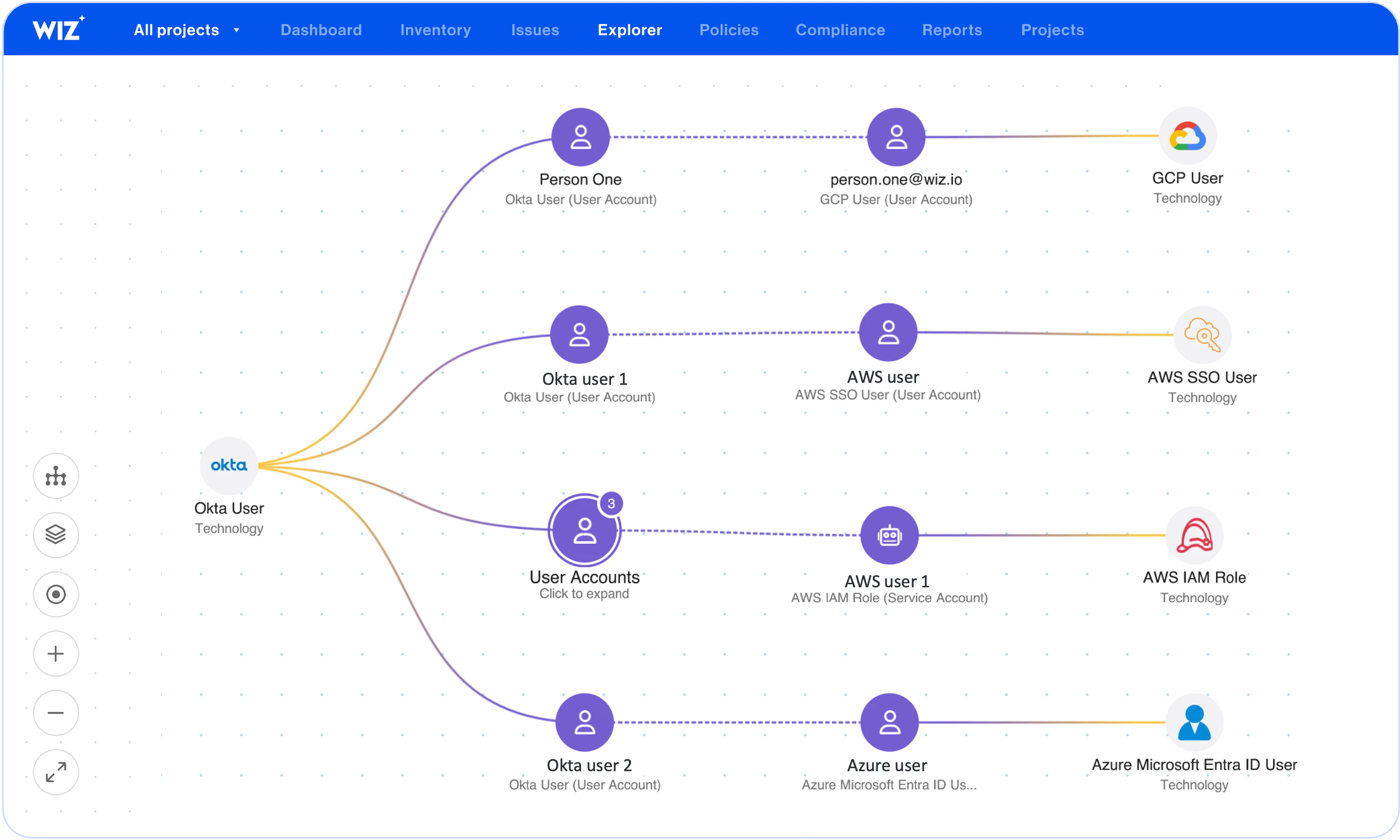
Start with a single question:
Which identities can actually reach our sensitive resources today?
That question shifts the focus from permissions hygiene to real security outcomes. It also exposes where visibility breaks down across teams, platforms, and identity types.
In practice, this question surfaces a small set of recurring drivers:
Identity sprawl across cloud accounts and teams
New projects, environments, and services continuously introduce new roles, service accounts, and trust relationships.Permissions granted for speed, not intent
Temporary admin access, wildcard permissions, and inherited roles are rarely revisited after delivery.Rapid expansion of automation and AI workloads
CI/CD systems, bots, and AI pipelines quietly accumulate broad access to infrastructure and data.Audit and compliance pressure
Teams are asked to prove least privilege and explain access to sensitive data without having a reliable, continuous view of effective permissions.
To define meaningful CIEM requirements, assess where you lack visibility today:
Cloud IAM across AWS, Azure, and GCP, including cross-account and cross-project access
Kubernetes RBAC, including service accounts, cluster roles, and namespace boundaries
CI/CD and automation identities that can modify infrastructure, code, or both
Modern best practice increasingly relies on workload identity federation using OIDC rather than static access keys. For example, CI/CD platforms such as GitHub Actions can authenticate to cloud providers using short-lived tokens that expire in minutes. A CIEM platform should be able to validate that:
Automation identities use short-lived credentials wherever possible
Any remaining static keys are rotated, scoped, and monitored
Pipeline roles enforce separation of duties between code changes and infrastructure changes
You should also be explicit about which identity types must be in scope from day one:
Human users in cloud directories and identity providers
Service accounts and roles in cloud providers
Workload identities such as Kubernetes service accounts and managed identities
API keys and tokens tied to applications and third-party integrations
Finally, define success in terms of blast radius reduction, not raw counts.
Instead of goals like “reduce the number of admin roles,” define outcomes that reflect real risk reduction, such as:
Reducing the number of identities that can reach sensitive data in production
Eliminating identity paths from internet-exposed workloads to critical assets
Shortening the time required to safely remediate newly introduced high-risk entitlements
The 8 Criteria for Evaluating CIEM Vendors
1. Multi-Cloud Coverage and Identity Normalization
Most organizations operate across multiple cloud providers and platforms. Identities are distributed across AWS, Azure, GCP, Kubernetes, and supporting services, each with different permission models and semantics.
A CIEM solution that only understands one provider or one identity system will leave meaningful blind spots.
At a minimum, a CIEM platform should provide deep, native support for:
AWS IAM and STS, including role assumption and cross-account access
Microsoft Entra ID and Azure RBAC for subscription and resource-level permissions
GCP IAM across projects and organizations
Kubernetes RBAC, including service accounts, roles, and cluster roles
Beyond ingestion, normalization is critical. A strong CIEM solution translates these different models into a unified view so teams can ask questions like:
Which identities have administrative access to production resources?
Which non-human identities can modify infrastructure?
Which identities span development and production environments?
Effective CIEM platforms also discover identities that are commonly overlooked:
Identities in forgotten or shadow accounts and subscriptions
Unused roles and service accounts with lingering permissions
Orphaned API keys that still function but lack clear ownership
These identities often represent the easiest entry points for attackers.
2. Effective Permissions Analysis (Not Just Granted Roles)
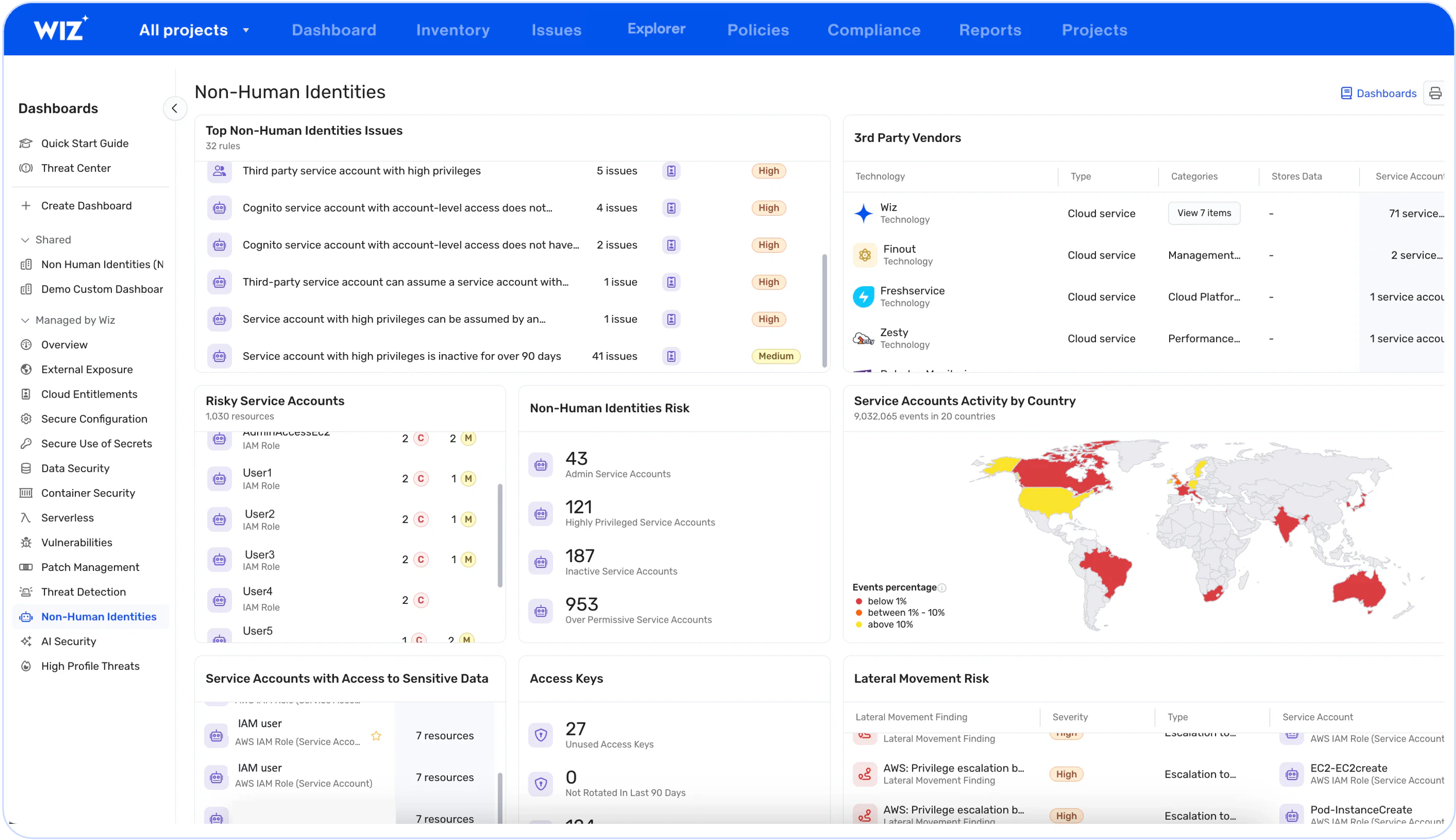
Listing attached policies is not enough to assess identity risk.
Effective permissions analysis determines what an identity can actually do once all access paths are resolved. This requires accounting for:
Direct and indirect role assignments
Group membership and nested groups
Role assumption and trust relationships
Cross-account and cross-project access
For example, a developer may not appear to have access to sensitive data directly, but may be able to assume a role in another account that does. Effective permissions analysis surfaces these hidden paths.
Without resolving effective access, CIEM tools consistently underestimate real blast radius. Vendors that only display attached policies or static role mappings cannot accurately represent identity risk.
3. Attack Path Analysis and Toxic Combination Detection
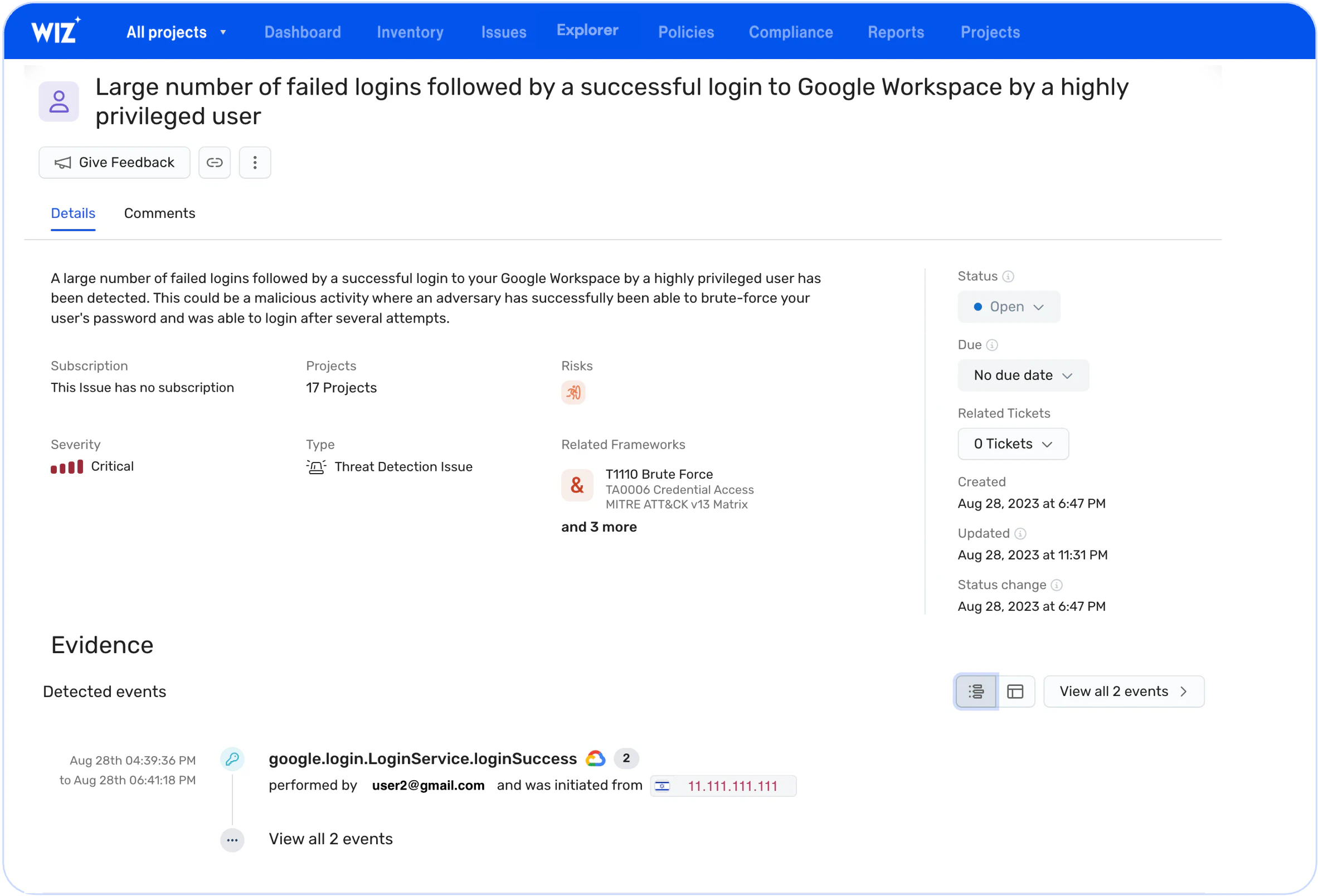
Permissions alone do not create risk. Risk emerges when permissions combine with exposure.
CIEM platforms should correlate identity access with other security factors, including:
Network exposure of the workloads using those identities
Vulnerabilities or misconfigurations on those workloads
The presence of sensitive or regulated data behind those access paths
From this context, the platform should surface toxic combinations, such as:
A service account running on an internet-exposed workload that can read sensitive data
A CI/CD role that can modify both application code and the infrastructure that runs it
A Kubernetes service account bound to cluster-admin in a namespace exposed via public ingress
Attack path analysis helps teams understand how an attacker could move laterally through identity chains. More importantly, it enables prioritization based on exploitability rather than raw permission volume.
4. Identity Context Across Cloud, Data, and AI Workloads
Modern identities interact with far more than virtual machines.
CIEM platforms must connect identity access across:
Cloud infrastructure such as compute, storage, and networking
Data systems including object stores, databases, and warehouses
AI and analytics workloads such as training pipelines, feature stores, and inference services
This context enables teams to answer critical questions, including:
Which identities can modify or poison training data?
Which identities can invoke production AI inference endpoints?
Where do identities cross boundaries between development, staging, and production?
Vendors that treat identity in isolation from data and AI systems will miss some of the highest-impact risks in modern environments.
5. Automation, Rightsizing, and Safe Remediation
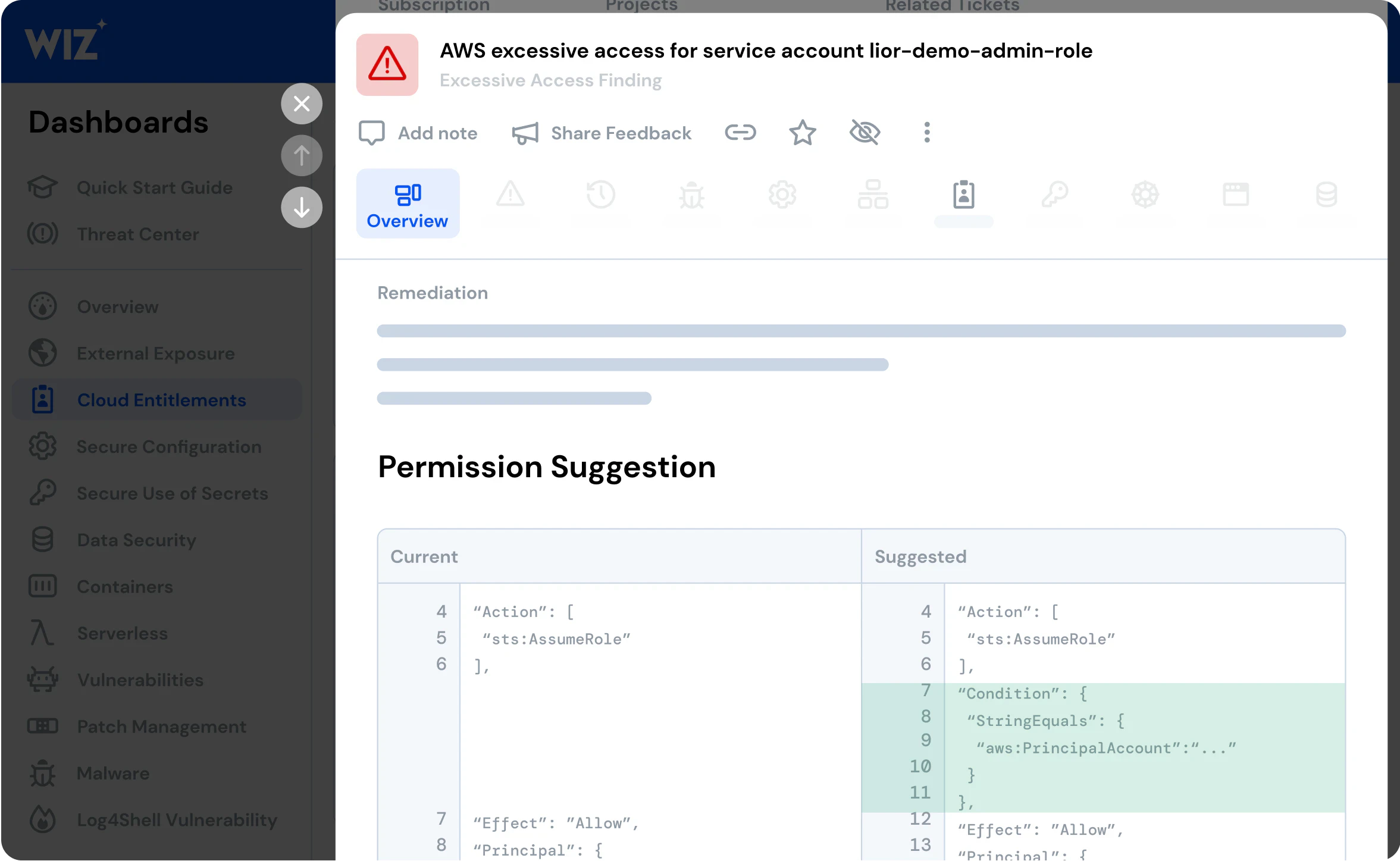
Visibility alone does not reduce risk.
A practical CIEM solution must help teams safely reduce permissions and keep them under control over time. Key capabilities include:
Automated rightsizing based on observed usage
Time-bound or just-in-time access for elevated permissions
Policy-as-code integration so identity controls are enforced in infrastructure pipelines
Equally important are safety mechanisms. The platform should support previewing changes, validating impact, and adding approval workflows for high-risk remediation actions.
CIEM platforms that only generate findings without providing safe remediation paths quickly lose adoption.
6. Integration with the Broader Security and DevOps Stack
Identity risk does not exist in isolation.
CIEM platforms should integrate with existing tools and workflows, including:
SIEM and SOAR systems for detection and response
CSPM and vulnerability management tools to add exploitability context
Ticketing and workflow systems for remediation tracking
CI/CD platforms to prevent risky entitlements before deployment
An API-first design is a strong signal of maturity. It allows organizations to extend CIEM findings into custom workflows, internal dashboards, and automation pipelines.
7. Enterprise Scalability and Operational Readiness
CIEM platforms must operate reliably at enterprise scale.
Evaluation questions should include:
Can the platform handle tens of thousands of identities and complex trust graphs?
How frequently does it refresh data, and what is the operational impact?
Can it operate continuously across large, multi-account environments?
Operational capabilities are equally important:
Role-based access control within the CIEM platform
Detailed audit trails for investigations and remediation
Reporting aligned to frameworks such as SOC 2, ISO 27001, NIST, PCI DSS, and HIPAA
CIEM should support both security operations and audit readiness without requiring separate tooling.
8. Usability Across Security, Cloud, and Engineering Teams
CIEM is only effective if it is usable by the teams responsible for fixing issues.
Strong usability signals include:
Clear visualizations of identity relationships and attack paths
Actionable findings that explain why a risk matters and how to fix it
Views tailored to security analysts, cloud platform teams, and developers
Instead of presenting raw policy documents, effective CIEM platforms translate complexity into decisions. For example, they explain which identity can delete production data and show the exact path that makes it possible.
CIEM adoption improves when engineers can remediate issues in the services they own, while security teams retain oversight and guardrails.
Common CIEM Implementation Mistakes to Avoid
Many CIEM initiatives fail not because of tooling gaps, but because of how teams approach identity risk in the cloud.
One of the most common mistakes is treating CIEM as a one-time cleanup project. Teams import identities, generate reports, remediate a handful of findings, and then move on. Cloud identities and permissions change constantly. Without continuous analysis, risk quickly returns to its previous state.
Another frequent issue is focusing only on detection. Large identity inventories and long lists of risky permissions do not reduce risk on their own. If remediation workflows are not defined early, teams will tune out CIEM findings as noise.
Machine identities are often overlooked. Reviews frequently focus on human users because they are easier to reason about and assign ownership to. Meanwhile, service accounts, CI/CD roles, and workload identities continue to accumulate broad permissions and quietly power the most critical systems.
Evaluating permissions without exposure context is another common failure. Flagging every wildcard permission or admin role regardless of whether it can reach sensitive resources leads directly to alert fatigue. Identity risk must be assessed in the context of reachability and exploitability.
CIEM programs also struggle when ownership is unclear. If it is not obvious who owns a risky identity or which team is responsible for remediation, findings will stall in dashboards instead of being fixed.
Finally, CIEM fails when it operates in isolation. Identity risk intersects with cloud posture, vulnerabilities, data security, and detection and response. When CIEM is not integrated into broader security and engineering workflows, it becomes another disconnected tool rather than an enabler of risk reduction.
Aligning Stakeholders Around CIEM Success
CIEM touches more teams than almost any other cloud security capability. Identity permissions span security, cloud platform teams, DevOps, and application owners, which means CIEM will stall unless expectations and ownership are aligned early.
Security teams are typically focused on reducing breach risk and limiting blast radius. They care about which identities can reach sensitive data, how easily attackers could move laterally, and how quickly high-risk paths can be eliminated.
Cloud and platform teams prioritize stability and consistency. They need confidence that CIEM-driven remediation will not break production systems or introduce fragile access patterns.
Developers and DevOps teams care most about speed and autonomy. They want clear guidance, scoped remediation, and self-service workflows that do not require deep IAM expertise or constant security approvals.
Successful CIEM programs translate identity risk into outcomes each group can act on.
For leadership and security stakeholders, CIEM should report on measurable risk reduction, such as fewer identities that can reach sensitive resources or shorter remediation times for high-risk access paths.
For platform teams, CIEM should reinforce standard patterns and guardrails, making it easier to build new services without reintroducing excessive permissions.
For developers, CIEM should surface findings in the context of the services they own and provide safe remediation paths they can execute themselves.
Shared metrics help align these groups. Common examples include:
Reduction in the number of identities with access to sensitive data by environment
Time to remediate newly discovered high-risk identity paths
Percentage of critical identity findings resolved within a defined SLA
Executive sponsorship is critical. When CIEM is positioned as an enabler of secure cloud and AI adoption rather than a blocking control, teams are more likely to invest time in remediation and long-term governance.
Horizontal Security and Ownership
CIEM works best when identity risk is addressed horizontally across teams instead of being centralized in a single security queue.
In a horizontal model, CIEM identifies risky identities and routes findings to the teams that own the affected services. Developers and platform teams can see why a finding matters, which permissions are excessive, and how to safely fix the issue in their own context.
Security teams retain oversight by setting policies, reviewing high-risk changes, and tracking progress against risk reduction goals. This balance prevents CIEM from becoming a bottleneck while still maintaining strong governance.
By distributing ownership and embedding identity risk into everyday workflows, CIEM becomes part of how teams build and operate in the cloud, not an occasional audit exercise.
Future-Proofing Your CIEM Investment
CIEM is not a short-term purchase. Cloud environments, identity models, and AI architectures evolve continuously, and a CIEM platform needs to keep pace without forcing repeated replatforming.
One of the most important considerations is how the platform handles growth in non-human identities. Automation, agents, and AI workloads are increasing faster than human users, and they often introduce new identity types and access patterns. A future-proof CIEM solution should be able to onboard new identity models without major redesign or manual mapping.
You should ask vendors how they adapt to change across several dimensions:
Cloud provider evolution
How quickly does the platform support new services, permission models, and identity constructs introduced by AWS, Azure, and GCP?Modern identity patterns
Can the platform model workload identity federation, short-lived credentials, and role chaining without losing visibility or accuracy?AI and data architectures
Does the platform understand identities interacting with data pipelines, model training workflows, and inference services, not just infrastructure primitives?
Architecture matters as much as features. Platforms built on extensible data models and graph-based analysis are better suited to absorb new relationships and attack paths as environments grow more complex.
Extensibility is another signal of longevity. An API-first design allows organizations to integrate CIEM findings into internal governance processes, custom dashboards, and automation workflows as needs change.
You should also evaluate vendor focus and investment. CIEM that exists as a lightly maintained add-on is unlikely to keep up with the pace of cloud and AI change. Vendors with sustained investment in cloud security research, identity modeling, and detection capabilities are more likely to deliver long-term value.
Finally, consider ecosystem fit. CIEM platforms that integrate deeply with your broader cloud security, data security, and detection and response tooling are easier to build around and less likely to become isolated over time.
A future-proof CIEM investment is one that continues to reduce identity blast radius as your cloud and AI footprint grows, rather than requiring constant manual tuning to stay relevant.
How Wiz Delivers CIEM as Part of a Unified CNAPP
With Wiz, CIEM is not a standalone product. It is a core capability of a unified cloud native application protection platform (CNAPP).
In a CNAPP model, identity risk is evaluated alongside workloads, networks, vulnerabilities, misconfigurations, data, and AI systems, not in isolation. Wiz brings CIEM into this unified context by modeling identities, their effective permissions, and what they can actually reach within a single Security Graph.
Because identity is deeply intertwined with exposure and exploitability in the cloud, separating CIEM from CSPM, vulnerability management, and data security creates blind spots. Wiz’s CNAPP approach eliminates those gaps by correlating identity entitlements with real-world conditions such as internet exposure, workload configuration, and sensitive data access.
Instead of asking separate questions like “who has access,” “what is exposed,” and “where is sensitive data,” teams see the full identity-based attack path in one place. For example, when Wiz identifies an over-privileged service account, it immediately shows whether that identity runs on an internet-exposed workload and whether it can reach sensitive data or AI pipelines.
Wiz calculates effective permissions across cloud providers and Kubernetes environments, resolving role assignments, trust relationships, and identity chains into a practical view of access. This allows identity risk to be prioritized the same way other CNAPP risks are prioritized, based on exploitability and potential impact.
Because Wiz is agentless, it can rapidly discover identities and entitlements across AWS, Azure, GCP, and Kubernetes without adding operational overhead. As environments change, Wiz continuously re-evaluates identity risk and surfaces newly introduced attack paths instead of relying on periodic access reviews.
Wiz also connects CIEM to detection and response within the same CNAPP platform. Identity-focused detection capabilities help teams identify active abuse of roles and permissions and investigate lateral movement in the context of exposed workloads and sensitive resources.
With code-to-cloud visibility, Wiz traces risky permissions and identity issues back to infrastructure-as-code and CI/CD definitions. This enables teams to fix root causes upstream and prevent over-privileged identities from being reintroduced.
By delivering CIEM as part of a unified CNAPP, Wiz enables teams to reduce identity-based attack paths using the same operating model they already use to manage cloud risk. Identity findings are prioritized, routed, and remediated alongside other cloud risks, reducing tool sprawl and accelerating blast radius reduction.
CIEM in Wiz is not about managing identities in isolation. It is about reducing identity-driven attack paths as part of a comprehensive CNAPP strategy.
If you want to see this in practice, a live demo can walk through how Wiz delivers CIEM as part of its CNAPP to discover identity risk, prioritize real attack paths, and safely reduce effective permissions across cloud and AI environments.
Get a personalized demo of identity-to-risk mapping with Wiz
See how Wiz CIEM uncovers excessive permissions, toxic combinations, and hidden access paths in minutes, giving you a clean, actionable map of identity risk.
