
What is CSPM?
Cloud security posture management (CSPM) is a security framework that continuously scans cloud infrastructure for misconfigurations, policy violations, and compliance gaps. CSPM tools connect to cloud provider APIs to monitor resource configurations across AWS, Azure, and GCP, flagging risks like a publicly exposed S3 bucket or an IAM role with admin access that no one has reviewed in months. According to the Wiz Cloud Threats Retrospective, 19% of documented cloud intrusions in 2025 began with misconfigurations, making continuous configuration monitoring a baseline requirement.
Get the 2025 Gartner CNAPP Market Guide
See how Gartner evaluates cloud-native application protection platforms and where the market is heading.

CSPM gives you a clear risk assessment of your cloud security posture across all providers. The practical advantages show up fast:
Integrated scanning that combines vulnerability and misconfiguration detection in one workflow
Automated policy enforcement that reduces risk and supports compliance with frameworks like PCI-DSS and SOC 2
Real-time monitoring that cuts response time with immediate alerts on configuration drift
CSPM frees up your security team by automating routine tasks and simplifying remediation. It checks your cloud setup against industry standards and flags gaps before auditors do, giving both security and compliance teams a shared view of what needs fixing.
Agent-based CSPM tools require installation on individual workloads, which adds deployment overhead. API-native approaches connect at the cloud control plane and return findings without touching production, making rollout faster across large environments.
What is DSPM?
Data security posture management (DSPM) is a security approach that discovers, classifies, and protects sensitive data across cloud environments. DSPM scans cloud-managed databases, object storage, and data warehouses to identify where regulated or confidential data lives, who can access it, and whether it is adequately protected.
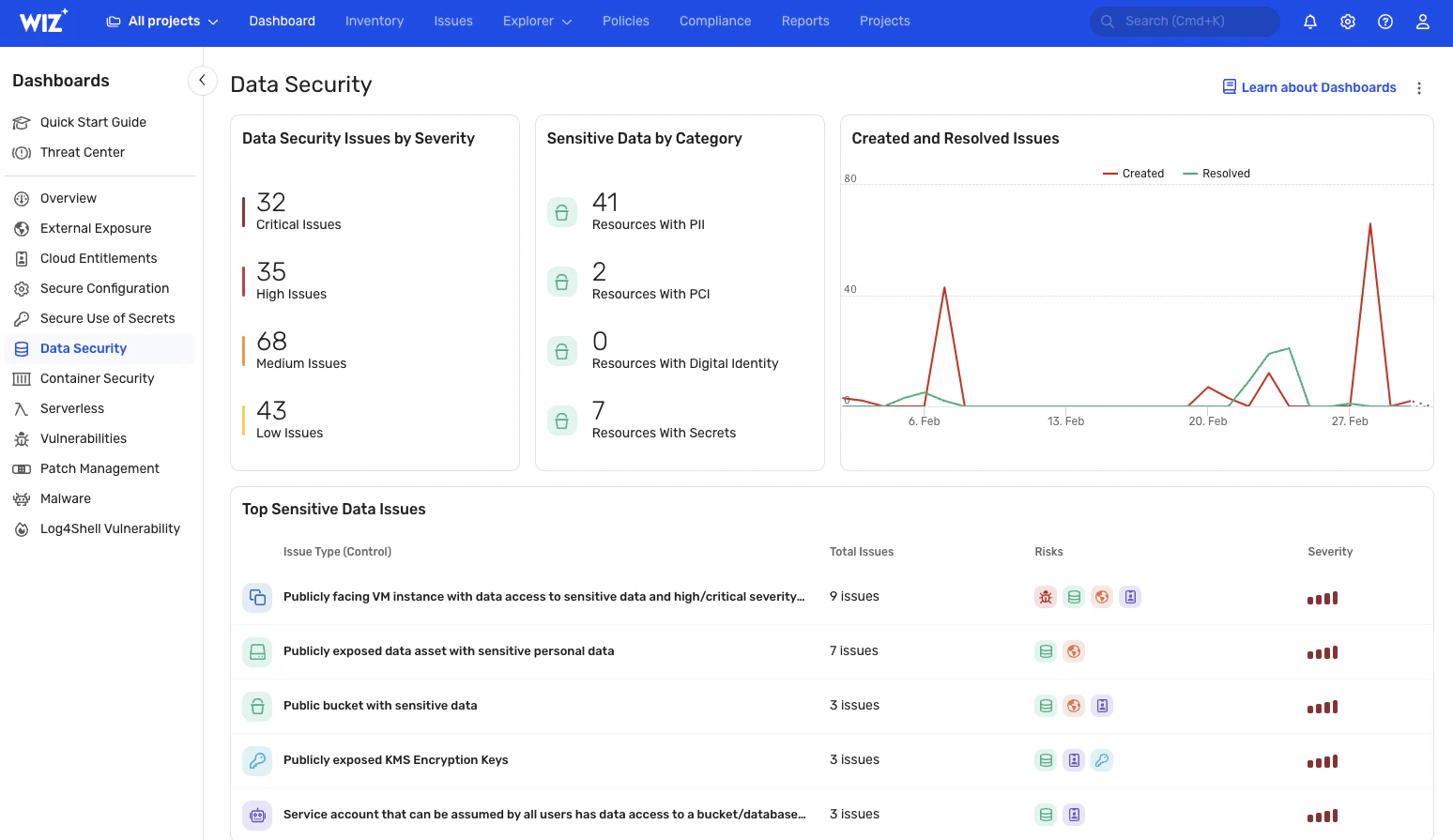
DSPM continuously monitors for potential risks that could impact your data. The measurable benefits include:
Data loss prevention through access monitoring and enforcement of encryption and backups
Reduced attack surface by closing entry points and vulnerabilities around sensitive data stores
Faster incident response through ongoing monitoring of data security metrics like access attempts and volume of data exposed
Simplified regulatory cloud compliance with GDPR, HIPAA, and similar frameworks through continuous visibility and policy enforcement
DSPM gives teams continuous visibility into where regulated data lives and who can reach it, which makes compliance reporting faster and data breach investigations easier to contain. It also simplifies regulatory compliance by proactively managing data security. It also enforces least privilege and other access control models so users only reach the data they need for their job, cutting risk overall.
CSPM vs DSPM: key differences
CSPM and DSPM address different layers of cloud security. CSPM monitors infrastructure configurations and access policies, while DSPM focuses on the sensitive data flowing through that infrastructure.
| Feature | CSPM | DSPM |
|---|---|---|
| Focus | Overall cloud security posture | Protecting sensitive data |
| Major strength | Continuous monitoring and misconfiguration detection | Identifying and securing sensitive data across environments |
| What it can't do | Directly protect individual data points | Secure the entire cloud environment |
| Best for | Organizations with complex cloud environments and/or compliance needs (e.g., PCI-DSS for processing payments) | Organizations with large amounts of sensitive data, organizations in highly regulated industries (e.g., healthcare, finance) |
| Typical protection scenario | CSPM at a retail company detects that an S3 bucket storing customer purchase history has public access enabled. This misconfiguration could allow anyone to access sensitive customer data. CSPM alerts the security team, who can then restrict access to those S3 storage buckets. | DSPM at a healthcare provider discovers that a large amount of patient data is stored on a cloud server without proper encryption. This unknown "shadow data" poses a significant security risk. DSPM alerts security, identifies the data, pinpoints its location, and helps implement risk-remediation steps. |
The table highlights a critical gap: CSPM catches the misconfigured bucket but does not know what data sits inside it. DSPM identifies the sensitive records but cannot tell you whether the infrastructure around them is exposed. Together, they turn two partial signals into one actionable finding.
How CSPM and DSPM work together
Consider a common scenario. CSPM scans your AWS environment and flags an S3 bucket with public read access. On its own, that finding lands in a queue alongside dozens of other misconfigurations. According to the Wiz Cloud Data Security Snapshot, 54% of cloud environments have exposed VMs and serverless functions containing sensitive data, so without data context, security teams cannot tell which findings carry real business risk. Meanwhile, DSPM scans the same environment and discovers that the bucket contains unencrypted personally identifiable information (PII), including names, addresses, and Social Security numbers.
When both signals feed into the same platform, the picture changes. The publicly accessible bucket jumps from a routine misconfiguration to a critical data exposure. Your security team sees one prioritized alert instead of two disconnected tickets, and remediation starts with the finding that carries the most business risk.
A cloud-native application protection platform (CNAPP) unifies CSPM, DSPM, and related capabilities within a single console. Most CNAPPs also include cloud infrastructure entitlement management (CIEM) and cloud workload protection (CWP), giving security teams one place to manage infrastructure, data, identity, and runtime risks.
Watch 12-min demo
See how Wiz Cloud finds toxic combinations across misconfigurations, identities, data exposure, and vulnerabilities.

How to choose between CSPM and DSPM
The right tool depends on what you are protecting and where your compliance obligations sit.
CSPM secures cloud infrastructure by identifying misconfigurations and identity issues. This is essential for organizations with complex cloud environments and compliance requirements.
DSPM prioritizes data security by identifying data-targeted vulnerabilities and enforcing security policies. This is essential for organizations with large amounts of sensitive data and those in regulated industries.
Organizations do not need to choose one over the other. CSPM spots a misconfigured storage bucket; DSPM reveals that the same bucket holds unencrypted patient records. Without both signals, the security team either misses the data risk or lacks the infrastructure context to prioritize the fix.
No organization wants a patchwork of single-purpose security tools, each with its own interface and learning curve. Instead of choosing between a standalone CSPM tool and a standalone DSPM tool, consider a CNAPP that brings both capabilities together. A single platform cuts complexity, gives your team clear visibility across all your clouds, and connects infrastructure risk to data exposure in one workflow.
CNAPP vs. CSPM Explained: Which Cloud Security Tool Wins?
Learn where CNAPP and CSPM overlap, where they differ, and which one is right for your organization.
Leia mais
How Wiz combines CSPM and DSPM
The challenge with running CSPM and DSPM as separate tools is correlation. Your infrastructure scanner flags a misconfigured bucket in one console while your data scanner classifies sensitive records in another, and your team has to manually connect those dots. Wiz solves this by running both capabilities on the same platform, connected through the Security Graph.

Wiz CSPM connects to AWS, Azure, and GCP through API-based connectors. It interrogates cloud APIs for resource configurations, then snapshots disk volumes to scan for vulnerabilities and secrets, all without installing agents or touching production workloads. Wiz DSPM discovers sensitive data across cloud-managed databases, self-managed databases, and public and private storage buckets. It classifies regulated data, tracks data lineage, supports custom regex classifiers, and identifies the geographic location of sensitive records.
Because both capabilities feed into the same Security Graph, findings correlate automatically. When Wiz DSPM identifies unencrypted PII in a bucket that Wiz CSPM has flagged as publicly accessible, the graph surfaces it as a single toxic combination rather than two disconnected alerts. Your team sees the exploitable 1% of risks that represent validated attack paths to critical data, and remediation starts with the highest business impact first. Wiz AI-APP extends this same visibility to AI workloads, discovering shadow AI deployments, detecting misconfigurations in AI service guardrails, and mapping attack paths between cloud resources and AI services.
See how Wiz unifies CSPM, DSPM, and AI security in a single agentless platform. Get a demo to explore the Security Graph firsthand.
Get a demo
Every cloud security solution, one platform. Learn why CISOs at the fastest-growing companies unify their cloud security with Wiz.
