



What is an incident response policy?
An incident response policy is a document that outlines your organization's plan for responding to cybersecurity incidents. It outlines who is responsible for what, how to communicate, and the phases of response, from preparation to recovery. It's not just a document—it's a critical component for protecting your business.
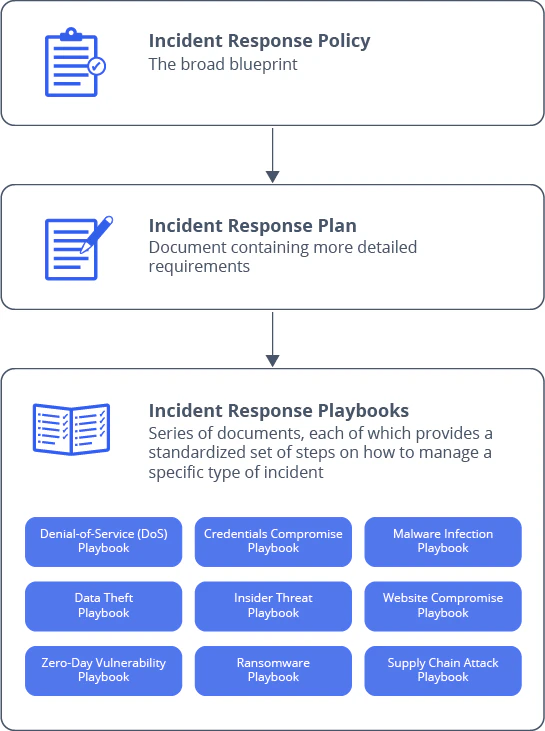
An incident response policy defines your organization’s governance and accountability for managing incidents. It serves as the foundation for your incident response plan (the operational process) and your playbooks (tactical, incident-specific procedures).
Your organization's leadership team must review and approve your incident response policy to ensure full buy-in, strengthen accountability, and authorize your incident response strategy.
Above all, your incident response policy should serve as a blueprint for managing the incident response lifecycle and provide a foundation for more detailed documentation on handling incidents.
How to Prepare for a Cloud Cyberattack: An Actionable Incident Response Plan Template
A quickstart guide to creating a robust incident response plan - designed specifically for companies with cloud-based deployments.

This documentation builds on your incident response policy, resulting in two distinct components: a structured incident response plan and a series of incident response playbooks. These components are defined as follows:
The incident response plan expands on the roadmap outlined in your incident response policy, providing details on preparation, management, and post-incident improvements your team needs to implement.
Each incident playbook is a standardized set of procedures you should follow in response to a particular type of incident. It details actionable steps to take at each stage of the response process, along with the tools needed to perform each task.
Everyone involved in the incident response process must be fully prepared in advance so they can calmly execute their tasks in a competent and efficient manner. In other words, success hinges on a carefully planned, comprehensive incident response strategy.
What does an incident response policy template include?
An effective incident response policy template should address the unique requirements of your organization. While these requirements will vary across businesses, these 12 standard sections are typically present in most incident response policy templates:
1. Introduction
The introduction provides a high-level overview of your IR policy’s purpose and explains why incident response is essential to your organization. It should resonate with senior decision-makers by connecting incident response to risk management and accountability.
The introduction should clearly lay out the following content:
The strategic importance of incident response, making both the technical and business case for having a clear, organization-wide incident response strategy
The purpose of the policy, why it was created, and to whom and what it applies
Your introduction should also include the following elements:
At least one statement that demonstrates your organization's commitment to security
A mandate for the creation of an incident response plan and detailed playbooks, ideally with a timeline for their creation
The position of the person who will be responsible for enforcing the policy within your company
2. Terminology
Cybersecurity can be complex, containing many technical terms and concepts that may be unfamiliar to team members outside of security or IT. To ensure that everyone shares a common language and to prevent time-consuming misunderstandings, your policy should include the following:
Set clear definitions for key terms, such as “vulnerability,” “threat,” “attack,” “event,” “incident,” “personal data,” “denial-of-service,” and different types of data breaches.
Including a glossary of all key terms you've used within the policy ensures a shared understanding across the organization.
3. Roles and responsibilities
You should also clearly define the scope of your policy in terms of its stakeholders and use it as the first step toward building your incident response team. For example, the policy should establish the following organizational components:
Establish a cyber incident response team.
Designate an incident manager to lead the team.
Identify backup personnel who can step in if the incident manager is unavailable.
Nominate the personnel responsible for developing your incident response plan.
Decide whether you need a third-party security provider.
Modern IR teams also depend on automation for incident response. To leverage effective automation, define roles for automated response systems—such as SOAR workflows, AWS Lambda responders, Azure Logic Apps, or Google Cloud Functions—that perform auto-remediation and specify escalation triggers for human review to ensure accountability and oversight.
The policy must then document the specific roles and responsibilities of each team member involved in the incident response lifecycle, including the incident manager, analysts, and communication liaisons.
4. Communications
This section will set the direction for your communication strategy and should establish the following requirements for implementation:
Establish designated points of contact.
Define primary and secondary methods of contact, typically via email, phone, and messaging apps.
Set out procedures for incident reporting and triaging affected systems.
Identify who will be responsible for notifying enforcement bodies in line with compliance requirements.
List all other parties you should inform in the event of a security incident, such as customers, suppliers, insurers, law enforcement, and service providers within your software supply chain.
Develop an external communications plan with contact information.
Outline responsibilities for reporting progress throughout the escalation to response process.
Integrate communication channels (e.g., Slack, Microsoft Teams, or PagerDuty) with ticketing, incident tracking, and case management tools (e.g., Jira, TheHive, or ServiceNow) to automatically capture and centralize alerts, forensic artifacts, and escalation notes. This integration ensures your team can audit critical context during an incident.
This section must clearly outline the protocols for both internal and external communication in the event of a security breach, including designated channels and points of contact for reporting and response.
5. Training
As part of your commitment to information security, your policy should outline plans for adequately training team members. It should typically cover the following:
Basic security awareness training
In-depth technical training for cybersecurity teams
How to use tools and technologies for detecting, analyzing, and responding to cyber attacks
Compliance training and incident handling
Dedicated incident management training
Your policy should also include hands-on exercises, such as red-team simulations and tabletop exercises, to ensure training efforts translate into real-world readiness. These simulations validate the effectiveness of your IR policies and help identify process gaps, improve coordination, and refine escalation procedures under realistic conditions.
This section must detail the training requirements for incident response team members and all other employees involved in security operations.
6. Regulatory compliance
Your incident response policy must ensure all response activities comply with relevant data protection and cybersecurity regulations. Legal and communications teams must understand specific reporting obligations, as regulatory requirements differ significantly. Laws such as GDPR and HIPAA require notification within defined timeframes, while others only mandate timely disclosure.
Under the terms of your policy, your organization should establish the following:
What regulations and standards apply to your organization
What types of data these regulations apply to
Requirements for notifying stakeholders in the event of an incident
This section should ensure your incident response aligns with applicable legal and regulatory requirements at every stage of detection, reporting, and recovery.
7. Asset inventory
Your asset inventory helps you define the scope of your incident response policy and provides a clear picture of your systems and their relationships. This inventory can also help security teams better understand the impacts of any security breach and identify potential avenues for lateral movement.
Static inventories are not effective in a cloud-native environment. Your policy should emphasize continuous asset discovery and automated updates to ensure your inventory always reflects current systems, workloads, and dependencies across on-premises and cloud infrastructure.
You should propose that your organization take the following actions:
Draw up a preliminary list of the IT assets you need to protect.
Map your inventory in real time, including the relationships between ephemeral cloud systems.
Use this map to set incident response and recovery priorities, accounting for service-level agreements (SLAs), potential revenue loss, and compliance requirements.
Detail your findings in your incident response procedures.
This section must include an inventory of critical assets—including systems, data, and cloud infrastructure—that helps identify and prioritize what you must protect during an incident.
Need a starting point for building or refining your incident response plan? Check out our roundup of free Incident Response Plan Templates – practical, cloud-ready examples to help you move faster.
8. Threat models
Different types of cybersecurity incidents require different responses. As such, you must include provisions for identifying and categorizing these threats.
Your policy must then recommend threat modeling techniques to help the organization understand the nature of each threat and document basic information. These key elements can include the following:
The risk it poses to your data and the organization as a whole
The likely goal of an attacker
The resources you need to deal with the attack
Suitable response procedures for each kind of attack
This section must outline the potential threats and attack vectors relevant to your organization, helping focus and guide incident response planning.
9. Security tooling
You should review existing security tooling for incident response management to determine whether you need additional tools.
Your policy should also reference the different types of solutions that offer incident response capabilities. These typically include the following:
Endpoint detection and response (EDR) for monitoring and analyzing endpoint activity
Cloud detection and response (CDR) to provide visibility and protection for cloud workloads
Extended detection and response (XDR) for unifying telemetry across API endpoints, networks, and cloud workloads
Security information and event management (SIEM) to centralize log data for correlation, alerting, and compliance reporting
Security orchestration, automation, and response (SOAR) to automate response workflows, integrate communication channels, and coordinate remediation tasks
Your IR policy must clearly map each tool category to its IR function—for example, recommending CWPP for workload visibility, SIEM for log correlation, and SOAR for orchestration.
This section categorizes the cybersecurity tools your team uses to support incident detection, response, and ongoing monitoring.
10. Detection and remediation
This section should provide a brief technical overview of the incident response process and cover the following:
Detection: Evaluating potential signs of an attack to determine whether a security incident has occurred or is likely to occur.
Analysis: Investigating an incident to determine its root cause, assess the likely impact on your deployments, and identify the appropriate corrective actions.
Containment: Applying technical measures to limit the spread and impact of the security breach.
Eradication: Removing the threat completely, which may include deleting malicious files, patching vulnerabilities, and blocking unauthorized access points.
Recovery: Executing a coordinated series of steps to restore systems to their previous state while ensuring the threat does not recur.
This section must outline the procedures for detecting and analyzing incidents, along with the steps taken for containment, eradication, remediation, and post-incident recovery.
11. Business continuity and disaster recovery
Business continuity and disaster recovery (BCDR) focuses on keeping mission-critical operations running during disruptions, such as a cyberattack, and restoring systems to normal operation with minimal downtime and business impact. Considering its crucial role in incident response, your policy should require your organization to address the following:
Outline measures for coordinating your response with the BCDR team.
Use common elements—such as processes, roles, and responsibilities—and incorporate them into your incident response plan.
Include brief guidance on when to trigger BCDR responses at each incident response stage.
This section must describe the strategies your organization uses to maintain business operations and recover essential services following an incident.
12. Review cycle
Finally, your policy should require a formal review process to ensure it remains effective over time, including the following:
Periodically review incident response plans and playbooks to reflect changes to your environment.
Update the plans after each incident as the response team identifies new lessons from previous experience.
This section of your incident response policy must mandate regular policy reviews and updates to ensure it remains effective and relevant as the threat landscape evolves.
This 12-step template provides a solid foundation for building your incident response policy. However, you must tailor the document to reflect your organization’s unique business needs and operational goals.
How to automate and integrate your incident response policy into existing workflows
Defining your incident response policy is only the beginning. To make responses effective in fast-moving cloud environments, you must also automate and integrate policy enforcement directly within your development workflows. This practice reduces manual effort, speeds up remediation, and ensures that your policy supports everything from your tools and pipelines to your day-to-day engineering decisions.
Below are a few practical ways you can operationalize your policy design and make it continuous, responsive, and risk-aware:
Use risk-based policy libraries
Risk-based policy libraries define and organize security policies based on actual threat exposure, asset sensitivity, and business impact. Instead of creating one-size-fits-all risk controls, you should develop different rules for high-risk and low-risk environments. For example, you can generate stricter response SLAs or detection thresholds for production workloads that handle sensitive enterprise data.
To get started, organize your assets by risk factor, data classification, and exposure level. Then, define tailored policies for each level using reusable policy templates. This modular approach enables easier policy scaling across teams while maintaining flexibility. You must also integrate version control for your policy library so updates follow your standard approval and review processes. Additionally, establish continuous update cycles to ensure that your policies remain accurate, align with evolving threats, and accurately reflect current infrastructure states.
Automate policy validation
Once you define the policies, the next step is enforcing them. Automating policy validation helps achieve this by allowing your team to continuously check infrastructure, configurations, and deployments against your defined rules and flag policy violations before deployment. This practice includes scanning for misconfigurations, ensuring detection coverage, and detecting changes that violate your incident response standards.
To leverage automated policy validation effectively, consider embedding validation checks directly into your runtime and infrastructure layers using tools like Wiz, Open Policy Agent, or CI/CD-native scanners. These tools let you set alerts or fail conditions for critical violations and issue warnings for low-risk issues. You can then feed the validation results into your incident metrics and use them to prioritize response as your workloads mature.
Embed integration checkpoints in CI/CD pipelines
Integrating policy checkpoints into your CI/CD pipelines helps you catch violations early and ensures that insecure code, misconfigured infrastructure, and unmonitored components never reach production. These checkpoints act as policy gates, ensuring that your incident response coverage evolves with each code change.
To start, map your incident response requirements to specific CI/CD checks. For example, you can enable runtime alerting or log specific system calls before deployment. Then, add these as automated tests in your pipeline. Tools like Wiz enhance this process by adding contextual risk analysis through the Wiz Security Graph, providing effective policy coverage without disrupting software delivery processes.
How to drive continuous improvement in incident response with Wiz’s telemetry insights
Metrics drive accountability. They reveal what’s working—and what needs to change. With telemetry insights from Wiz, your team can continuously improve how you respond to incidents and alerts.
Wiz ingests telemetry across your entire cloud-native stack. This gives you the data to define baseline KPIs, track improvements, and uncover visibility gaps. If a policy falls short, you’ll have the evidence to quickly course-correct.
The Wiz Security Graph adds rich context by mapping your cloud assets, identities, and risks, as well as their relationships. This helps teams trace attack origins, understand impact, and see how threats move through your environment. It also highlights blind spots—like workloads with no runtime visibility or services without alerts—so you can close those gaps before they become problems.
During every incident, Wiz captures forensic data to support faster, more effective reviews. That makes it easier to fine-tune policies, resolve the root cause, and strengthen your response over time.
How to create an incident response policy: 7 steps
Your incident response policy should outline the steps, responsibilities, and resources your team needs to respond effectively and minimize potential impacts. Here are seven steps to help you get started:
1. Assess existing assets and security measures
Identify all critical assets and evaluate your current security posture. To do this, use automated discovery tools to map on-premises and cloud workloads, infrastructure, and third-party services. Classify assets by sensitivity, business impact, and regulatory requirements.
Establish a continuously updated baseline as your environment changes, and link each asset to risk-based policies and response playbooks. This practice ensures your incident response plan prioritizes the most critical risks and aligns with both operational and compliance needs.
2. Establish an incident response team
Define both human and automated roles for incident response. Assign core responsibilities for decision-making, technical analysis, and communications, and integrate automated responders such as SOAR workflows, AWS Lambda functions, Azure Logic Apps, or Google Cloud Functions for routine remediation tasks.
Clearly document escalation paths and maintain this information in a version-controlled repository. This ensures that every team member knows their responsibilities for coordinated, timely responses.
3. Create an incident response plan
Translate your incident response policy into scenario-specific, actionable playbooks. For each type of incident—such as misconfigured cloud workloads, privileged pod compromise, or service disruptions—define step-by-step procedures covering detection, containment, eradication, and recovery.
Ensure playbooks include the tools, automation scripts, and decision makers needed at each stage. Regularly test these playbooks using tabletop exercises or red-team simulations to validate effectiveness under realistic conditions.
4. Define communication protocols
During an incident, communication must be structured, automated, and auditable. Define notification requirements: who to notify, through which channels (email, Slack, Teams, PagerDuty), and under what conditions. Integrate these channels with incident tracking and case management tools so alerts, forensic artifacts, and response notes are automatically captured and centralized. This approach ensures timely updates to internal teams, external stakeholders, and regulators while minimizing confusion and manual overhead.
5. Ensure regulatory compliance
You must comply with regulations such as GDPR or HIPAA, which have strict timelines for reporting breaches and notifying stakeholders. Incorporate these regulatory requirements directly into your incident response policy to prepare your IR team to respond quickly and compliantly.
6. Incorporate training and awareness
Your policy is only as strong as the people using it. Regularly train your team on procedures, run mock scenarios, and educate employees on basic security awareness. This proactive approach will help you prevent incidents before they begin.
7. Review and update the policy regularly
Implement regular review cycles that incorporate lessons from real incidents, threat intelligence, and new regulatory requirements. Leverage telemetry from security tools, CI/CD pipelines, and automated validation checks to identify gaps or outdated controls. Use version control to track changes and test updates in simulations before deployment, so the policy remains relevant, actionable, and aligned with your dynamic environment.
How Wiz Helps with Incident Response in the Cloud
Wiz provides features that assist with the identification, containment, and eradication steps of an incident response plan. Key features include the following:
Detection and analysis: Wiz integrates with cloud provider activity logs (like AWS CloudTrail and Azure Activity Logs) to monitor cloud environments, detect threats, and analyze potential attack paths. It continuously assesses risks, prioritizes threats by impact, and provides context for attack path analysis.
Containment and eradication: Our platform provides container forensics and runtime execution data to help you investigate incidents and understand their potential blast radius. We also offer pre-built and customizable response playbooks for common cloud threats.
Wiz aims to empower security teams by offering a comprehensive CDR solution that streamlines the incident response process and allows them to perform the following:
Reduce alert fatigue: Prioritize threats based on context and potential impact.
Shorten investigation time: Use efficient tools for gathering evidence.
Take quicker action: Leverage pre-built playbooks and automated response capabilities.
Want to see how Wiz accelerates your incident response strategy? Schedule a demo to learn how we deliver real-time threat detection, contextual awareness, and playbook-driven remediation—so your team can investigate, contain, and resolve threats faster.
Or, download our cloud incident response template to create your own incident response policy on demand.
Detect active cloud threats
Learn how Wiz Defend detects active threats using runtime signals and cloud context—so you can respond faster and with precision.
