



What are incident response playbooks?
Incident response playbooks are structured documents that provide step-by-step instructions for security teams during cybersecurity incidents. These playbooks accelerate response times and reduce human error by delivering clear, actionable procedures for handling malware infections, unauthorized access, DDoS attacks, data breaches, and insider threats. This speed is critical in a landscape where the median attacker dwell time has dropped to just 10 days, according to Mandiant's M-Trends 2024 report.
IR Playbook [Template]: Compromised AWS Credentials
A quickstart guide to creating a robust incident response plan - designed specifically for companies with cloud-based deployments.

The benefits of incident response playbooks
Structured incident response playbooks eliminate chaos during security incidents by providing predetermined procedures that teams can execute immediately. Organizations without playbooks experience delayed responses, overlooked critical steps, and escalating damage from minor incidents.
Key organizational benefits:
Reduced response time: Teams act immediately without decision paralysis during high-stress situations
Minimized breach impact: Systematic containment prevents minor incidents from becoming major breaches
Enhanced team coordination: Clear role assignments eliminate confusion and improve cross-team collaboration
When to use incident response playbooks
Comprehensive incident response coverage requires dedicated playbooks for each major attack vector your organization faces. Different incident types demand unique containment and remediation strategies.
Critical scenarios requiring dedicated playbooks:
External attacks: DDoS attacks, malware infections, and supply chain compromises
Access-based incidents: Credential compromise, IAM privilege escalation, and insider threats
Advanced persistent threats: Lateral movement and data theft scenarios
Beyond attack-specific playbooks, create role-based procedures for different teams. Security teams need technical remediation steps, while legal teams require compliance guidance and PR teams need communication protocols.
These playbooks can also reduce your mean time to detect (MTTD) and respond (MTTR), which helps your teams stop or mitigate cyber threats before they become a bigger issue. Organizations that use IR playbooks tend to see faster resolution times and lower alert fatigue when they minimize false positives. These improvements enhance response quality by providing clarity to the teams that need it.
Components of an incident response playbook
Effective incident response playbooks contain standardized components that guide teams through systematic incident handling. These components ensure comprehensive coverage from initial detection through post-incident analysis.
A common playbook structure follows proven frameworks like SANS Institute's methodology, organizing response activities into sequential phases that build upon each other.
Preparation
Preparation activities establish the foundation for effective incident response by ensuring teams have necessary tools, visibility, and processes ready before incidents occur.
Critical preparation steps:
Tool inventory and consolidation: Catalog all incident response tools and eliminate redundant solutions that create operational complexity
Comprehensive environment visibility: Deploy monitoring solutions that provide real-time insights across cloud, on-premises, and hybrid infrastructures
Blind spot assessment: Validate log collection coverage and runtime visibility to ensure no critical assets lack monitoring
Advanced preparation benefits from unified platforms like Wiz Defend, which consolidates traditional point solutions into comprehensive cloud-native visibility, threat detection, and automated response capabilities.
Detection
Identify threat vectors and risk factors based on your organization’s threat model. For example, you can map out entry points, assets, and trust levels using data flow diagrams and methods like STRIDE and MITRE ATT&CK.
Categorize and triage malware with automated tools to classify and prioritize threats based on severity and potential impact.
Monitor for suspicious or unusual patterns of credential use.
Identification
Verify and prioritize the incident according to its relative severity.
Determine the scope of the incident and the MITRE ATT&CK technique to use.
Gather and analyze indicators of compromise and map them to known threat actors. For example, you can analyze patterns and indicators and identify known threat actors using tactics, techniques, and procedures.
Containment and eradication
Determine the relevant containment action—which depends on the type of attack and the relevant tools you have in place—to cover the affected assets. One such action is cloud detection and response.
Consider runtime response and blocking specific processes for host-level incidents.
Isolate compromised entities using security group settings or rotate credentials for compromised identities during incidents that affect cloud assets.
Rebuild affected systems in the following ways:
In traditional environments, this may mean wiping machines and reinstalling software.
In containerized, cloud-based environments, this may mean updating container images to clean, secured versions and redeploying your workloads.
Restore service and patch and update defenses.
Post-incident activities
Update any relevant policies and procedures.
Review and harden your defensive posture.
Conduct a thorough root-cause analysis with all stakeholders—including IT, development, and security operations teams—to ensure that the incident doesn’t recur in the future.
Playbook examples and templates from across the web
When it's time to create a playbook for your organization, it's better to start with pre-built templates. This saves you the time and trouble of drafting from scratch, makes sure nothing falls through the cracks, and provides a solid foundation for your own organization-specific IR playbook. Many experts provide playbook examples and templates to the security community at no charge.
Below are some example playbook templates you could start with:
Wiz’s IR Playbook Template: AWS Ransomware Attacks
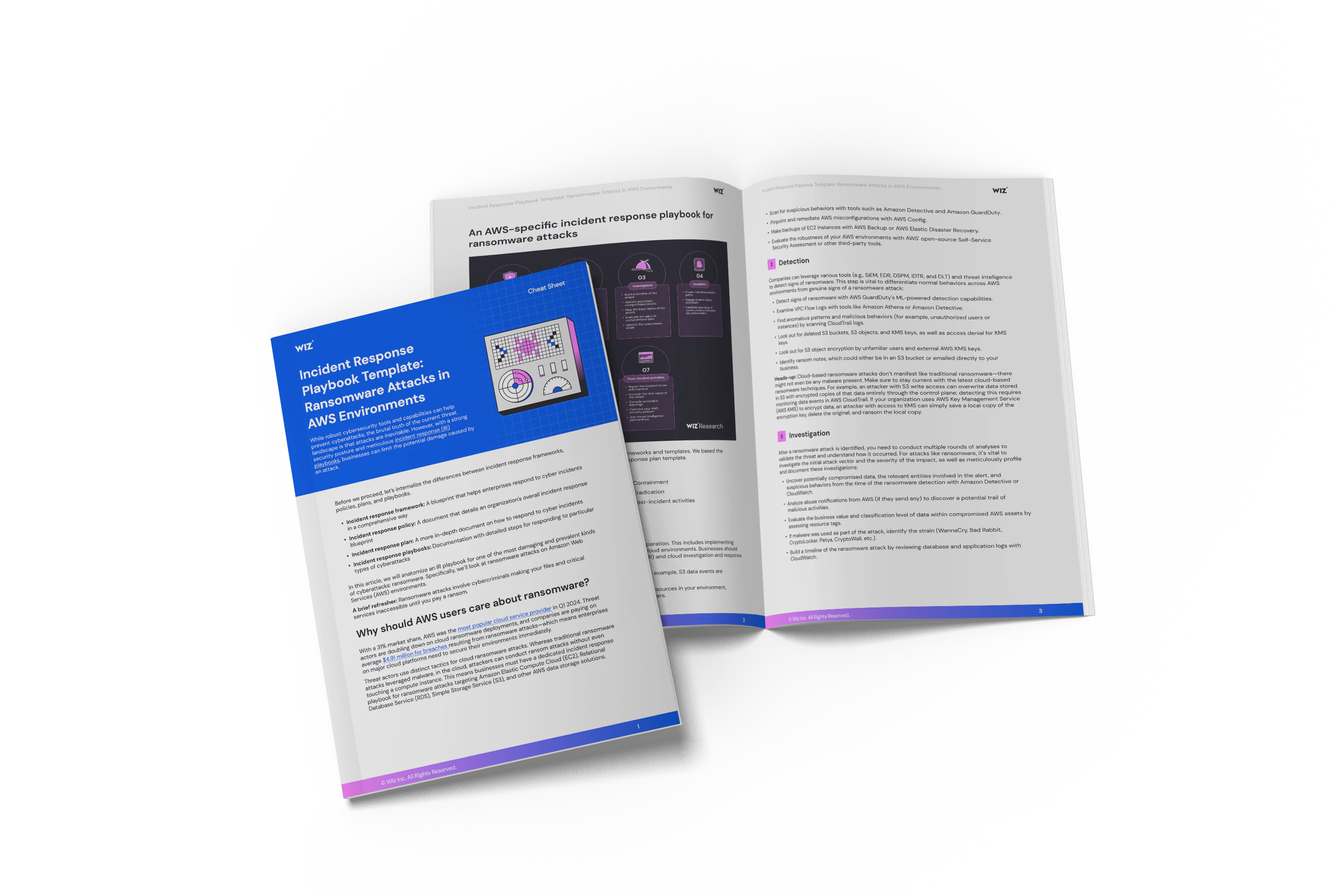
The AWS ransomware IR playbook template from Wiz gives incident responders a practical, step-by-step guide for AWS environment incidents. Using this playbook, response teams can navigate ransomware incidents with a structured approach that minimizes disruption and supports swift recovery.
Here are some key highlights:
Clear, actionable steps: This template breaks down each response stage—from detection to containment—to help responders act with clarity and precision.
AWS-focused strategies: Unlike general playbooks, this one focuses on AWS to help with key targets, including unique considerations for IAM, S3, and EC2.
Enhanced preparedness and follow-up: It also offers preparation insights to bolster defenses in advance, as well as a post-incident review framework to drive continuous improvement.
Downloading this playbook equips teams with an AWS-specific roadmap for ransomware response and empowers them to act confidently and mitigate potential risks before they escalate. It’s a valuable resource for strengthening cloud incident response and protecting AWS infrastructure.
Wiz’s IR Playbook Template: Compromised AWS Credentials

Wiz’s IR playbook template for compromised AWS credentials is a step-by-step guide to help AWS users detect, investigate, contain, eradicate, and remediate incidents that involve compromised credentials.
Download this template to access the following features:
Comprehensive guidance: The template provides step-by-step instructions for how to detect, investigate, contain, and eradicate threats that involve compromised credentials in your AWS environment.
AWS-native solutions: It focuses on leveraging AWS tools like GuardDuty, Security Hub, CloudTrail, and IAM Access Analyzer for efficient, effective response.
Actionable examples: These include instructions and examples for disabling compromised credentials, isolating resources, and mitigating long-term risks.
Proactive remediation steps: The template also shows how to identify vulnerabilities and transition from long-term credentials to more secure, temporary credentials.
Wiz’s IR Playbook Template: Privilege Escalation in EKS Clusters
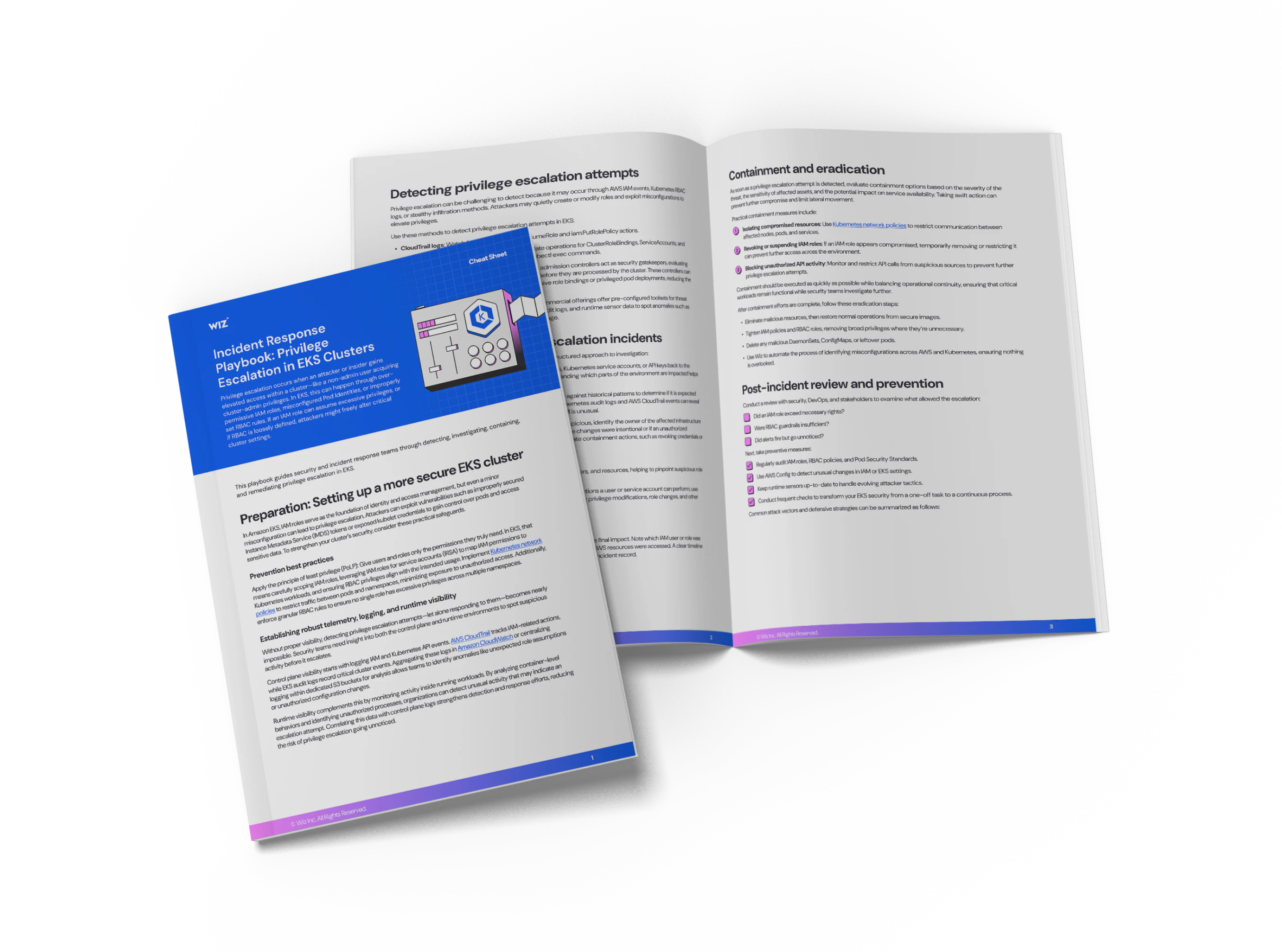
Wiz’s IR playbook template for EKS privilege escalation follows a structured approach to detecting, investigating, and mitigating privilege escalation in EKS.
Download this template for the below guidance:
Best practices for prevention: This playbook template shows how to enforce least privilege, secure IAM roles, and harden Kubernetes role-based access control policies to reduce risk.
Detailed detection methods: It teaches how to leverage AWS CloudTrail logs, Kubernetes audit logs, and runtime monitoring to identify unauthorized access attempts.
Effective containment and remediation strategies: The template also helps teams implement rapid response actions to isolate compromised resources, revoke excessive privileges, and prevent further escalation.
Proactive security recommendations: These show you how to strengthen your EKS security with continuous monitoring, automated enforcement, and policy-based guardrails.
NIST and the United States Federal Government
The National Institute of Standards and Technology (NIST) has created thorough, expert-vetted materials for cybersecurity and incident response. Its latest guidance, which supersedes the 2012 version, helps organizations integrate incident response with the updated Cybersecurity Framework (CSF) 2.0.
Guide to Malware Incident Prevention and Handling for Desktops and Laptops
Data Breach Response: A Guide for Business from the Federal Trade Commission (which is more for small businesses)
Cybersecurity Incident & Vulnerability Response Playbooks from the Cybersecurity & Infrastructure Security Agency
These government-sourced templates are a good foundation for a compliance-aligned response but often require cloud-specific tailoring.
CERT Société Générale
The Computer Emergency Response Team (CERT) of Société Générale offers a range of publicly available playbooks for the following scenarios:
Worm infections and malware
Trademark infringement
Phishing response procedures
Insider threat investigations
DDoS attacks
Major cloud providers and other sources
Most major cloud providers offer example playbooks for scenarios that are relevant to their customers. For example, AWS offers a playbook resources hub with samples, templates, and development workshops. However, be sure to approach any provider-specific resources with caution since they may not adapt well to the multi-cloud environments that most organizations are running today.
Governments outside the US may also make IR playbook templates available at no charge to the public through their cybersecurity departments.
Watch Wiz Defend's IR Playbooks in Action
See how Wiz Defend automates triage, maps blast radius, and triggers cloud-native response actions.
