



What is product security and why these tools matter now
Product Security is a discipline focused on securing software products as complete, interconnected systems, rather than treating applications, infrastructure, and runtime environments as separate concerns.
Modern software is continuously built, deployed, and updated. Cloud-native architectures rely on microservices, APIs, containers, serverless functions, and third-party services that change frequently and operate across multiple environments. In this model, risk does not originate from a single component in isolation. It emerges from how code, infrastructure, identities, and data interact once software is running in production.
Traditional application security approaches were designed to evaluate code-level issues early in development, and they remain an essential part of secure software delivery. However, as systems become more distributed and dynamic, code-focused findings alone often lack the context needed to understand real-world impact. A vulnerability that looks critical in isolation may be unreachable in practice, while a moderate issue can become high risk when combined with cloud exposure and excessive permissions.
Product Security emphasizes real-world exploitability over theoretical severity. It asks whether a weakness is exposed, whether it can be reached by an attacker, and what access it would grant if exploited. Answering those questions requires visibility across the full product lifecycle, from source code and build pipelines to cloud configuration and runtime behavior.
This is why Product Security tools matter now. They are designed to help teams understand how individual findings relate to one another and how risk accumulates across modern software systems. By providing shared context across development, cloud, and production environments, these tools support better prioritization, faster remediation, and security decisions that align with how software is actually built and operated.
Catch code risks before you deploy
Learn how Wiz Code scans IaC, containers, and pipelines to stop misconfigurations and vulnerabilities before they hit your cloud.

How product security differs from traditional application security
Application Security focuses on identifying and remediating weaknesses within application code and its immediate execution paths. This includes insecure coding patterns, vulnerable dependencies, and logic flaws that can be exploited at runtime. Over time, AppSec teams and tools have played a critical role in helping organizations shift security earlier in the development lifecycle by embedding scanning and feedback directly into developer workflows.
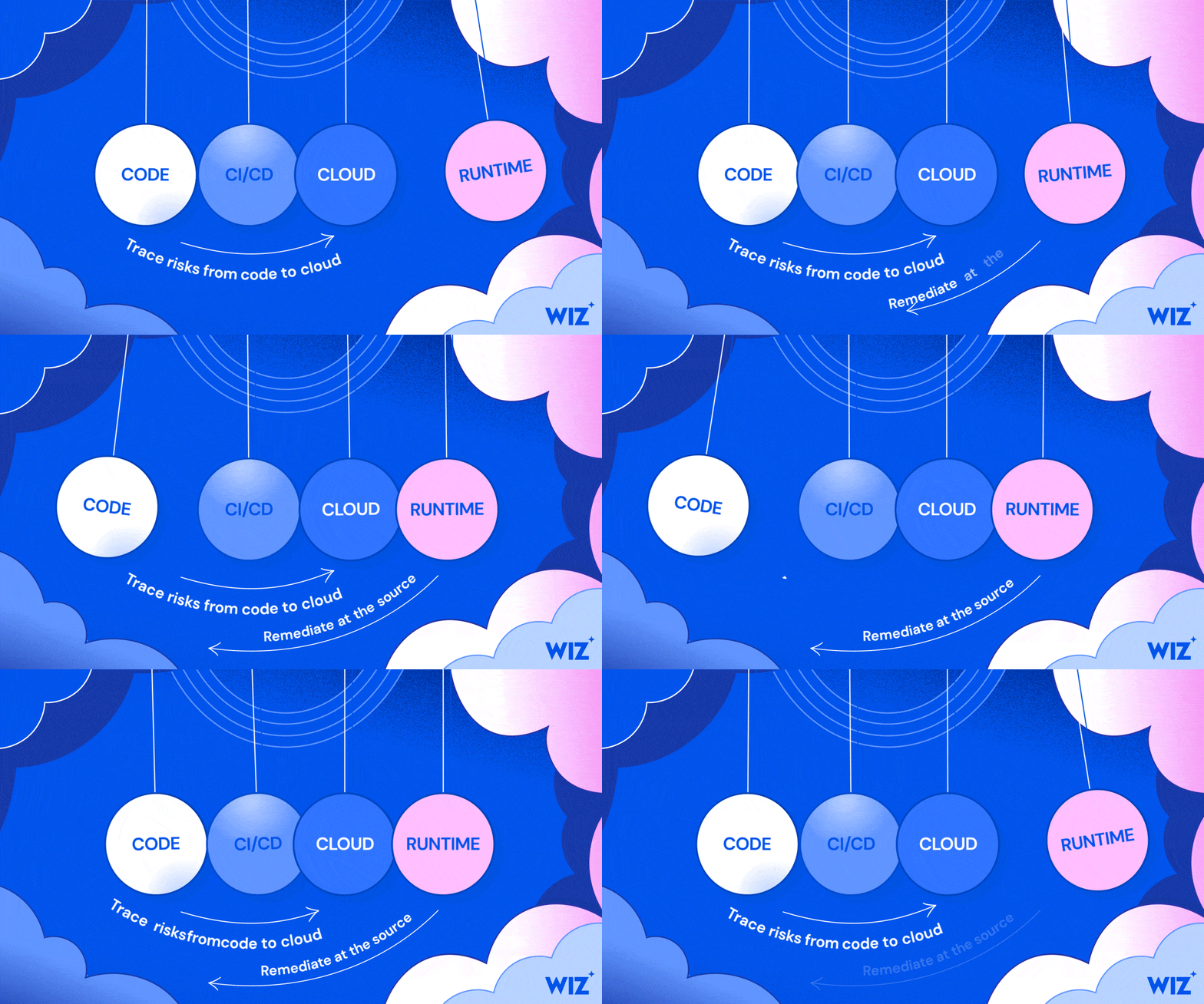
Product Security builds on that foundation by expanding the focus from individual applications to the product as a whole. Rather than evaluating services in isolation, Product Security includes individual applications as part of a broader system that also spans cloud infrastructure, identity and access controls, data stores, deployment pipelines, and production environments. The goal is not to replace application-focused security, but to understand how applications behave once they are deployed and interconnected.
In practice, Product Security does not look the same in every organization. In some environments, it leans heavily into cloud and infrastructure security. In others, it grows out of DevSecOps programs or evolves from traditional AppSec teams. As Product Security functions mature, many teams begin to specialize, with some focusing on CI/CD and supply chain risk, others on cloud posture, runtime detection and response, or adversarial testing. While the scope can vary, the mandate stays consistent: secure the product and the production environment as a whole.
Application Security teams often consider exploitability when assessing vulnerabilities, but they are typically working with tooling that is scoped to a specific codebase or application. Product Security adds the broader visibility needed to connect those findings to deployment context. By using tools that span code, cloud infrastructure, identity, and runtime environments, Product Security teams can understand how vulnerabilities interact with exposure, permissions, and service relationships, and whether they meaningfully increase risk over time.
This difference becomes especially clear in how findings are evaluated and prioritized. Application Security commonly relies on standardized severity scoring and point-in-time assessments to guide remediation. Product Security emphasizes continuous visibility and correlation across multiple risk signals to surface combinations of exposure, privilege, reachability, and dependency that create exploitable attack paths.
These approaches are complementary, not competing. Application Security remains a critical input to Product Security, particularly for early detection and developer enablement. Product Security extends that work by providing the system-level context needed to prioritize remediation based on real-world exposure and impact, helping organizations align security decisions with how modern software products are built, deployed, and operated.
Core capabilities to evaluate in product security tools
Evaluating Product Security tools starts with understanding whether they help teams see risk as it actually exists across a software product, not just as a collection of isolated findings.
One of the most important capabilities is the ability to connect development-time signals with what is running in production. Tools that provide code-to-cloud visibility allow teams to trace issues from source code and infrastructure definitions through CI/CD pipelines and into deployed cloud environments. This connection makes it easier to understand how a weakness introduced during development translates into real exposure later on.
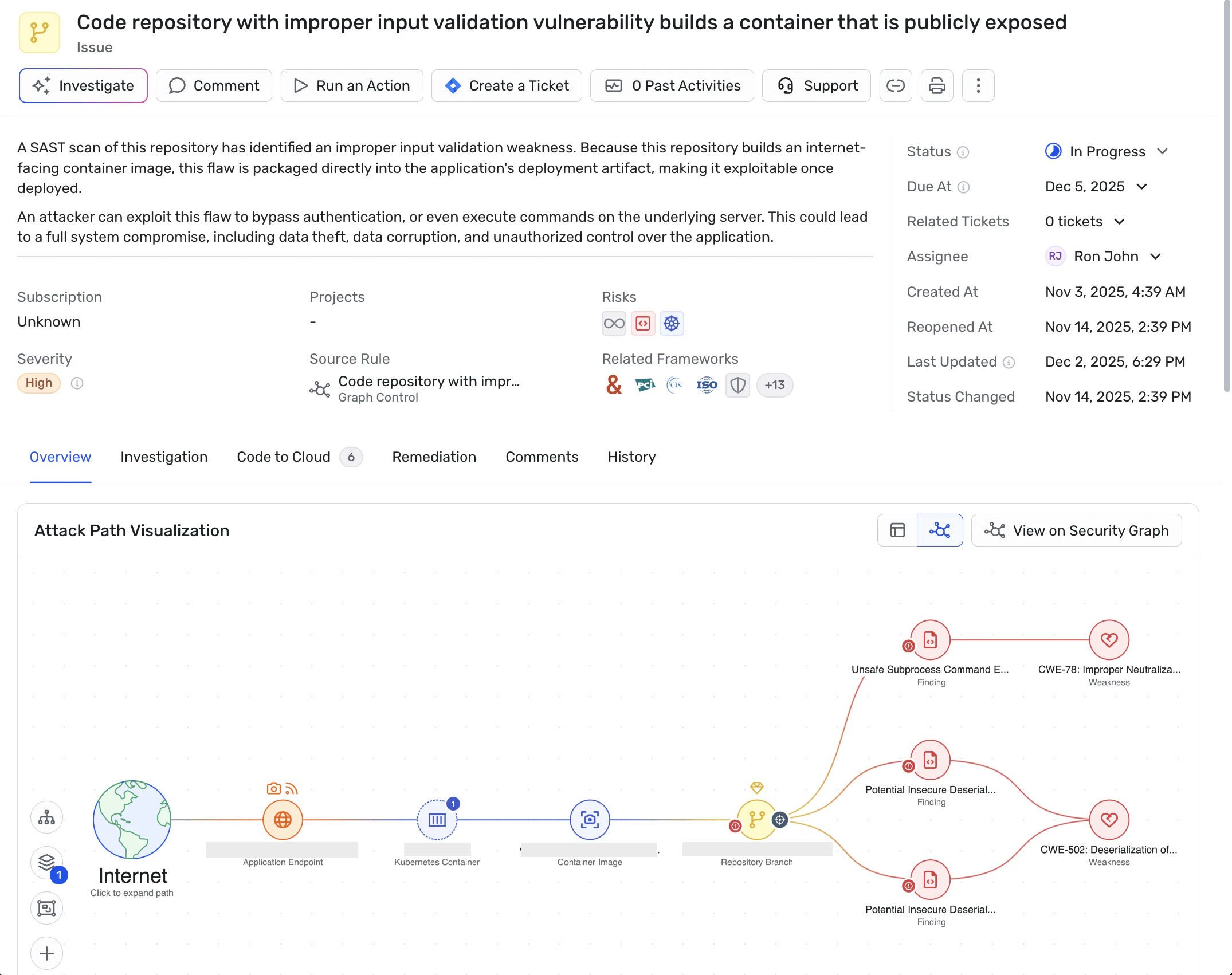
Prioritization is another area where Product Security tools differ from traditional approaches. Rather than treating all high-severity findings as equally urgent, effective tools incorporate environmental context such as exposure, reachability, and privilege. This added context helps teams focus their effort on issues that meaningfully increase risk in their specific environment.
Because Product Security spans multiple domains, clear ownership also matters. When tools can associate findings with specific services, repositories, or teams, remediation becomes a shared responsibility rather than a handoff problem. This clarity supports collaboration between security, engineering, and platform teams and reduces friction during triage and fixing.
Strong Product Security tools also support visibility across the full software lifecycle. That includes early detection during development, validation of infrastructure and configuration changes, and ongoing insight into runtime conditions. Having continuity across these stages helps teams address issues early while still accounting for how risk evolves after deployment.
Finally, these capabilities need to hold up at scale. Modern environments change quickly and often span multiple clouds and regions. Tools that integrate cleanly with existing developer workflows and security systems, and that apply consistent policies across environments, are better suited to support long-term Product Security programs.
Wiz Named a Leader in IDC’s ASPM MarketScape
See why IDC recognized Wiz as a leader in Application Security Posture Management and how we’re helping organizations reduce risk across the SDLC.

Common tool categories used in product security programs
Product Security programs typically rely on multiple categories of tools, each designed to address a different part of the overall risk picture. These categories are best thought of as complementary layers rather than alternatives, with value coming from how well they work together.
Many programs start with code and build-time security tools. These include static analysis, dependency scanning, secret detection, and infrastructure-as-code validation. Their role is to help teams identify issues early, when fixes are fastest and least disruptive. They provide essential signal, but usually without full awareness of how software will be deployed or exposed in production.
As software moves into the cloud, cloud and infrastructure security tools become critical. These tools focus on understanding how environments are configured, how workloads are deployed, and how identities and permissions are assigned. They help teams see where misconfigurations, excessive access, or exposed services could increase risk once applications are running.
Runtime detection and response tools add another layer by monitoring production environments for suspicious behavior and active threats. These tools focus on what is happening now, helping teams detect misuse, lateral movement, or attempts to exploit existing weaknesses. On their own, they may not explain why a risk exists, but they are valuable for understanding how threats unfold in real time.
Product Security programs also depend on developer enablement and workflow tooling. CI/CD platforms, issue tracking systems, and infrastructure frameworks are not security tools by themselves, but they play a critical role in operationalizing remediation. When security findings integrate directly into these systems, teams are more likely to act on them consistently.
In practice, effective Product Security programs combine these categories based on their architecture, maturity, and organizational structure. Some organizations emphasize early detection, others prioritize production visibility, and many do both. The goal is not to standardize on a single category, but to ensure that insights from each layer can be connected and understood together.
Get the Application Security Best Practices [Cheat Sheet]
This 6-page guide goes beyond basics — it’s a deep dive into advanced, practical AppSec strategies for developers, security engineers, and DevOps teams.

Top product security tools by category
Product Security tools span several categories, each addressing a different aspect of risk across the software lifecycle. The tools listed below represent common approaches within each category. Organizations often combine multiple tools depending on architecture, maturity, and team structure.
Code and dependency security tools
Code and dependency security tools help teams identify issues early in the software development lifecycle, before changes are deployed into production environments. These tools form a foundational input to Product Security programs by surfacing risks close to where they are introduced.
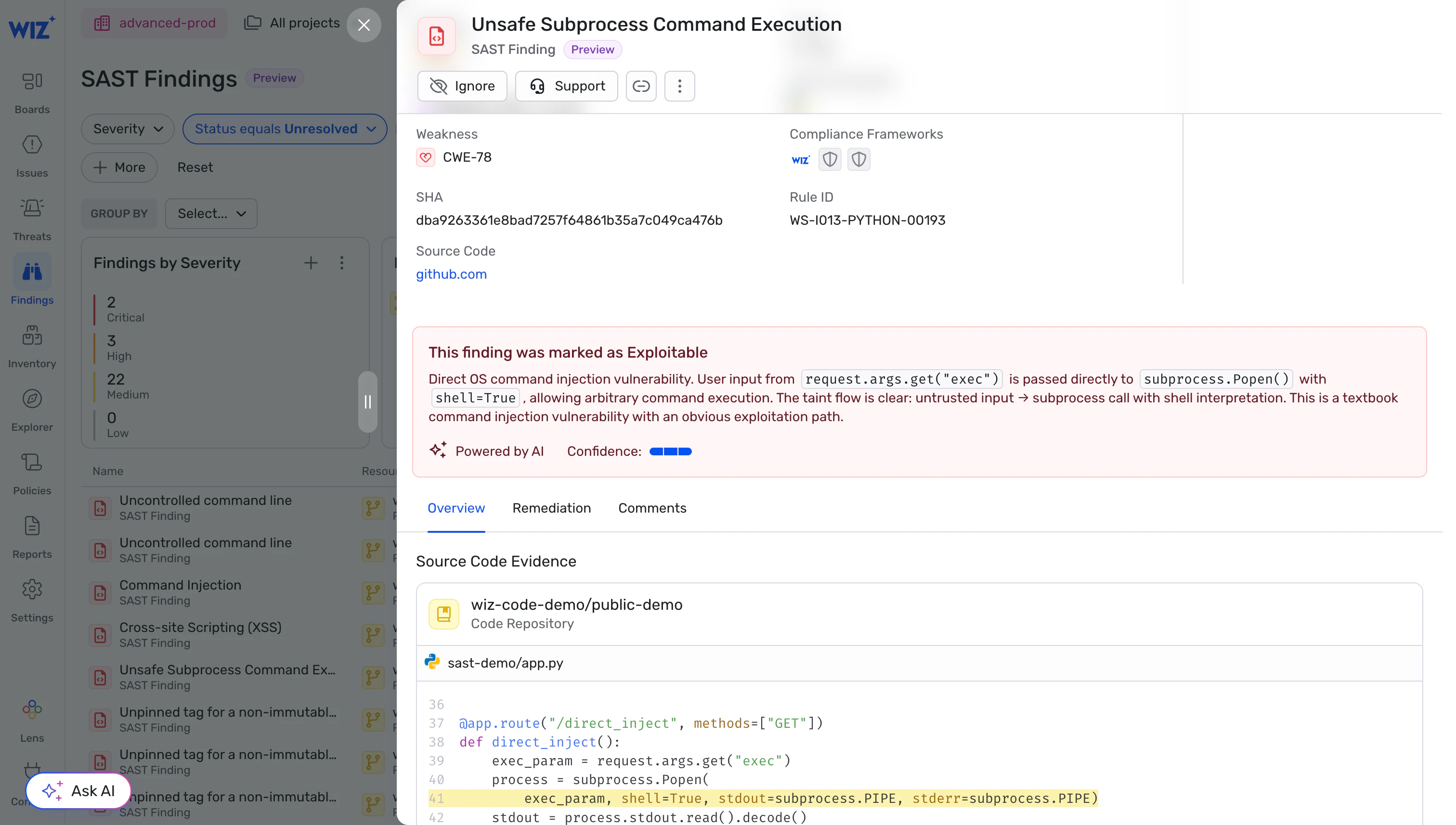
Static application security testing (SAST) tools analyze first party code to detect insecure patterns, logic flaws, and unsafe constructs. Examples include Wiz Code, Checkmarx, Veracode, Fortify, and Semgrep. While approaches differ in depth of analysis and developer experience, these tools are commonly used to surface issues during development when remediation is fastest.
Software composition analysis (SCA) tools focus on identifying vulnerable third-party dependencies and open source licensing risks. Many organizations use tools such as Wiz Code, Snyk, Mend, and Black Duck. Some solutions emphasize broad dependency coverage, while others incorporate additional context to help teams understand how dependency risks relate to deployed environments.
Secret scanning tools detect exposed credentials and sensitive information in repositories, build artifacts, and configuration files. Teams may rely on capabilities from Wiz Code, GitHub Advanced Security, GitGuardian, or TruffleHog. These tools help reduce the risk of credential misuse by catching issues before they propagate into production systems.
Taken together, these tools improve code hygiene, reduce avoidable risk, and provide critical early signals. In Product Security programs, their value increases when development-time findings can be connected to how software is actually deployed, exposed, and operated in production.
Application and API security testing tools
Application and API security testing tools focus on how software behaves when it is running, helping teams validate exploitability and identify weaknesses that may not be visible through static analysis alone.
Dynamic application security testing (DAST) tools simulate external attacks against live applications to identify exploitable vulnerabilities. Common examples include Invicti, Acunetix, Rapid7 AppSpider, and PortSwigger Burp Suite. These tools are often used to validate findings surfaced earlier in development and to identify issues introduced through configuration or deployment.
Interactive application security testing (IAST) tools observe application behavior from within during testing and staging. Platforms such as Contrast Security, Veracode IAST, and Synopsys Seeker provide visibility into execution paths and runtime behavior during testing cycles.
API security tools address the growing risk associated with API-driven architectures. Vendors like Salt Security, Noname Security, and Traceable focus on API discovery, behavioral analysis, and abuse detection.
In Product Security programs, these tools complement development-time scanning by validating how applications and APIs behave when deployed. Findings from tools like Wiz Code gain additional value when they can be correlated with runtime testing results and production exposure data.
Cloud and infrastructure security tools
Cloud and infrastructure security tools provide visibility into how software is deployed and operated across cloud environments, including configuration, identity permissions, workloads, and data exposure.
Cloud-native application protection platforms (CNAPP) bring together multiple cloud security capabilities to help teams understand exposure, reachability, and blast radius. Examples include Wiz, Palo Alto Prisma Cloud, Lacework, and Orca Security. While implementations vary, these platforms are commonly used to connect infrastructure misconfigurations, identity risks, and workload vulnerabilities.
Cloud workload protection (CWPP) tools focus more narrowly on hosts, containers, and workloads. Vendors such as Aqua Security, Sysdig, and Trend Micro Cloud One emphasize runtime workload monitoring and controls.
Identity and access security tools help organizations understand and manage permissions across cloud environments. Examples include Microsoft Entra Permissions Management and Okta Identity Governance.
For Product Security teams, cloud and infrastructure tools provide the context needed to understand whether issues identified in code, including those surfaced by Wiz Code, are actually exposed and exploitable once deployed.
Runtime detection and response tools
Runtime detection and response tools focus on identifying active threats and suspicious activity in production environments.
Cloud-native threat detection services such as AWS GuardDuty and Google Cloud Security Command Center provide provider-specific visibility into malicious behavior and anomalous activity. Platforms like Wiz Defend correlate runtime signals with broader cloud and configuration context.
Endpoint and extended detection platforms, including CrowdStrike, Microsoft Defender, and SentinelOne, focus on detecting malicious behavior across endpoints and workloads.
SIEM and SOAR platforms such as Splunk, Elastic Security, and Palo Alto Networks Cortex XSIAM aggregate signals and automate response workflows.
Runtime tools are most effective in Product Security programs when their alerts can be connected back to development-time findings and deployment context, including code and configuration risks identified earlier by tools like Wiz Code.
Developer enablement and remediation tooling
Developer enablement tools help translate Product Security findings into action by embedding remediation into existing workflows.
CI/CD platforms such as GitHub Actions, GitLab CI, and Jenkins automate build and deployment processes and serve as natural integration points for development-time security signals.
Issue tracking and workflow systems including Atlassian Jira, Linear, and ServiceNow help establish ownership and track remediation across teams.
Infrastructure-as-code frameworks such as HashiCorp Terraform, AWS CloudFormation, and Pulumi define and manage cloud environments, making security issues easier to fix through version-controlled changes.
While these tools are not security products on their own, they are essential to making Product Security actionable. When findings from tools like Wiz Code are routed directly into these systems with clear ownership and guidance, teams are more likely to remediate issues consistently and at scale.
Choosing the right product security approach for your organization
There is no single Product Security toolset that fits every organization. The right approach depends on how software is built, deployed, and operated, as well as how responsibilities are distributed across teams.
Architecture is often the first factor to consider. Organizations with a small number of services and slower release cycles may prioritize early detection and manual review, while highly distributed, cloud-native environments typically benefit from tools that provide continuous visibility across infrastructure and runtime. Multi-cloud deployments, frequent configuration changes, and heavy use of managed services all increase the need for contextual awareness.
Development velocity also plays a role. Teams practicing continuous deployment often look for tooling that integrates directly into CI/CD pipelines and developer workflows, while organizations with more structured release processes may emphasize periodic validation and centralized oversight. In both cases, the goal is to surface risk without slowing delivery.
Team structure and maturity matter just as much as technology. Some organizations have dedicated AppSec teams embedded with engineering, others centralize Product Security within platform or cloud teams. Tooling choices should reflect where expertise lives and how remediation is handled in practice.
Operational considerations are also important. Organizations may prefer broader platforms to reduce integration overhead, or they may choose specialized tools where deep functionality is required. Compliance and audit requirements can influence reporting needs, while internal capacity often determines how much manual tuning and maintenance a team can realistically support.
Ultimately, a strong Product Security approach aligns tools with organizational realities. The most effective programs combine development-time, cloud, and runtime signals in a way that matches team workflows and focuses effort on reducing real-world risk.
What is a product security engineer?
Product Security Engineer is a security professional who embeds security into software design, development, and operations throughout product lifecycle.
Mehr lesen

How Wiz enables a modern product security model with unified visibility
Product Security requires visibility across code, cloud infrastructure, identities, data, and runtime behavior, and the ability to understand how risks in each area relate to one another. Without that connection, teams are often left prioritizing individual findings without a clear view of which issues actually increase real-world risk.
Wiz is a Product Security platform that combines Application Security Posture Management (ASPM), cloud infrastructure security, identity risk, and runtime threat detection into a single, unified system. This allows Product Security teams to assess exploitability, exposure, and impact across the full software product lifecycle, from code to cloud to runtime.
At the core of this approach is the Wiz Security Graph, which maps relationships between assets, permissions, exposures, and vulnerabilities. This allows teams to move beyond isolated alerts and understand which conditions create meaningful risk in their environment. Prioritization is based on exposure, reachability, and potential impact, helping teams focus remediation on issues that matter most.
Wiz Code extends this model earlier into the software development lifecycle. It analyzes source code, infrastructure-as-code, containers, secrets, and dependencies, and applies the same contextual lens by correlating development-time findings with production realities. This helps teams fix issues early while also understanding how those issues would behave once deployed.
For runtime visibility, Wiz Defend adds detection of suspicious activity in production environments and correlates those signals with cloud context and development-time findings. This shared visibility supports faster investigation and clearer understanding of how runtime events relate back to underlying risks.
Together, Wiz, Wiz Code, and Wiz Defend support a Product Security approach that spans from code to cloud to runtime. By connecting signals across the software lifecycle, they help security, engineering, and operations teams prioritize effectively, collaborate more easily, and reduce real-world risk without slowing software delivery.
Guided Tour