

The software development lifecycle (SDLC) is the backbone of modern application delivery, and it has become one of the most targeted attack surfaces. Every stage, from source code and dependencies to CI/CD pipelines and cloud infrastructure, introduces risk. Production-only security is no longer sufficient. Attackers increasingly exploit weaknesses introduced earlier in the lifecycle, long before applications ever reach runtime.
Application Security Posture Management (ASPM) emerged in response to this shift. Its promise was to give security teams visibility across the SDLC by aggregating findings from scanners and tools. While this improved coverage and reporting, aggregation alone did not solve the core problem. Teams were still left manually correlating alerts to determine which issues were actually deployed, reachable, and exploitable in real environments.
Catch code risks before you deploy
Learn how Wiz Code scans IaC, containers, and pipelines to stop misconfigurations and vulnerabilities before they hit your cloud.

True application security posture is not defined by how many findings exist, but by whether teams can confidently answer a simple question: which application risks actually matter right now?
Wiz takes a different approach to ASPM. Instead of aggregating signals in isolation, Wiz correlates application risk across code and cloud. By directly connecting code-level issues to the services they deploy into, the cloud resources they touch, and the exposure they create, Wiz grounds AppSec decisions in real-world context. This transforms ASPM from alert management into continuous risk validation.
Securing the SDLC with Wiz means integrating security from the moment developers write code through deployment, runtime, and incident response, while continuously validating exploitability along the way. In this guide, we will walk through five steps that show how Wiz operationalizes modern ASPM across the entire SDLC.
Here's how security maps across the SDLC:
| SDLC Stage | Key Security Controls | Outcomes |
|---|---|---|
| Code | SAST, SCA, secrets scanning, IaC scanning | Identify insecure code and configuration as early as possible in the development lifecycle |
| Pipeline | Image scanning, policy gates, artifact signing, SAST, SCA, Secrets, IaC | Block risky deployments |
| Cloud | CSPM, network segmentation, CIEM | Secure runtime infrastructure |
| Runtime | CDR, workload protection, attack path analysis | Detect and respond to active threats |
Each stage builds on the previous one to create defense in depth.
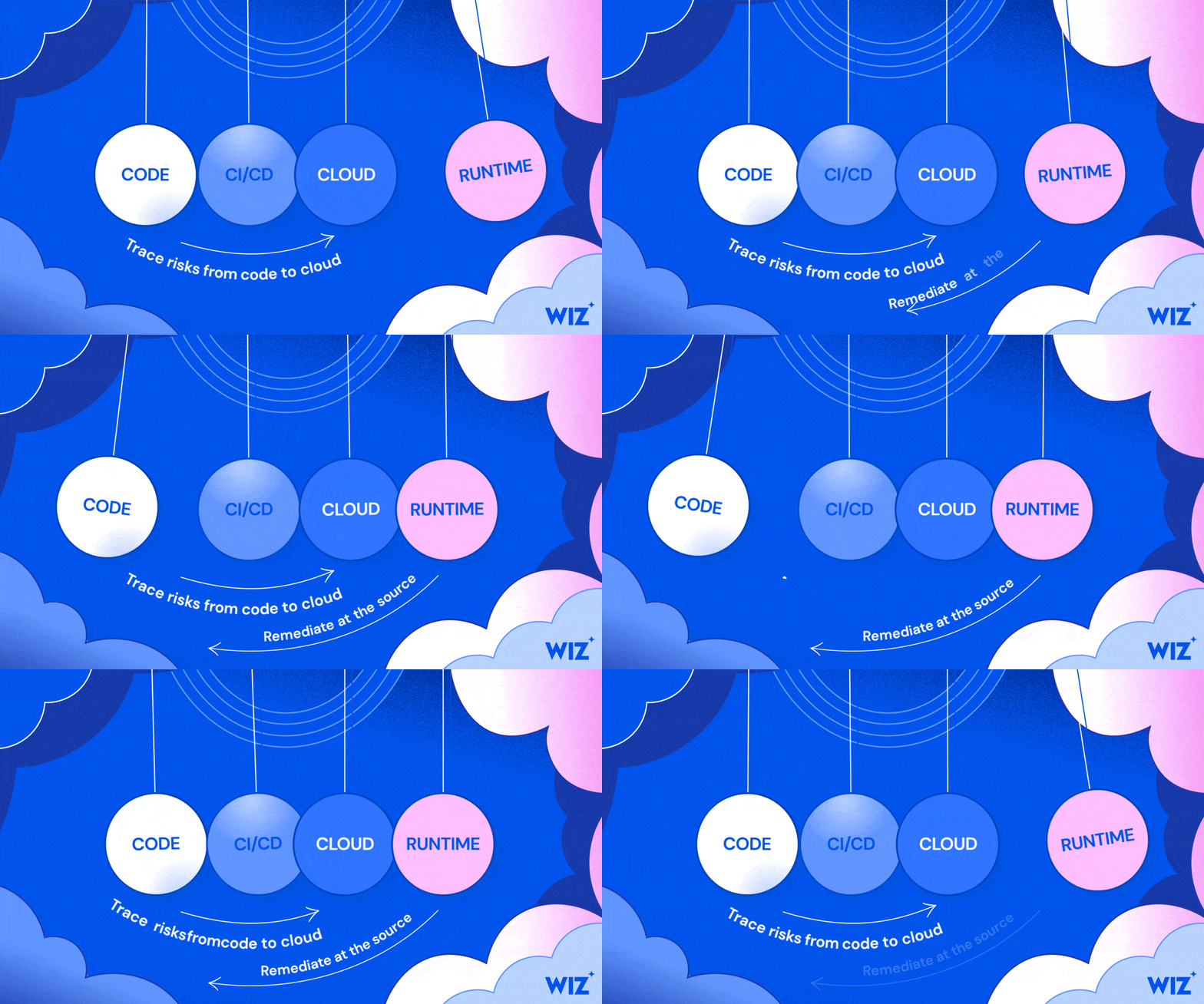
Step 1: Secure code early with cloud context in mind
Securing the SDLC starts before anything is built or deployed. Once insecure code, dependencies, or infrastructure definitions move downstream, fixing them becomes slower, more disruptive, and more expensive. That's why effective SDLC security begins in development—but not by overwhelming developers with disconnected findings.
With Wiz, securing code early is about validating application risk, not just finding issues. Instead of treating code findings as isolated defects, Wiz evaluates them in the context of the cloud environments they will run in, the exposure they create, and the assets they can impact.
Identify real application risk in proprietary code
While Static application security testing (SAST) is essential for identifying common coding flaws like injection vulnerabilities before deployment, traditional tools often produce long lists of disconnected findings that are difficult for developers to prioritize. To solve this, Wiz Code approaches SAST differently by evaluating code issues alongside cloud context rather than as standalone signals.
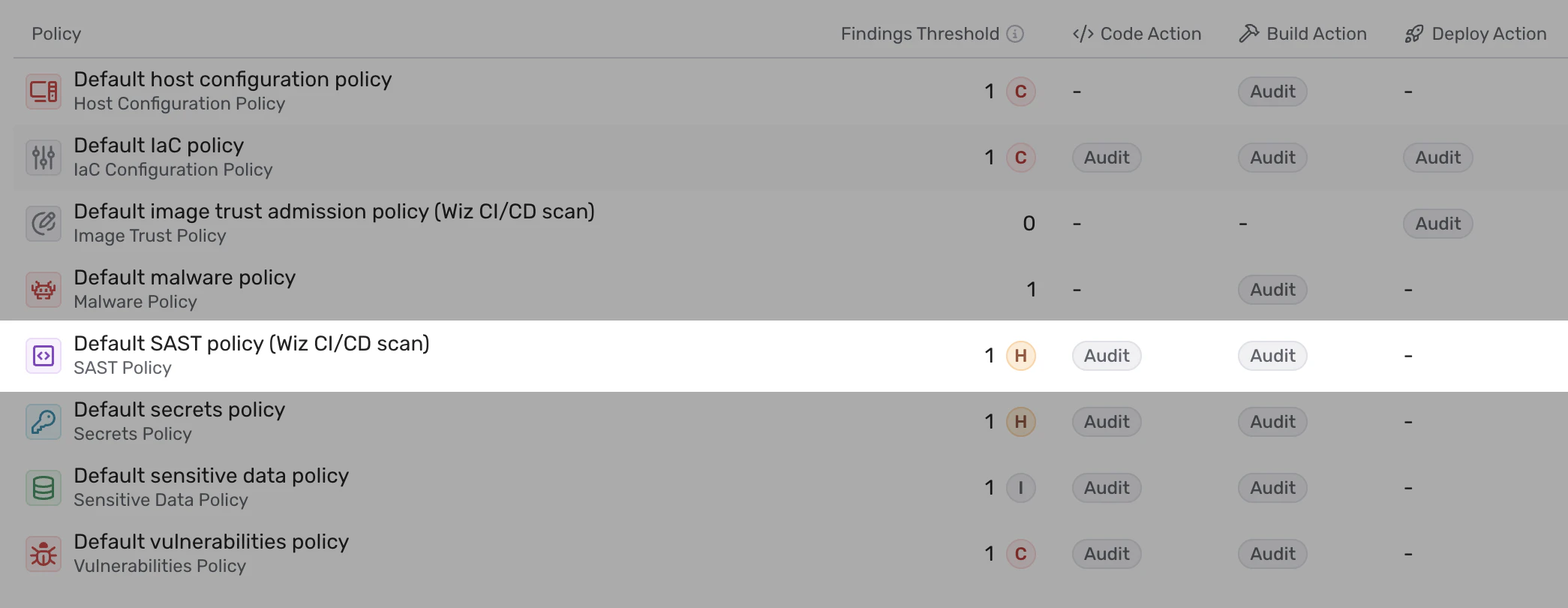
Wiz Code approaches SAST differently. Rather than treating code issues as standalone signals, it evaluates them alongside cloud context. Vulnerabilities become more meaningful when they're tied to real exposure, ownership, and downstream impact. A flaw in a service that never touches production carries a very different risk profile than one deployed behind a public endpoint with access to sensitive data.
By prioritizing findings based on how code is actually used in the cloud, Wiz helps teams focus remediation efforts where they reduce real risk, not just theoretical weaknesses.
Reduce dependency risk by focusing on what is truly exposed
Most modern applications are assembled from open-source libraries and third-party packages. Software composition analysis (SCA) is essential for identifying known vulnerabilities and license risks within these dependencies, but raw vulnerability counts alone rarely tell teams what to fix first.
With Wiz Code, dependency findings are evaluated in the context of runtime exposure. Vulnerabilities that are unreachable or unused are deprioritized, while those tied to internet-facing workloads or sensitive data paths rise to the top. This allows teams to move beyond "patch everything" approaches and instead address the dependencies that actually expand the attack surface.
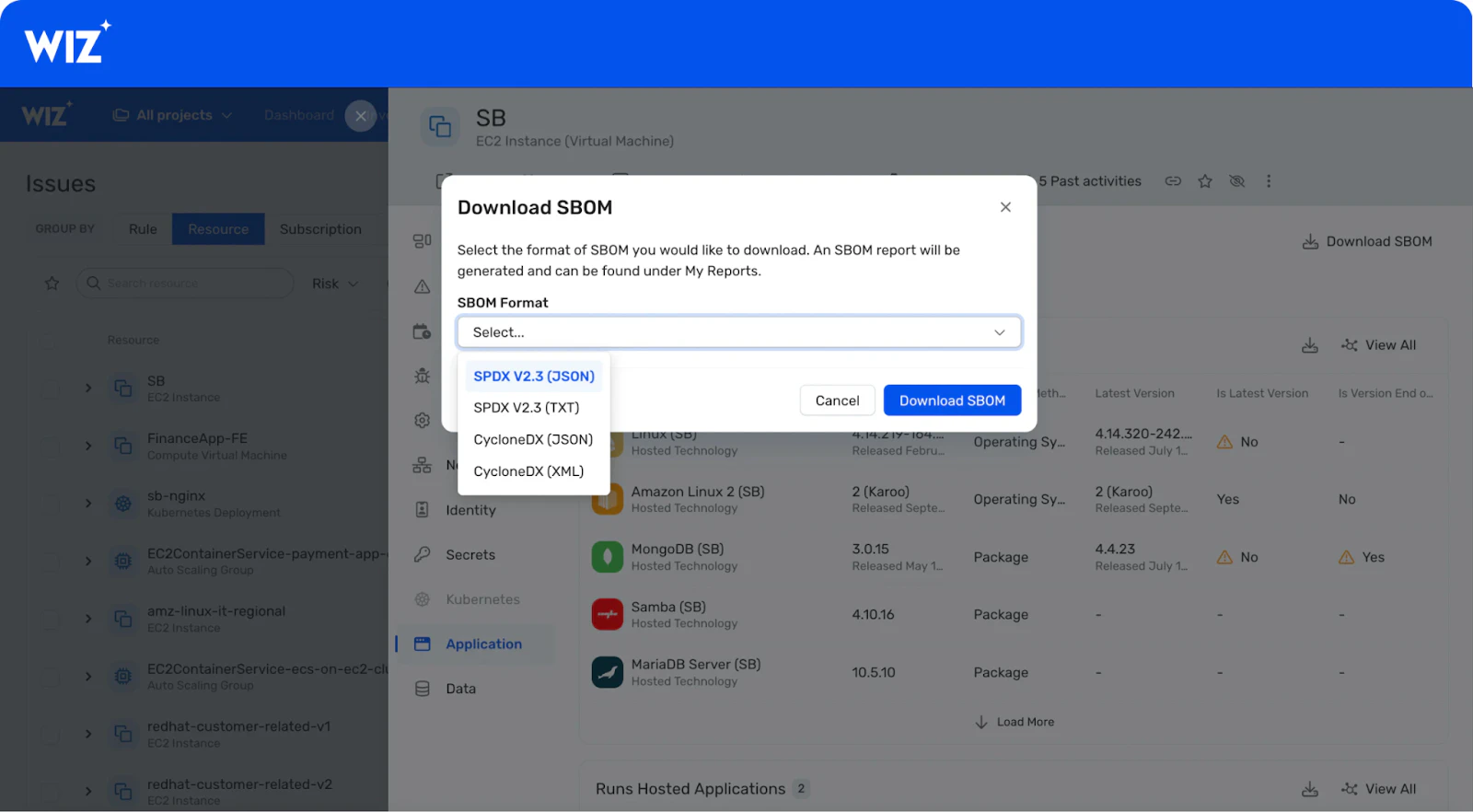
This same visibility also supports software bill of materials (SBOM) initiatives, helping organizations understand not just what components they use, but which ones introduce meaningful risk. This isn't just a nice-to-have—many organizations and regulators are moving toward SBOM requirements, especially in critical infrastructure, by 2025 (see this overview).
Prevent secrets from becoming production incidents
Hardcoded credentials, API keys, and tokens remain one of the fastest ways for attackers to gain access to cloud environments. Just how severe? 39 million secrets were leaked across GitHub in 2024. While secrets scanning can detect exposed credentials in repositories, the real challenge is understanding when a leaked secret creates a viable attack path.
Wiz Code correlates secrets found in code with the permissions, workloads, and resources they can access in the cloud. This makes it clear which exposures represent immediate risk and which are contained or inactive. Instead of treating every leaked secret as equally urgent, teams can focus on those that enable real compromise scenarios.
This context-driven approach helps security teams respond faster while giving developers clearer guidance on why a specific secret matters—and Wiz Code provides automated remediation guidance to help you fix exposures quickly.
Catch infrastructure risk before it reaches the cloud
Infrastructure as code (IaC) defines cloud resources long before they exist. Misconfigurations introduced at this stage often propagate directly into production environments, where they become harder to detect and fix.
Wiz Code analyzes IaC templates,including Terraform, CloudFormation, and Kubernetes manifests,with awareness of how those configurations would behave once deployed. Rather than flagging policy violations in isolation, Wiz highlights misconfigurations that would meaningfully increase exposure, permissions, or attack paths in the cloud.
This allows teams to address risky patterns early, while the fix is still a code change, not a live incident. Wiz Code provides IaC scanning with policy enforcement that works consistently across your environments.
Treat supply chain risk as part of development, not just CI/CD
Software supply chain attacks frequently begin in development, long before artifacts reach production. Insecure dependencies, unsigned artifacts, and overly permissive credentials all contribute to downstream compromise. Modern supply chain attacks target the build and distribution process itself, making it essential to implement SLSA (Supply chain Levels for Software Artifacts) framework practices to verify artifact integrity.
Wiz provides visibility into supply chain risk across repositories, pipelines, and registries, allowing teams to reason about trust, provenance, and access holistically. Instead of managing these concerns as separate tooling domains, Wiz helps teams understand how weaknesses in development can later be exploited in runtime environments. Wiz surfaces supply chain risks across your VCS, CI/CD, and artifact registries to help you close gaps before attackers exploit them.
By addressing supply chain risk early and in context, organizations reduce the likelihood that compromised code ever reaches deployment.
Step 2: Secure your CI/CD pipelines
In a modern ASPM model, CI/CD pipelines are not just delivery mechanisms. They are part of the application attack surface. Risks introduced here must be evaluated in the same way as code and cloud issues, based on whether they enable real compromise rather than whether a control is technically misconfigured.
Once code leaves the developer's workstation, it enters your CI/CD pipelines,critical infrastructure that must be secured just like your production environment. Because compromised pipelines can be used to inject malicious code into production software, they are high-value targets for attackers. You need to implement security checks at both the build and deployment stages to prevent vulnerabilities and detect potential supply chain attacks.
Secure your build environments and runners
Since build environments often execute untrusted code, they require strict isolation to prevent persistent threats from taking root. Harden your build servers by using ephemeral runners and implementing the principle of least privilege for all build processes. Wiz automates this hardening process by surfacing CI/CD and VCS misconfigurations—such as exposed runners or missing branch protections—while providing the ownership context needed to route fixes directly to the right team.
Example: OIDC federation for CI/CD
# GitHub Actions workflow using OIDC permissions: id-token: write contents: read steps: - name: Configure AWS credentials uses: aws-actions/configure-aws-credentials@v4 with: role-to-assume: arn:aws:iam::123456789012:role/GitHubActionsRole aws-region: us-east-1Implement container image security scanning
Because container images package application code with all its dependencies, they must be scanned for vulnerabilities and malware before they are ever deployed. Wiz enhances this process by scanning images with runtime context, allowing you to prioritize fixes based on actual reachability rather than a long, unprioritized list of theoretical vulnerabilities. Establish policies to automatically block risky images and enforce image trust with signed artifacts at admission.
Example: Cosign image signing
# Sign container image cosign sign --key cosign.key myregistry.io/myapp:v1.0 # Verify signature at admission cosign verify --key cosign.pub myregistry.io/myapp:v1.0Deploy hardened container images with WizOS
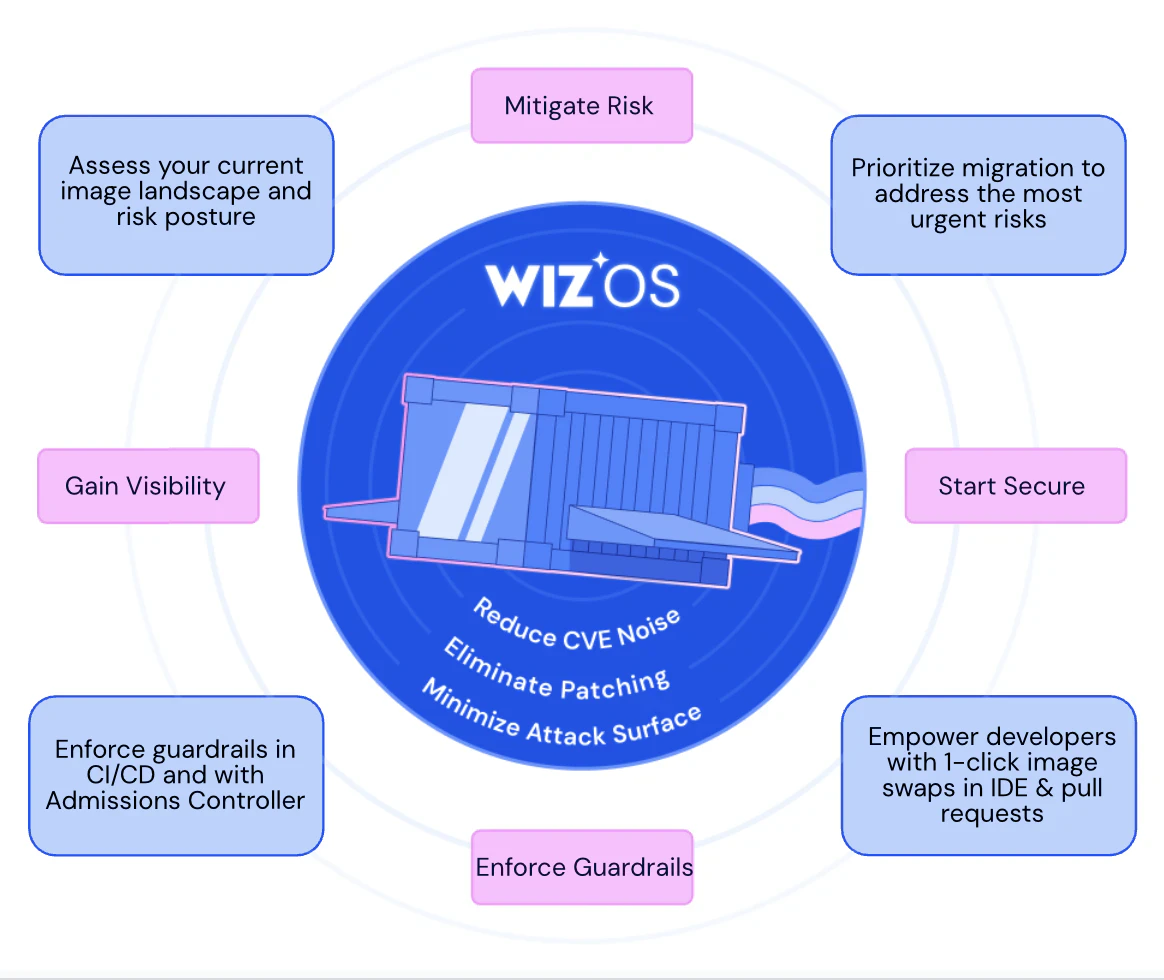
Base images often contain unnecessary packages and vulnerabilities that increase your attack surface and overwhelm developers with alert noise. To solve this, WizOS provides a hardened, minimal container image maintained by Wiz at near-zero CVEs. By adopting WizOS, you reduce the burden of constant remediation while benefiting from a trusted foundation that is natively recognized by the Wiz platform to suppress inherited vulnerability alerts.
Enforce security policies in deployment pipelines
To prevent risky deployments from reaching production, you must implement automated policy enforcement via admission controllers that act as final checkpoints. Wiz provides the unified policy engine that connects these checkpoints from code to cloud, ensuring that security standards remain consistent across the entire software lifecycle. These gates block deployments that violate policies while providing clear remediation guidance directly to developers.
Example: Kyverno policy for signed images
apiVersion: kyverno.io/v1 kind: ClusterPolicy metadata: name: verify-image-signatures spec: validationFailureAction: enforce rules: - name: verify-signature match: resources: kinds: - Pod verifyImages: - imageReferences: - "*" attestors: - entries: - keys: publicKeys: |- -----BEGIN PUBLIC KEY----- [your public key] -----END PUBLIC KEY-----Step 3: Secure cloud infrastructure and deployments
After code passes through your pipelines, it deploys to cloud infrastructure where it runs and serves users. Securing this environment requires continuous monitoring because cloud resources are dynamic and ephemeral, spinning up and down constantly. You need to detect misconfigurations, excessive permissions, and network exposures in real time to protect the runtime environment.
With Wiz, cloud security is not treated as a standalone posture exercise. Instead, infrastructure risk is continuously evaluated in the context of what’s running, what it can reach, and what it can impact. This ensures teams focus on conditions that attackers can actually exploit, not just isolated misconfigurations.
Identify cloud misconfigurations that create real exposure
Cloud security posture management (CSPM) is essential for detecting misconfigurations such as public storage, overly permissive security groups, and weak encryption settings. But misconfigurations alone don’t determine risk. What matters is whether those issues actually expand your attack surface and create reachable paths into your environment.
This is where attack surface management (ASM) becomes critical. Wiz continuously maps external and internal exposure across cloud resources, identities, and services, showing which misconfigurations are reachable, exploitable, and connected to real workloads. A misconfigured resource that is unreachable or isolated presents a very different risk profile than one exposed to the internet or reachable through lateral movement.
Wiz Cloud evaluates CSPM findings in combination with attack surface visibility, identity permissions, and data sensitivity. Rather than surfacing a flat list of posture violations, Wiz highlights toxic combinations, cases where misconfigurations actively increase exposure and enable attack paths toward sensitive assets or privileged roles.
This unified view allows teams to focus remediation on the configuration issues that materially expand the attack surface, instead of spending time on violations that are technically noncompliant but operationally low risk.
Wiz Named a Leader in IDC’s ASPM MarketScape
See why IDC recognized Wiz as a leader in Application Security Posture Management and how we’re helping organizations reduce risk across the SDLC.

Understand and limit lateral movement across the cloud
Most cloud breaches do not stop at initial access. Once attackers gain a foothold, they attempt to move laterally across workloads, services, and identities to reach higher value targets.
Network segmentation and access controls are designed to limit this movement, but it is often difficult to reason about how effective those controls actually are. Wiz models network exposure and access relationships as part of its Security Graph, making lateral movement paths visible across the environment.
This allows teams to see which workloads are reachable, how trust relationships connect services, and where segmentation breaks down. Instead of relying on assumed boundaries, teams can identify the specific paths that allow unintended access and address them before they are exploited.
Detect active threats at runtime with cloud context
Since threats can emerge after deployment, runtime protection is necessary to monitor workloads for anomalous behavior, such as suspicious process execution or container escapes. This protection must be lightweight to ensure it doesn't impact application performance. Wiz Defend provides this visibility using a lightweight, eBPF-based sensor that identifies active threats in real time and correlates them with the underlying cloud context.
Prioritize protection around sensitive data
The presence of sensitive data fundamentally changes the impact of a cloud security issue. A misconfiguration affecting a system with no sensitive data has very different consequences than the same issue affecting a workload that processes customer records or credentials.
Wiz DSPM continuously discovers and classifies data across cloud environments and connects those findings to the Security Graph. This allows teams to see which workloads, identities, and access paths intersect with sensitive data and to prioritize remediation accordingly.
Instead of treating all storage and data assets as equal, teams can focus protection efforts on the data that would cause the most harm if exposed.
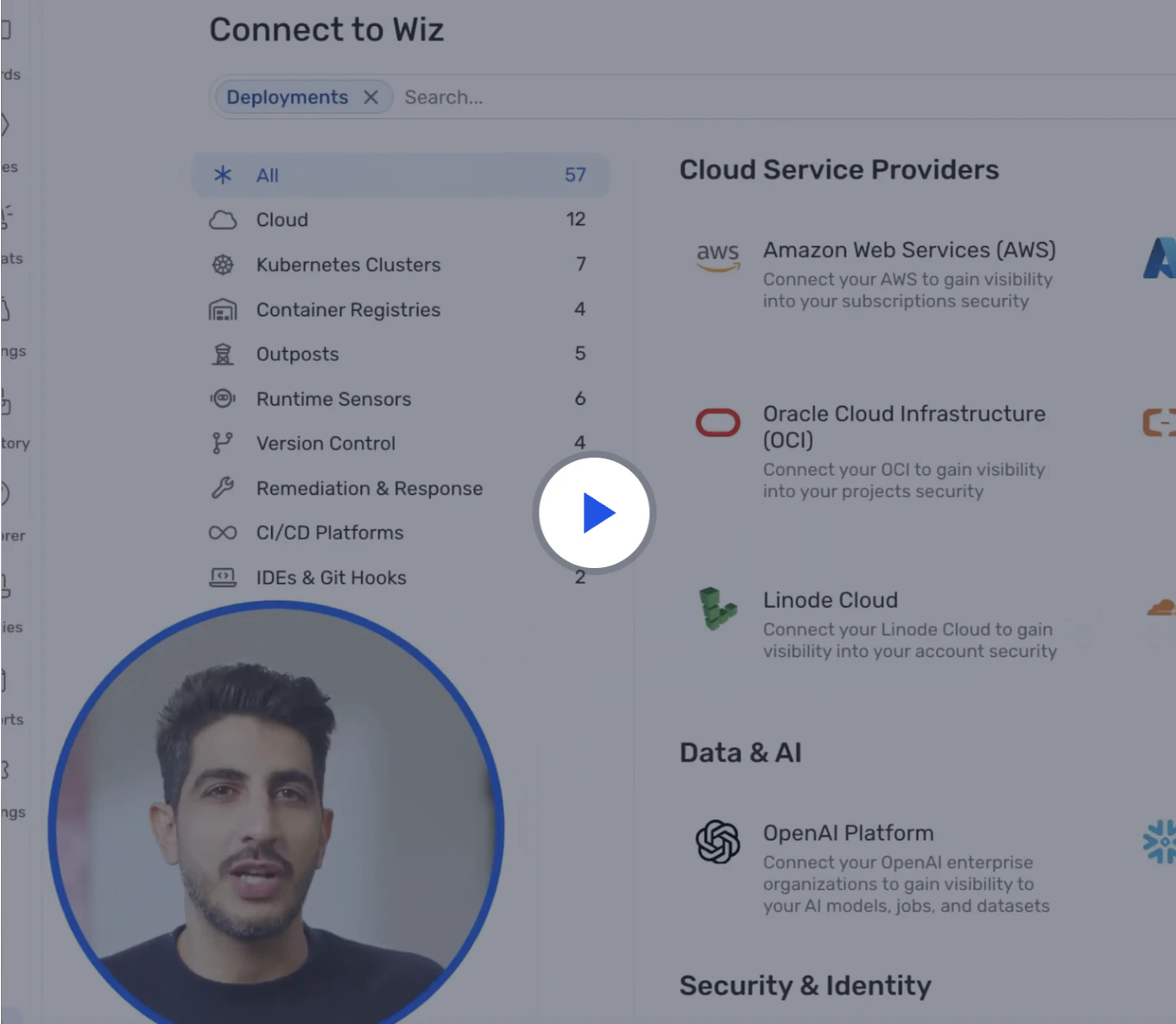
Watch 5-min demo
Learn about the full power of the Wiz cloud security platform. Built to protect your cloud environment from code to runtime. Watch now
Watch now
Step 4: Establish monitoring and incident response
Even with strong preventive controls, threats can still emerge in production environments. That's why continuous monitoring is essential for rapid threat detection and response. By correlating signals across code, cloud, and runtime environments, you gain a full-stack view of your security posture.
With Wiz, monitoring and incident response are built on correlated context across code, cloud, identity, and runtime. This allows teams to investigate threats as complete scenarios rather than isolated alerts, reducing time to response and limiting blast radius.
Detect suspicious activity with cloud detection and response
Cloud environments generate massive volumes of logs and events. API calls, identity activity, and runtime signals all provide valuable telemetry, but on their own they are difficult to interpret and easy to overwhelm teams with noise.
Wiz Defend delivers cloud detection and response by correlating cloud logs and runtime activity with posture, exposure, and identity context. Alerts are evaluated based on where they originate, what they can access, and how they connect to the broader environment. This produces higher fidelity detections that reflect real risk, not just unusual behavior.
Because Wiz maintains code to cloud traceability, teams can quickly understand how a runtime incident relates back to earlier stages of the SDLC. This makes root cause analysis faster and more reliable, especially when incidents originate from issues introduced earlier in development or deployment.
Prioritize response using attack path analysis
Because not all vulnerabilities pose equal risk, security teams must move beyond isolated defects to analyze how flaws combine into exploitable attack paths. The Wiz Security Graph automates this complex correlation by linking misconfigurations, identity risks, and vulnerabilities into a single visual model, allowing you to fix the specific combinations that lead to critical assets first.
Maintain continuous compliance as part of monitoring
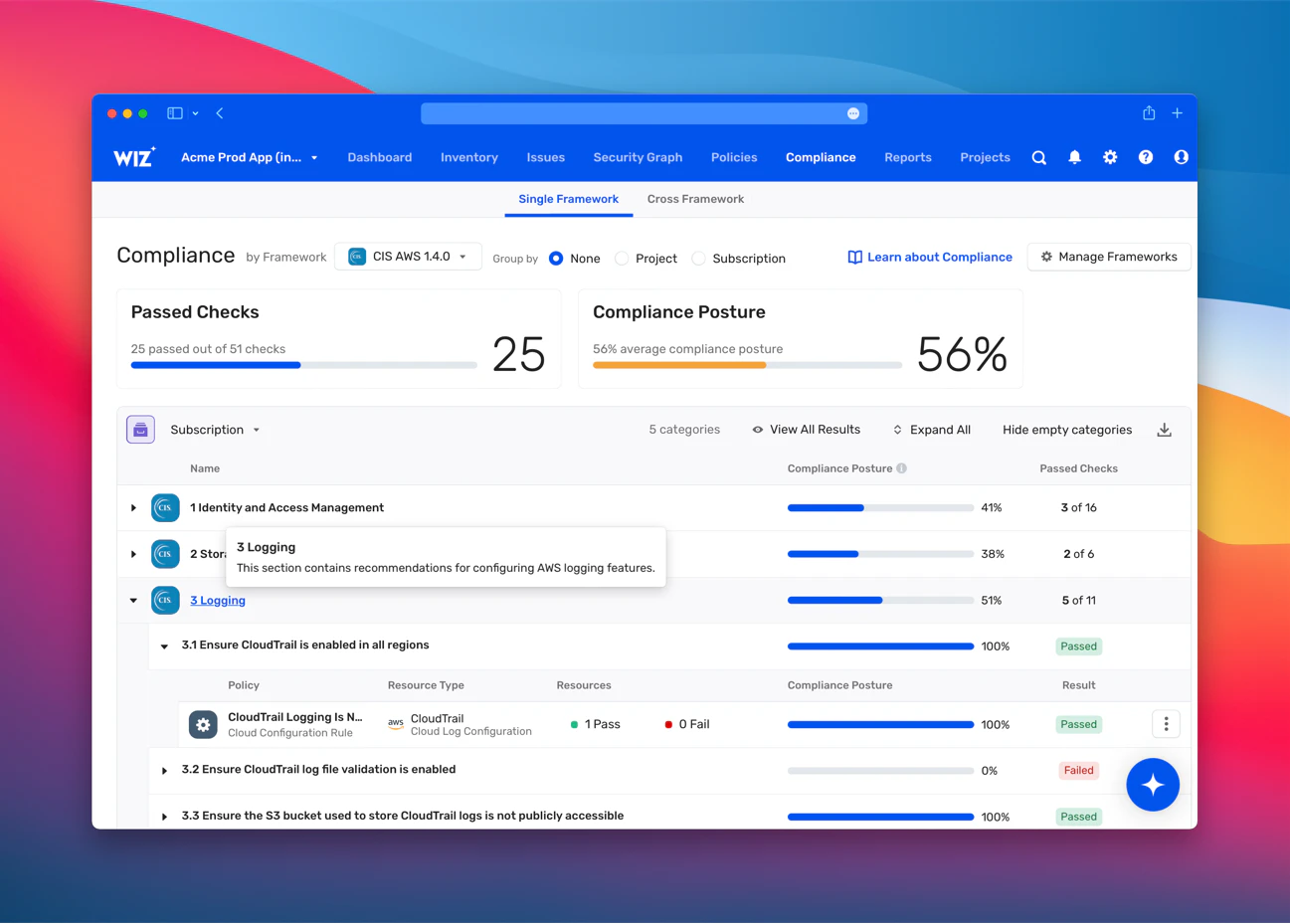
Compliance requirements do not stop once an application is deployed. Controls tied to secure development, access management, logging, and monitoring must be continuously enforced to remain effective.
Wiz provides continuous compliance visibility across cloud environments by mapping security signals to relevant control objectives. This allows teams to detect drift from frameworks such as NIST SSDF, ISO 27001, SOC 2, and PCI DSS as it occurs, rather than discovering gaps during audits.
By embedding compliance monitoring into daily security operations, organizations can reduce audit friction and treat governance as an ongoing process rather than a periodic scramble.
Respond to incidents with speed and context
Cloud incidents can escalate quickly due to the scale and automation of modern environments. Effective response requires the ability to understand scope, contain threats, and coordinate remediation without losing time to manual investigation.
Wiz integrates detection and context with incident response workflows, enabling teams to act based on complete situational awareness. By understanding which workloads, identities, and data are affected, teams can prioritize containment actions that stop attacker movement and reduce exposure.
This context driven approach ensures that response actions are proportional, targeted, and aligned with actual risk rather than reactive or overly broad.
| Framework | Relevant Controls | SDLC Coverage |
|---|---|---|
| NIST SSDF | PW.1 (secure design), PS.1 (protect code), PW.4 (secure build) | Code scanning, IaC validation, pipeline hardening |
| ISO 27001 Annex A | A.14.2 (secure development), A.12.6 (vulnerability management) | SAST, SCA, continuous monitoring |
| SOC 2 | CC6.6 (logical access), CC8.1 (change management) | RBAC, policy gates, audit logging |
| PCI DSS 4.0 | 6.2 (secure SDLC), 10.2 (audit trails) | Code review, secrets scanning, CDR |
| CIS Benchmarks | CIS Controls 16 (application security), 8 (audit logs) | Image scanning, runtime protection |
Map your security controls to these frameworks to demonstrate continuous compliance.
Step 5: Manage access control and identity
In cloud environments, identity defines access. Human users, service accounts, and automated processes all interact with code, pipelines, infrastructure, and data. When identities are overprivileged or poorly governed, attackers do not need to exploit software vulnerabilities to cause damage. Stolen or misused credentials alone are often enough to move laterally and access critical resources.
With Wiz, identity security is treated as a foundational signal across the SDLC. Permissions are continuously evaluated in context, allowing teams to understand how identities contribute to real attack paths and where access needs to be reduced before it can be abused.
Enforce least privilege through role based access control
Role based access control limits permissions by aligning access with job function rather than individual users. This reduces the risk of privilege accumulation and makes access decisions easier to reason about as teams grow and change.
Wiz supports granular RBAC for security operations by allowing organizations to scope visibility and responsibilities across environments, teams, and business units. More importantly, identity permissions are evaluated in context. Excessive access becomes a risk only when it intersects with exposed workloads, sensitive data, or critical infrastructure.
By understanding which roles actually create meaningful blast radius, teams can focus access reviews on the permissions that matter most instead of treating all privilege equally.

Reduce risk from non human identities and automation
Service accounts and automated workflows often accumulate permissions over time. These identities frequently operate without direct oversight and are rarely reviewed, which makes them attractive targets for attackers.
Wiz continuously inventories non-human identities across cloud environments and correlates their permissions with the resources they can reach. This makes it possible to identify service accounts that are overprivileged, unused, or positioned on attack paths to sensitive assets.
By prioritizing access reduction for identities that meaningfully expand exposure, teams can secure CI/CD pipelines and automation without disrupting legitimate workflows.
Secure your SDLC from code to cloud with Wiz Code
Securing a modern SDLC requires more than broad visibility across tools. It requires a clear, continuously validated understanding of which application risks actually matter across how software is built, deployed, and exposed. When security signals are scattered across disconnected scanners and platforms, teams are forced into reactive workflows, manual correlation, and constant context switching. Risk persists not because issues go undetected, but because confidence remains elusive.
This is the gap Application Security Posture Management was meant to address. But posture cannot be established through aggregation alone. True posture requires grounding application risk in real-world context.
Take a tour to see how Wiz secures your SDLC from code to cloud.
See Wiz Code in Action
Wiz Code delivers this foundation by connecting code security directly to cloud reality. Instead of treating findings from SAST, SCA, infrastructure as code scanning, and secrets detection as isolated defects, Wiz Code evaluates them as risk hypotheses and validates them against how applications actually run. This shifts teams from chasing theoretical issues to fixing vulnerabilities that meaningfully increase exposure.
Because Wiz Code is part of the broader Wiz platform, code findings are never evaluated in isolation. They are continuously correlated with cloud configuration, attack surface exposure, identity permissions, runtime behavior, and data sensitivity. This code-to-cloud traceability transforms ASPM from alert management into a continuous, measurable view of application risk.
The result is an SDLC where developers receive fewer, higher-confidence issues with clear ownership and guidance, security teams prioritize based on exploitability rather than volume, and organizations reduce risk without slowing delivery. Wiz Code is not just how teams secure code earlier. It is how modern ASPM begins.
As one security engineer put it:
Wiz Code has helped us shift left our security responsibilities. Teams are now catching and fixing issues before they get deployed and coming to us earlier for help designing their solutions. Having source repositories directly in Wiz also has helped us ensure projects are scoped to their actual owners, as a lot of accounts are shared. Having that direct sourcing to the repos speeds up triage for us as well.
Rory Carson, Security Engineer at Contentful
By integrating naturally into existing developer workflows, Wiz Code provides timely feedback without slowing delivery. Developers gain clarity on what needs to be fixed and security teams gain confidence that effort is focused on real risk.
How Wiz consolidates SDLC security
Wiz eliminates the need for tool sprawl by providing agentless coverage across your entire stack through a unified Security Graph. By consolidating CSPM, CIEM, DSPM, vulnerability management, and runtime detection into one platform, Wiz enables you to prioritize exploitable risk by correlating findings across every stage of the lifecycle. This horizontal approach not only removes the friction of context switching but also allows you to assign issues to the right owner with full code-to-cloud traceability.
By focusing remediation on what actually matters, your organization can reduce its overall attack surface while maintaining the velocity required for modern application delivery. Ready to see code-to-cloud security in action? Get a demo to see how Wiz helps teams secure every SDLC stage—from the first commit to runtime—with shared context, unified policy, and risk-based remediation.
Secure the SDLC with Wiz
See Wiz in action and learn how to build a faster, more secure SDLC with a personalized walkthrough of the platform.
