



What is open source security?
Open-source security is the practice of identifying, assessing, and mitigating vulnerabilities in software built with publicly available source code. It spans the entire software lifecycle, from selecting and integrating open-source components through production monitoring and patching.
Open-source software powers everything from operating systems like Linux to databases like PostgreSQL. With the rise of cloud services and AI technologies that rely heavily on OSS, adoption continues to accelerate. The collaborative nature of open source means more eyes spotting and fixing security issues, and organizations save on licensing fees while gaining the flexibility to customize software for their needs.
That accessibility comes with tradeoffs. The same openness that fuels innovation can also introduce security risks when contributions are not properly reviewed or when widely used projects lack active maintenance. Without deliberate security practices, organizations expose themselves to vulnerabilities that malicious actors actively seek to exploit.
Catch code risks before you deploy
Learn how Wiz Code scans IaC, containers, and pipelines to stop misconfigurations and vulnerabilities before they hit your cloud.

Why open source security matters
According to a report by Canonical, 83% of organizations recognize the value of adopting open source, but they report significant gaps in security and governance. With OSS embedded in nearly every modern application stack, the security of these components directly affects an organization's overall risk posture. Wiz Research shows that 7% of documented cloud intrusions in 2025 were traced back to supply chain compromises, highlighting the real-world stakes.
Regulatory pressure is also increasing. Government mandates now recommend or require software bills of materials (SBOMs) as a baseline for software transparency, and frameworks like the NIST Secure Software Development Framework and the EU Cyber Resilience Act are raising the bar for open-source governance. At the same time, supply chain attacks are growing more sophisticated, with attackers targeting upstream repositories, build systems, and package registries to compromise software before it reaches production.
The business case is straightforward: organizations that treat open-source security as a discipline build more resilient software, reduce remediation costs, and maintain the trust of customers and regulators. Ignoring it means accepting risk that compounds with every unvetted dependency.
The risks of open-source software
Understanding specific risk categories helps teams build targeted defenses rather than relying on generic security measures. The following risks represent the most common and consequential threats facing organizations that depend on open-source components.
Known vulnerabilities and unpatched dependencies
Dependency vulnerabilities occur when a flaw in one open-source component propagates through the chain of libraries that depend on it. Because modern applications can have hundreds of transitive dependencies, a single unpatched vulnerability can cascade across your entire software stack.
Not all OSS projects receive equal maintenance. One study found that much of the most widely used FOSS is developed by only a handful of contributors. When projects become outdated, unpatched vulnerabilities linger in the codebase, and this is particularly problematic for widely used libraries that are no longer actively maintained. Our research also shows that over 8,000 infection instances were caused by just the top 5 compromised packages, illustrating how concentrated risk can be.
Lack of maintainer accountability
Anyone can contribute to open-source projects, which creates risk when contributions are not properly reviewed. Unlike commercial software with dedicated security teams, many OSS projects depend on volunteer maintainers who may lack the resources for thorough code auditing. The XZ Utils incident demonstrated how a single trusted maintainer position could be exploited to introduce a backdoor into critical infrastructure.
Supply chain attacks and typosquatting
OSS can be a target for supply chain attacks, where attackers compromise software at its source or during distribution. These attacks have grown more sophisticated, targeting upstream repositories, build pipelines, and package registries to inject malicious code before it reaches production environments. According to Wiz research, 90% of malicious packages originated from public registries.
Typosquatting is a particularly insidious variant. Attackers publish packages with names nearly identical to popular libraries, hoping developers will install the malicious version by mistake. The npm ecosystem has seen malicious packages that infected thousands of dependent projects through this technique. Dependency confusion attacks follow a similar pattern, exploiting how package managers resolve internal versus public package names.
License compliance risks
Open-source licenses carry legal obligations that vary significantly, from permissive licenses like MIT to copyleft licenses like GPL that require derivative works to be released under the same terms. Failing to track and comply with these requirements can result in legal liability, forced code disclosure, or the need to re-engineer components under time pressure.
Real-world examples of open source security breaches
Several high-profile breaches illustrate how open-source vulnerabilities translate into real-world damage at scale.
Log4j vulnerability (Log4Shell): Discovered in November 2021, this flaw in the widely used Java logging library Log4j was identified by CISA as a critical remote code execution (RCE) vulnerability that allowed attackers to run arbitrary code on affected systems. Given Log4j's widespread use, the vulnerability had a massive impact, prompting urgent patches and mitigation efforts across the tech industry.
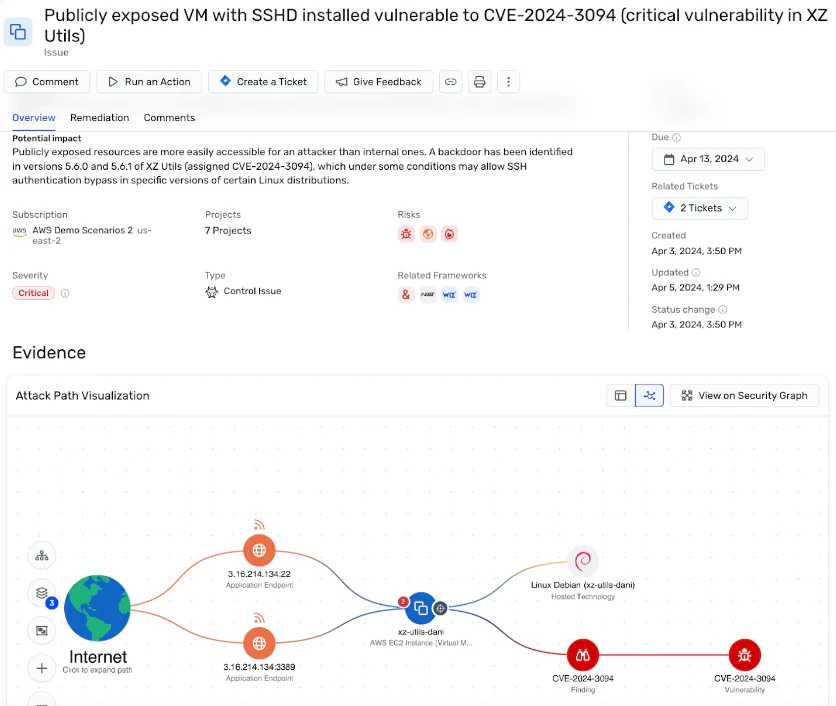
XZ Utils vulnerability (CVE-2024-3094): Found in 2024, this critical RCE vulnerability contained malicious code that could compromise Linux distributions. The backdoor highlighted how even trusted compression utilities can become attack vectors, as detailed in the Wiz State of Code Security Report 2025.
These incidents reinforced the same lesson: visibility into your open-source dependencies is not optional. Organizations that maintained accurate SBOMs and had continuous monitoring in place were able to assess their exposure within hours rather than weeks.
CI/CD Pipeline Security Best Practices [Cheat Sheet]
In this 13 page cheat sheet we'll cover best practices in the following areas of the CI/CD pipeline: infrastructure security, code security, secrets management, access and authentication, and monitoring and response.

Best practices for securing open-source software
Securing open-source software requires deliberate practices woven into how your team builds, deploys, and operates applications. The following eight practices provide a practical framework for reducing OSS risk without slowing development velocity.
Maintain a software bill of materials (SBOM)
A software bill of materials (SBOM) catalogs every open-source component and dependency in your applications, giving you immediate visibility into which systems are affected when a new vulnerability is disclosed. Government agencies like CISA now recommend SBOMs as a baseline for software transparency and supply chain security.
An up-to-date SBOM makes it easier to apply patches and manage dependencies.


Automate dependency scanning and updates
Promptly applying patches to open-source dependencies is one of the most effective ways to reduce your attack surface. Software vulnerabilities are often disclosed publicly and must be addressed quickly to prevent exploitation.
Pair automated dependency scanning with periodic manual code reviews and penetration testing to catch issues that automated tools might miss. Implementing these tools in your CI/CD pipeline ensures updates are handled promptly and with minimal manual intervention.
Enforce least-privilege access controls
When building or integrating OSS, secure coding practices are critical. Input validation, proper error handling, encryption, and avoiding hardcoded secrets reduce the vulnerabilities introduced during development.
Adhere to the principle of least privilege (PoLP), defense in depth, and fail-safe defaults. Tools like ESLint and SonarQube help enforce coding standards and detect issues early, while limiting each component's access to only what it needs to function.
Establish an open source governance policy
Choosing reputable sources for OSS is crucial for maintaining software integrity. Download components only from official repositories or well-known sources, and verify each project's popularity, community activity, and maintenance status before adoption. The Linux Foundation Census III report found that much of the most widely used open-source software is maintained by only a small number of contributors, making governance and vetting essential.
Use tools like sigstore to verify the authenticity and integrity of downloaded components. Beyond individual vetting, establish a formal governance policy that defines which licenses are acceptable, who can approve new dependencies, and how abandoned projects are identified and replaced.
Monitor for vulnerabilities continuously
Continuous monitoring is critical for responding promptly to new threats. Solutions like Wiz provide continuous monitoring across cloud and software environments, ensuring new vulnerabilities are identified and addressed swiftly.
Keep your monitoring tools and processes current to address evolving threats. In practice, this means regularly reviewing detection rules and ensuring your tooling covers new package registries and dependency formats as your stack evolves.
Vet open source components before adoption
Before adding a new open-source dependency, evaluate its security posture. Check the project's commit history, maintainer responsiveness, known CVE count, and community size. A project with infrequent updates and a single maintainer carries more risk than one backed by an active community.
Conduct periodic audits of all OSS components to verify license compliance. Tools like Deps.dev provide insights into dependencies and licenses, while FOSSA offers automated scanning and continuous monitoring to ensure compliance with licensing terms. Take corrective action immediately for any non-compliant components.
Secure your CI/CD pipeline
DevSecOps integrates security checks into every stage of the CI/CD pipeline, making vulnerability detection a routine part of building and deploying software rather than a separate gatekeeping step. Conduct security assessments at initial development stages to address vulnerabilities before they reach production, and follow CI/CD security best practices to harden your build infrastructure.
Introduce automated security testing at each CI/CD phase. Tools like the Wiz CLI integrate with pipelines like Jenkins to maintain security without slowing development. Include incident response procedures that define how your team will triage and remediate newly disclosed vulnerabilities across your pipeline.

Train your team on open source security practices
Technical controls are only as effective as the people applying them. Regular training ensures developers understand how to evaluate open-source components, recognize supply chain attack patterns, and follow your organization's governance policy when selecting dependencies.
Build security awareness into onboarding and conduct periodic workshops that cover real-world incidents like Log4Shell and XZ Utils. Teams that understand the "why" behind security practices are far more likely to follow them consistently.
The Secure Coding Best Practices [Cheat Sheet]
With curated insights and easy-to-follow code snippets, this 11-page cheat sheet simplifies complex security concepts, empowering every developer to build secure, reliable applications.
Download Cheat Sheet
Open source security tools and solutions
Open-source security tools automate vulnerability detection and dependency management at scale and generally fall into three categories.
Software Composition Analysis (SCA): These foundational tools scan projects to identify open-source components and dependencies, check for known vulnerabilities, and often report on license compliance. Snyk Open Source is a widely used developer-first SCA tool that integrates directly into IDEs and CI/CD workflows to surface vulnerabilities early.
Static Application Security Testing (SAST): SAST tools analyze source code for security flaws without executing the application. While not OSS-exclusive, they find vulnerabilities where custom code integrates with open-source libraries.
Dependency Checkers: Lightweight tools or plugins integrated into package managers or CI/CD pipelines that check project dependencies against vulnerability databases. Trivy is a comprehensive open-source security scanner for containers, filesystems, and git repositories. OWASP Dependency-Check identifies known vulnerable components in Java, .NET, and other ecosystems.
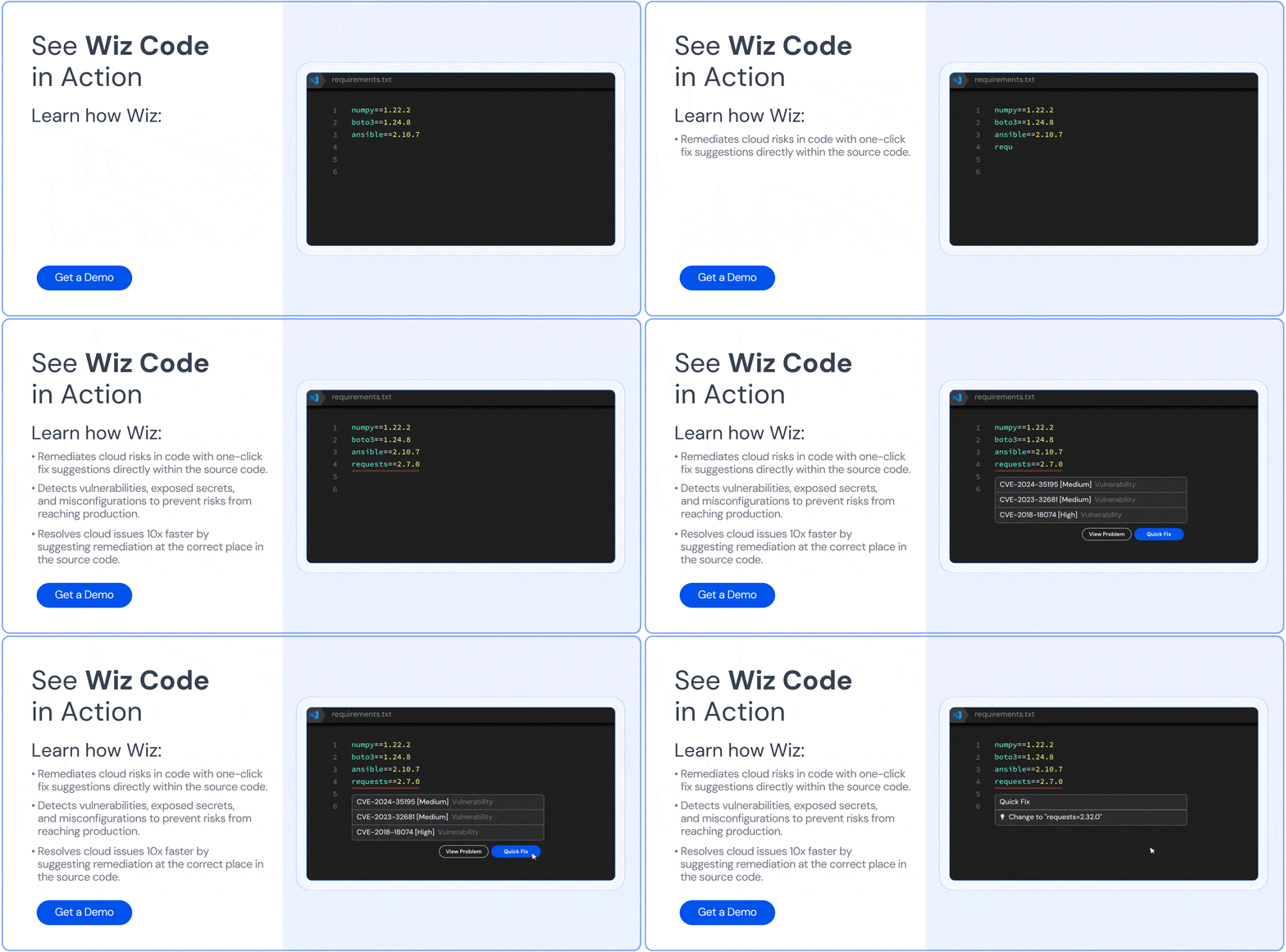
While many point solutions exist, a modern approach requires a unified platform. Wiz integrates SCA and other security scanning directly into a cloud-native security platform.
More importantly, Wiz correlates open-source vulnerabilities with cloud context, including network exposure, permissions, and data access, helping you focus on risks that are actually exploitable in your environment rather than chasing every CVE in isolation.
Secure your open-source software with Wiz
Securing open-source software is essential for building resilient applications, and it becomes far more manageable when your tools connect code-level findings to real cloud risk. Wiz brings application security and cloud security together so your team can prioritize what actually matters.
Wiz connects code-level findings to real cloud risk across each of these areas:
Agentless SBOM: Wiz maintains an accurate, centralized inventory of all OSS components and their dependencies across your cloud environments without requiring intrusive agents.
Cloud-context risk correlation: Wiz connects open-source vulnerabilities with runtime exposure, identity permissions, and data access, so you focus remediation on genuinely exploitable risks.
Auto-remediation and CI/CD integration: Automated workflows resolve identified vulnerabilities and misconfigurations, integrating with platforms like GitHub to catch issues early in development, as demonstrated in the Private Research University case study.
AI workload protection: As organizations build AI-powered applications that rely on open-source models and frameworks, Wiz extends the same visibility and risk correlation to AI workloads, ensuring OSS risks in AI pipelines receive the same scrutiny as traditional application dependencies.
To learn how Wiz can help you secure your open-source software from code to cloud, get a demo.