

What is cloud workload security?
Cloud workload security is the practice of protecting compute resources running inside cloud environments from exploitation, misconfiguration, and runtime attacks. Unlike traditional security that focuses on hardware, workload security protects the dynamic applications and processing layers running inside the cloud.
Advanced Cloud Security Best Practices [Cheat Sheet]
Download this cheat sheet for actionable security playbooks, hands-on code snippets, and CLI commands to harden and protect your cloud environment.

Why attackers target workloads
Workloads run application logic and process corporate data, which makes them high-value targets. Compromise one and an attacker can read live secrets, inherit the credentials of an over-permissioned service account, or use it as a foothold to move laterally into connected services.
A few traits make workloads especially exposed:
They hold live secrets and access tokens that unlock other systems.
They frequently run with more privileges than they need.
They spin up and tear down constantly, so teams lose track of what's actually running.
They communicate over internal networks that legacy perimeter tools never inspect.
Securing them is also your job, not your provider's: under the shared responsibility model, everything inside the workload is yours to protect.
This keeps the useful internal link but demotes it to one closing sentence instead of the whole section.
How cloud workload security works
Modern workload security shifts the focus from network perimeters to internal asset behavior. Traditional security strategies rely on north-south perimeter firewalls to inspect traffic entering and exiting a data center. However, modern cloud attacks primarily move east-west, shifting laterally between internal, interconnected workloads once an initial entry point is breached.
To understand how modern cloud workload protection operates, it helps to contrast it with legacy network security:
| Operational dimension | Legacy network security | Modern cloud workload security |
|---|---|---|
| Traffic focus | North-south: Inspects data crossing the perimeter boundary. | East-west: Monitors communication between internal workloads. |
| Infrastructure type | Static: Built for persistent, long-running physical servers. | Ephemeral: Built for containers and serverless functions that scale in seconds. |
| Defense mechanism | IP-centric: Relies on rigid firewall rules and network perimeters. | Identity and context-centric: Relies on microsegmentation, behavioral signatures, and eBPF-based runtime visibility into process, network, and syscall activity. |
Benefits of cloud workload security
As enterprise footprints scale, security teams face severe visibility gaps. According to the 2026 Wiz CISO Security Budget Benchmark, cloud security remains the top funding priority globally as organizations race to secure rapidly expanding cloud environments.
A strong workload security strategy delivers:
Comprehensive attack surface visibility: Eliminates blind spots by auto-discovering every active VM, container, and AI endpoint across hybrid and multi-cloud infrastructure.
Prioritized risk reduction: Shifts teams away from chasing isolated alerts by identifying toxic risk combinations, such as a workload that is simultaneously publicly exposed, highly privileged, and unpatched.
Minimized lateral movement: Restricts attacker traversal by applying zero-trust identity policies and workload-level segmentation controls.
Faster Mean Time to Respond (MTTR): Uses automated behavioral monitoring and real-time alerts to help SecOps teams intercept active runtime exploits before data exfiltration occurs.
Continuous compliance guardrails: Automatically maps workload configurations against regulatory frameworks like SOC 2, HIPAA, PCI DSS, and new AI safety standards.
Security threats to cloud workloads
Cloud workloads face risks across identities, networking, APIs, runtime environments, and third-party software dependencies.
Common threats include:
| Threat | Description |
|---|---|
| Illegitimate access to workloads | Attackers increasingly rely on stolen credentials, exposed secrets, and overprivileged identities instead of brute-force attacks. Once inside a workload, they can access sensitive data, move laterally across environments, or escalate privileges. |
| Malware and ransomware | Attackers can introduce malware or ransomware through vulnerable applications, compromised containers, or misconfigured workloads. These attacks can disrupt operations, encrypt critical systems, or create persistence inside cloud environments. |
| Misconfigured security controls | Misconfigured IAM policies, storage permissions, network rules, and exposed services remain one of the most common causes of cloud breaches. Small configuration mistakes can unintentionally expose workloads or sensitive data to the internet. |
| API and interface vulnerabilities | APIs expand connectivity between services, applications, and cloud resources, but insecure authentication, excessive permissions, or exposed endpoints can create exploitable attack paths across environments. |
| Insecure supply chain components | Open source libraries, third-party containers, and external dependencies can introduce vulnerabilities or malicious code into workloads. As software supply chains grow more complex, these dependencies become harder to track and secure consistently. |
Watch 12-min demo
Learn how Wiz Cloud surfaces toxic combinations across misconfigurations, identities, vulnerabilities, and data—so you can take action fast.

Best practices for cloud workload security
To build a resilient defense, security controls must extend across the entire lifecycle of the workload, from the initial code commit to active runtime execution.
1. Shift left with Infrastructure as Code (IaC) scanning
Manual provisioning across multi-cloud environments creates catastrophic configuration drift. Organizations should enforce security policies during the build phase by scanning Infrastructure as code (IaC) templates and container images within the CI/CD pipeline. Catching a misconfigured cloud port or a critical vulnerability (think container image CVEs or misconfigured Kubernetes manifests) before deployment drastically reduces the production attack surface and prevents risky workloads from ever going live.
2. Govern non-human identities and enforce least privilege
The cloud attack surface is heavily dominated by machine-to-machine interactions rather than human users. According to the Wiz 2026 State of AI in the Cloud Report, non-human identities now vastly outnumber human credentials, with 57% of organizations deploying self-hosted AI agents and 80% adopting Model Context Protocol (MCP) servers.
Because these autonomous entities require high-level access to function, security teams must restrict these service accounts to strict least-privilege permissions. Ensuring tight governance prevents a compromised workload from being used by an attacker to escalate administrative control across your cloud control plane.
3. Transition to a unified security graph
Siloed security tools (separate scanners for vulnerabilities, identities, and malware) produce fragmented data and severe alert fatigue. This isolation creates dangerous blind spots; as documented in the Wiz 2026 Cloud Threat Retrospective, the vast majority of successful cloud breaches do not come from a single critical flaw, but rather from a toxic combination of multiple minor risks intersecting, such as a workload that is simultaneously publicly exposed, highly privileged, and unpatched.
Centralizing your monitoring into a platform that constructs a unified security graph allows your SecOps team to connect workload behaviors directly to identity permissions and visualize the exact blast radius of an active threat instantly.
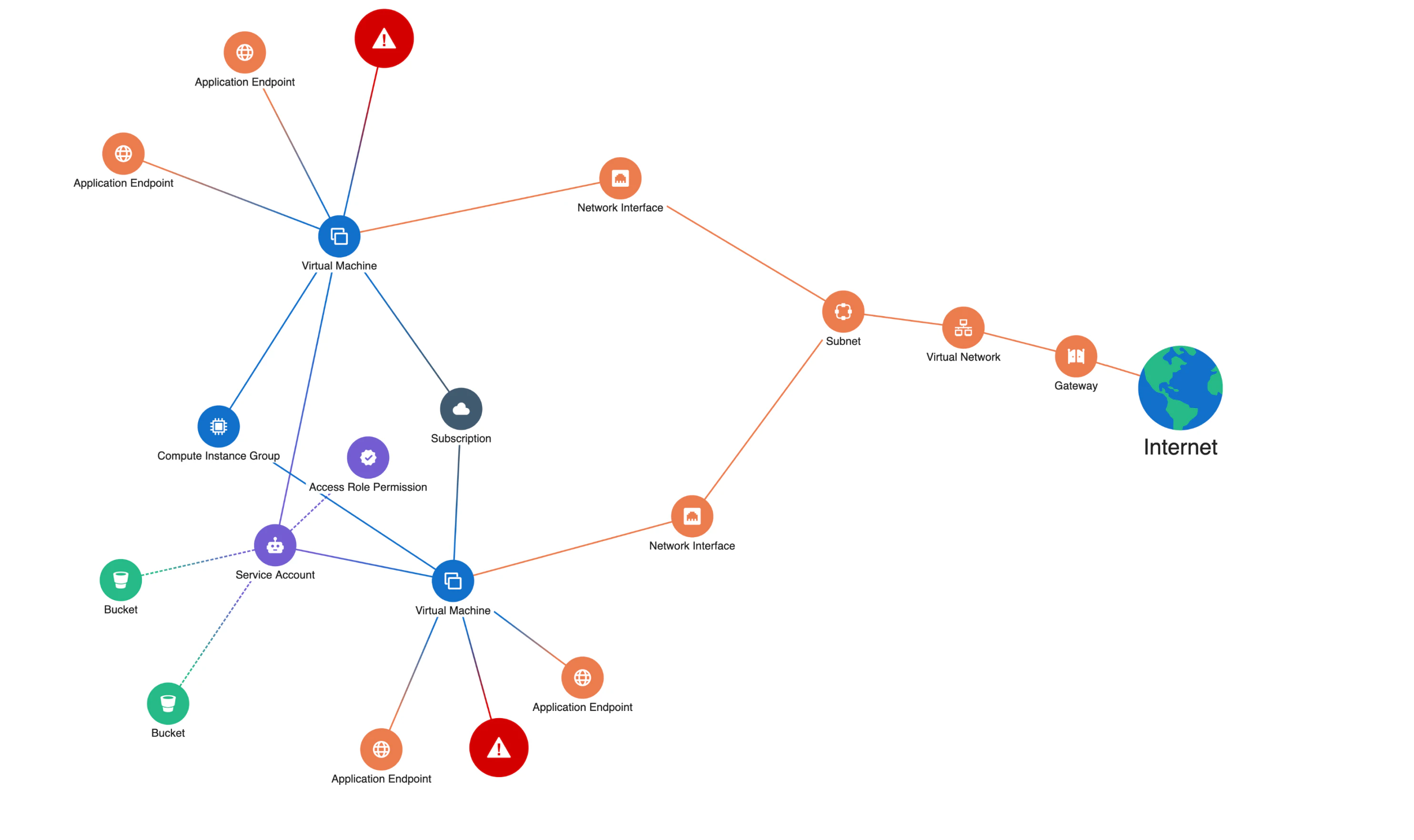
Centralized monitoring improves visibility across workloads, cloud management consoles, identities, and network activity. Context-rich alerts help teams investigate suspicious behavior faster and reduce time spent reviewing low-priority findings.
4. Combine agentless scanning with cloud-native runtime security
While agentless scanning is essential for continuous, 100% posture inventory across your entire cloud footprint, protecting running applications requires real-time behavioral monitoring.
Organizations should deploy lightweight runtime detection capabilities alongside their posture management. This combined approach ensures you can catch active container drift, anomalous process executions, and zero-day exploits the moment they occur in production, without sacrificing total visibility.
What is a cloud workload protection platform?
Cloud workload protection platform (CWPP) refers to the capabilities that secure compute at runtime: VMs, containers, serverless functions, Kubernetes workloads, and on-premises services.
Teams no longer buy CWPP as a standalone product. Workload protection is one pillar of a Cloud Native Application Protection Platform (CNAPP), which unifies it with posture management (CSPM), identity (CIEM), and data security so workload findings carry full cloud context. A siloed CWPP gives you runtime detection but strands it from the posture, identity, and exposure data needed to tell which alerts matter."
What workload protection delivers inside a CNAPP
Modern CWPPs increasingly use AI and machine learning to identify unusual workload behavior that traditional signature-based detection can miss. This includes unexpected process execution, anomalous network activity, privilege escalation attempts, and workload behavior that differs from established runtime patterns.
Delivered as part of a CNAPP, workload protection provides:
Misconfiguration detection: Identifies insecure workload configurations and exposed services before they can be exploited.
Workload segmentation: Limits lateral movement between workloads through granular network and policy controls.
Behavioral monitoring: Detects suspicious runtime activity across workloads and container environments.
Malware detection: Identifies malicious files, processes, and runtime threats inside workloads.
Integration with CSPM and CNAPP: Connects workload security findings with broader cloud posture, identity, and exposure context.
When evaluating workload protection, prioritize a CNAPP that supports hybrid and multi-cloud environments, provide continuous runtime visibility, and prioritize findings using real workload context rather than isolated alerts.
How Wiz secures cloud workloads
To effectively defend dynamic compute environments, organizations need a unified approach to security. Wiz delivers workload protection as part of a unified CNAPP, replacing disconnected point solutions with a single, agentless security graph. Wiz scans every layer of your compute infrastructure, including hosts, VMs, containers, serverless architectures, and self-hosted AI models, without requiring complex agent deployments that degrade performance.
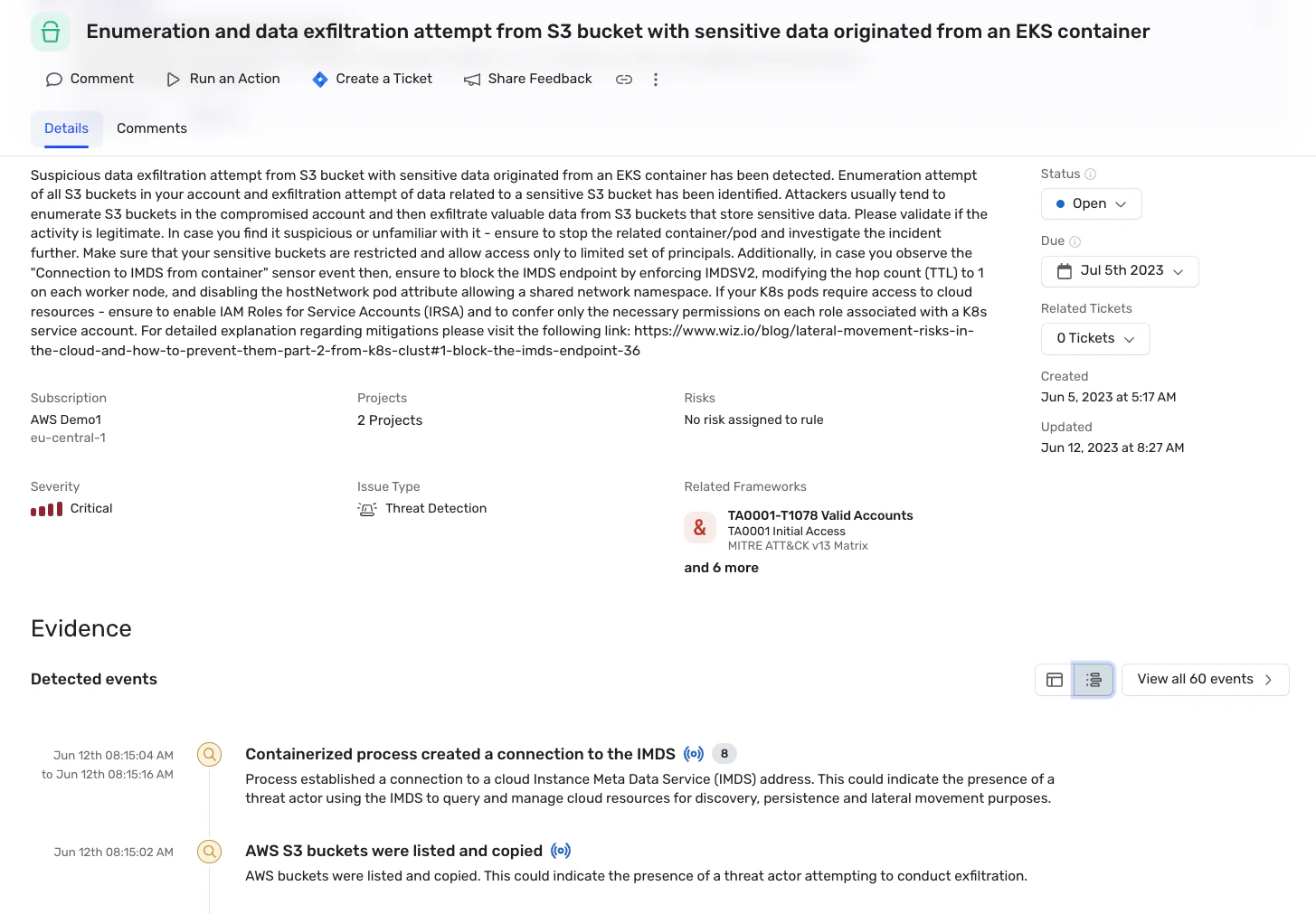
By correlating runtime threat events, Kubernetes logs, cloud audit trails, and data exposure context into prioritized Wiz Issues, Wiz eliminates alert fatigue. If an active exploit occurs, Wiz Defend charts the exact attack path in real time, mapping out affected identities, exposed assets, and sensitive data so your SecOps team can contain the threat immediately.
Wiz also secures advanced AI workloads, from tracking model endpoints to uncovering exposed training data, giving you the cloud-native context to build, deploy, and run securely.
Get a demo to see how Wiz can transform your cloud workload security from isolated alerts into actionable risk management.
Gain 100% visibility into your cloud environments
Learn how even large enterprises, like Siemens, can gain 100% cloud visibility with Wiz
