Closing the Loop: Why Reactive Still Matters
Modern cloud attacks move at machine speed. And even with the automated, risk-based ConMon and “Secure by Design” code security guardrails discussed in Part 2 and Part 3 of this Agile FedRAMP Playbook series, a complete security strategy must account for worst-case scenarios, and adapt to emerging threats. For organizations seeking or maintaining a FedRAMP authorization, the ability to rapidly detect, investigate, and report incidents is more than just best practice; it’s a regulatory requirement covered by several controls within the Configuration Management (CM), Incident Response (IR), and System and Information Integrity (SI) families. Wiz Defend serves as a technical bridge across these families, helping to provide the automated visibility and cloud-native context needed for FedRAMP’s stringent evidentiary standards.
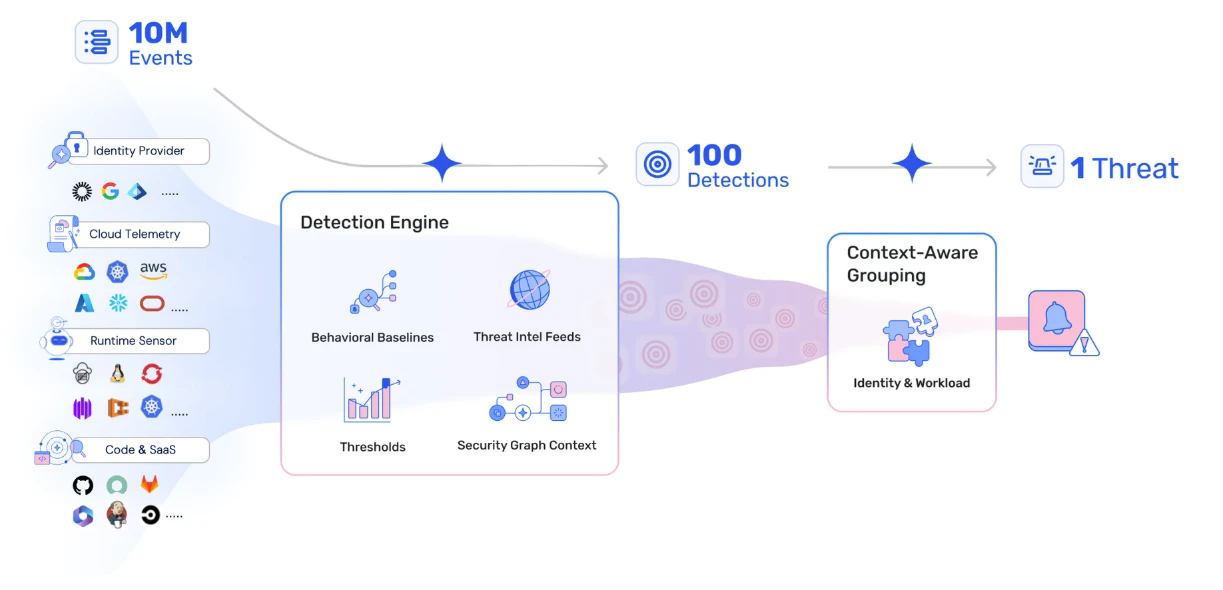
Wiz Defend supports this Reactive Risk Management approach by enabling high-fidelity detection and rapid investigation across the cloud stack. While SIEMs provide the essential foundation for log aggregation, the challenge for modern SOCs is the sheer velocity and volume of cloud events. Without a unified Cloud Detection and Response (CDR) strategy to inject cloud-native context, related events are often viewed in isolation, obscuring the true attack path. By automatically correlating disparate events into a single, meaningful narrative, SOC teams can drastically reduce alert fatigue and move from “we have a signal” to “we have the full scope and a path to remediation.”
Mapping Cloud Detection and Response to FedRAMP
The requirements for incident handling are some of the most stringent in the FedRAMP framework, requiring high levels of technical proof and rapid reporting timelines.
FedRAMP Rev 5: The Incident Response (IR) family is the core focus here. Controls like IR-4 (Incident Handling), IR-5 (Incident Monitoring), and IR-6 (Incident Reporting) require CSPs to implement a comprehensive program that can track and report suspected incidents to the FedRAMP Program Management Office (PMO) or US-CERT within hours. Additionally, SI-4 (System Monitoring) requires continuous monitoring for unauthorized behavior. Wiz Defend ensures that IR controls aren't just met at a point-in-time audit, but are enforced as a continuous 'Secure by Design' outcome, aligning with the latest NIST SSDF guidelines.
FedRAMP 20x: This framework shifts the focus to performance-based metrics. The Incident Response (INR) and Monitoring, Logging, and Auditing (MLA) Key Security Indicators (KSIs) emphasize the persistent monitoring and evaluation of logs, machine-based information resources, and other sources with incorporated review of root cause with demonstrated application of lessons learned to reduce future events.
Incident Response Force Multipliers: Wiz Defend & Runtime Sensor
Wiz Defend is a cloud-native detection and response solution that helps automate the evidentiary requirements for FedRAMP incident response. By working in tandem with the Wiz Runtime Sensor, it provides a "defense-in-depth" approach that turns raw telemetry into actionable compliance artifacts:
The Wiz Runtime Sensor: A lightweight, eBPF-based sensor that monitors process-level activity. For FedRAMP, this provides the granular visibility needed to detect unauthorized software execution (aka drift) and sophisticated threats like fileless malware or reverse shells without the performance tax or management complexity of legacy agent architectures.
Wiz Defend: A unified CDR engine monitoring threats across the entire cloud stack, including identities, networks, data, and workloads. By mapping real-time signals directly to the Wiz Security Graph, it transforms disconnected telemetry into context-aware detections. Rather than manual alert triage, teams are equipped to catch, contain, and remediate threats with the speed required to protect sensitive federal data.
Together, these capabilities bridge the gap between workload activity and cloud infrastructure data, ensuring that security signals are never analyzed in a vacuum. Instead of forcing incident response teams to manually reconstruct the blast radius from disconnected log entries, Wiz Defend automatically helps surface the "who, what, and where" of an event. This ensures analysts aren't weighed down by isolated "suspect processes," but are immediately alerted to critical incidents, such as a suspicious process executing on a boundary-facing server with access to sensitive data.

This helps streamline:
Continuous Baseline Integrity (Drift Detection): Identifying when a container or VM deviates from its "authorized" state, assisting with the core FedRAMP requirement for maintaining a secure, validated baseline.
Real-Time Behavioral Monitoring: Detecting sophisticated threats like fileless malware and reverse shells which often evade traditional log-based detection.
Contextual Alert Prioritization: By correlating runtime signals with the Security Graph, Wiz helps "de-noise" the environment and deduplicate alerts. A suspicious process is no longer just a generic alert; it is prioritized based on its proximity to high-value assets or "Toxic Combinations.” By prioritizing Toxic Combinations over flat CVE checklists, Wiz enables organizations to focus remediation on the 1% of risks that pose the greatest threat to the environment.
How Wiz Defend Enables “Agile” Incident Response
To meet the exacting evidence requirements of FedRAMP, CSPs must demonstrate more than just log collection; they must prove they are actively monitoring and responding to unauthorized activity within their authorization boundary. Wiz Defend provides the technical bridge between raw telemetry and these specific regulatory outcomes.
Wiz Defend helps incident response teams to provide the required technical proof for reactive incident handling and persistent monitoring essential for meeting many of the FedRAMP Rev 5 and 20x controls and KSIs.
| FedRAMP Mandate | Wiz Defend Capability | Technical Evidence for 3PAOs |
|---|---|---|
| IR-4: Incident Handling | Contextual Attack Path Analysis | Automatically correlates runtime signals with the Wiz Security Graph to identify the blast radius and initial entry point, assisting in root-cause investigation and ensuring consistency of incident detection and analysis capabilities across your organization |
| IR-5: Incident Monitoring | Real-Time Behavioral Detection | Automatically captures and maintains critical incident metadata (e.g., identity, data sensitivity, and network exposure) to support incident analysis including an audit trail of the attack path, which correlates identity, process execution, and data access, without requiring manual log reconstruction |
| IR-6: Incident Reporting | Automated Alert Contextualization | Accelerates the identification of "suspected incidents" by providing immediate visibility into the affected data and boundary, helping meet strict reporting windows |
| SI-4: System Monitoring (and its enhancements) | Enhanced Visibility & Continuous Drift Detection | Provides continuous boundary monitoring to detect unauthorized connections, anomalous process execution, and deviations from hardened baselines (also assists with many Configuration Management [CM] controls including CM-2, CM-7(2&5), and CM-8(3) |
| 20x MLA: Monitoring, Logging, and Auditing | Signal-to-Noise Optimization & Risk Analysis | Reviews events across cloud, audit, and SaaS sources while leveraging the Wiz Security Graph to identify visibility gaps (missing log categories) and prioritize risk-informed remediation (MLA-01, MLA-05) |
| 20x IR: Incident Response | Rapid Investigation Workflow | Streamlines the path from detection to remediation, directly supporting performance-based metrics for time-to-remediate (KSI-IR-05) |
Strengthening the Evidence Chain
To maintain an agile posture, incident handling must move at the speed of the cloud. This requires more than just log collection; it requires a system that automatically generates the "who, what, and where" of an event to meet the technical proof needed for Rev 5 and 20x compliance. Wiz Defend helps organizations meet these requirements by providing the "how" and "why" behind every alert, helping to accelerate detection and response activities through:
Granular Infrastructure-Wide Visibility: While traditional logging might show a successful login, the Wiz Runtime Sensor uses eBPF to capture what happened next. By monitoring process lineage and file integrity at the kernel level, Wiz provides the low-level granular evidence needed to help identify unauthorized use of the system required by SI-4, without the performance lag of traditional agents.
Automated Root Cause & Blast Radius: Agile IR replaces manual "log-diving" with the Wiz Security Graph. When a behavioral anomaly is detected—such as a reverse shell—Wiz automatically correlates it with identity permissions and data sensitivity. This provides an immediate, visual narrative of the blast radius, allowing analysts to satisfy IR-4 root-cause requirements in minutes rather than days.
Automated Incident Narrative: Beyond simple detection, tracking and documenting the "how" and "when" of an incident is a core requirement of IR-5 (Incident Monitoring). Wiz Defend helps provide this visibility by automatically capturing and maintaining high-fidelity metadata, including the specific identity used, the commands executed, and the data accessed, to construct a chronological narrative of the event. By correlating these signals into a unified attack path, security teams gain a persistent, verifiable record of the incident’s lifecycle. This ensures the technical evidence and context needed for deep-dive analysis is preserved and ready for review, reducing the manual effort required to reconstruct complex event sequences from discrete log entries.

Eliminating the "Pivot" Penalty: A major bottleneck in FedRAMP SOCs is jumping between the SIEM, cloud consoles, and endpoint tools. Wiz Defend provides a unified investigation interface where runtime signals are viewed alongside the cloud control plane. This technical consolidation is what directly drives down the MTTR metrics required by the 20x INR KSI.
Proactive Assurance of Logging Integrity: To meet the "persistent evaluation" mandate of 20x MLA, Wiz doesn't just analyze logs, it validates the logging infrastructure itself. By identifying "dark corners" where logging is disabled or misconfigured, Wiz ensures your evidentiary baseline is complete before an auditor asks to see it.
Behavioral Threat Defense: Beyond simple drift detection, Wiz Defend identifies sophisticated "living-off-the-land" techniques that standard log-based detection often misses. This is helpful for SI-4(b) (system monitoring) to ensure monitoring isn't just a passive activity, but a proactive defense against modern fileless malware, lateral movement, and identifying atypical use of the system.
Conclusion: Turning Compliance into a Competitive Advantage
The journey toward FedRAMP operational agility is a shift in mindset. It shifts away from manual spreadsheets and point-in-time audits toward the updated FedRAMP goals where security is integrated throughout the software development lifecycle. By leveraging automation to handle the heavy lifting of evidence collection and risk prioritization, security teams can move at the speed of the cloud while meeting the rigor required by the U.S. Government.
Over the course of this four-part series, we have defined the blueprint for modernizing your compliance posture:
Part 1: Our FedRAMP Journey: We shared the story of Wiz’s FedRAMP High journey to outline the importance of having a strong risk-management foundation. This foundation helps transform compliance from a potential bottleneck into a streamlined, automated process that helps avoid "Innovation Gaps” between commercial and government environments.
Part 2: Proactive Risk Management & ConMon: We detailed how to modernize Continuous Monitoring (ConMon) by moving from flat vulnerability lists to a context-aware approach. By using the Wiz Security Graph to identify "Toxic Combinations," organizations can prioritize risks based on their actual exploitability and impact, significantly reducing the administrative burden of the monthly POA&M process.
Part 3: Secure by Design: We looked at the impact of "shift left" security by integrating Wiz Code into the development pipeline, helping ensure security guardrails are active before a single line of code reaches production.
Part 4: Closing the Loop with Reactive Defense: Finally, we’ve shown how to bridge the gap between workload activity and cloud infrastructure. By leveraging Wiz Defend and the Wiz Runtime Sensor, organizations can automate the "who, what, and where" of incident response, meeting the intention behind FedRAMP Rev 5 and 20x evidentiary requirements with high-fidelity, context-driven visibility.
The "Agile FedRAMP" playbook isn't just about obtaining an authorization; it’s about maintaining a continuous state of audit-readiness while staying ahead of threats at machine speed. By unifying proactive guardrails with reactive detection, you aren't just checking a box, you are building a more resilient cloud for the mission-critical data you protect.