



With the rise of cloud services and cloud native development, developers can now spin up and deploy APIs faster than ever. However, this also makes it harder to manage APIs, especially with malicious actors using increasingly sophisticated attack techniques.
In cloud-native architecture, APIs are used heavily in microservices to enable microservice communication, as well as facilitate scalability and resilience. APIs also handle sensitive customer data, making the risk of exposure an even greater concern due to the potential ramifications for a company’s reputation, customer trust, and bottom line.
The Salt Security State of API Security Report 2025 found that close to 34% of organizations reported an API security issue related to data exposure or a privacy accident. And according to the Global State of API Security 2025, 57% of organizations experienced at least one data breach caused by API exploitation in the past two years.
This makes assessing API risks in production crucial, including real-time threat detection and incident response to catch issues that slip through pre-deployment testing.
Advanced API Security Best Practices [Cheat Sheet]
Get the Wiz API Security Best Practices Cheat Sheet and fortify your API infrastructure with proven, advanced techniques tailored for secure, high-performance API management.

What is an API risk assessment?
An API risk assessment is a systematic process for evaluating the APIs used across an organization. The goal is to identify any vulnerabilities, misconfigurations, or other risks that could be exploited by threat actors and result in severe damage to a business and its brand.
How do you conduct an API risk assessment?
There are two types of methodologies for assessing API risks: manual penetration testing and automated API testing.
Manual penetration testing
This approach entails security professionals simulating real-world attacks on APIs to uncover vulnerabilities like broken authentication, improper authorization, and business logic flaws. The drawback of penetration testing is that it consumes a ton of resources and is not so simple to scale. As a result, coverage can be limited, leaving some APIs potentially exposed to risk.
Automated API testing
Here, developers rely on automated tools to discover APIs and assess them for risks using dynamic application security testing (DAST) and attack surface analysis. These solutions can continuously scan for common vulnerabilities, misconfigurations, and exposure risks, providing broader coverage and faster feedback than manual penetration testing.
API risk assessment in production
API risk assessments in the test environment are meant to mitigate the impact of API security failures that happen when you’re running live. However, no matter how thorough your testing is, problems can still pop up in production.
This makes assessing API risks in the production environment crucial.

Challenges of securing APIs
Securing APIs is increasingly complex as attacks become more frequent and sophisticated. Attackers now use AI-driven automated tools to continuously scan for exposures, focusing on externally exposed and insecure APIs.
Below are key challenges organizations need to address to secure their API services.
Shadow APIs
Shadow APIs are unmanaged or undocumented endpoints that escape security oversight. These often arise from rapid development cycles, legacy integrations, or a lack of centralized inventory.
Because they are not tracked or monitored, shadow APIs can introduce serious vulnerabilities and serve as hidden entry points for threat actors.
Zombie endpoints
Zombie endpoints are deprecated APIs that remain accessible due to poor inventory management or incomplete decommissioning. Although no longer in active use, these endpoints can still process requests and expose sensitive data.
Attackers often target zombie APIs because they are less likely to be patched or monitored, making them a significant risk.
OWASP Top 10 API Security Risks
The OWASP API Security Top 10 (2023) details 10 critical risk categories that organizations should prioritize:
Broken Object Level Authorization (BOLA) – Attackers manipulate object IDs to access unauthorized data.
Broken Authentication – Weak authentication mechanisms allow credential attacks.
Broken Object Property Level Authorization (BOPLA) – Users can read or modify object properties they shouldn't access.
Unrestricted Resource Consumption – Missing rate limits enable denial-of-service attacks.
Broken Function Level Authorization (BFLA) – Users can perform administrative actions without proper privileges.
Unrestricted Access to Sensitive Business Flows – Automated abuse of legitimate workflows (e.g., ticket scalping).
Server Side Request Forgery (SSRF) – APIs can be tricked into making unauthorized requests.
Security Misconfiguration – Default settings, verbose errors, or missing patches create vulnerabilities.
Improper Inventory Management – Undocumented or deprecated API versions remain accessible.
Unsafe Consumption of APIs – Trusting third-party API data without validation leads to weaker security standards.
OWASP API Security Top 10 Risks and How to Mitigate Them
The OWASP API Security Project offers software developers and cloud security practitioners guidance on preventing, identifying, and remediating the most critical security risks facing application programming interfaces (APIs).
Leggi di più
Compliance violations
APIs that expose sensitive data or lack proper security controls can violate regulatory requirements, including GDPR, HIPAA, and PCI DSS. Organizations that find themselves in non-compliance face legal, financial, and reputational consequences.
Adhering to application security frameworks like NIST SP 800-53, ISO 27001, and SOC 2 to maintain robust API governance is critical.
Given the above concerns, the faster you’re able to spot an API security issue, the less impact it may cause to your organization. This demands an automated discovery approach.
Automated discovery
Nowadays, manually checking every API endpoint is impractical. Modern organizations managing dynamic and ephemeral cloud ecosystems deploy, update, and retire APIs at a rapid pace, often across multiple teams and cloud platforms.
Automated discovery tools let you uncover and address any ongoing security issues stemming from both shadow and zombie APIs:
Shadow APIs: Often created for temporary use or by individual developers, automated discovery is the only scalable way to detect and bring these APIs under governance.
Zombie endpoints: Retired but still accessible, automated tools can identify these by comparing active network traffic and code references against official inventories.
While manual testing may still be essential for finding complex business logic flaws, automated discovery may help uncover API risks fast, but to fully benefit from an API risk assessment, you’ll need proper tooling.
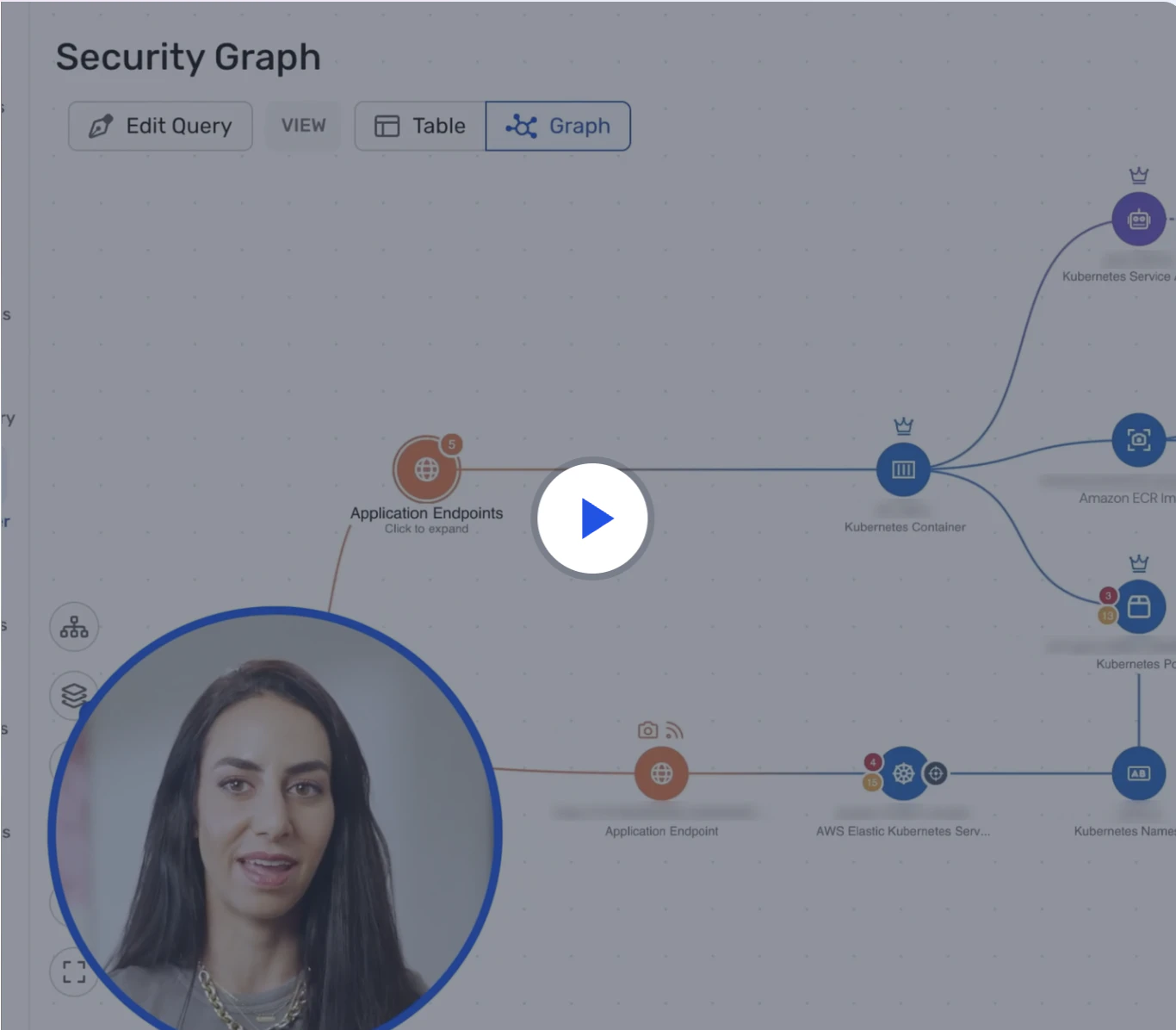
Watch 12-min Demo
Learn about the full power of the Wiz cloud security platform. Built to protect your cloud environment from code to runtime.
Watch now
Getting API risk assessment right
An effective API risk assessment requires security expertise and business understanding. It also demands a solution that includes:
Critical security checklists, e.g., the OWASP API Security Top 10
SAST to analyze code for hardcoded secrets and injection flaws, DAST to probe running APIs for authentication and authorization issues, plus contract/schema validation (OpenAPI, GraphQL), fuzz testing for input handling, and Software Bill of Materials (SBOM) analysis to identify vulnerable third-party dependencies
External attack surface testing to simulate real-world attacks and prioritize exposures
Contextual prioritization by assessing vulnerabilities based on authentication and authorization posture (BOLA/BFLA/BOPLA risk), external exposure to the internet, business impact and data sensitivity (PII, payment data), cloud resource relationships (lateral movement paths), and active exploitation indicators
This combination of tactics ensures companies remediate the most critical risks.
API security pipeline
As an application is being developed, APIs are updated from time to time. Without proper checks in place for API risks after every code change, API security flaws can be introduced and passed to the production environment.
The solution is to leverage CI/CD. A CI/CD pipeline embeds testing for API risks directly into your development pipeline for automated validation.
This shift left testing approach uses continuous checks—starting from design—to ensure that every change in your API code is accompanied by tests for security flaws, allowing for swift detection and remediation.
How Wiz enables comprehensive API risk assessment
Wiz is an all-in-one tool designed to help companies remain on top of evolving threats. With Wiz API Security Posture Management (API SPM), it extends that shift left approach with continuous API discovery, posture assessment, and unified vulnerability management tailored to API security best practices.
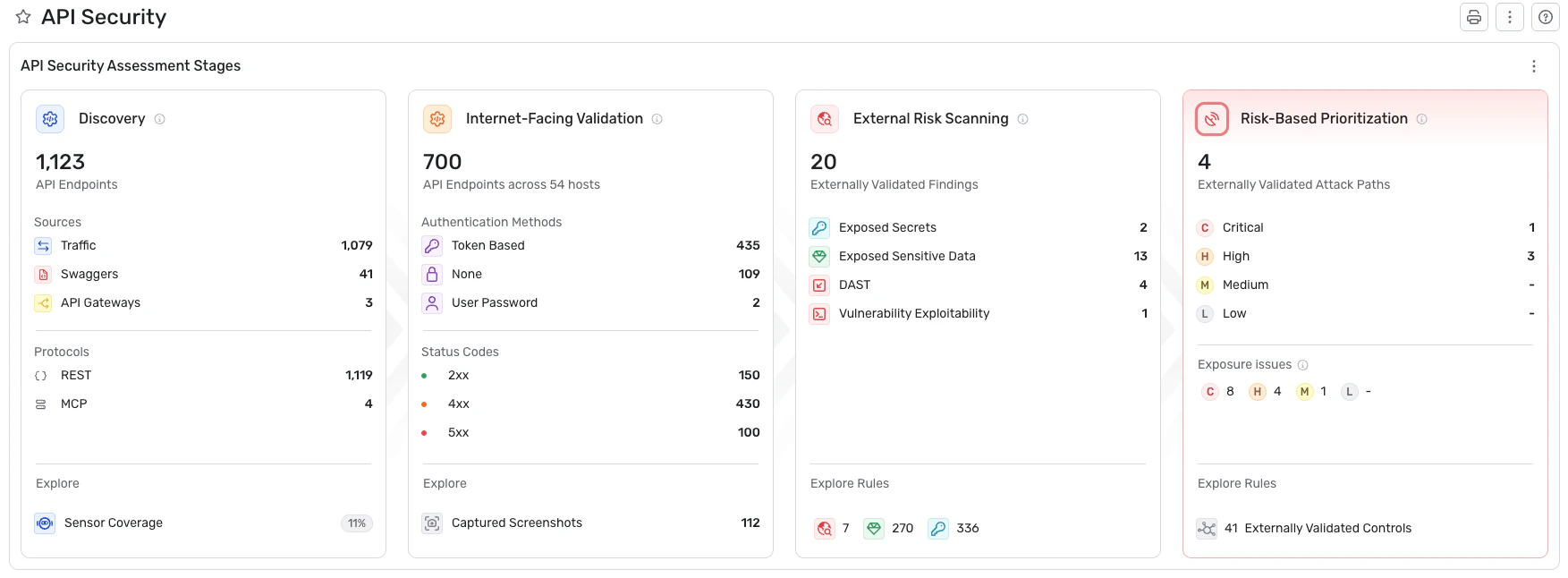
Wiz allows development and security teams to integrate API risk assessment early and continuously throughout the software delivery lifecycle:
API Security Posture Management (API SPM): Continuously discovers managed, shadow, and zombie APIs, maintains a context-rich inventory, and maps OWASP API Top 10 risks to exposure and sensitive data so teams can prioritize the APIs that matter most
Attack surface analysis: Identifies all exploitable entry points, including APIs that traditional tools can often overlook
Risk assessment: Evaluates exposed API and application endpoints, prioritizing remediation based on real business impacts
Agentless discovery: Maintains a complete API inventory without installing agents, removing the unnecessary complexity of executing risk assessment (ideal for dynamic cloud-native environments)
Code-to-cloud traceability: Links vulnerabilities to source code for smooth and quick remediation, helping developers fix security issues fast
Wiz API SPM streamlines API risk assessment so that security teams can manage exposures proactively. Its continuous monitoring and automated policy enforcement help your API security posture keep pace as your application evolves, including APIs that expose AI services or connect AI applications to sensitive data stores.
To get started with an API risk assessment using Wiz’s tailored security service, contact us for a demo today.
Agentless, contextual API discovery
Wiz helps teams quickly uncover every API in their cloud environment, known and unknown, and see their exposure with full execution context.
