


Key factors organizations consider when evaluating exposure management platforms
Exposure management has evolved significantly as environments have become more hybrid, distributed, and cloud-native. With assets spread across on-premises infrastructure, cloud services, identities, applications, and external-facing systems, organizations often evaluate multiple platforms to understand how each aligns with their architecture, operating model, and long-term security goals.
AWS Vulnerability Management Best Practices [Cheat Sheet]
This 8-page cheat sheet breaks down the critical steps to fortifying your AWS security posture. From asset discovery and agentless scanning to risk-based prioritization and patch management, it covers the essential strategies needed to safeguard your AWS workloads.

While priorities vary by organization, several common considerations typically shape these evaluations:
Deployment model and operational fit
Exposure management platforms differ in how they collect data, including network scanning, host-based agents, cloud provider APIs, workload instrumentation, or combinations of these methods. Each approach carries distinct operational implications related to deployment effort, maintenance overhead, coverage depth, and compatibility with existing infrastructure. Teams often prioritize models that align with both their technical environment and available resources.
Coverage across environments
Some platforms emphasize traditional infrastructure and endpoint visibility, while others extend coverage to cloud services, identities, containers, SaaS applications, AI workloads, or application development pipelines. Understanding which environments and asset types a platform can assess helps organizations determine how it contributes to a unified view of exposure.
Integration with existing workflows
Exposure management intersects with many functions, including cloud operations, vulnerability remediation, compliance, and DevSecOps. Organizations assess how well a platform integrates with existing tools and processes, such as ticketing systems, CI/CD pipelines, cloud-native services, and security operations tooling.
Context and prioritization approach
Platforms vary in how they correlate findings across vulnerabilities, misconfigurations, identity permissions, network exposure, exploitability signals, and threat intelligence. Some emphasize risk modeling or relationship-based context, while others focus on compliance frameworks, asset criticality, or remediation readiness. These differences influence how teams prioritize work and communicate risk internally.
Program scalability and long-term strategy
As exposure management programs mature, organizations may expand their scope to include areas such as AI security, data security, threat detection and response, or application security testing. Evaluating how a platform scales in capability, usability, and integration helps teams plan for future needs without introducing unnecessary operational complexity.
Tenable alternatives overview
The platforms outlined below represent a range of approaches to exposure management and cloud security. Each solution reflects different design choices around deployment models, data collection methods, environment coverage, and how risk context is presented to security teams.
Rather than ranking or scoring these platforms, this overview highlights how they position themselves within the broader exposure management landscape. Some emphasize infrastructure and endpoint visibility, others focus on cloud-native context, identity risk, external attack surface visibility, or risk quantification.
Organizations evaluating exposure management solutions typically consider how these approaches align with their existing architecture, operational workflows, and long-term security strategy. The following sections describe how each platform approaches exposure management, helping readers understand the trade-offs and assumptions behind different solutions.
1.Wiz
Wiz approaches exposure management by modeling risk across cloud, hybrid, on-premises, SaaS, and AI environments using a primarily agentless, cloud API–driven architecture. The platform collects contextual information about resources, configurations, vulnerabilities, identity permissions, data, secrets, and external exposure signals.
This information is correlated within the Wiz Security Graph, which represents relationships between assets and risk factors. By analyzing how different findings connect, such as a misconfiguration combined with broad permissions or a vulnerable workload with external reachability, Wiz helps teams understand where combinations of issues may form potential exposure paths within their environment.
In addition to agentless visibility, Wiz offers an optional lightweight runtime sensor for teams that want deeper workload-level insight. This hybrid model allows organizations to balance ease of deployment with additional runtime context, depending on their operational preferences and coverage requirements.
Wiz also integrates with external scanners and data sources through its Unified Vulnerability Management (UVM) capabilities, enabling teams to bring vulnerability, application, data, and other security findings into a single contextual view. Combined with Wiz Attack Surface Management (ASM), which focuses on identifying externally reachable assets and exposures, the platform supports teams in evaluating which risks may be both reachable and impactful in their specific environment.
Overall, Wiz’s approach is designed to help organizations view exposure management as a connected set of risks rather than isolated findings, supporting prioritization decisions based on environment context, exploitability signals, and asset relationships.
2. Qualys
The Qualys TruRisk Platform supports exposure management across hybrid environments using a combination of authenticated scanning, network-based discovery, lightweight agents, and cloud service integrations. This multi-method approach enables organizations to build an asset inventory spanning servers, endpoints, network devices, and cloud resources.
Qualys layers vulnerability findings, configuration assessments, and compliance indicators onto this asset inventory, helping teams understand exposure across both traditional infrastructure and cloud environments. Its risk scoring and prioritization capabilities are designed to help organizations evaluate remediation urgency based on factors such as asset criticality and vulnerability characteristics.
The platform also integrates with patch management and remediation workflows, allowing teams to connect exposure findings directly to operational processes. This alignment supports organizations with established vulnerability management and compliance programs that require consistent coverage across on-premises and cloud-based assets.
Overall, Qualys’s approach emphasizes broad asset visibility, scanning-based assessment, and operational integration, making it well suited for organizations managing diverse hybrid environments with mature vulnerability and remediation practices.
3. Rapid7 InsightVM + InsightCloudSec
Rapid7’s exposure management capabilities combine infrastructure-focused vulnerability assessment with cloud and identity posture visibility. InsightVM identifies vulnerabilities across physical, virtual, and cloud-based systems using authenticated scanning and optional agents, while InsightCloudSec focuses on cloud resources, identity and access management policies, network configurations, and container environments.
Together, these platforms provide visibility into vulnerabilities, misconfigurations, and privilege-related risks across hybrid and cloud environments. By correlating findings from infrastructure and cloud contexts, teams can better understand where exposures may arise due to combinations of system weaknesses, permissions, and configuration states.
Rapid7 supports automation and integration across its broader security platform, allowing organizations to connect exposure findings to remediation workflows, ticketing systems, and detection and response processes. This ecosystem-based approach is often used by teams looking to align exposure management with incident response, threat detection, and security operations.
Overall, Rapid7’s approach reflects a modular strategy that brings together infrastructure and cloud posture insights, supporting organizations that want flexibility in how exposure management integrates with broader security operations.
4. CrowdStrike Falcon Spotlight / Falcon Exposure Management
CrowdStrike Falcon Spotlight identifies vulnerabilities using telemetry collected by the Falcon agent deployed on endpoints and servers. Because the agent continuously gathers asset, configuration, and runtime information, organizations can review vulnerability and exposure data without relying on periodic network scans.
Falcon Exposure Management extends this foundation by incorporating broader asset discovery, external attack surface visibility, and identity-related risk context. These capabilities allow teams to assess exposure across endpoints, identities, and externally facing assets using a common data model within the Falcon platform.
CrowdStrike’s approach emphasizes continuous visibility through endpoint telemetry and integration across its broader security platform. This model is often aligned with organizations that already rely on Falcon for endpoint protection and want to evaluate exposure management within an agent-based, unified security ecosystem.
Watch 12-min demo
Learn what makes Wiz the platform to enable your cloud security operation

5. Microsoft Defender Vulnerability Management + Defender for Cloud
Microsoft Defender Vulnerability Management provides host-level vulnerability discovery and configuration assessment across Windows, macOS, and Linux systems. It leverages endpoint telemetry to identify vulnerabilities, software inventory, and security configuration issues across managed devices.
Defender for Cloud extends this visibility into cloud and hybrid environments by evaluating cloud resource configurations, workload protections, identity permissions, and security posture across supported cloud platforms. Together, these services provide a consolidated view of vulnerabilities and posture-related risks across endpoints, cloud workloads, and identities.
By integrating vulnerability findings with cloud posture and identity context, the Microsoft Defender ecosystem helps teams understand how infrastructure weaknesses and configuration issues may contribute to broader exposure scenarios. Organizations can review and prioritize findings within the same tooling they use for endpoint protection, identity management, and security monitoring.
This approach is often well suited for organizations operating primarily within Microsoft-centered environments that prefer integrated security capabilities aligned with existing Microsoft infrastructure and operational workflows.
6. Balbix
Balbix approaches exposure management through a risk-quantification and modeling perspective. Rather than relying on a single assessment method, the platform aggregates data from a variety of existing sources, such as vulnerability scanners, cloud security tools, endpoint detection and response platforms, identity systems, and asset inventories.
Using this aggregated data, Balbix models relationships between assets, dependencies, vulnerabilities, misconfigurations, and permissions, and applies analytics to estimate potential business impact. This allows teams to view technical exposure in terms of risk levels, likelihood, and potential operational or financial consequences.
Balbix’s approach is often aligned with organizations that want to integrate exposure management into broader risk management, governance, or executive reporting workflows. By emphasizing quantification and prioritization at a program level, the platform supports teams looking to connect security findings to business context and decision-making processes.
Wiz’s approach to exposure management
Wiz’s approach to exposure management centers on creating a unified view of risks across cloud environments, hybrid, on-prem, SaaS, and AI. Instead of treating vulnerabilities, misconfigurations, identity permissions, and external exposure as separate risk categories, the platform models how these elements relate to one another and how they may contribute to potential attack paths.
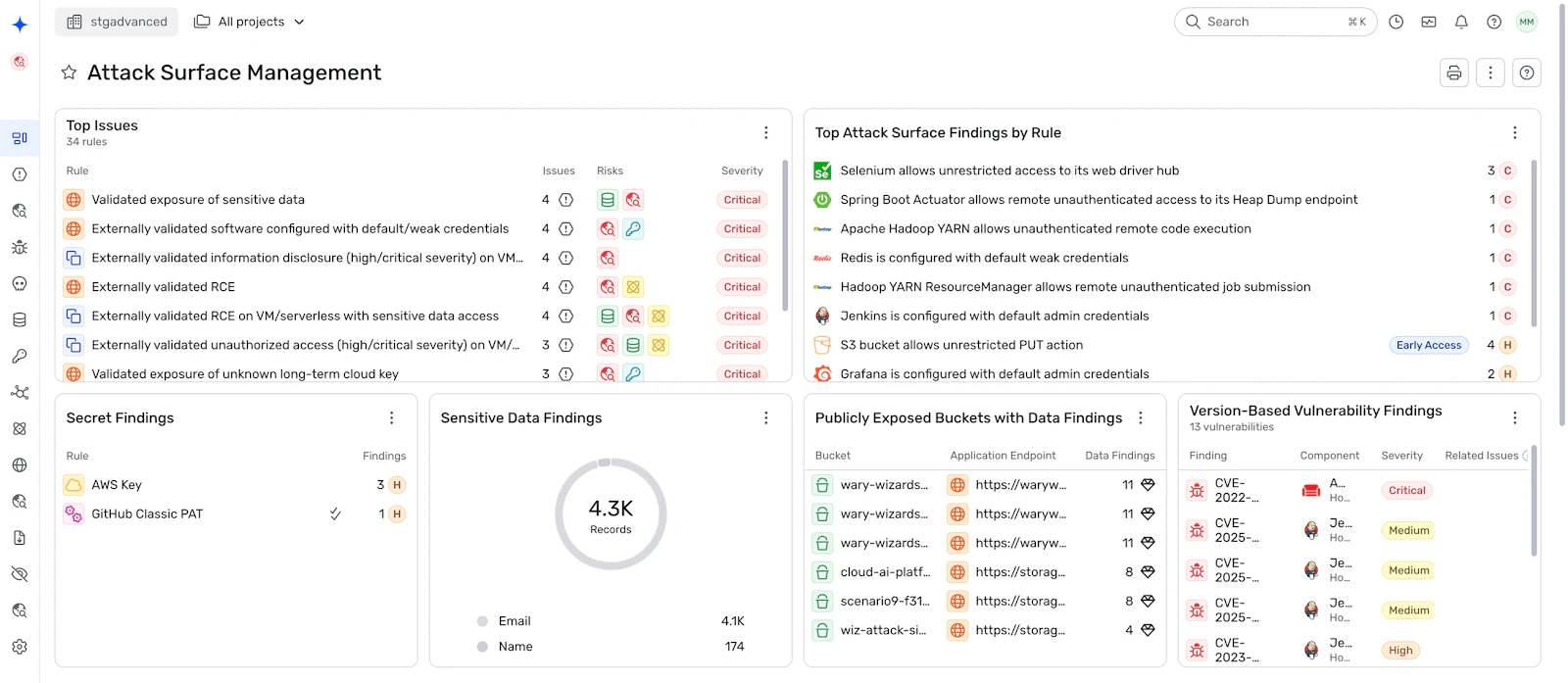
Wiz Unified Vulnerability Management (UVM) enables teams to unify their external scanners (vulnerability, app, data scanners, and more) and correlates all risk data to environment context from the native Wiz Scanners on the Wiz Security to empower teams to prioritize risks everywhere. This helps teams understand which vulnerabilities result in true attack path, what is the impact of a certain risk, and who is the owner responsible for remediating them.
Wiz Attack Surface Management (ASM) provides validation of which resources and risks are truly exposed and exploitable from the outside, indicating attackers can reach them.
ASM connects these external risks to internal context from the Wiz Security Graph, allowing teams to see how an external exposure could lead to an attack path in their environment, so they can prioritize exploitable risk with context.
Together, UVM and ASM offer a unified view of exposure by enabling teams to reduce risk eveywhere with context and exploitability validation. l This approach is designed to help teams focus on the combinations of risks that are most relevant to their environment and align remediation efforts with the highest-priority exposures.
Request a demo to understand how UVM and ASM work together to surface and contextualize cloud exposures.
Uncover Vulnerabilities Across Your Clouds and Workloads
Learn why CISOs at the fastest growing companies choose Wiz to secure their cloud environments.

Evaluating other cloud security shortlists?
Cloud security architectures vary widely depending on whether your priority is runtime workload defense, developer-first code security, endpoint consolidation, or unified multi-cloud posture. Explore our other curated peer shortlists:
Sensor-first and runtime defense: Top Upwind Alternatives & Competitors
Developer and application security: Top Snyk Alternatives & Competitors
Hybrid cloud and network security: Top Fortinet Competitors & Alternatives
EDR and workload protection: Top CrowdStrike Alternatives & Competitors
Enterprise multi-cloud suites: Top Palo Alto Networks Competitors
Unified CNAPP platforms: Top Cloud Security Alternatives to Wiz